Direct Answer: Masonry fireplace construction costs vary because bids often cover different scopes, some include the engineered footing, permits, and coastal-rated materials, and some don’t. Those missing pieces always show up later.
If you’ve collected two or three bids for a masonry fireplace and found yourself staring at numbers that look completely unrelated, you’re not imagining things. A $14,000 quote and a $28,000 quote for what sounds like the same project can both be real, honest numbers, because they’re often describing two very different scopes of work.
I’ve talked with homeowners across the Monterey Peninsula who come into the process expecting bids to be roughly in the same ballpark. When they’re not, the natural assumption is that someone is overcharging. But the more common explanation is that the lower bid is simply missing something, sometimes a lot of things.
In this article, I want to walk through the three cost drivers that separate a complete masonry fireplace construction bid from one that looks good on paper but creates problems later. This isn’t about defending any price point. It’s about helping you read a proposal the way a contractor reads one.
The Foundation Is the Biggest Cost Most Homeowners Never See
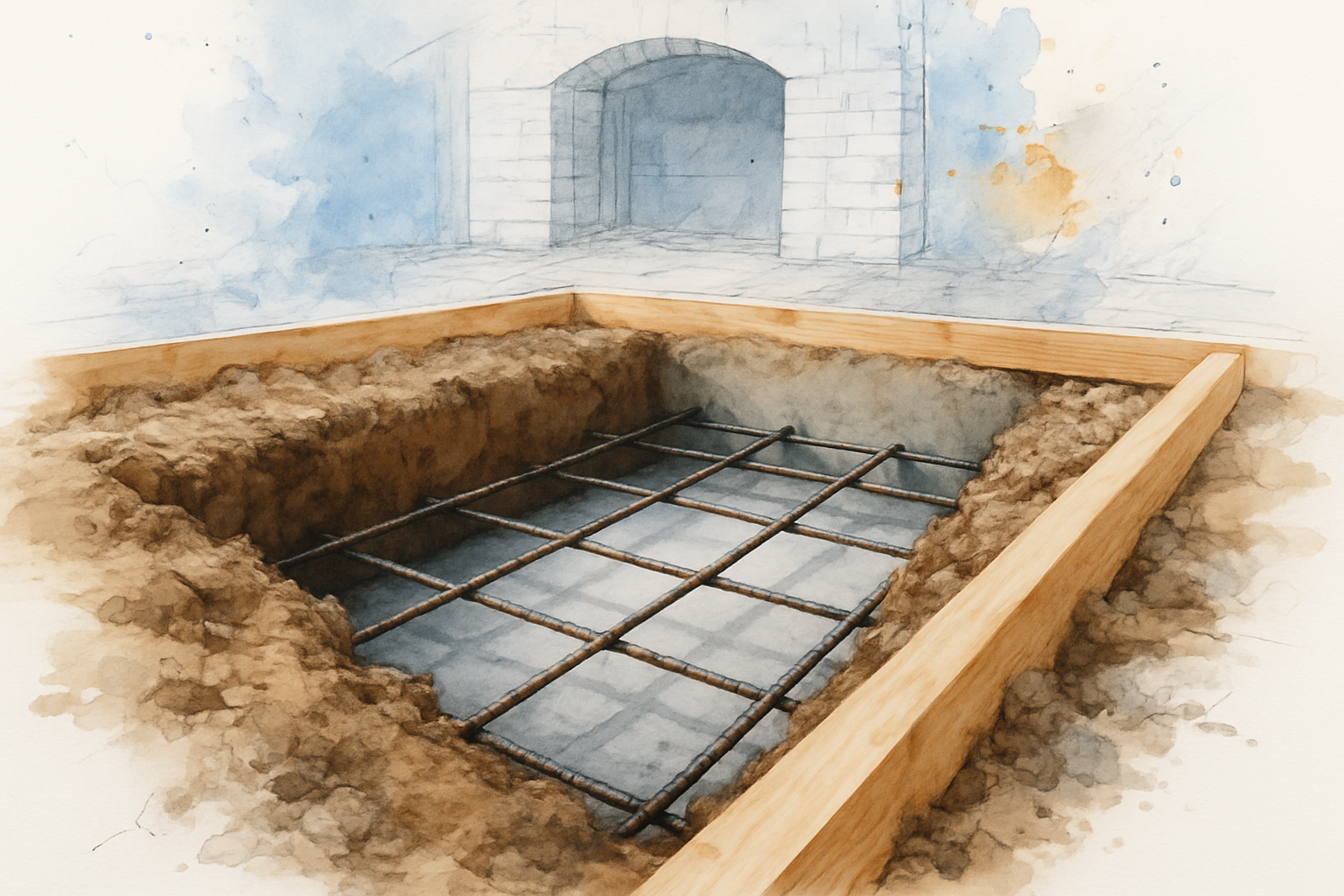
When people picture a masonry fireplace, they think about the stone facing, the mantel, the firebox opening. That’s the part that shows up on Pinterest and drives the initial excitement. But the single largest cost variable in most projects is something you’ll never see once the work is done: the footing and foundation.
A full masonry fireplace is one of the heaviest structures you can build into a home. Depending on the design and materials, you’re talking about a structure that can weigh several tons, all bearing down on a foundation that has to stay stable through decades of use. In Monterey County’s seismic environment, that foundation also has to handle lateral movement, not just vertical load.
Jurisdictions across the Monterey Peninsula require a permitted structural inspection at the footing stage before any above-grade work can begin. That means a building inspector has to sign off on the rebar layout, the footing dimensions, and the concrete before the first course of block goes up. If that step gets skipped or undersized, the project can be halted mid-build, or worse, pass visual inspection while hiding a real structural problem.
You can read more about what goes into this stage in How a Masonry Fireplace Foundation Changes Everything. The short version: any bid that doesn’t explicitly address the foundation and footing work, including engineering and inspection, is not a complete bid.
Why Material Selection Costs More Here Than in Most California Markets
The Monterey Peninsula’s microclimate is genuinely different from inland California, and it affects masonry material costs in ways that don’t show up in national cost guides.
Salt air and moisture cycling, the daily pattern of marine layer rolling in, burning off, and returning, accelerate the breakdown of porous stone, certain mortar mixes, and improperly sealed veneers. A contractor who sources materials without accounting for the coastal environment can deliver a fireplace that looks perfectly fine at completion. But within two to four seasons, you may see:
- Spalling, where the face of stone or brick breaks away in flakes
- Efflorescence, the white mineral salt deposits that push through the surface as moisture moves through masonry
- Mortar joint failure, where the joint between stones begins to crack and crumble before the masonry itself shows any wear
A coastal-appropriate build means selecting stone with low absorption rates, using a mortar mix formulated for wet, salt-exposed conditions, and applying sealers rated for that environment. For outdoor fireplaces specifically, the firebox lining and refractory materials have to handle both the heat cycling from fires and the moisture load from the marine layer. You can see how much the coastal climate shapes outdoor fireplace planning in Planning an Outdoor Fireplace: What the Peninsula’s Climate Changes.
This type of material specification costs more upfront. But it’s the difference between a fireplace that holds up for 30-plus years and one that needs significant repair work inside a decade. A bid that comes in low on materials is often using what’s available and affordable, not what the environment actually demands.
The California Building Standards Commission sets baseline requirements for masonry construction under Title 24, which updates regularly, the 2025 code edition takes effect January 1, 2026. But those baseline requirements are a floor, not a ceiling, and local conditions on the Monterey Peninsula often call for specification choices that go beyond the minimum.
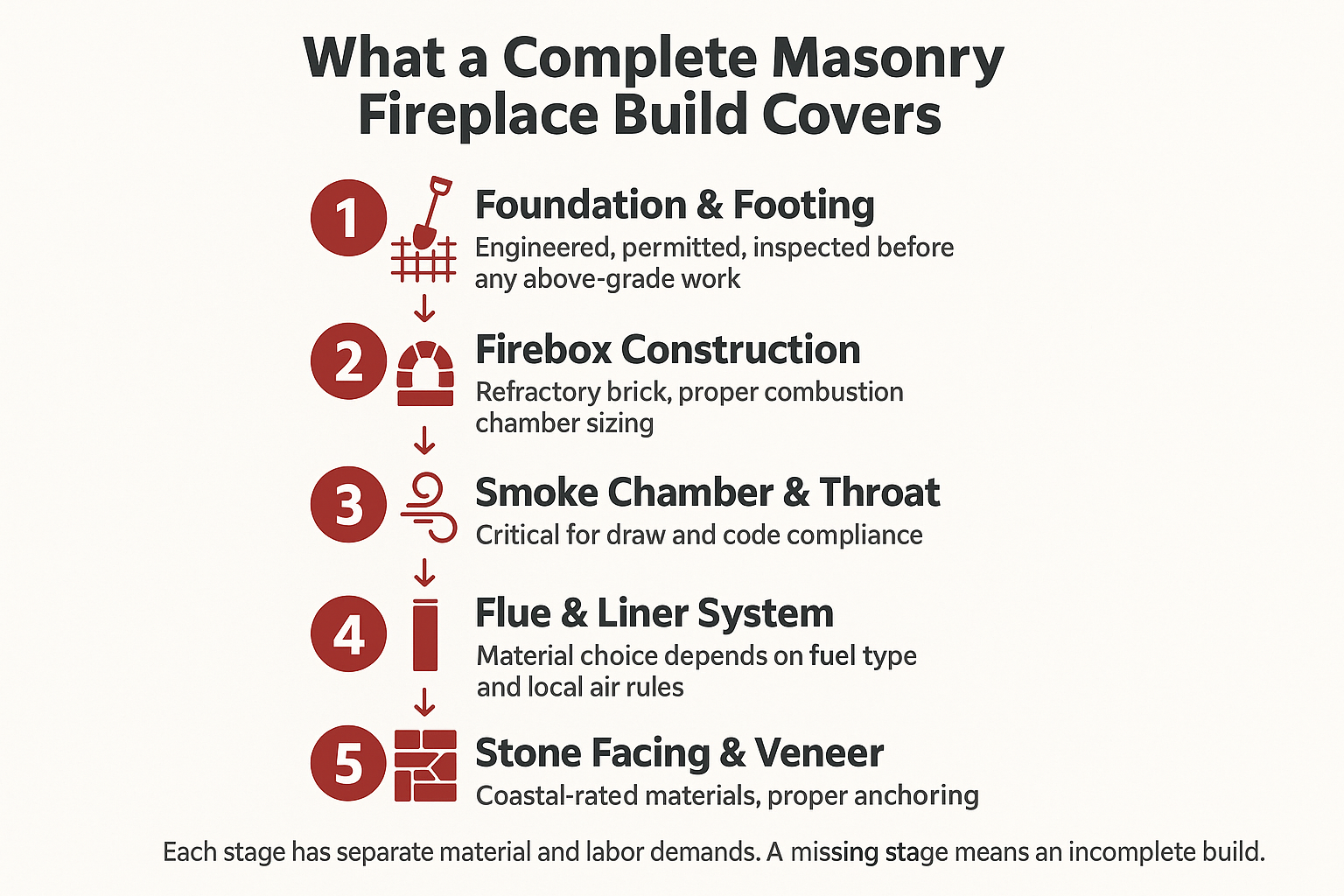
What a Complete Masonry Fireplace Build Actually Covers
This breakdown shows the distinct stages of masonry fireplace construction and why each one carries its own cost.
How Labor Gets Underestimated, and What That Looks Like in a Bid
A masonry fireplace is not one job. It’s five distinct skill stages that happen in sequence, each with its own materials, tolerances, and required inspections.
Here’s what a complete build actually involves:
- Footing and foundation work, forming, reinforcing, and pouring the concrete base
- Firebox construction, laying refractory brick to precise geometry for safe combustion
- Smoke chamber and throat, shaping the chamber above the firebox to direct smoke properly
- Flue and liner installation, selecting and installing the right liner for the fuel type and local air rules
- Decorative facing, the stone, veneer, or masonry finish visible from the room
Each stage takes different skills and different materials. When a bid looks low on labor, it’s almost always because one or more stages have been collapsed, shortcut, or skipped entirely.
One pattern I’ve seen more than once: a contractor skips the smoke chamber in favor of dropping in a prefab insert that isn’t engineered for the specific firebox. It saves labor hours on the front end, but it often creates draw problems, and it may not pass a final inspection depending on the jurisdiction. In the City of Monterey, Carmel, or unincorporated Monterey County, inspectors check these stages, they’re not rubber-stamp sign-offs.
For a detailed look at how these stages connect in sequence, How a Masonry Fireplace Actually Gets Built, From Footing to Firebox walks through each one in plain terms.
What Bids Often Include vs. What a Complete Build Requires
Not every proposal covers the same scope. This comparison shows common gaps between a low bid and a complete one.
| Build Stage | Often Missing in Low Bids | Why It Matters |
|---|---|---|
| Foundation & Footing | Engineering, rebar, permitted inspection | Required before above-grade work in most Peninsula jurisdictions |
| Firebox Construction | Refractory brick spec, proper dimensions | Affects combustion safety and inspection approval |
| Smoke Chamber & Throat | Sometimes replaced with prefab shortcut | Affects draw, code compliance, and final inspection |
| Flue & Liner | Liner type may not match fuel type or local air rules | Monterey Bay Air Resources District rules apply to wood-burning systems |
| Facing Materials | Standard materials, not coastal-rated | Salt air and moisture cycling degrade wrong materials within seasons |
| Permits & Inspections | Sometimes excluded from quoted price | Cost is real regardless, leaving it out makes bids incomparable |
Permits Are a Real Cost, and Leaving Them Out Isn’t an Option
Permit and inspection fees are line items that vary by jurisdiction, and homeowners who receive bids with permits excluded are genuinely comparing apples to oranges.
The City of Monterey, the City of Carmel, and unincorporated Monterey County each have their own building departments with their own review timelines and fee schedules. A permitted fireplace build in one jurisdiction may take four to six weeks from application to final inspection. In another, it may move faster or carry additional review requirements.
On top of building permits, wood-burning appliances on the Monterey Peninsula are subject to Monterey Bay Air Resources District rules that govern combustion design and fuel type. These aren’t suggestions, they’re regulatory requirements that affect whether a wood-burning fireplace can legally be installed in a given location. You can get a solid overview of how those air quality rules interact with fireplace construction in What Monterey County’s Air Rules Mean for Your Fireplace Build.
A contractor who leaves permits out of a quote isn’t saving you money. Those costs exist whether they’re in the bid or not. They just become a surprise after you’ve already committed to the project.
Frequently Asked Questions About Masonry Fireplace Construction Costs
Why does one bid for my fireplace cost almost twice as much as another for the same project?
In most cases, the bids aren’t describing the same project. The lower bid is probably excluding the engineered footing, the permit fees, coastal-appropriate materials, or one of the construction stages like the smoke chamber. When you look at what’s actually included line by line, the gap usually makes sense. The question to ask isn’t ‘why is this one expensive’, it’s ‘what does each bid actually cover?’
Do I really need a permit for a masonry fireplace in Monterey County?
Yes, in virtually every jurisdiction on the Peninsula. A masonry fireplace is a structural element that requires permitted inspections, typically at the footing stage before any above-grade work begins, and again at completion. Skipping permits doesn’t make the requirement go away; it creates a code violation that can surface when you sell the property or make a homeowner’s insurance claim.
What makes some stone materials better suited for the Monterey Peninsula’s climate?
The salt air and constant moisture cycling here are harder on masonry than most people expect. Low-absorption stone types, mortar mixes formulated for wet and salty conditions, and properly rated sealers are what hold up over time. Porous stone and standard mortar can look fine for a year or two, then start showing spalling or joint failure as the marine layer does its work season after season.
How do I know if a masonry contractor is licensed to do this type of work in California?
You can verify any contractor’s license directly through the California Contractors State License Board’s check-a-license tool at cslb.ca.gov. For fireplace construction, look for a C-29 masonry classification, that’s the designation that covers the full scope of fireplace and structural masonry work under California law. A general contractor license does not automatically cover the same scope. You can also read How to Read a California Contractor’s License Before You Hire for a plain-language explanation of what to look for.
Can I save money by doing just the decorative stone facing myself after a contractor builds the firebox?
The facing stage is one of the few parts of a masonry fireplace where splitting the scope is sometimes feasible, but only if the contractor and homeowner agree upfront and the substrate is properly prepared. The bigger concern is material selection: the wrong veneer or the wrong anchoring method in a coastal environment leads to the failures described earlier. If you’re thinking about a facing project on an existing fireplace, Fireplace Facings: Why the Stone Around the Opening Matters More Than It Looks covers what that decision actually involves.
What’s a realistic cost range for masonry fireplace construction on the Monterey Peninsula?
Costs vary significantly based on size, fuel type, foundation conditions, material choices, and which jurisdiction you’re building in. From what we see in Monterey County, a complete masonry fireplace build, including the footing, firebox, smoke chamber, liner, and decorative facing, can range widely depending on those factors. The most useful thing to do is get a written, itemized proposal that breaks out each stage rather than a single lump-sum number. That’s the only way to compare bids honestly.
Want to Know What a Complete Bid Should Look Like?
Stonecap Masonry is a licensed C-29 masonry contractor (CSLB #1073620) based in Salinas, serving homeowners across the Monterey Peninsula, Carmel, Carmel Valley, Pebble Beach, and Pacific Grove. If you’re in the process of comparing proposals and want to talk through what each one actually covers, you can reach the Stonecap team at 831-262-0442 or request a consultation at stonecapmasonry.com.
