
Direct Answer: Go to contractors.cslb.ca.gov and search the contractor’s license number. Check the classification, expiration date, bond status, and workers’ comp status before signing anything.
Most homeowners on the Monterey Peninsula do some version of due diligence before hiring a contractor. They check a website, read a few reviews, maybe ask a neighbor. But there’s one step that almost nobody takes, and it’s the one that actually tells you whether the contractor standing in your driveway is operating legally.
The CSLB’s online license check is free, takes about two minutes, and shows you things no contractor bio or Google listing will ever tell you. I’ve seen homeowners in Salinas, Carmel, and Pebble Beach hire someone based on a nice truck and a firm handshake, and end up with unpermitted work, no insurance coverage, and no legal recourse when something goes wrong.
This article walks through exactly what the license check shows, what each field means in plain terms, and what specifically to look for when you’re hiring for masonry work.
Where the License Check Actually Lives, and What It Costs You
The tool is at contractors.cslb.ca.gov, maintained by the California Contractors State License Board. You can search by license number, business name, or the contractor’s name. It’s free, no login required, and the data is updated in real time.
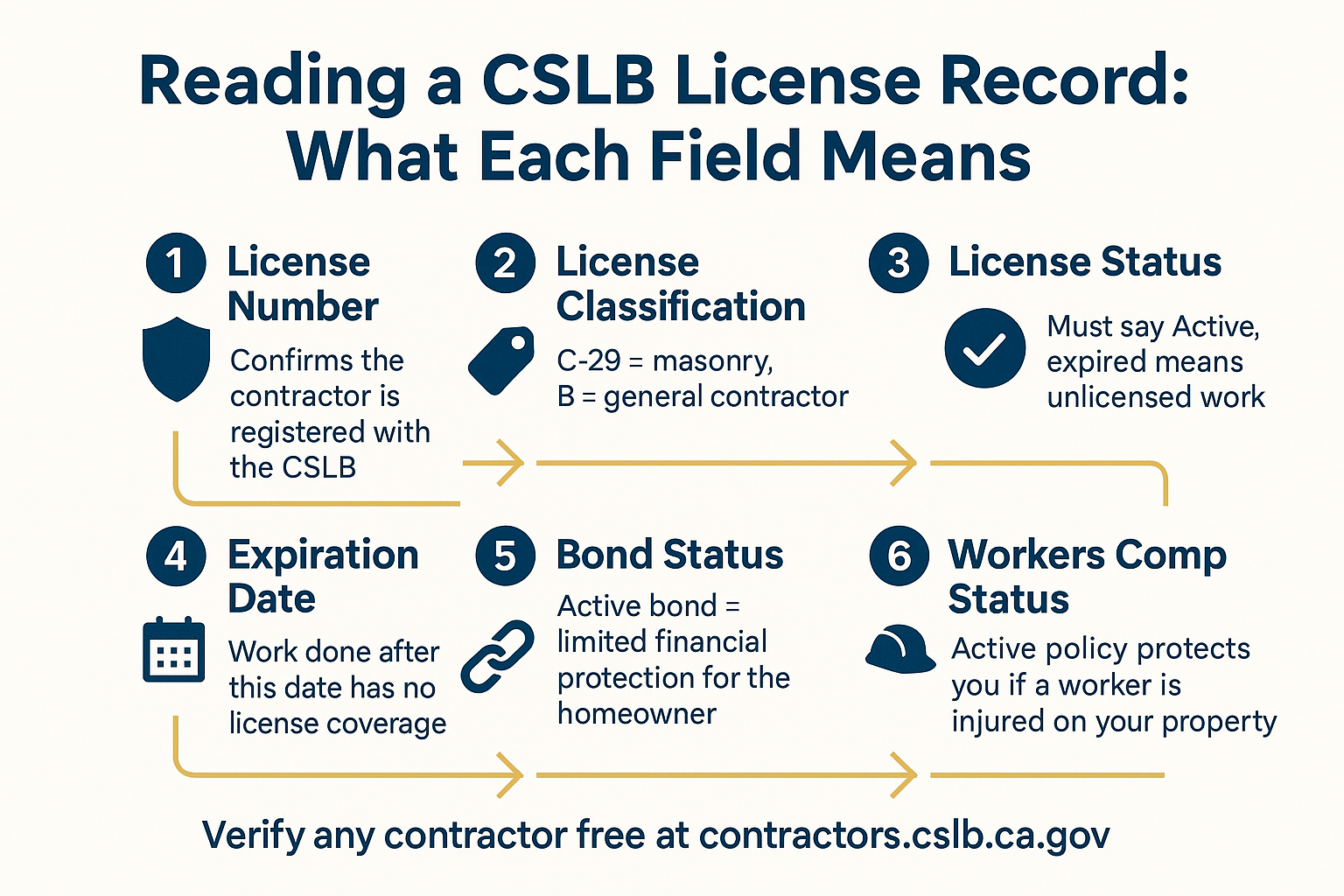
When you pull up a contractor’s record, you’ll see several fields. Each one tells you something different:
- License number, confirms the contractor is in the system at all
- License classification, tells you what type of work they’re legally allowed to do
- License status, shows whether it’s active, expired, suspended, or revoked
- Expiration date, any work done under an expired license is effectively unlicensed work
- Bond status, confirms the contractor’s bond is current and active
- Workers’ compensation status, shows whether the contractor carries workers’ comp or has filed a valid exemption
- Disciplinary actions, any formal complaints, citations, or suspensions on record
Most homeowners stop at step one. They see a license number in the contractor’s email signature, assume it’s fine, and move on. But the number alone means very little, what matters is what the full record shows.

Why the License Classification Matters for Masonry Work
This is the part most people miss, and it matters a lot for anyone hiring for masonry specifically.
In California, the classification for masonry work is C-29. That designation covers fireplaces, retaining walls, stone veneer, block work, patios, and structural masonry, essentially the full scope of what a dedicated masonry contractor does. If you’re hiring someone for masonry-only work, their license should show C-29 authority.
A B license (general building contractor) can perform masonry as part of a larger, multi-trade project. But if someone with only a B license is bidding a standalone masonry job, a retaining wall by itself, a fireplace facing, a stone patio, that’s a compliance issue worth flagging before any money changes hands.
I’ve talked with homeowners who didn’t know this distinction existed until after a project was already underway. Asking a contractor upfront, “What’s your license classification and does it cover this specific scope of work?” is a completely fair question. Any licensed contractor should be able to answer it without hesitation.
For reference, Stonecap Masonry holds CSLB License #1073620 under the C-29 masonry classification. You can verify that yourself through the CSLB tool anytime.
Bonded and Insured: What Those Words Actually Mean
“Bonded and insured” appears in nearly every contractor’s marketing. The phrase sounds reassuring, but it covers two different things, and most homeowners couldn’t explain either one.
Being bonded means the contractor has an active contractor’s bond through the CSLB. This bond provides limited consumer protection, typically up to $25,000, if a contractor fails to finish the job, causes damage, or violates contractor law. It’s not a guarantee that everything will go perfectly. But it does create a formal financial backstop that an unlicensed operator can’t offer.
Being insured is a separate matter entirely. This means the contractor carries general liability insurance and, where employees are involved, workers’ compensation coverage. If a worker is injured on your property, workers’ comp is what keeps that from becoming your financial problem. If the contractor’s equipment damages your landscaping or structure, general liability is what pays for it.
The CSLB license check shows the current status of both the bond and workers’ comp. That’s why looking it up yourself is more reliable than taking a contractor’s word for it, the record reflects real-time status, not what was true six months ago when a policy may have lapsed.
For projects on the Monterey Peninsula, where job sites sometimes involve steep terrain, mature landscaping, and historic structures, these protections aren’t theoretical. They matter in practice.
What the CSLB License Check Shows at a Glance
This breakdown covers each field in the CSLB license record and what it tells you before you sign a contract.
The $500 Rule Most Homeowners Have Never Heard Of
Here’s something that surprises a lot of people: in California, anyone performing work valued at $500 or more in combined labor and materials is required to hold a contractor’s license. That threshold is lower than most homeowners assume.
That means even smaller masonry jobs, repointing a section of mortar joints, replacing a few cracked pavers, resetting a shifted capstone after a wet winter, can fall under the licensing requirement depending on what the total job costs.
This doesn’t mean that every handyman offering to patch your front walkway for $400 is breaking the law. But it does mean that when a job starts to approach or exceed that threshold, the person doing the work should be licensed. And you should be able to verify it.
I bring this up because we occasionally hear from homeowners who hired someone for what seemed like a small repair, the kind of thing that felt too minor to worry about credentials, and then discovered the work was done incorrectly. One homeowner in Monterey County reached out after a repair to a concrete block retaining wall failed during the rainy season. The original contractor had no C-29 license, no bond, and no workers’ comp on file. There was no legal path to recovery.
For context on what proper masonry repair actually involves versus a cosmetic patch, The Real Difference Between a Cosmetic Fix and a Masonry Repair walks through the distinction clearly.
License Classifications for Common Masonry and Hardscape Work
This table shows which California contractor license classification applies to common project types. When hiring for masonry-only work, C-29 authority should be present in the license record.
| Project Type | Required Classification | Notes |
|---|---|---|
| Retaining wall (masonry) | C-29 | Structural retaining walls may also require permits and engineering |
| Outdoor fireplace or fire pit | C-29 | Gas connections require a separate C-36 (plumbing) license |
| Stone veneer installation | C-29 | Includes both structural and decorative veneer applications |
| Paver patio or walkway | C-27 or C-29 | Depends on whether work includes masonry elements or base prep |
| Masonry repair or repointing | C-29 | Applies when total job cost reaches $500 or more in labor and materials |
| Multi-trade project (masonry + framing + other) | B (general contractor) | Can self-perform masonry as part of a larger multi-trade project |
| Fireplace facing | C-29 | Interior or exterior; includes stone, tile, and veneer facings |
Asking for License and Insurance Info Is Not Rude, It’s Normal
One pattern I’ve noticed in the Monterey County market: homeowners who’ve had a bad experience with a previous contractor now ask to see license and insurance information before they’ll even schedule a site visit. And they sometimes apologize for asking, as if it’s an unusual request.
It isn’t. Asking for this upfront is standard practice, and any legitimate licensed contractor will have the information ready. A license number, proof of general liability insurance, and workers’ comp documentation should be available without hesitation.
If a contractor gets defensive when you ask, that’s useful information.
The CSLB tool makes this even easier, you don’t have to rely on documents the contractor provides. You can look up the license number yourself and see the bond and workers’ comp status in real time. It takes two minutes, and it removes any possibility of someone handing you a document that’s outdated or altered.
For masonry work specifically, where projects like fireplaces, retaining walls, and stone patios often represent significant investment, taking two minutes to verify a license is worth it. A homeowner in Pebble Beach who reached out to confirm licensing before scheduling a site visit told us clearly: “I just want to know who I’m letting onto my property.” That’s a reasonable thing to want to know.
What Disciplinary History Looks Like, and When to Worry
The CSLB license record also shows disciplinary history, and this section is underused. Most homeowners don’t scroll down far enough to see it.
Disciplinary actions can include:
- Citations, formal violations issued by the CSLB for specific complaints
- Suspensions, periods during which the license was not valid
- Revocations, loss of license, usually for serious or repeated violations
- Probationary status, the license is active but under conditions set by the CSLB
A single older citation isn’t automatically a dealbreaker, and context matters. But a pattern of complaints, a recent suspension, or a revocation that was later reinstated are all worth knowing before you commit to a project.
The CSLB’s own consumer guidance recommends verifying license status before signing any contract. That’s not boilerplate, it’s practical advice that a meaningful number of California homeowners skip.
For anyone hiring for work like stone veneer installation or structural masonry, where improper technique creates problems that don’t show up until months later, the contractor’s compliance history is part of evaluating their reliability.
Frequently Asked Questions About Verifying a Contractor’s License in California
Where do I actually go to check a contractor’s license in California?
The CSLB’s license check tool is at contractors.cslb.ca.gov. You can search by license number, business name, or individual name. The results show up immediately and are updated in real time, no account or login needed.
What’s the difference between a C-29 and a B license for masonry work?
A C-29 is a specialty masonry contractor license. It covers masonry-specific work, fireplaces, retaining walls, stone patios, block work, veneer installation, and similar projects. A B license (general building contractor) allows a contractor to perform masonry as part of a larger multi-trade project, but it doesn’t automatically authorize standalone masonry-only work. If someone is bidding a masonry-only job without C-29 authority in their license record, that’s worth asking about before any deposit changes hands.
Does every small masonry repair require a licensed contractor?
In California, the licensing requirement applies to any work valued at $500 or more in combined labor and materials. That’s lower than most people expect. Even minor masonry repairs, repointing mortar joints, resetting a capstone, replacing a few broken pavers, can cross that threshold depending on the scope and materials involved. When in doubt, ask the contractor for their license number and verify it yourself.
What does the bond status field actually mean?
An active bond means the contractor has a current contractor’s bond on file with the CSLB. This bond provides limited financial protection, up to $25,000, if the contractor fails to complete the work or causes damage and doesn’t make it right. It’s not insurance, and it doesn’t cover everything. But a lapsed or missing bond is a real red flag, and the CSLB tool shows the current status so you don’t have to take the contractor’s word for it.
Is it rude to ask a contractor for license and insurance information before scheduling a visit?
No. Any licensed, insured contractor expects this question and should be able to answer it immediately. A license number, general liability insurance certificate, and workers’ comp documentation are standard items any professional should have ready. If a contractor pushes back on this request, that response itself tells you something.
Do masonry permits on the Monterey Peninsula connect to license status?
Yes, in practice. When a permit is pulled for masonry work, a retaining wall, an outdoor fireplace, structural block work, the local building department typically requires the contractor to be licensed for that scope of work. Permit requirements vary by jurisdiction and project type across Monterey County, but an unlicensed contractor generally cannot pull a permit in their own name. Work done without proper permits can create serious problems at resale and may not pass inspection. For a deeper look at what proper masonry construction involves, How a Masonry Fireplace Actually Gets Built explains the process from footing to firebox.
Questions About Hiring a Licensed Masonry Contractor in Salinas or Monterey County?
Stonecap Masonry holds CSLB License #1073620 under the C-29 masonry classification, and the team is happy to share license and insurance documentation before a site visit is ever scheduled. For homeowners across the Monterey Peninsula, Salinas, Carmel, Pebble Beach, Pacific Grove, and Carmel Valley, you can reach the Stonecap team by phone at 831-262-0442 or by visiting stonecapmasonry.com to request a quote.
