Direct Answer: The Monterey Peninsula’s salt air, moisture cycling, and seismic activity change nearly every material and structural decision in an outdoor fireplace build — starting with the footing and ending with the firebox liner.
An outdoor fireplace is one of the most requested masonry projects we get calls about on the Monterey Peninsula. And it’s also one of the most underestimated — not because it’s complicated to picture, but because the coast changes what the build actually requires.
I’ve talked with homeowners in Pebble Beach and Carmel who came to us having already sketched out a design, picked their stone, and even pulled up contractor profiles online — before ever thinking about the footing, the firebox liner, or what Monterey County’s air quality rules say about fuel type. Those decisions shape everything that comes after.
This isn’t an article to sell you on a project. It’s here to walk you through what the Peninsula’s specific climate and regulatory environment actually change about how an outdoor masonry fireplace gets planned and built — so you’re asking the right questions before any work starts.
Why Salt Air Changes Your Material Choices
Carmel, Pebble Beach, and Pacific Grove sit close enough to the water that salt air is a daily reality — not just a coastal aesthetic. For masonry, that matters in ways that aren’t immediately obvious.
Metal components embedded in or attached to an outdoor fireplace — dampers, lintel plates, embedded anchors — corrode significantly faster in a salt-air environment than they would fifteen miles inland. I’ve seen damper hardware on coastal fireplaces show rust within two or three seasons when standard-grade steel was used. Stainless steel or hot-dipped galvanized components are the baseline for anything metal that touches this build.
Mortar joint selection matters for the same reason. The Peninsula’s moisture cycling — coastal fog in the morning, drying winds in the afternoon, occasional hard rain in winter — puts mortar through more expansion and contraction than most inland California climates. A mortar mix that’s too rigid will crack; one that’s too soft won’t hold. Getting that mix right for the specific exposure isn’t a detail — it’s what separates a fireplace that looks the same in year seven as it did in year one from one that starts showing joint deterioration within a few seasons.
For the stone or veneer facing itself, the material selection decisions that affect longevity in a coastal environment are worth understanding before you fall in love with a particular look. Some natural stones absorb more moisture than others. That matters here.
The Footing Question — and Why Your Existing Patio May Not Answer It
We hear a version of this pretty regularly: a homeowner has an existing concrete patio and wants to add a fire feature on top of it. One inquiry we received from a Pebble Beach homeowner described exactly this situation — they wanted to build a grill and fire feature on their patio and were looking for a quote to get started.
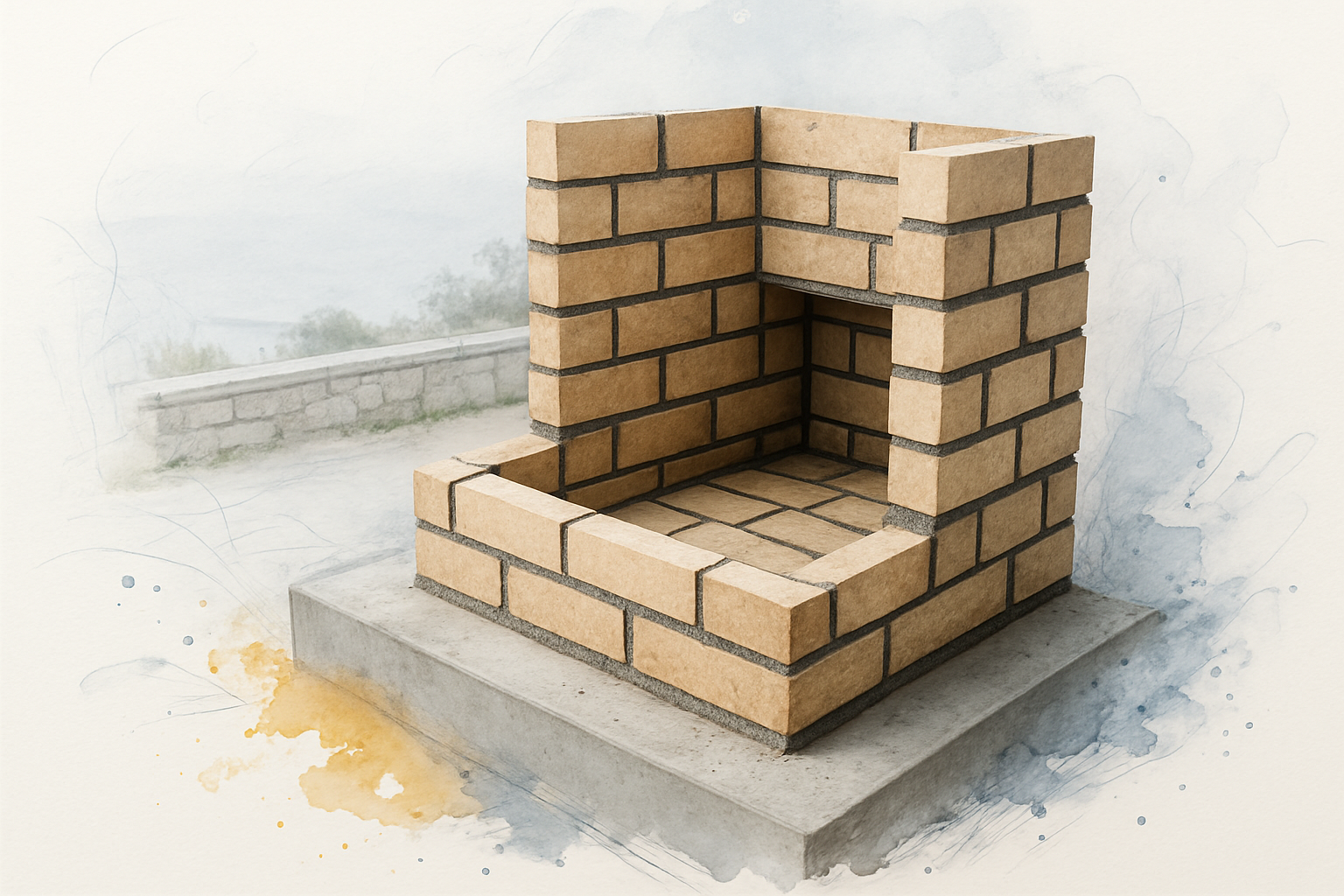
That’s a completely reasonable starting point. But an outdoor masonry fireplace isn’t furniture you set on an existing surface. It’s a heavy, permanent structure that needs its own dedicated footing — typically poured concrete, sized and reinforced based on the fireplace dimensions, the soil conditions, and local seismic requirements.
Whether an existing patio slab can serve as part of that footing — or whether it needs to be cut and a new footing poured beneath it — depends on the slab’s thickness, its reinforcement, the soil bearing capacity underneath, and what the local building department requires. None of that can be assumed from a photo or a general conversation. It has to be assessed on-site.
Monterey County sits in a high seismic hazard zone. The California Building Code sets minimum footing requirements for masonry structures, and local jurisdictions may go further. That’s not a bureaucratic inconvenience — it’s the reason a properly built outdoor fireplace stays standing after a significant shaking event. You can read more about how a masonry fireplace foundation changes everything before committing to a design footprint.
The short version: don’t finalize your fireplace size, location, or design until someone has evaluated whether your site can actually support it.
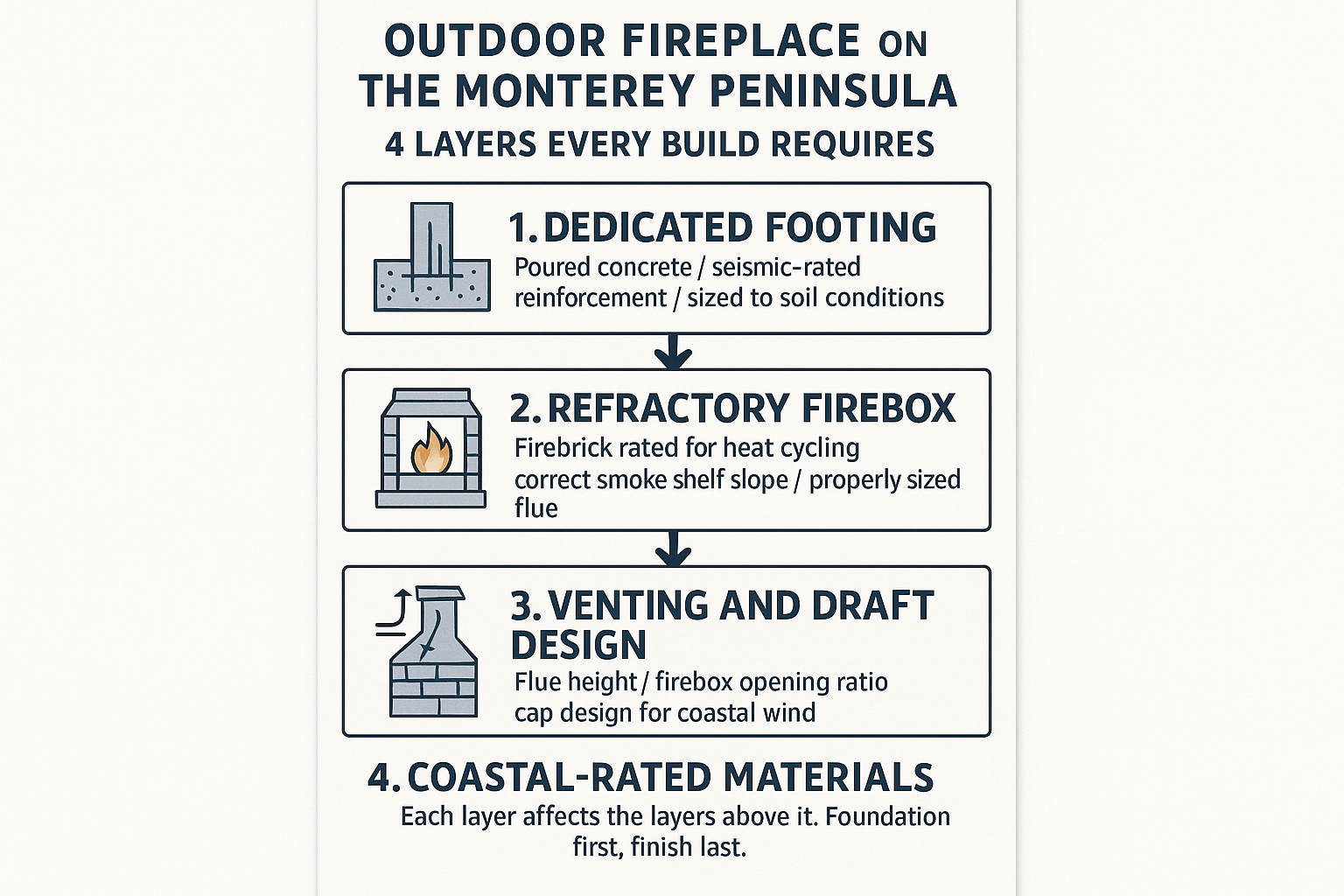
What Goes Into an Outdoor Fireplace Build on the Monterey Peninsula
This overview shows the four decision layers that shape every outdoor fireplace project in a coastal California environment — from the ground up.
Inside the Firebox — Where Quality Actually Lives
Most homeowners focus on the exterior stone facing when they’re planning an outdoor fireplace. That’s understandable — it’s what you see every day. But the interior of the firebox is where the structure either holds up or starts failing, and most people never look closely at it after the build is done.
A masonry firebox that will hold up to repeated heat cycling needs refractory firebrick on the interior surfaces — not standard CMU block, not regular stone, and not a thin veneer of firebrick mortared over something else. Refractory brick is engineered to expand and contract with heat without cracking. Standard materials aren’t. An outdoor fireplace built with the wrong interior materials will begin to spall — the face of the brick or stone splits and pops off — within a few seasons of regular use.
Beyond materials, the geometry of the firebox matters:
- Smoke shelf slope — a correctly angled smoke shelf directs smoke into the flue rather than back into the firebox opening
- Firebox opening ratio — the height and width of the opening relative to the flue area determines whether the fireplace draws cleanly or smokes toward the seating area
- Flue sizing — undersized flues on coastal sites can also be affected by the prevailing afternoon wind patterns common along the Peninsula
These aren’t variables you dial in after the fact. They’re designed and built in sequence, from the firebox floor up. If the geometry is wrong at the build stage, there’s no easy fix later. You can see more about how a masonry fireplace actually gets built from footing to firebox to understand what that sequence looks like in practice.
California’s Regulatory Layer — and Why It Hits Differently Here
California’s rules around outdoor fire features are layered in ways that catch people off guard, and Monterey County adds its own layer on top of state minimums.
At the state level, the 2025 California Fire Code (effective January 1, 2026) governs outdoor burning broadly. Gas-connected outdoor fireplaces also fall under Title 24 energy code provisions — including a prohibition on standing pilot lights and a requirement for outside combustion air intake. These aren’t optional upgrades; they affect how a gas fireplace gets designed and permitted.
On top of that, the Monterey Bay Air Resources District has its own rules governing wood-burning appliances. There are curtailment days when wood burning is prohibited entirely, and there are ongoing registration and opacity requirements for wood-burning devices. That’s not something you figure out after installation. What Monterey County’s air rules mean for your fireplace build breaks this down in more detail.
The fuel type decision — wood versus gas — isn’t just a lifestyle preference at this point. It affects permitting, compliance, and the long-term flexibility of the structure. For a deeper look at what that choice changes in the actual build, gas vs. wood fireplace construction in Monterey County is worth reading before you finalize anything.
The bottom line on permits: always check with your local planning department before finalizing the design. Requirements vary by jurisdiction, project type, and whether gas is involved. What’s permitted in Carmel may work differently than what’s required in Salinas or Pacific Grove.
Outdoor Fireplace Planning: Key Variables by Location
These are the main factors that vary depending on where on the Peninsula your project sits. Every one of them affects design decisions, permitting, or material selection.
| Factor | Why It Matters | Applies Where |
|---|---|---|
| Salt air exposure | Accelerates metal corrosion; affects mortar joint durability | Carmel, Pebble Beach, Pacific Grove, Monterey |
| Seismic zone requirements | Drives footing depth, reinforcement, and structural design | All Monterey County jurisdictions |
| Air quality district rules | Wood-burning curtailment days; registration requirements | Monterey Bay Air Resources District area |
| Title 24 gas code (eff. Jan 1, 2026) | Prohibits standing pilots; requires outside combustion air | All California gas-connected fire features |
| Local permit jurisdiction | City vs. county rules differ; some projects require inspection | Varies — Salinas, Carmel, Pacific Grove, unincorporated county |
What a Finished Project Actually Becomes
I want to share something a client said, because it gets at why getting the structural work right from the start matters beyond the technical checklist.
Andy and Kris Stoddard of Carmel Valley had a built-in gas grill project completed. Andy’s description in his review: “The finished project is beautiful. It has become a well-used focal point in our backyard.”
That outcome — a feature that gets used constantly, not just admired once — depends entirely on getting the invisible work right. A fire feature that doesn’t draw well, or that starts showing mortar cracking or spalling firebrick after two seasons, doesn’t become a backyard focal point. It becomes a frustration and eventually a repair bill.
The structural decisions made before any stone is laid are what determine whether you end up with the version Andy described. The footing, the firebox geometry, the material choices for a coastal environment — none of that is visible in the finished photographs, but all of it is present in every fire you build in that fireplace for the next twenty years.
If you’re in the early stages of thinking through an outdoor living project and want to understand what drives the cost differences between bids, what to know before building an outdoor fireplace on the Monterey Peninsula gives a grounded starting point.
Frequently Asked Questions About Outdoor Fireplaces on the Monterey Peninsula
Do I need a permit to build an outdoor fireplace in Monterey County?
In most cases, yes — especially if gas is involved. Permit requirements vary by jurisdiction and project type. A wood-burning outdoor fireplace built in unincorporated Monterey County may be treated differently than the same structure in the City of Salinas or Carmel. The safest approach is to check with your local planning department before finalizing any design. Never assume a permit isn’t required based on a neighbor’s project or a contractor’s verbal assurance.
Can I add an outdoor fireplace to my existing patio without breaking up the concrete?
Maybe — but it depends on the slab. A masonry fireplace needs a dedicated footing capable of supporting significant weight, reinforced for seismic loads. Whether an existing slab qualifies depends on its thickness, its reinforcement, and the soil underneath it. That assessment has to happen on-site before any design decisions are locked in. Some existing patios work; some require cutting and pouring a new footing.
What does an outdoor fireplace cost on the Monterey Peninsula?
Costs vary significantly depending on the size of the fireplace, the stone selected, whether gas is involved, whether a permit is required, and site-specific factors like footing depth and access. Many Monterey County homeowners see outdoor fireplace projects in a range that starts somewhere in the mid-five figures for a straightforward build and can go considerably higher for large custom structures with premium stone and integrated features. The only way to get an accurate number is an on-site assessment — too many variables affect the final cost to quote reliably from a description alone.
Is wood burning allowed in outdoor fireplaces in this area?
Wood burning is regulated by the Monterey Bay Air Resources District, which enforces curtailment days when burning is prohibited due to air quality conditions. There are also registration and ongoing compliance requirements for wood-burning appliances. It’s a meaningful regulatory layer that’s worth understanding before choosing wood as your fuel type. Are you allowed to burn wood in an outdoor fireplace in Salinas? covers this in detail.
What’s the difference between firebrick and regular brick in a firebox?
Firebrick — also called refractory brick — is engineered to withstand the thermal expansion and contraction of repeated heat cycles without cracking or spalling. Regular brick and standard CMU block are not. Building a firebox interior with the wrong materials typically results in visible deterioration within a few seasons of regular use. It’s not a cost-cutting shortcut that works — it’s one that fails predictably.
How do I verify that a masonry contractor is properly licensed in California?
The California Contractors State License Board maintains a public license check tool at cslb.ca.gov. You can search by contractor name, business name, or license number and verify that the license is active, bonded, and insured. For masonry work, look for a C-29 classification — that’s the specific credential that covers the full scope of masonry contracting in California. Verifying this before signing any contract takes about two minutes and protects you from unlicensed work, which can create significant liability issues.
Ready to Talk Through Your Outdoor Fireplace Project?
If you’re planning an outdoor fireplace or fire feature on the Monterey Peninsula and want to understand what your specific site actually requires, Stonecap Masonry is available for on-site consultations across Salinas, Carmel, Pebble Beach, Carmel Valley, and Pacific Grove. Call 831-262-0442 or visit stonecapmasonry.com to request a quote — and bring your questions about footings, fuel type, and permits, because those conversations are worth having before the design is set.
