Direct Answer: It depends on the day. Wood burning in outdoor fireplaces in Salinas is regulated by the Monterey Bay Air Resources District, which issues seasonal burn bans. On restricted days, wood burning is prohibited — even in a permitted outdoor fireplace.
You spent real money on an outdoor fireplace. Maybe you’re still planning one. Either way, you want to know if you can actually light a wood fire in it — or if Monterey County’s air rules are going to shut that down.
The honest answer is more nuanced than a yes or no. Wood burning is allowed in Salinas, but it’s regulated by the Monterey Bay Air Resources District (MBARD) through a seasonal program called Spare the Air. On days when air quality drops below certain thresholds, wood burning — including in outdoor fireplaces — is restricted or prohibited entirely.
This article covers what those rules actually mean for homeowners, how the burn day system works in practice, and what it means for your fireplace design if you want to burn wood without worrying every fall whether tonight is a legal fire night.
How the Monterey Bay Air District Controls Wood Burning
The Monterey Bay Air Resources District covers Monterey, Santa Cruz, and San Benito counties. It’s the local authority on air quality, and it has jurisdiction over residential wood burning — including outdoor fireplaces and fire pits.
MBARD runs a Smoke Management Program that goes into effect seasonally, roughly from November through the end of February. During this period, MBARD monitors air quality daily and issues No-Burn Nights when particulate matter (PM2.5) levels are forecast to be unhealthy. On those nights, burning any solid fuel — wood, manufactured logs, pellets — is prohibited in the Bay Area Air Basin and surrounding districts.
To know whether a given night is a burn night or a no-burn night in Salinas, you check one of two ways:
- Call MBARD’s burn day hotline at (831) 647-9411
- Check the MBARD website at mbard.org the evening before or day of
Violations carry real fines. First-time violations through MBARD’s complaint process can result in warnings or fines starting around $50 to $500, and repeat violations go up from there. More importantly, neighbors notice smoke, and complaints get logged.
Beyond the seasonal program, MBARD Regulation 4, Rule 406 also restricts open burning on a broader basis. Most outdoor fireplaces with a proper masonry structure — a defined firebox, walls, and a chimney — are treated differently than open pit burning, but the seasonal no-burn days apply regardless of fireplace type.
What Burn Day Restrictions Mean for Your Outdoor Fireplace Design
If you’re planning an outdoor fireplace and want real flexibility, this is the part that actually shapes the decisions you’ll make with your mason.
Wood-burning fireplaces are still worth building. Most winter evenings in Salinas are legal burn nights — MBARD typically issues 15 to 30 no-burn nights per season, though that number fluctuates year to year based on weather patterns. The majority of fall and winter nights, a wood fire is allowed.
But if you want zero restrictions, a gas-burning outdoor fireplace sidesteps MBARD’s wood-burning rules entirely. Natural gas and propane don’t generate the same PM2.5 particulates that trigger burn bans. You can run a gas fire on a no-burn night without any concern.
There’s a third option worth knowing: dual-fuel fireplace designs. These are built with a gas starter or gas log set inside a firebox that’s also sized and lined to handle wood. You can burn wood on permitted nights and switch to gas on restricted nights. This requires planning from the masonry side — the firebox dimensions, flue sizing, and gas line rough-in all need to be coordinated before the foundation is poured.
For homeowners in Carmel Valley or inland Salinas, where fall evenings are cooler and drier, wood burning tends to be the priority. For properties closer to the Monterey Bay waterfront, where the fog keeps things milder and aesthetics matter as much as heat output, gas or dual-fuel systems are increasingly common.
If you want to think through how these choices affect your overall outdoor fireplace build, the outdoor fireplace planning guide for the Monterey Peninsula covers the structural and permitting side in detail.
Wood vs. Gas vs. Dual-Fuel: Outdoor Fireplace Comparison for Salinas Homeowners
This table summarizes the key practical differences between fuel types for outdoor fireplaces on the Monterey Peninsula.
| Fuel Type | Subject to MBARD Burn Bans? | Permit Required? | Relative Installation Cost |
|---|---|---|---|
| Wood Only | Yes — restricted on No-Burn Nights Nov–Feb | Yes — building permit typically required | Lower upfront; no gas line needed |
| Natural Gas / Propane | No — not restricted by seasonal burn rules | Yes — building + gas permit typically required | Higher; gas line rough-in adds cost |
| Dual-Fuel (Wood + Gas) | Wood side restricted on No-Burn Nights | Yes — building + gas permit typically required | Highest upfront; most flexible long-term |
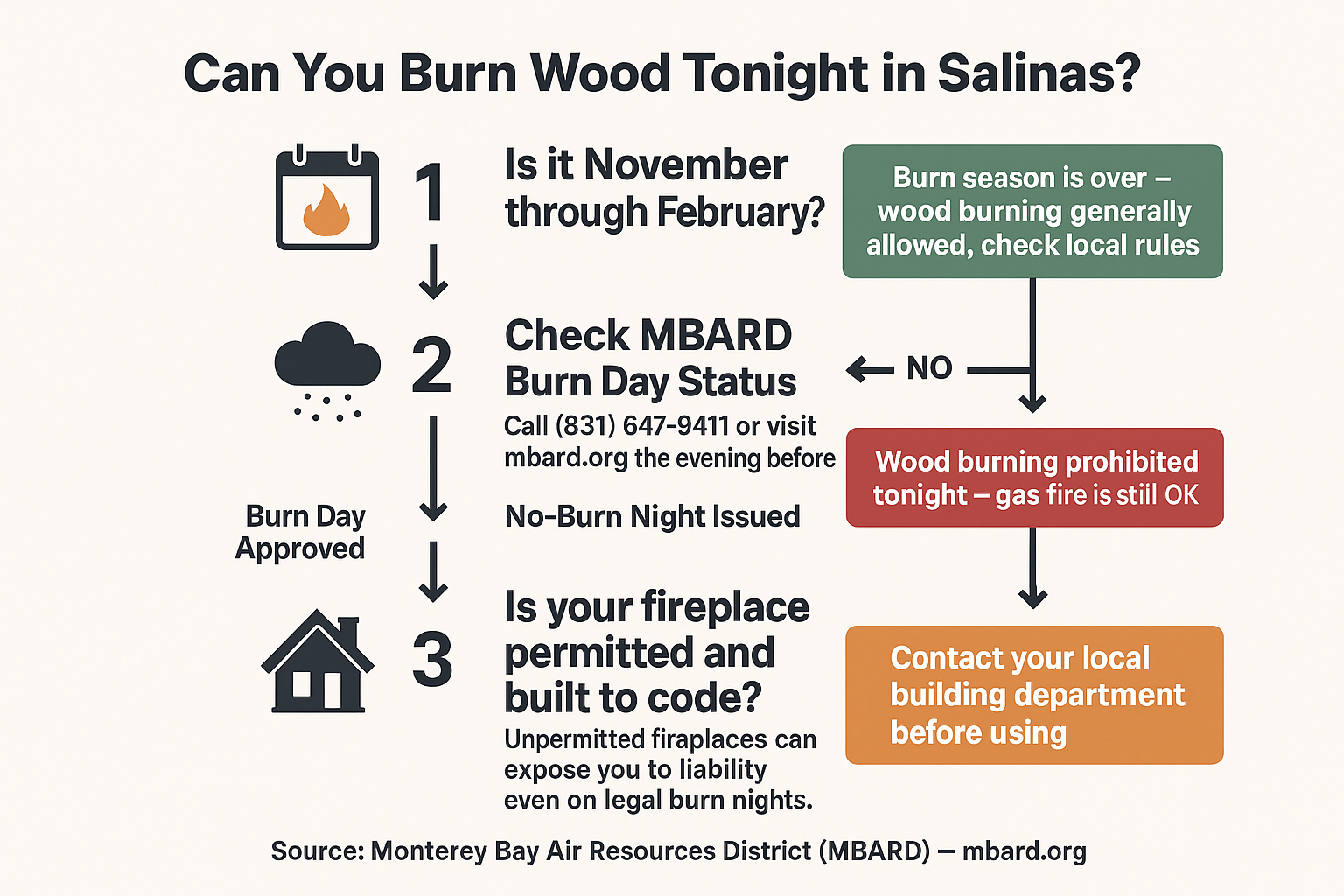
The Salinas Outdoor Fireplace Burn Day Decision Tree
This visual walks through how a Salinas homeowner decides whether they can legally burn wood on any given evening.
Permits, Inspections, and What Salinas Requires Before You Build
Getting the burn-day rules right is one thing. Making sure the fireplace itself is legal to operate is a separate question — and it starts before the first stone is set.
In Salinas and across Monterey County, an outdoor fireplace is generally a permitted structure. The City of Salinas Building Division and Monterey County Building Services both require permits for permanent masonry fireplaces. The scope of inspections typically includes:
- Foundation depth and footing size
- Firebox dimensions and firebrick lining
- Flue sizing and chimney height above the structure
- Clearances to combustible materials
Permit costs in Salinas for an outdoor fireplace project typically run $200 to $600 depending on project valuation, though exact fees vary. Processing times have ranged from 2 to 6 weeks for standard residential projects — plan ahead if you’re targeting a specific completion date.
California’s 2025 Title 24 building standards, which take effect January 1, 2026, update energy and construction requirements statewide. For masonry structures, these standards affect how certain fireplaces are classified, insulated, and inspected. Any fireplace permitted after that date will be reviewed against the updated code, so timelines matter if you’re planning a project in late 2025.
One important note: permit requirements vary by jurisdiction and project type. What’s required in the City of Salinas may differ from what Monterey County requires for an unincorporated rural property in Carmel Valley. Always confirm with your local building department before construction begins. A licensed C-29 masonry contractor — someone who holds an active CSLB license — will typically pull permits on your behalf and know which jurisdiction’s rules apply to your address. You can verify any contractor’s license status at the CSLB’s check-a-license tool at cslb.ca.gov.
For more on what the masonry construction process looks like from ground prep through final inspection, the guide to what separates a solid hardscape installation from one that fails early covers why that sequence matters.
Why Coastal Conditions in Salinas Affect the Masonry Itself
Burn-day rules and permits are important, but there’s a third factor that shapes how long your outdoor fireplace actually lasts: the Monterey Bay’s coastal environment.
Salinas sits close enough to the Bay that salt air, moisture cycling, and coastal fog are constant factors. Those conditions accelerate wear on mortar joints, exposed stone faces, and grout lines — especially in fireplaces that go through repeated heat-and-cool cycles every burn season.
Two material choices matter most for coastal durability:
- Refractory mortar inside the firebox — standard mortar will crack and fail from thermal expansion. Refractory (heat-rated) mortar is required, not optional.
- Exterior mortar mix for the outer structure — a mortar with the right water-cement ratio and sulfate resistance holds up far better in salt air than a generic mix.
Stone selection also plays a role. Porous natural stones absorb moisture and can spall (break apart at the face) when coastal moisture freezes in cold inland nights — less of a risk in Carmel proper, more of a concern in higher-elevation Carmel Valley areas that see overnight frost. Denser stones like granite, quartzite, and certain basalts tend to perform better in wet coastal conditions than softer sandstone or limestone.
For a closer look at how Salinas soil and weather interact with hardscape construction in general, the article on hardscape projects and Salinas soil and weather goes into the ground-level details that affect any outdoor masonry installation.
Frequently Asked Questions About Wood Burning and Outdoor Fireplaces in Salinas
How do I find out if tonight is a no-burn night in Salinas?
Call MBARD’s burn day hotline at (831) 647-9411 or check mbard.org. Notifications are typically posted by the afternoon of the day before. Some homeowners sign up for email alerts through MBARD’s website so they don’t have to check manually every evening during burn season.
Do Spare the Air rules apply to outdoor fireplaces the same way they apply to indoor ones?
Yes. MBARD’s seasonal wood-burning restrictions apply to all solid-fuel burning devices — indoor fireplaces, outdoor fireplaces, fire pits, and wood stoves. The structure’s location doesn’t change whether the restriction applies. The only exception is if you’re burning in a device that qualifies under MBARD’s specific exemption rules, which are narrow and generally apply to cooking appliances, not decorative fireplaces.
Can I burn manufactured fire logs instead of wood on a restricted night?
Generally, no. Manufactured fire logs are still solid fuel and are typically prohibited under MBARD no-burn restrictions. Gas logs or a gas burner are the clean alternatives on restricted nights.
Do I need a permit for an outdoor fireplace in Salinas, or is that just for indoor fireplaces?
Permits are typically required for both. A permanent outdoor masonry fireplace is a structure, and it triggers the same permitting requirements as an indoor one in most Salinas and Monterey County jurisdictions. Requirements vary by city versus unincorporated county land, so confirm with your local building department. A licensed C-29 masonry contractor will usually handle permit applications as part of the project.
What’s the difference between a fire pit and an outdoor fireplace from a permit and burn-day standpoint?
From MBARD’s standpoint, both are subject to the same seasonal wood-burning restrictions — a fire pit doesn’t get a pass just because it’s open on top. From a permit standpoint, fire pits are treated differently than full fireplace structures in most jurisdictions. A simple in-ground fire pit may require only a minor permit or no permit depending on size and materials, while a built masonry fireplace with a chimney almost always triggers a full building permit. The fire pit construction guide covers what goes into a properly built fire pit versus a full fireplace.
How do I know if a masonry contractor is actually licensed to build an outdoor fireplace in California?
Look up their license number at cslb.ca.gov before signing anything. A legitimate masonry contractor in California will hold a C-29 license — that’s the classification that covers fireplace construction, stonework, and structural masonry. You can see license status, expiration date, and any disciplinary actions in real time through the CSLB’s online database. For more on what to look for when hiring a masonry contractor, The Truth About Hiring a Licensed Masonry Contractor in California breaks down the process.
Planning an Outdoor Fireplace on the Monterey Peninsula?
Stonecap Masonry Inc. builds wood-burning, gas, and dual-fuel outdoor fireplaces across Salinas, Carmel, Carmel Valley, and the surrounding Monterey Peninsula — with a working knowledge of MBARD rules, local permit requirements, and the material choices that hold up in coastal conditions. Reach the Stonecap team at (831) 262-0442 or visit stonecapmasonry.com to ask questions or request a project quote.
