Direct Answer: Monterey Bay Air Resources District No-Burn alerts restrict wood-burning fireplaces on designated days during November through February, which directly affects whether your fireplace gets used when you planned to use it — and how it needs to be built.
Most homeowners who reach out about fireplace construction in Monterey County start with questions about stone type, size, and cost. Those are fair questions. But the conversation that actually shapes the project — the one that determines what you can legally build and how often you can actually use it — starts somewhere else entirely. It starts with fuel type.
The Monterey Bay Air Resources District (MBARD) runs a wood-burning season from November through February. During that window, they issue mandatory No-Burn alerts on days when air quality is expected to drop. On those days, burning wood in a fireplace is illegal — residential or outdoor, it doesn’t matter. A wood-burning fireplace built without that in mind is one that sits cold on the exact evenings you pictured yourself using it.
I’ve seen homeowners get well into the design phase before anyone brought this up. That’s a problem. The fuel choice isn’t a finishing detail — it changes the firebox design, the venting, the clearances, the permits required, and the coordination trades involved. Getting it right starts before the first stone is ever set.
How MBARD No-Burn Alerts Work — and Why They’re Getting More Frequent
MBARD issues No-Burn alerts when fine particulate matter (PM2.5) is forecast to reach levels that affect air quality across the Monterey Bay region. On those days, burning wood in any fireplace — including outdoor fireplaces and fire pits — is prohibited.
For context on where regulations are heading: the Bay Area Air Quality Management District lowered its Spare the Air alert threshold in October 2025, dropping the trigger from 35 micrograms per cubic meter to 25 micrograms of fine particulate matter. That single change pushed estimated annual Spare the Air alerts from an average of around 15 per year up to an estimated 19 to 41 per year. MBARD operates under its own rules and is a separate agency, but the broader California regulatory trend matters here. Restrictions are tightening, not loosening.
What that means practically: if you’re weighing a wood-burning fireplace for a property in Pebble Beach, Pacific Grove, or Carmel Valley, you need to go in with realistic expectations about how many evenings per year you’ll actually be able to light it during prime fireplace season. For some homeowners, that calculus still favors wood. For others, it changes the decision entirely.
For a closer look at how the fuel choice affects the construction itself, Gas vs. Wood: What That Choice Really Means for a Masonry Fireplace Build breaks that down in detail.
What the City of Monterey’s Updated Fire Code Adds to the Picture
The City of Monterey updated its Fire Code through Ordinance 3712 in April 2026, adopting the 2025 California Fire Code. One of the relevant provisions: open burning is restricted unless the fire is confined to an approved container authorized by the Monterey Bay Air Pollution Control District.
That language — “approved container” — sounds simple, but it carries real weight at the design stage. The firebox type, the enclosure structure, and even the chimney configuration can all factor into whether a fireplace qualifies under that standard. And the answer isn’t the same everywhere.
Permit requirements for fireplace construction in Monterey County vary by jurisdiction. What the City of Salinas requires may not be what the County of Monterey, the City of Carmel, or the City of Pacific Grove requires. The consistent thread is this: a permitted fireplace build will be inspected, and any masonry element that fails inspection adds cost and delays that an unlicensed or underqualified contractor likely didn’t budget for.
Before any design is finalized, homeowners should confirm with their specific planning department what the approval pathway looks like for their project type. This is not a step to skip or guess at — it’s where project costs can grow unexpectedly if the early research isn’t done. California’s 2025 Title 24 building standards, in effect since January 1, 2026, apply to permitted masonry work statewide, and fireplace construction typically falls within their scope.
Gas vs. Wood: The Design Consequences Are Bigger Than Most People Expect
Choosing gas over wood isn’t just a lifestyle preference — it changes the physical structure of what gets built.
A gas-fueled firebox has:
- Different clearance requirements from combustible materials
- Specific venting configurations depending on whether it’s a direct-vent or B-vent unit
- A gas line rough-in that has to be coordinated with a licensed plumber or gas contractor before any masonry is laid around it
- Burner pan and ignition component placement that affects firebox dimensions from the start
None of that rough-in work is masonry — but all of it shapes how the masonry gets built. The firebox opening size, the hearth extension dimensions, the way the surround ties into the structure — all of it has to account for what’s going inside.
On the wood-burning side, the trade-off runs the other direction. No gas coordination needed, but you’re working within MBARD’s seasonal burn window, and the firebox, throat, smoke chamber, and flue dimensions have to be sized correctly from the footing up. An undersized flue in a wood-burning fireplace doesn’t just perform poorly — it’s a draft problem that’s expensive to fix after the fact.
For anyone still working through the structural side of how a fireplace gets built from the ground up, How a Masonry Fireplace Actually Gets Built, From Footing to Firebox covers that process in detail.
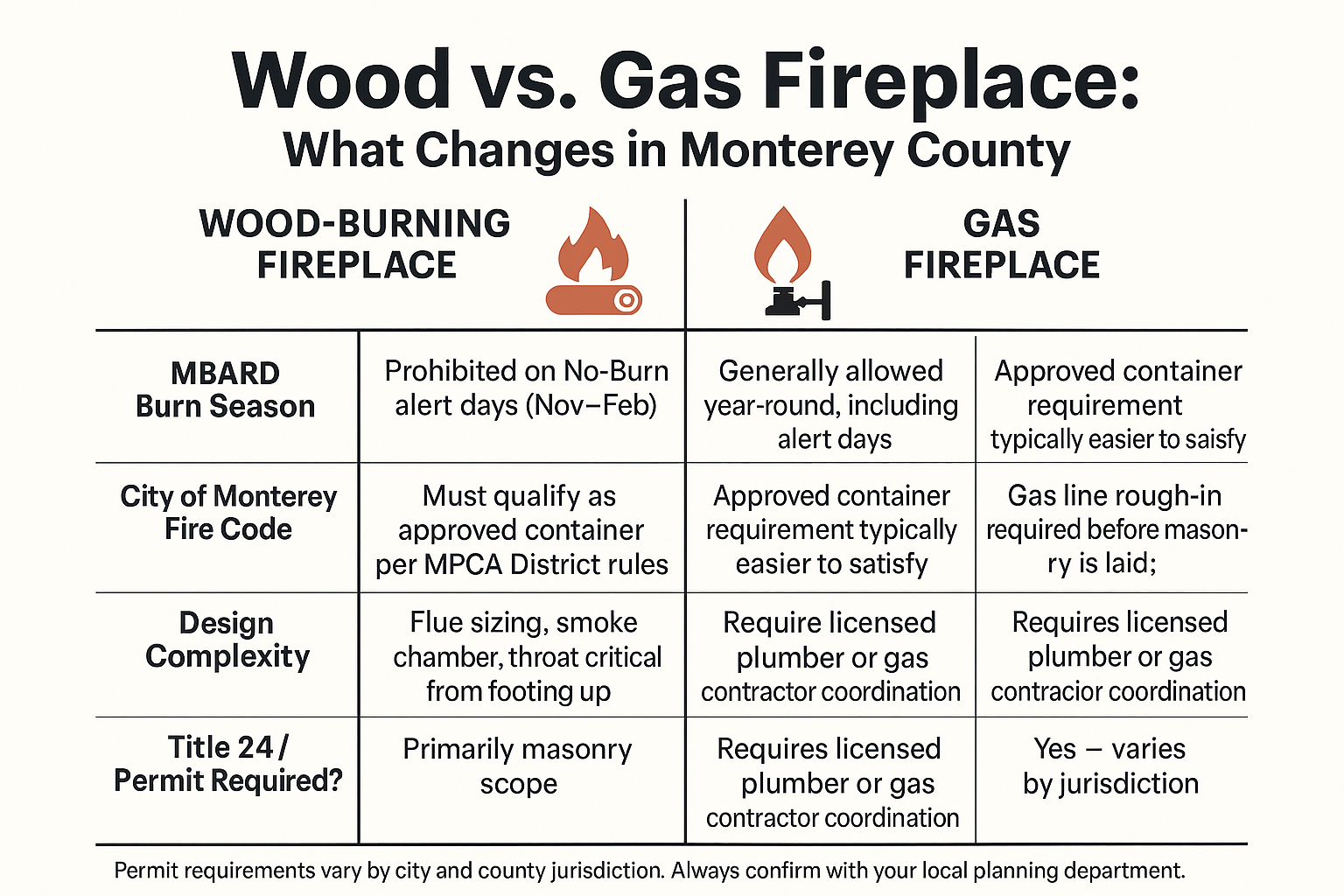
Fuel Type Decision Snapshot: Wood vs. Gas in Monterey County
This infographic summarizes the key differences between wood-burning and gas fireplace builds under Monterey County’s current air quality and code environment.
Why the Coastal Environment Changes Every Material Decision
A fireplace built a few blocks from Monterey Bay in Pacific Grove or Pebble Beach faces something an inland project doesn’t: salt air, persistent moisture cycling, and a microclimate that accelerates deterioration in materials that weren’t specified for those conditions.
This shows up in a few specific places:
- Mortar selection: Standard mortars used inland can degrade faster under salt exposure. Refractory mortar in the firebox is a given, but the mortar joints in the surround and chimney cap need to be specified for coastal durability, not just selected off a standard spec sheet.
- Stone and veneer choices: Some stone types are more porous and absorb moisture more readily — a liability in a freeze-thaw or salt-spray environment. Material selection here isn’t aesthetic; it’s structural longevity.
- Metal components: Chimney caps, dampers, and any exposed hardware corrode faster on the coast. Stainless steel or coated components are worth the added cost when you’re building 200 yards from the ocean.
- Chimney cap design: A poorly detailed cap lets moisture in from above while salt air works from below. It’s one of the first things to fail on a coastal fireplace and one of the most preventable.
These decisions happen at the design stage, not during construction. Changing course after the masonry is set is expensive. Getting the material specs right at the start — accounting for where the property actually sits — is where the long-term value of a well-built fireplace is protected.
What to Know Before Building an Outdoor Fireplace on the Monterey Peninsula covers more of what the coastal environment demands from a project like this.
Fireplace Fuel Type: Key Considerations at a Glance
This table compares the primary planning and compliance factors for wood-burning versus gas fireplace construction under Monterey County’s current regulatory environment.
| Factor | Wood-Burning | Gas (Natural Gas or Propane) |
|---|---|---|
| MBARD No-Burn Alerts | Prohibited on alert days (Nov–Feb season) | Generally permitted on alert days |
| Seasonal Usability | Limited during Nov–Feb window | Year-round use typical |
| City of Monterey Fire Code | Must meet approved container standard | Typically easier to qualify under local code |
| Building Permit Required | Yes — varies by jurisdiction | Yes — varies by jurisdiction |
| Trade Coordination Needed | Primarily masonry scope | Gas contractor + masonry coordination required |
| Coastal Material Risk | Flue liner, mortar, chimney cap all exposure points | Burner components + metal hardware also at risk |
| Title 24 Applicability | Yes (effective Jan 1, 2026) | Yes (effective Jan 1, 2026) |
When the Compliance Work Pays Off in the Finished Project
There’s a version of this that goes wrong — a fireplace or fire feature that looks finished but can’t be used the way the homeowner planned, because the fuel choice wasn’t thought through early, or the permit pathway wasn’t confirmed before the design was locked in.
And there’s a version that goes right.
Andy Stoddard in Carmel Valley described it this way after a built-in gas grill project at his home: “The finished project is beautiful. It has become a well used focal point in our backyard.” That’s the outcome. A piece of masonry that gets used regularly, that holds up, and that becomes part of how the home is lived in — not a structure that sits idle because of a restriction nobody thought to check.
The compliance decisions — fuel type, permit pathway, approved container qualification, material specs for the coastal environment — aren’t obstacles to that outcome. They’re what makes it possible. A masonry fireplace or outdoor fire feature that was built with all of that figured out from the start is one that will still be performing well years down the road.
Stonecap Masonry holds CSLB License #1073620 under the C-29 masonry contractor classification, which covers the masonry scope of fireplace and fire feature construction in California. Homeowners can verify any contractor’s license through the CSLB’s official check-a-license tool at cslb.ca.gov — something worth doing before any project begins, regardless of who you hire.
Frequently Asked Questions About Fireplace Construction in Monterey County
Can I burn wood in my outdoor fireplace during Spare the Air days?
No. When the Monterey Bay Air Resources District issues a No-Burn alert during the wood-burning season (November through February), burning wood in any fireplace or fire pit — indoor or outdoor — is prohibited. Natural gas and propane fireplaces are generally allowed on those days, which is one of the main reasons many homeowners on the Peninsula choose gas.
Do I need a permit to build a masonry fireplace in Monterey County?
In most cases, yes. Fireplace construction typically requires a building permit, and the specific requirements vary by jurisdiction — what the City of Salinas requires may differ from Carmel or the unincorporated county. California’s 2025 Title 24 building standards (in effect since January 1, 2026) apply statewide. Always check with your local planning department before finalizing a design.
Does choosing gas over wood change how the masonry is built?
Significantly. A gas firebox has different clearance requirements and needs a gas line rough-in completed before the masonry is laid around it. That coordination has to happen with a licensed plumber or gas contractor — it’s outside the masonry scope, but it directly affects how the structure is designed and sized. Getting that sequencing wrong adds cost.
How does living near the coast affect my fireplace materials?
Salt air and moisture cycling accelerate deterioration in mortars, certain stone types, and metal components like chimney caps and dampers. Pebble Beach, Pacific Grove, and coastal Monterey properties face this year-round. Material decisions — from the mortar mix to the chimney cap specification — need to account for that exposure from the design stage. What works fine inland may fail early on the coast.
What does the City of Monterey’s updated Fire Code mean for my fireplace project?
Under Ordinance 3712 (April 2026), open burning in the City of Monterey must be confined to an approved container authorized by the Monterey Bay Air Pollution Control District. At the design stage, this affects the firebox type, enclosure, and chimney configuration. Homeowners should confirm with their local planning department how that applies to their specific project before any design is locked in.
How can I verify that a masonry contractor is properly licensed in California?
Use the CSLB’s official check-a-license tool at cslb.ca.gov. A legitimate masonry contractor should hold a C-29 classification from the California Contractors State License Board. That’s the designation that legally covers the full scope of masonry work, including fireplace construction. Verifying before hiring is the single fastest way to reduce contractor risk.
Planning a Fireplace Build on the Monterey Peninsula?
If you’re sorting through fuel type, permit requirements, or material choices for a fireplace project in Monterey County, Stonecap Masonry is available to walk through the specifics with you. Call 831-262-0442 or visit stonecapmasonry.com to request a quote and start the conversation with the right questions already on the table.
