
Direct Answer: Most chimney leaks start at the top: a cracked crown, washed-out mortar joints above the roofline, or spalling brick. Roof flashing is the other common source, and that one belongs to a roofer.
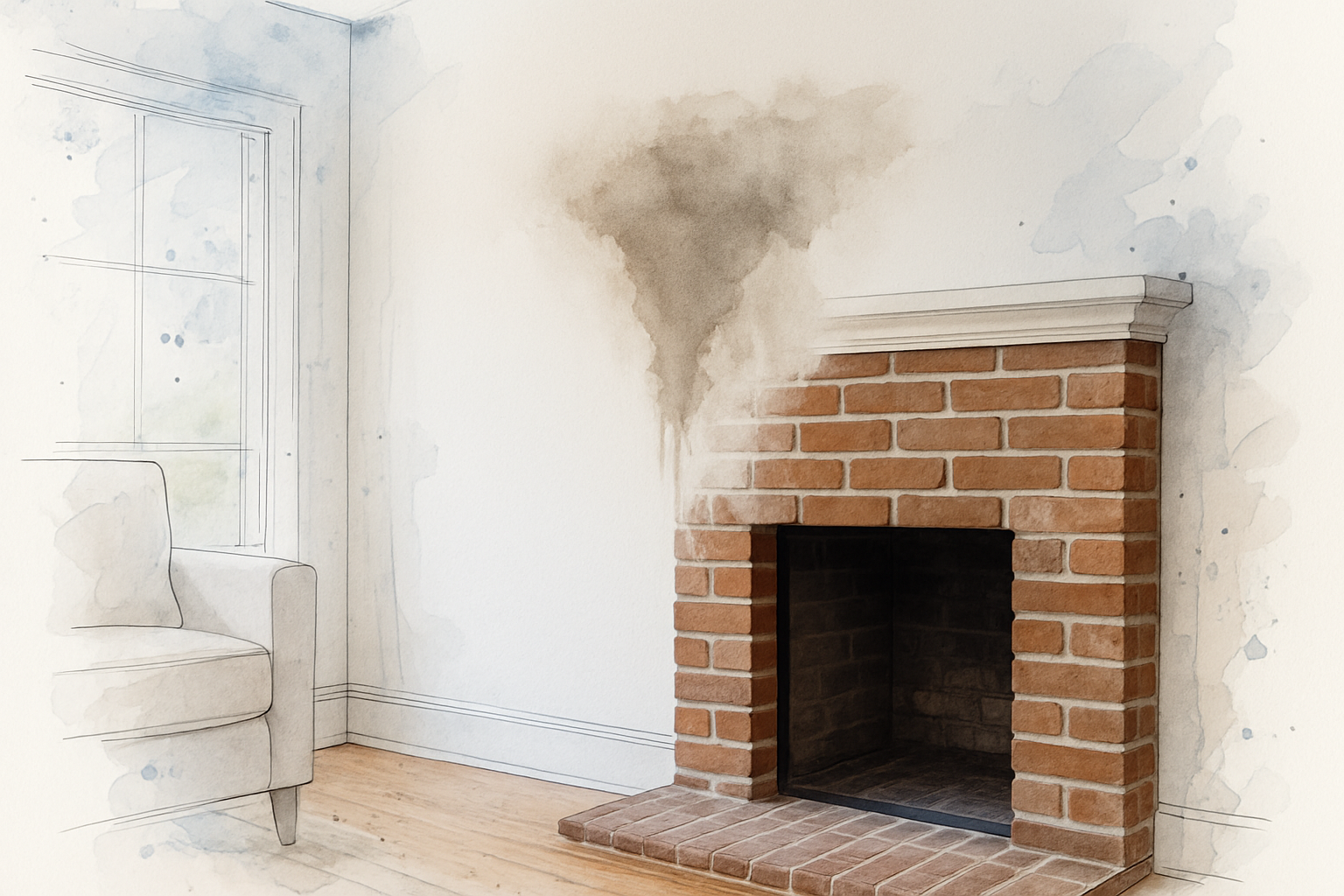
You walk past the fireplace a day after a storm and there it is. A damp gray mark on the drywall beside the firebox, maybe a little white crusting on the brick, maybe a smell you cannot place.
I get these calls every December and January, almost always from homeowners in Carmel, Pacific Grove, and the older neighborhoods of Salinas. The question is always the same: is this the roof, is this the chimney, or is this nothing?
So let me walk the chimney the way I would on a site visit, from the crown down to the firebox. For each thing you might be seeing, I will tell you plainly whether it means watch it, fix it this season, or get eyes on it structurally.
Start at the Top: The Crown Is the Usual Suspect
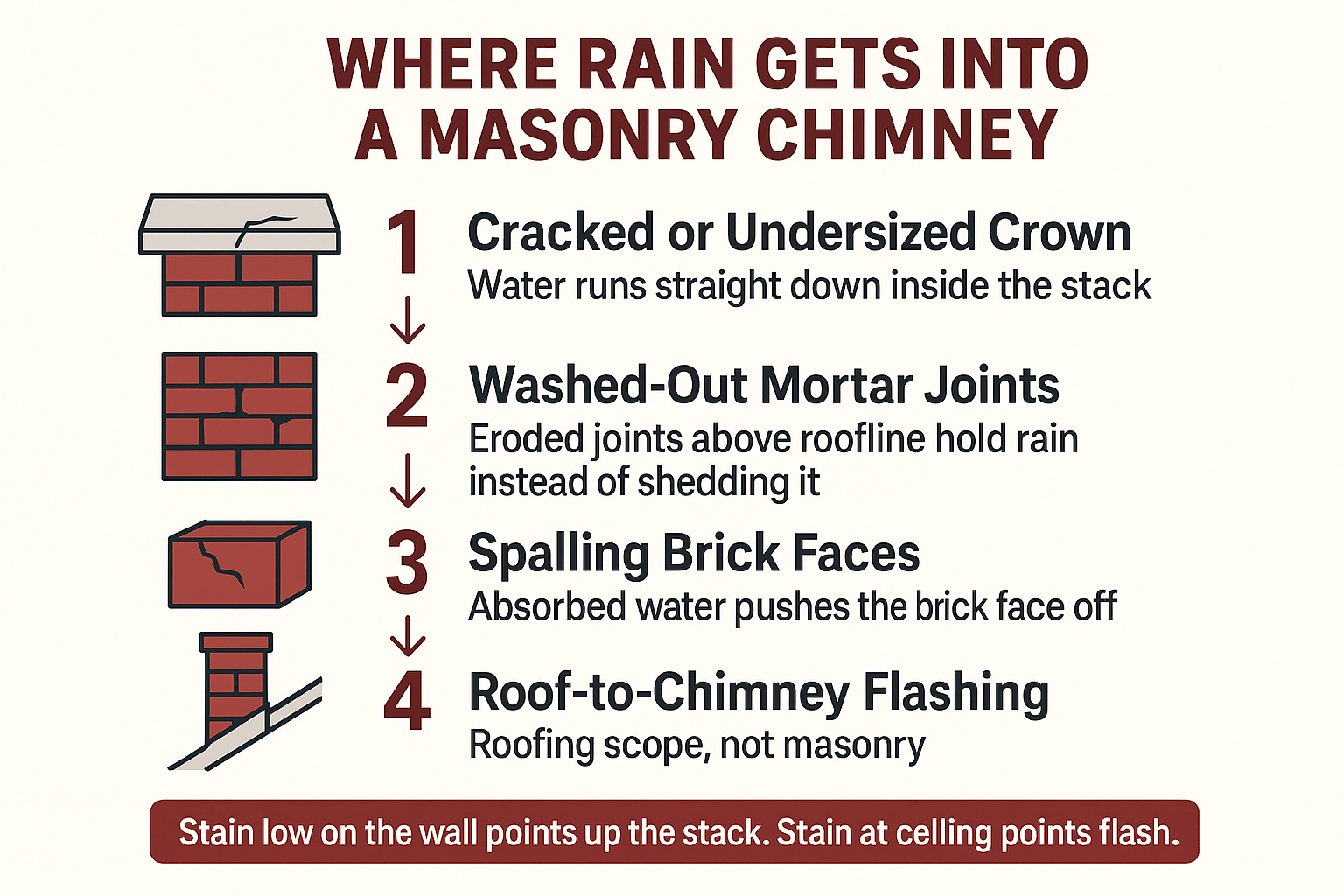
The crown is the slab of concrete or mortar capping the top of the brick stack. Its only job is to shed rain away from the masonry below it. When it is cracked, too thin, or poured flush with the brick instead of overhanging, water goes straight down inside the stack.
I see three crown problems over and over on Peninsula homes:
- Hairline cracks across the crown. Common, often repairable with the right sealant or a recast. Fix it this season.
- A wide crack you can get a fingernail into, or missing chunks. Water is already running down the interior. Fix it now, before the wet months.
- A crown that is really just a smear of mortar sloped the wrong way. This one was built undersized from day one. It needs replacement, not patching.
Here is why the crown matters more than people think. A chimney is a stack of brick and mortar with a flue inside, and the chimney above a masonry fireplace has real structural work to do. Soak the inside of that stack for a few weeks and the mortar starts giving up from the middle out, where nobody can see it.
One more sign: a white powdery bloom on the brick, inside or out. That is efflorescence, salt carried out of the masonry by water passing through it. It is not the problem itself. It is proof that water is moving where it should not be.
Below the Crown: Open Joints, Flaking Brick, and the Roof Junction
Once water gets past the crown, the next weak spots are the mortar joints in the courses above the roofline. Those courses take weather from every side with nothing shielding them.
When the joint face erodes back behind the brick face, rain collects in the recess instead of running off. The repair for that is repointing, which means cutting out the failed mortar to a consistent depth and packing in new. Done right it lasts decades. Done shallow, it falls out in two winters.
Then there is spalling, where the face of a brick flakes or pops off and leaves a crumbly pocket. Spalling means water got absorbed into the brick body and worked its way back out. A few spalled faces near the top is a repair. A whole face of the stack shedding brick is a rebuild conversation.
And finally, the roof-to-chimney junction. If your stain shows up near the ceiling line rather than down by the firebox, suspect the flashing, the metal that ties the chimney into the roof. More on who handles that in a minute.
If you are standing there trying to judge a crack from the ground, this guide on telling whether a masonry crack actually needs repair is a better use of your time than a ladder.
What You See and What It Usually Means
This is roughly how I sort symptoms during a first look at a chimney. It is a starting point, not a diagnosis.
| What you’re seeing | Likely source | How urgent |
|---|---|---|
| White powdery bloom on interior brick | Water passing through the masonry | Get it looked at this season |
| Damp stain low on the wall beside the firebox | Crown or open joints above the roof | Repair before the wet months |
| Stain near the ceiling line only | Roof flashing at the chimney junction | Roofing trade, not masonry |
| Brick faces flaking or popping off | Saturation cycling in and out of the brick | Repair now, rebuild if widespread |
| Stack visibly leaning or joints open all around | Deterioration running deep into the stack | Structural evaluation, stay off the roof |
Forget Freeze-Thaw. On This Coast the Problem Is Saturation
Search this topic online and every article blames freeze-thaw cycling. Water gets in, freezes, expands, breaks the masonry apart. That is a real mechanism, and it is largely irrelevant here.
The Monterey Peninsula almost never freezes. What we get instead is saturation. Atmospheric rivers roll through and keep the masonry wet for weeks, then salt-laden fog off the bay slows the drying between storms.
Masonry that never fully dries stays soft at the joints. Salt crystallizes inside the pores and pushes the brick face apart from the inside. No freeze required.
This winter, the odds are tilted the wrong way. NOAA’s Climate Prediction Center is carrying an El Nino Advisory with a greater than 90 percent chance of a very strong event through fall and winter, and their seasonal outlook moved California into the above-normal category for winter precipitation. You can read the current ENSO diagnostic discussion from NOAA’s Climate Prediction Center yourself.
I want to be careful here. A strong El Nino shifts probabilities, it does not promise a flood. But if your chimney already has open joints and a cracked crown going into a wetter-than-normal season, that is a different risk than it was last year. What a strong El Nino winter actually does to masonry goes deeper on that.
Where Rain Gets Into a Masonry Chimney
Four entry points, working from the top of the stack down to the roofline.
Who Actually Owns the Fix
This is where most homeowners get spun around. Three trades look at the same leak and each one sees their own piece of it.
Here is the honest line around a C-29 masonry classification:
- Masonry scope: crown replacement or recast, repointing joints above the roofline, rebuilding damaged brick courses, firebox and smoke chamber masonry, and structural repair to the stack.
- Roofing scope: the flashing where the chimney passes through the roof, and any shingle or underlayment repair around it.
- Chimney specialist scope: sweeping, flue liner inspection, and liner replacement.
- Plumbing scope: gas lines, if your fireplace has a gas log or starter.
We do this on other work too. On a fire pit build with a gas connection, we bring in a licensed plumber rather than crossing out of our classification.
So if a mason tells you your stain is a flashing problem and hands you back to a roofer, that is good information. A contractor willing to say “that is outside my license” is telling you something useful about how they work.
If the Stack Comes Apart, Deal With Reinforcement Too
When deterioration runs deep enough that the top section has to come down and go back up, do not treat it as a cosmetic job. Monterey County sits in an active seismic region, and an unreinforced brick stack is one of the first things to fail in a shake.
A lot of the homes I work on in Salinas and Pacific Grove were built between the 1940s and the 1970s. Tall brick chimney, no vertical steel inside it, nothing tying it back to the framing.
In a rebuild, two things matter beyond the brick:
- Vertical reinforcement, meaning steel bars running up through the stack and grouted in place, so the stack behaves as one piece instead of loose layers.
- Anchorage, meaning straps or ties connecting the chimney back to the house framing at specified points so it cannot peel away.
California’s 2025 Title 24 standards took effect January 1, 2026, so permitted chimney work this season falls under the updated framework. Permit requirements vary by jurisdiction and by how much of the stack is involved, and your local planning or building department makes that call, not your contractor. How seismic zone rules shape a masonry build covers the reasoning in more detail.
And please do not climb up to assess or patch this yourself. A deteriorated stack is exactly the thing you do not want to be standing on.
Why Two Quotes on the Same Chimney Can Be Thousands Apart
The same leaking chimney can be quoted as a half day of repointing or a full teardown and rebuild above the roof. Both bids can be honest. They are describing different scopes.
What actually moves the number:
- How far down the deterioration runs. Three bad courses is a different job than fifteen.
- Access. A single story ranch versus a two story home needing scaffolding changes labor significantly.
- Crown approach. A recast over a sound crown costs less than a full tear-off and new pour.
- Material matching. If the original brick or stone is out of production, sourcing a close match takes time and money.
- Interior damage. If water already reached framing or drywall, that repair sits outside the masonry scope and adds another trade.
Costs vary a lot locally, but many Monterey County homeowners find that targeted repointing of the exposed courses lands well below a partial rebuild, and a rebuild with new reinforcement sits higher again. Anyone quoting a firm number without getting up to look at the crown is guessing. What repointing actually costs and what drives the price breaks down those variables.
One homeowner who contacted us after a vehicle damaged a block wall ended her message by asking us to confirm license and insurance before anything else. That is a smart instinct. Any California contractor’s license can be checked through the CSLB check-a-license tool before money changes hands, and I would rather a customer do that than skip it.
The Part Nobody Mentions Until the Work Is Done: Matching
On a chimney rebuild, you will judge the result on one thing. Do the new top courses look like they were always there, or do they look like a patch?
That comes down to brick or stone selection, mortar color, and joint tooling matching what is already on the house. Mortar dries lighter than it looks wet, so getting the color right takes a test panel and patience.
It is the same skill that shows up on hardscape. A Carmel Valley client put it simply after we rebuilt around an existing pool: the work “matched the stone hardscape around the pool perfectly” (Andy S.). Same judgment, different elevation.
Frequently Asked Questions About Masonry Chimney Water Damage
How do I tell if the stain is the chimney or the roof?
Location is the best clue. A stain high near the ceiling line usually points to flashing at the roof junction, which is roofing work. A stain lower down beside the firebox, especially with white powdery residue on the brick, usually means water is traveling down inside the stack from a bad crown or open joints.
Can I just seal the chimney and be done with it?
Sometimes, but only after the real entry point is closed. A sealer applied over cracked crown or eroded joints can trap moisture inside the masonry and make the flaking worse. Repair first, then consider a breathable masonry sealer if it fits the situation.
Is this urgent, or can it wait until spring?
If the stain appeared after a single storm and has not spread, monitoring through the season is reasonable. If it is growing storm to storm, or you can see missing crown pieces or brick faces on the ground, that is a this-season repair. A leaning stack or joints open all the way around is a stop-and-get-it-evaluated situation.
Does a chimney repair need a permit in Monterey County?
It depends on the jurisdiction and how much of the stack is involved. Minor repointing often differs from a rebuild above the roofline with new reinforcement. Your local planning or building department makes that determination, and since California’s 2025 Title 24 standards took effect January 1, 2026, any permitted work falls under the updated rules.
Why does my chimney look worse every winter if we never get a freeze?
Because the damage here comes from staying wet, not from freezing. Long storm stretches soak the masonry and coastal fog keeps it from drying out. Salt in that moisture crystallizes inside the brick and mortar and breaks it down from within.
Looking at a Stain and Not Sure Who to Call?
If you are in Monterey County and that mark beside the firebox has you guessing between the roof and the chimney, it is worth having someone look at the crown and the joints before the next stretch of storms. Licensed masonry help is available locally through Stonecap Masonry at 831-262-0442 or stonecapmasonry.com, CSLB License #1073620. And if the answer turns out to be flashing, a good mason will tell you that too.
