
Direct Answer: Repointing costs in Monterey County generally range from $3 to $20 per square foot, but access difficulty, mortar type, and minimum job fees all push the final number up significantly.
Most homeowners searching for masonry repair in Salinas or anywhere on the Monterey Peninsula have already noticed the problem: crumbling mortar joints, gaps between stones, or a wall that looks like it’s slowly losing its grip. What they haven’t figured out yet is why two quotes for the same stretch of wall can differ by hundreds of dollars, or why a small corner repair can still cost more than they expected.
Before we talk money, I need to separate two terms that get used interchangeably all the time, and that confusion causes real problems when people are comparing bids. Repointing means removing the old, failed mortar from the existing joints and packing in fresh mortar matched to the original. Tuckpointing is a more specific technique that adds a thin contrasting mortar line inside the fresh joint for a cleaner visual result. Both restore weather resistance and structural stability, but tuckpointing takes more labor and precision, so it costs more.
If a contractor uses these terms interchangeably without explaining which one you’re getting, that’s worth asking about before you sign anything. Here’s what actually drives the price on the Central Coast, and what you should be watching for when a quote lands in your inbox.
Why the Per-Square-Foot Number Only Tells Half the Story
Nationally, repointing is commonly quoted in a range of roughly $3 to $20 per square foot, depending on access, mortar type, and how much of the joint needs to come out. On California’s Central Coast, labor rates tend to sit at the higher end of that range given the local cost-of-living context. But that per-square-foot number is not the whole picture, and I want to be direct about that.
Almost every repointing job carries a minimum job fee, regardless of how small the repair is. Mortar mixing, protecting surrounding surfaces, cleanup, and travel time are fixed costs that don’t shrink just because the damaged area is small. I’ve seen homeowners genuinely surprised that a two-foot corner repair costs as much as it does, but once you understand that the preparation and mobilization alone eat up a significant portion of the job cost, it makes sense.
The practical takeaway: if you have multiple small areas that need attention, combining them into one visit is almost always more cost-effective than scheduling separate repairs. A masonry contractor‘s time is the most expensive part of a small job, not the mortar.
For a deeper look at what separates a surface-level patch from a real structural fix, this article on the real difference between a cosmetic fix and a masonry repair covers exactly that.
The Single Factor That Changes Your Quote the Most: Access
Of all the variables that move a repointing price, access is the biggest one, and it’s the one most homeowners don’t think about until they see the quote.
A retaining wall or patio-level garden wall is straightforward. A mason can work from the ground, tools are close by, and the job moves efficiently. But a chimney above the roofline or a second-story exterior wall is a different situation entirely. That work requires scaffolding, which adds both material rental cost and meaningful setup time to every invoice. On taller structures, you might be looking at a full day of scaffolding setup before a single joint gets touched.
I’d be skeptical of any quote for elevated repointing that doesn’t itemize the scaffolding separately. If a contractor is absorbing that cost into a flat per-square-foot rate without disclosing it, you have no way to compare their bid fairly against another.
Here on the Monterey Peninsula, properties in Pebble Beach, Carmel, and the hillsides above Salinas often have tiered landscaping and retaining walls on slopes, which adds a complexity layer even for ground-level work. Uneven terrain can slow a crew down and require additional staging, and that time shows up in the quote.
For reference on how access and site conditions affect larger hardscape projects, what separates a solid hardscape installation from one that fails early gets into the site preparation side of this.
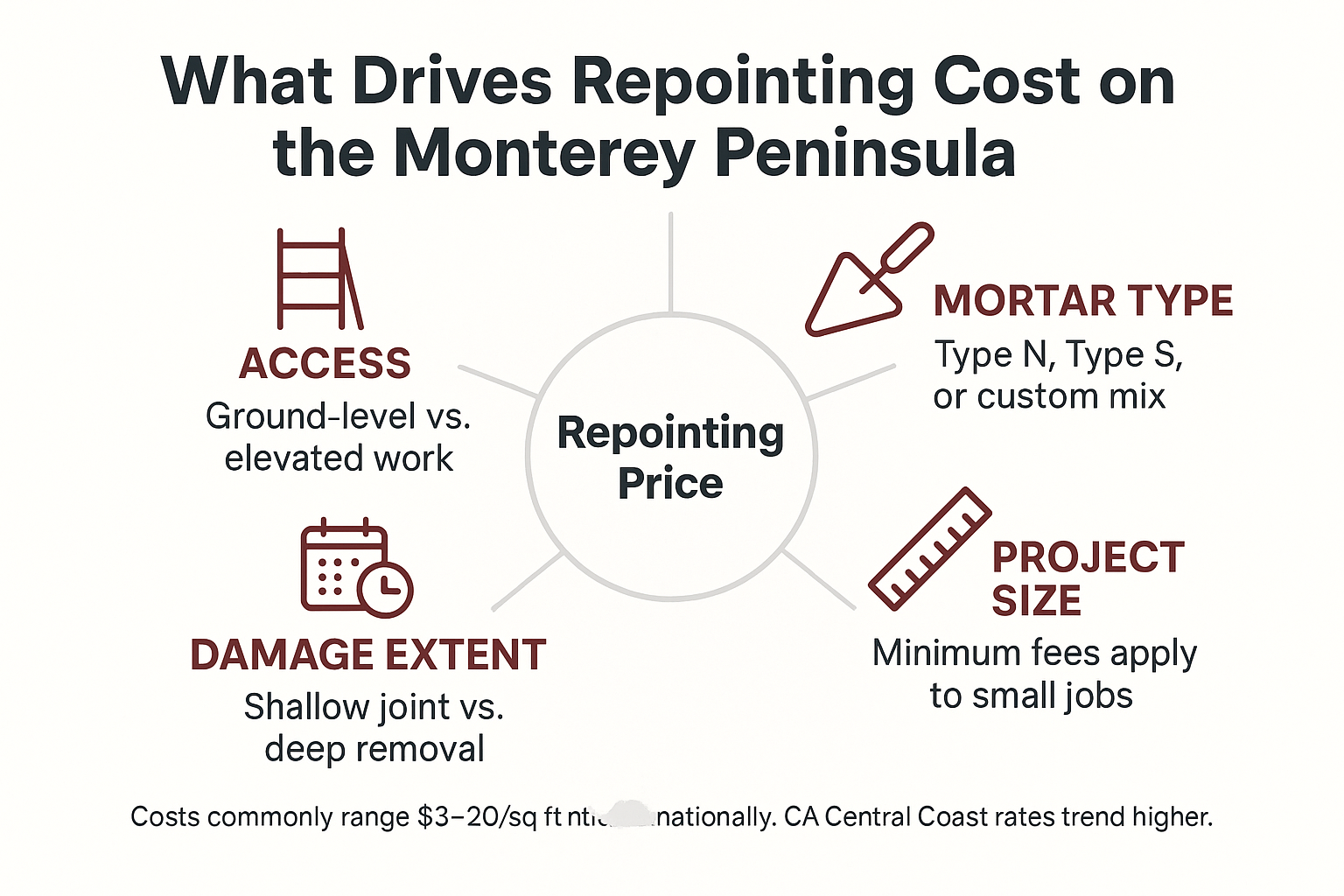
What Repointing Costs Depend On
This breakdown covers the four main factors that move a repointing quote up or down on the Monterey Peninsula.
Mortar Matching Is Not Optional, and Getting It Wrong Is Expensive
This is the part of repointing that I think gets the least attention in online cost guides, and it’s the part that matters most from a craftsmanship standpoint.
Not all mortar is interchangeable. Using a mix that is harder than the original masonry forces stress into the stone or brick units rather than the joint, and over time, the face of those units can spall off. That’s an irreversible failure. You can’t un-spall a brick face.
The two mortar types most relevant to residential masonry repair here are:
- Type N mortar, moderate strength, good flexibility, suited for softer stone and brick. This is the right choice for many older residential walls and for materials common to coastal construction on the Peninsula.
- Type S mortar, higher compressive strength, used in below-grade applications, retaining walls, and situations where the masonry needs to resist lateral load.
Many homes in Carmel, Pacific Grove, and Salinas were built with older, softer mortars formulated for the region’s conditions. A contractor who applies a one-size-fits-all Portland-heavy mix to one of those walls isn’t saving you money, they’re creating a problem that costs far more to fix later. A good mason will test a small sample area, assess the original mortar composition, and match it before committing to the full repair.
This is one of the clearest examples of why how to tell if a masonry crack actually needs repair matters, because the type of damage visible often signals what kind of mortar failure caused it in the first place. The ASTM International standard C270 covers mortar specifications for unit masonry and is the reference point most licensed masons use when specifying mortar type for a given application.
Type N vs. Type S Mortar: A Simple Reference
Here’s a plain-language comparison of the two mortar types most relevant to residential masonry repair on the Monterey Peninsula.
| Mortar Type | Strength Level | Best Used For |
|---|---|---|
| Type N | Medium (750 psi) | Soft stone, older brick, above-grade exterior walls, coastal residential masonry |
| Type S | High (1800 psi) | Retaining walls, below-grade work, high-lateral-load applications |
| Portland-heavy custom mix | Very high (varies) | Structural CMU block, new construction, not for repointing soft historic masonry |
Who You Hire Changes the Risk, Not Just the Price
One pattern I’ve seen consistently: the homeowners who ask the best questions upfront tend to end up with the best outcomes. A property owner near Moss Landing came to us with a concrete block retaining wall corner damaged by a third-party vehicle. Before they even asked about scheduling, they wanted license and insurance confirmation. That’s exactly the right instinct.
In California, any masonry contractor taking on structural repair work should hold a current C-29 license from the CSLB. This isn’t paperwork for its own sake, the C-29 classification specifically covers the scope of work involved in structural masonry repair, and it comes with bonding and insurance requirements that protect you if something goes wrong on your property. You can verify any contractor’s license directly through the CSLB’s license check tool.
Contractors who can’t show a current license, general liability coverage, and workers’ compensation aren’t offering you a bargain. They’re passing their risk onto you. If an unlicensed worker is injured on your property, or the repair fails and there’s no bond to collect against, the savings on the quote don’t begin to cover the exposure.
Frequently Asked Questions About Repointing Masonry Costs
How do I know if my wall needs repointing or something more serious?
If the mortar in the joints is soft, recessed, or crumbling but the stone or brick units themselves look solid, repointing is likely the right fix. If you’re seeing cracks running through the units themselves, bowing, or wall movement, that points to a structural issue that a surface repair won’t solve. The article on is cracking masonry a warning sign or just normal settling walks through how to read those signs.
Is repointing something a homeowner can do themselves?
For very small cosmetic areas on a low-risk surface like a garden border wall, some homeowners do attempt it. But getting the mortar match wrong on any structural wall, a chimney, a retaining wall, a load-bearing exterior, can cause damage that costs far more to fix than the original repair. I wouldn’t recommend DIY on anything structural, and I’d especially caution against it on older masonry where the original mortar type isn’t obvious.
Why does a small repair cost almost as much as a larger one?
Because the fixed costs don’t change. Mixing mortar, setting up site protection, traveling to the job, and cleaning up afterward take roughly the same amount of time whether the repair is two square feet or twenty. Most contractors apply a minimum job fee that reflects those fixed costs, so small repairs often feel expensive per square foot. Grouping multiple small repairs into one visit is almost always more economical.
Does repointing require a permit in Monterey County?
For routine joint repair on a non-structural surface, a permit typically isn’t required. But on a chimney, a retaining wall over a certain height, or any structural masonry element, permit requirements can apply, and they vary by jurisdiction and project scope. Requirements differ between the City of Salinas, the City of Monterey, and unincorporated Monterey County. Always ask your contractor to clarify whether your specific project needs a permit before work begins.
How does the coastal climate here affect how often masonry needs repointing?
The Monterey Peninsula’s salt air, marine moisture, and temperature cycling accelerate mortar deterioration faster than in drier inland climates. Joints that might last 25 to 30 years in a dry climate can start showing real degradation in 15 years or less here, especially on north-facing or shaded walls that stay damp. Catching it early, when only the surface of the joint has failed, is much less expensive than waiting until moisture has gotten behind the face of the masonry.
Ready to Get a Straight Answer on Your Repair?
If you have a retaining wall, chimney, patio wall, or any masonry surface showing joint deterioration on the Monterey Peninsula, Stonecap Masonry is available to take a look and give you an honest assessment of what the repair actually involves. You can reach the team at 831-262-0442 or request a quote at stonecapmasonry.com.
