
Direct Answer: Some masonry cracks are cosmetic and stable. Others signal structural movement, water intrusion, or foundation stress. The crack’s pattern, width, and location tell you which one you’re dealing with.
You notice a crack in your retaining wall, chimney, or stone facade and your first instinct is to wonder if something is wrong. Sometimes it is. But masonry that has never developed a single crack over years of service is actually pretty rare, especially in Monterey County where salt air, clay-heavy soils, and a documented seismic risk profile put real stress on masonry over time.
The problem is that a hairline crack and a structural failure can look surprisingly similar to an untrained eye — and treating a serious crack as cosmetic is one of the more expensive mistakes a homeowner can make. Getting it wrong in the other direction — panicking over settling shrinkage cracks and paying for unnecessary repairs — isn’t cheap either.
This article focuses on the two things that actually matter: how to read what a crack is telling you, and what the local conditions in Monterey County mean for that answer. Skip the guesswork. Here’s how experienced masons think through it.
What Normal Settling Looks Like in Masonry
Masonry moves. Concrete shrinks as it cures. Mortar joints expand and contract with temperature changes. Stone and brick shift slightly as the soil underneath adjusts to seasonal moisture levels. All of this is expected, and most of it produces cracks that are genuinely not a problem.
The cracks that fall into the “normal settling” category tend to share a few characteristics:
- Hairline width — typically under 1/16 of an inch, often described as the thickness of a credit card or thinner
- Horizontal mortar joint cracks running along a single joint line without continuing into the masonry units themselves
- Uniform spider-web or map cracking across a concrete surface, which is called crazing and is almost always cosmetic
- Stable over time — when you mark the ends of the crack with a pencil and check back in 30 to 60 days, it hasn’t grown
In Carmel Valley and parts of Salinas, expansive clay soils mean that some seasonal movement — and the minor cracking that comes with it — is practically unavoidable. A patio or garden wall installed without proper base preparation may show more of this movement than one built with adequate compacted base and drainage. If you’ve noticed cracking alongside sinking or uneven sections on your patio or walkway, the base layer is often the real story.
Crack Patterns That Deserve a Closer Look
Not all cracks are created equal, and the shape and direction of a crack tells you more than its size alone. Masons use crack patterns as diagnostic information — the same way a doctor reads an X-ray.
Diagonal stair-step cracks running through mortar joints in a block or brick wall are one of the most common warning signs. They typically indicate differential settlement — meaning one part of the wall’s foundation is sinking faster than another. This isn’t something to watch and wait on indefinitely.
Vertical cracks that run straight through masonry units (not just the mortar) suggest tension stress, often tied to foundation movement or, in retaining walls, lateral soil pressure building behind the wall. A retaining wall showing this pattern along with any forward lean should be evaluated promptly — the warning signs that a retaining wall is under more stress than it looks often show up in the masonry before the lean becomes obvious.
Cracks with displacement — where one side of the crack sits higher or further out than the other — are the clearest red flag of all. Any crack where the two faces are no longer in the same plane means structural movement has already occurred.
Width matters too:
- Under 1/16″ — monitor, likely cosmetic
- 1/16″ to 1/4″ — worth a professional look, especially if diagonal or near a corner
- Over 1/4″ — schedule an evaluation; do not treat this as cosmetic
- Any width with displacement — call a licensed mason now
For a deeper breakdown of where cosmetic damage ends and structural failure begins, this guide on masonry damage covers the distinction with more detail.
Why Monterey County Changes the Answer
Cracking that would be purely cosmetic in a dry, stable climate can carry a different risk profile on the Monterey Peninsula. Three local factors are worth understanding.
Salt air and moisture cycling. Coastal properties from Pacific Grove to Pebble Beach deal with salt-laden air that works into masonry pores and mortar joints over time. When moisture infiltrates a crack and then dries out repeatedly, it accelerates deterioration. A small crack that isn’t addressed can double in width within a couple of seasons of coastal weather, particularly in north-facing or shaded walls where drying is slow.
Seismic activity. Monterey County sits within a seismically active region — the San Andreas fault runs directly through the area, and ground movement events are not hypothetical here. Masonry that has existing cracks, especially in older unreinforced structures, is more vulnerable to seismic damage than masonry in good repair. How seismic risk changes the way masonry should be built covers this in the context of commercial structures, but the underlying principle applies to residential masonry as well.
Soil conditions. Parts of Salinas and the Salinas Valley sit on clay-rich soils with significant shrink-swell behavior. In wet winters, these soils expand. In dry summers, they contract. Masonry installed without proper drainage and base preparation will reflect this movement more aggressively than masonry built to account for it. If cracking seems to worsen every spring, seasonal soil movement is a logical first suspect.
How to Read a Masonry Crack: A Quick Reference
This visual summary covers the four crack types Monterey County homeowners encounter most often and what each one typically means.
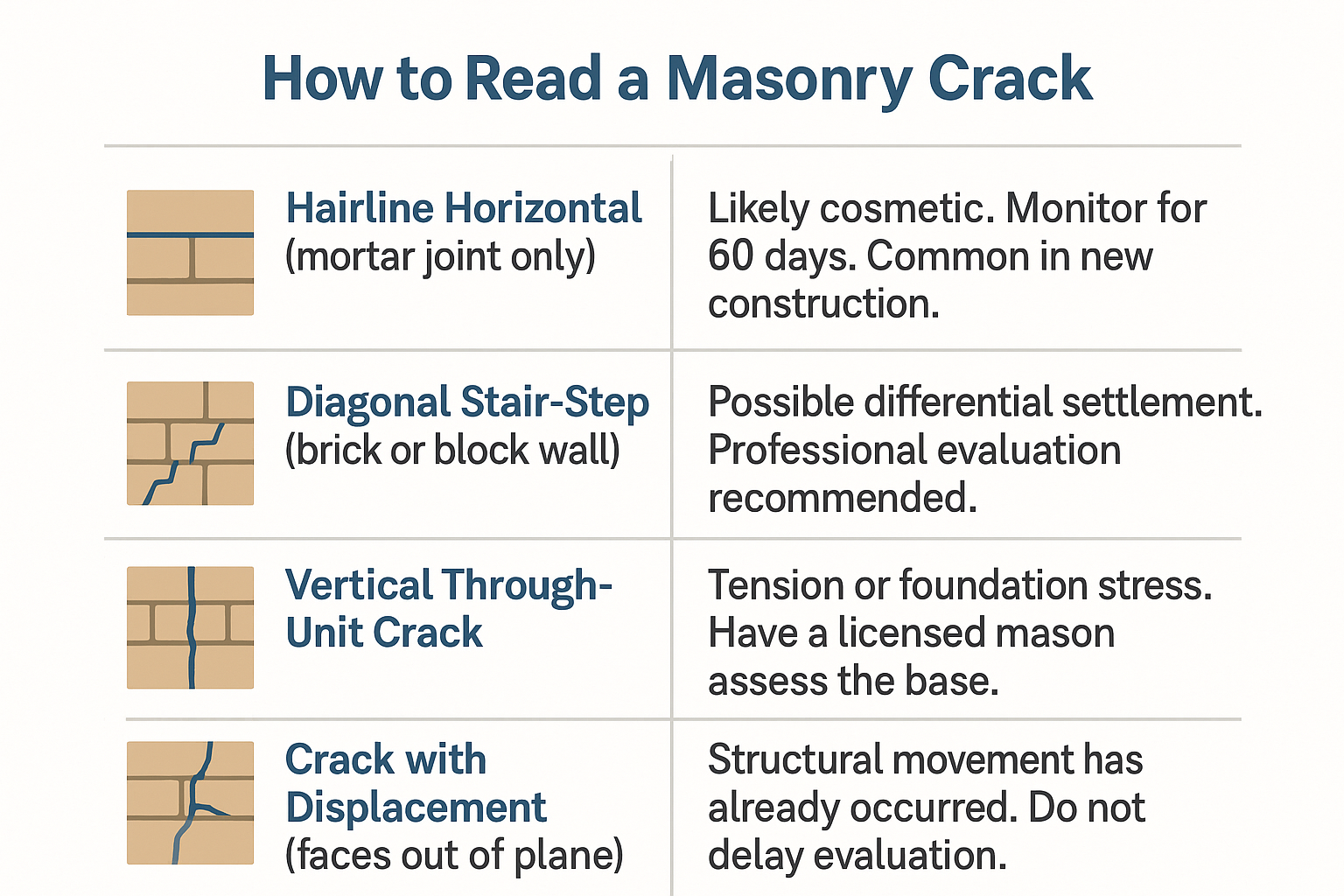
Crack Type Quick Reference: What It Looks Like vs. What It Likely Means
Use this table as a first-pass reference. It doesn’t replace a professional assessment, but it gives you a starting framework before you call anyone.
| Crack Type | Typical Appearance | Most Likely Cause | Urgency Level |
|---|---|---|---|
| Hairline mortar crack | Under 1/16″, along joint only, stable | Shrinkage, thermal cycling | Monitor — low urgency |
| Diagonal stair-step | Follows mortar joints in stair pattern | Differential settlement | Get a professional look |
| Vertical through-unit | Straight vertical, splits the masonry unit itself | Tension stress, foundation shift | Evaluate soon |
| Horizontal mid-wall crack | Runs horizontally across a retaining wall face | Lateral soil pressure from behind | Evaluate promptly |
| Crack with displacement | One side sits higher or juts outward | Structural movement already occurred | Act now — do not delay |
| Spider-web / crazing | Fine network of surface cracks, no depth | Concrete surface shrinkage | Cosmetic — no action needed |
When Monitoring Makes Sense — and When It Doesn’t
One piece of practical advice that’s worth understanding: marking a crack and watching it for 60 days is a legitimate diagnostic tool, not just a way to procrastinate. If you put a small pencil mark at each end of a crack and it doesn’t grow, that’s useful information. A stable hairline crack in a non-structural wall is genuinely different from one that gains a quarter-inch in two months.
But there are situations where waiting is the wrong call. If the crack is in a retaining wall, a chimney, a structural foundation wall, or any masonry that is actively holding something up or back, the calculus changes. A retaining wall with a horizontal crack midway up its face is showing signs of lateral stress that may already be at or near a critical threshold — knowing when a leaning or cracked retaining wall has become urgent is a judgment call better made sooner than later.
The other situation where monitoring doesn’t work well: older unreinforced masonry in a seismically active area. Commercial property owners dealing with URM structures already know they’re operating under Monterey’s hazard-reduction requirements. But residential owners of older Salinas homes with original brick or block construction should treat new cracking patterns with more caution than a homeowner in a low-seismic region would.
When there’s genuine doubt about whether a crack is stable or progressing, the right move is a professional evaluation — not a YouTube repair tutorial. Some masonry repairs look straightforward from the outside but require removing material, repointing with the correct mortar mix, and addressing whatever caused the crack in the first place.
Frequently Asked Questions About Masonry Cracks
Can I just fill a crack with caulk or mortar myself?
For surface-level cosmetic cracks with no structural concern, minor tuckpointing is sometimes a reasonable DIY fix — but only if you’re using the correct mortar mix. Using a mortar that’s too hard (too high a Portland cement ratio) in older masonry can actually cause more cracking by making the joint stiffer than the surrounding material. And caulk is almost never the right answer for a masonry crack; it doesn’t bond properly to most masonry surfaces long-term and can trap moisture behind it. For anything structural, leave it to a licensed mason.
My house was built in the 1970s and has hairline cracks everywhere. Is that normal?
For a structure that old, some surface cracking is expected — decades of thermal cycling, moisture exposure, and minor soil movement add up. What matters is whether the cracks are stable and shallow or whether any of them show displacement, are wider than 1/4 inch, or have changed noticeably in recent years. A one-time walk-through by a licensed C-29 mason can usually tell you quickly which ones to watch and which ones need work.
Does a new patio or retaining wall crack as it cures?
Yes, and this is normal. Concrete and mortar both shrink slightly as they cure, and that process can produce hairline surface cracks within the first few weeks. These are called shrinkage cracks and are generally cosmetic. A well-built installation may include control joints specifically to direct this shrinkage to planned locations rather than random ones. If you’re seeing cracks that developed months after construction — not weeks — that’s a different pattern worth paying attention to.
How much does masonry crack repair typically cost in Monterey County?
It varies significantly by scope. Repointing a section of mortar joints on a garden wall might run $300 to $800 for a small area. Repairing a structural crack in a retaining wall — which may involve excavation, addressing the drainage issue behind the wall, and rebuilding a section — can run $2,500 to $8,000 or more depending on wall height and length. The wide range comes down to what caused the crack. Treating the symptom without addressing the cause is a repair that will need to be done again.
Does crack repair on a retaining wall or structural masonry require a permit in Monterey County?
It depends on the scope. Cosmetic repointing or minor mortar repair typically doesn’t require a permit. Structural repair — anything involving rebuilding a section of wall, addressing foundation elements, or changing the wall’s drainage system — likely does. Requirements vary by jurisdiction, so it’s worth checking with the City of Salinas, City of Monterey, or Monterey County Planning Department depending on where your property is located. A licensed contractor familiar with local requirements can advise you during the estimate process.
Not Sure What Your Crack Is Telling You?
Stonecap Masonry serves homeowners and property owners across the Monterey Peninsula — from Salinas and Carmel Valley to Pacific Grove and Pebble Beach. If you’ve got cracking masonry you’re not sure how to read, a licensed C-29 mason can take a look and give you a straight answer. Reach out to the Stonecap team at 831-262-0442 or visit stonecapmasonry.com to get started.
