
Direct Answer: In seismically active areas like Monterey County, commercial masonry must use reinforced systems, flexible mortars, and proper anchorage to resist lateral forces that unreinforced masonry cannot survive.
Most commercial property owners on the Monterey Peninsula think about masonry in terms of aesthetics — how it looks, how long it lasts, what it costs per square foot. But in Monterey County, there’s a variable that changes every one of those decisions before a single block gets set: seismic risk.
Monterey County sits near the Hayward, Calaveras, and San Andreas fault systems. The U.S. Geological Survey classifies most of the Peninsula as a high seismic hazard zone, meaning buildings here face lateral ground forces that can shear, crack, or collapse unreinforced masonry in ways that a standard construction approach simply cannot absorb.
This article focuses on two things that actually matter to a commercial property owner navigating a masonry project in this region: what seismic requirements mean for how masonry is built, and what happens when those requirements are skipped. If you own commercial property here and you’re planning a masonry project — or managing a building with older masonry — this is worth understanding.
Why Unreinforced Masonry Is a Known Liability in Monterey County
Unreinforced masonry (URM) refers to brick, block, or stone construction that has no steel reinforcement embedded inside it. Older commercial buildings throughout downtown Monterey, Salinas, and Pacific Grove were built this way — and many still stand today, carrying hidden structural risk.
During an earthquake, masonry walls behave very differently from wood-frame or steel construction. Wood can flex. URM cannot. When lateral ground forces hit an unreinforced wall, the mortar joints crack, wythes separate, and in severe cases the wall collapses outward — a failure mode that’s been documented in every major California earthquake since 1971.
The City of Monterey has an active URM Hazard Reduction Program that identifies at-risk commercial structures and requires owners to either retrofit or document compliance. If you manage a commercial property with brick or block construction built before the early 1980s, there’s a real possibility it’s on that list — or should be. Understanding what commercial property owners commonly get wrong about masonry maintenance is a useful starting point before any retrofit or repair conversation.
The cost of ignoring this isn’t just structural. Liability exposure for a building that fails during a seismic event — and was known to be at risk — is significant.
What Seismically Compliant Commercial Masonry Actually Requires
When a licensed masonry contractor builds new commercial masonry in a high seismic zone, the work looks different from a low-risk environment. Several specific requirements come into play:
- Reinforced CMU (Concrete Masonry Unit) construction: Vertical and horizontal rebar is embedded through the hollow cores of concrete block walls, which are then grouted solid. This creates a composite wall system that can absorb lateral movement without cracking apart.
- Proper grout consolidation: Cores must be fully filled — partial grouting defeats the purpose. This is inspected by building departments and cannot be hidden after the fact.
- Seismic anchors and ties: Where masonry meets a steel or wood structure — rooflines, floor diaphragms, column connections — mechanical anchors transfer lateral loads rather than letting the wall act independently.
- Flexible mortar joints in veneer applications: Thin stone or brick veneer attached to a commercial building needs isolation joints and flexible setting materials that allow minor movement without the veneer cracking off the substrate.
- Compliant base and footing design: Footings for commercial masonry walls must account for soil conditions. In Salinas and coastal areas, expansive clay soils and moisture cycling add another variable that affects footing depth and width.
California’s 2025 Title 24 building standards, which take effect January 1, 2026, continue to govern structural masonry in commercial applications. Any permitted commercial masonry project in Monterey County will be reviewed against these standards. The requirements aren’t optional, and a contractor who doesn’t know them by name is a contractor worth questioning.
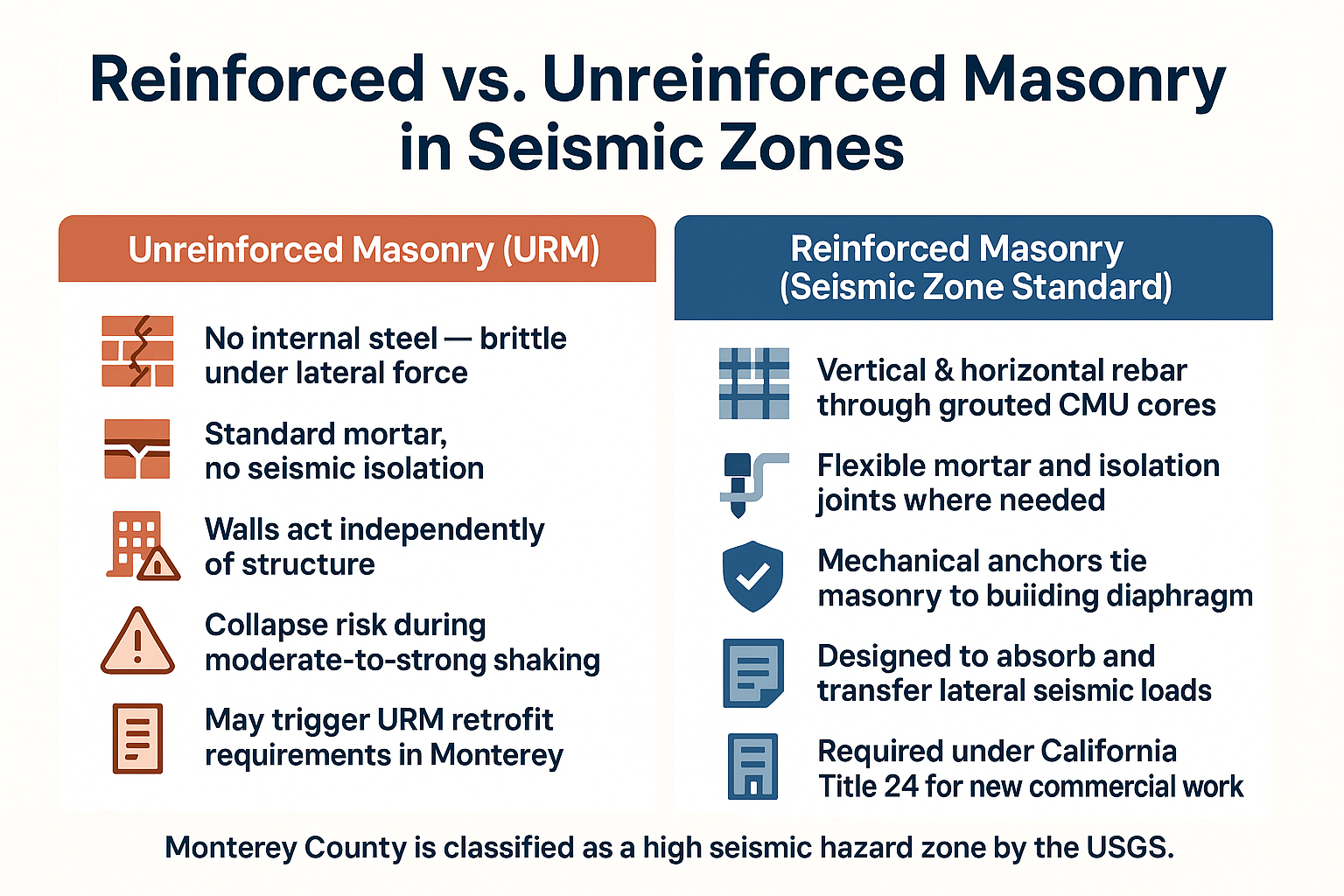
Reinforced vs. Unreinforced Masonry: What Changes in a Seismic Zone
This comparison shows the key structural differences between unreinforced masonry and seismically compliant reinforced masonry construction.
The Real Cost Gap Between Code-Minimum and Properly Built
Commercial property owners sometimes see two masonry bids and wonder why one is $15,000 to $25,000 higher than the other on a mid-size project. Seismic compliance is often the answer — or more precisely, the question is whether the lower bid includes it at all.
Proper seismic construction adds cost in a few specific ways:
- Rebar, grout, and the labor to properly consolidate cores adds $8 to $14 per square foot to a CMU wall compared to an ungrouted block wall.
- Seismic anchor hardware and the detailing work at connection points — rooflines, diaphragm attachments — adds installation time that shows up in labor cost.
- Inspections. Reinforced masonry in commercial applications requires special inspection by a third-party inspector during grouting. That’s a required line item, not an optional add-on.
- When veneer work is involved on a commercial facade, proper anchorage systems — mechanical ties, isolation joints, backer board — cost more than a thin-set adhesive application, which is not code-compliant in this seismic category.
The short version: a bid that looks $20,000 cheaper may simply be skipping the compliance work. And when Monterey County’s building department catches it — or when a seismic event tests it — the cost of fixing it runs significantly higher than doing it right the first time.
For anyone evaluating the real difference between cosmetic damage and structural failure in masonry, the distinction often traces back to whether the original construction met seismic standards.
Seismic Requirements by Masonry Application Type — Commercial Projects in Monterey County
Requirements vary by project type. This table outlines what seismic compliance typically involves for common commercial masonry applications — always verify with your local building department, as project-specific conditions apply.
| Application | Key Seismic Requirement | Inspection Trigger |
|---|---|---|
| New CMU block wall (structural) | Vertical & horizontal rebar, full core grouting | Special inspection required during grouting |
| Stone or brick veneer on commercial facade | Mechanical anchors, isolation joints, compliant substrate | Plan check review; field inspection at attachment |
| URM retrofit (existing building) | Anchor bolts, parapet bracing, diaphragm connections | Structural engineer stamp required; phased inspections |
| Masonry retaining wall (commercial) | Rebar per engineering, drainage compliance | Building department permit and inspection |
| Masonry repair on existing commercial structure | Match existing spec; seismic detailing at connections | May require permit depending on scope and jurisdiction |
How to Verify You’re Hiring a Contractor Who Actually Knows This
In California, the C-29 masonry contractor license is the credential that covers the full scope of commercial masonry work — structural and decorative. Any contractor working on a permitted commercial masonry project in Monterey County should hold a current C-29 license and carry both bonding and liability insurance.
You can verify any contractor’s license status directly through the California Contractors State License Board (CSLB) at cslb.ca.gov — search by license number or company name. A license that’s expired, suspended, or carries unresolved complaints is a clear warning sign before a contract is ever signed.
Beyond the license, a few direct questions separate contractors who understand seismic compliance from those who don’t:
- “Will this project require a special inspection, and who arranges that?”
- “How are you detailing the anchor connections at the roofline?”
- “What grout consolidation method do you use, and how do you document it for inspection?”
A contractor who hesitates on any of these — or who deflects to “that’s the engineer’s job” without knowing the answer themselves — may not have the field experience the project requires.
For context on what structural masonry damage looks like when these steps are skipped, the overview on warning signs your retaining wall is under more stress than it looks applies the same logic to another common masonry structure.
Frequently Asked Questions About Seismic Risk and Commercial Masonry
Does every commercial masonry project in Monterey County require seismic reinforcement?
Not every project, no. Small repairs and cosmetic work often fall below the threshold that triggers full structural requirements. But any new structural wall, significant facade work, or project that requires a building permit will be reviewed against California’s seismic design standards. When in doubt, ask the building department before you assume a permit isn’t needed — the answer varies by jurisdiction and project scope.
What is a special inspection, and who pays for it?
A special inspection is a third-party verification that specific work — like reinforced masonry grouting — is being done correctly during construction, not just examined after the fact. It’s required by the building department on many commercial masonry projects in high seismic zones. The property owner or general contractor typically pays for it. It’s a real cost line that should appear in any honest bid.
My commercial building was built in the 1960s. How do I know if it’s on Monterey’s URM list?
Contact the City of Monterey’s Building Department directly. They maintain records of structures identified under the URM Hazard Reduction Program. If your building has unreinforced brick or hollow clay tile construction and was built before roughly 1975, it’s worth asking the question — even if no one has ever raised it with you before.
Can I use natural stone on a commercial building in a seismic zone?
Yes, but the attachment method changes significantly. Natural stone veneer on a commercial building in Monterey County must be mechanically anchored — not just adhered — and the anchorage system has to meet California seismic standards. The stone itself isn’t the problem; it’s how it’s tied to the structure beneath it. This is an area where material selection and installation method have to be designed together, not chosen separately.
Does seismic compliance make masonry maintenance more complex?
Properly reinforced masonry is actually easier to maintain over time because it’s less likely to develop the crack patterns and joint failures that signal deeper structural movement. When cracks do appear in reinforced commercial masonry, they tend to be isolated and repairable. In URM structures, the same cracks often indicate something more serious is happening at the wall system level.
Have Questions About a Commercial Masonry Project in Monterey County?
Stonecap Masonry Inc. is a licensed C-29 masonry contractor based in Salinas, holding CSLB License #1073620, with direct experience on reinforced commercial masonry projects across the Monterey Peninsula. If you’re managing a commercial property with existing masonry concerns — or planning new construction that needs to meet California’s seismic standards — you can reach the Stonecap team at 831-262-0442 or visit stonecapmasonry.com to start a conversation.
