
Direct Answer: Most commercial property owners treat masonry maintenance as optional until something fails. In Monterey County’s salt air and seismic environment, that delay turns minor repairs into major structural problems.
Commercial masonry problems rarely announce themselves. A cracked mortar joint or a little surface staining gets written off as cosmetic — something to deal with later, when the budget opens up. But on the Monterey Peninsula, where salt air, heavy moisture cycling, and seismic activity all put constant pressure on masonry structures, later often means a repair bill that’s three or four times what it would have been.
Property managers in Salinas, Monterey, and Pacific Grove are dealing with building stock that ranges from 1950s concrete block to more recent mixed-use construction. Many of these buildings have unreinforced masonry (URM) elements or aging facades that haven’t seen professional attention in years. The City of Monterey has an active URM hazard-reduction program for exactly this reason — the risk is documented and the compliance clock is real.
This article focuses on the two or three mistakes that actually drive expensive outcomes for commercial owners — not a laundry list of things that could go wrong, but the specific decisions where inaction becomes a liability.
Treating Mortar Deterioration Like a Cosmetic Problem
This is the most common and most expensive mistake. Property owners see weathered, slightly recessed mortar joints and assume it’s a surface issue — something to power-wash or paint over. But mortar is the structural glue holding a masonry wall together. When it starts breaking down, water gets in.
On the Monterey Peninsula, that water doesn’t just sit. The coast’s wet winters and dry summers create constant moisture cycling — the wall absorbs water, the water expands and contracts, and the masonry slowly shifts. Salt-laden air from Monterey Bay accelerates this further by eating at the mineral bonds in both the mortar and the masonry units themselves.
The repair for deteriorated mortar joints is called repointing (sometimes called tuckpointing) — a mason removes the degraded mortar to a specific depth, usually ¾ inch to 1 inch, and packs in fresh mortar matched to the original mix. Done early, this is a manageable line item. A standard repointing job on a commercial facade in Monterey County typically runs $8 to $15 per square foot, depending on access and mortar type.
Wait until the joint failure has allowed water infiltration into the wall cavity, and now you’re looking at:
– Efflorescence and staining that requires surface treatment
– Spalled or fractured masonry units that need replacement
– Potential moisture damage to interior wall assemblies
– In older URM buildings, compromised structural capacity
A repair that starts at $3,000–$6,000 for a facade section can climb past $20,000 once water damage is factored in. That’s not a worst-case scenario — it’s what happens regularly when repointing gets deferred for two or three rental cycles. Learn more about the real difference between cosmetic damage and structural failure in masonry to understand where that line actually sits.
Skipping Structural Assessment on Older Buildings
A lot of commercial property in Salinas and downtown Monterey was built before California’s seismic standards were tightened in the late 1970s and again after the 1989 Loma Prieta earthquake. That earthquake caused significant URM failures across the region and led directly to Monterey County adopting stricter requirements for older masonry structures.
Here’s the practical problem for property owners: you can’t tell from a visual inspection whether a masonry wall is structurally sound or not. Cracks tell part of the story, but not all of it. Knowing how to read a masonry crack matters — a horizontal crack in a brick wall means something very different than a hairline vertical crack in a block wall.
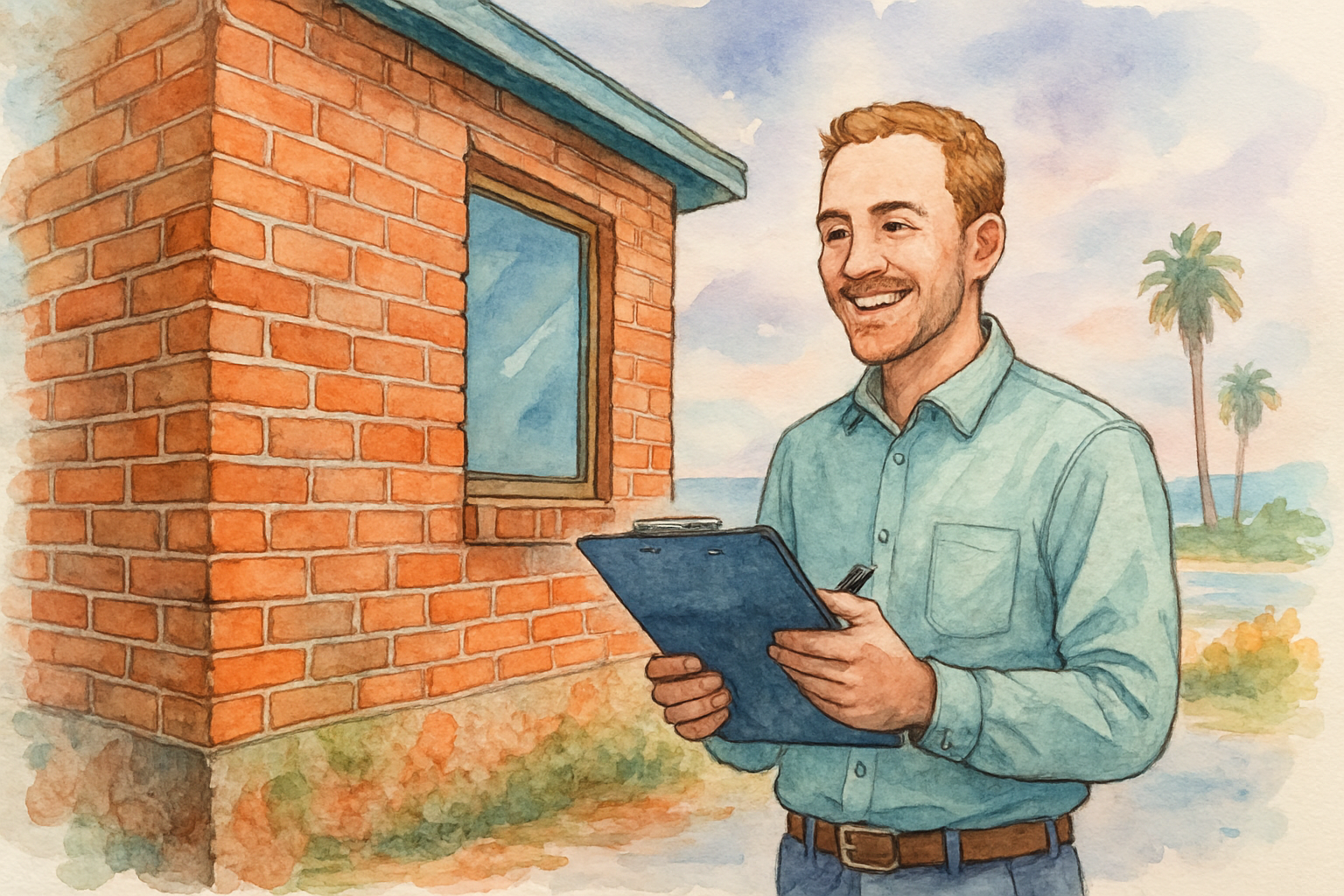
The mistake isn’t just ignoring cracks. It’s skipping periodic professional assessment entirely. Most commercial owners only call a mason when something is visibly broken or a tenant complains. But a licensed C-29 masonry contractor can identify problems that don’t have obvious surface signs — compromised lintels above window openings, failed wall ties in stone veneer facades, or block walls with drainage issues that are slowly building hydrostatic pressure.
For buildings that fall under Monterey’s URM program or that have any exterior masonry above occupied space, a professional walk-through every 3 to 5 years is reasonable risk management. An assessment visit from a licensed contractor typically costs $150 to $400 — far less than the liability exposure from a facade failure or a tenant injury claim.
The Real Cost of Deferred Masonry Maintenance
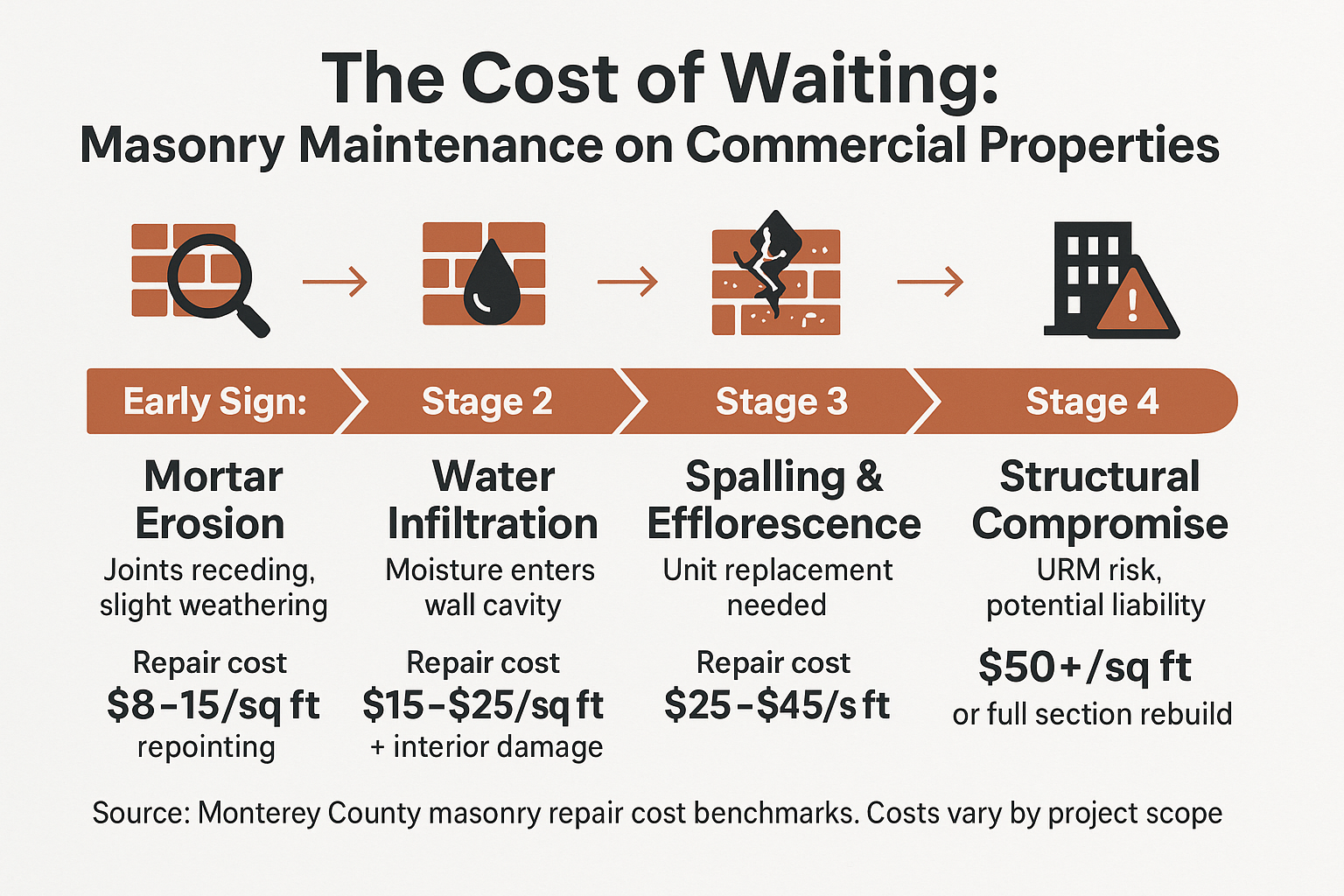
This infographic shows how the same masonry problem grows in cost and complexity when repairs are delayed at each stage.
Hiring Outside the C-29 License Classification
This one costs property owners money in a different way — not through repair costs, but through liability, permit problems, and work that fails to meet California code.
California’s CSLB (Contractors State License Board) requires masonry work to be performed by a contractor holding a C-29 masonry classification or a General B license covering the full scope of work. A lot of handyman services, unlicensed general laborers, and even some landscape contractors take on masonry repair or facade work without the right credential. The problem isn’t just legal — it’s practical. Masonry has specific requirements around mortar mix ratios, joint depth, substrate preparation, and in seismic zones, reinforcement detailing. Someone without formal masonry training guesses at these things.
For commercial property owners, the stakes are higher than for a homeowner. If work is performed by an unlicensed contractor and something fails — a veneer section, a retaining wall, a parapet — your insurance carrier will ask who did the work. An unlicensed contractor creates a coverage gap that can be difficult or impossible to close after the fact.
You can verify any contractor’s license status directly through the CSLB’s license check tool. Look for an active license, confirm the C-29 classification or a B license with verified masonry scope, and check that the bond and insurance are current. This takes about two minutes and eliminates a significant category of risk.
For larger projects — structural repairs, facade work above occupied areas, or anything requiring a permit — also confirm that the contractor is pulling permits in their own name. A contractor who suggests the owner pull the permit to save money is a contractor who doesn’t want their work inspected.
Common Commercial Masonry Problems: What They Signal and What They Cost
These are the issues Monterey County commercial property owners most commonly defer — with a realistic sense of what early vs. late repair looks like in cost.
| Problem | Early Repair Cost (Caught Promptly) | Deferred Repair Cost (Water/Damage Involved) |
|---|---|---|
| Mortar joint deterioration (repointing) | $8–$15/sq ft | $20–$35/sq ft + interior remediation |
| Single cracked masonry unit | $150–$400 per unit | $600–$1,500+ if water has entered wall cavity |
| Efflorescence and surface staining | $300–$800 for treatment | $1,500–$4,000+ if source isn’t addressed |
| Failing stone or brick veneer ties | $1,200–$3,500 for section reanchoring | $8,000–$20,000+ for full veneer removal and reinstallation |
| Retaining wall drainage failure | $800–$2,500 for drain repair | $15,000–$40,000+ for wall reconstruction |
What a Legitimate Maintenance Plan Actually Looks Like
Most commercial masonry doesn’t need constant attention — it needs the right attention at the right intervals. The properties that avoid expensive surprises are the ones with a simple, documented maintenance approach.
A practical framework for a commercial building with exterior masonry:
- Annual visual inspection by property staff — look for new cracks, joint erosion, staining, or any signs of movement at control joints
- Professional masonry assessment every 3–5 years — a licensed C-29 contractor walks the property and documents anything that needs attention, with photos
- Repointing as needed, typically in sections before deterioration reaches the wall cavity
- Drainage check after major rain events — especially for any retaining walls or below-grade masonry. Warning signs that a retaining wall is under stress are worth understanding before the rainy season, not after
- Permit compliance review when any repair triggers a threshold — California’s 2025 Title 24 building standards (effective January 1, 2026) include updated requirements for permitted masonry work that affect how certain repairs must be documented and inspected
This isn’t a complicated system. The goal is catching problems at Stage 1 or Stage 2 in the cost progression shown above — not eliminating problems entirely, because no masonry on the Monterey coast stays perfect forever.
Frequently Asked Questions About Commercial Masonry Maintenance
How often does commercial masonry actually need professional inspection in Monterey County?
Every 3 to 5 years is a reasonable standard for most commercial buildings with exterior masonry. Buildings near the water — anywhere from Pacific Grove to Moss Landing — may benefit from more frequent attention because salt air accelerates mortar deterioration faster than inland locations. If your building is older than 1979 and has unreinforced brick or block walls, a professional assessment should happen sooner rather than later given Monterey’s seismic risk profile.
Does repointing always require a permit?
Not always, but it depends on the jurisdiction and the scope of work. Routine repointing of mortar joints on a facade is often treated as maintenance and doesn’t trigger a permit. But if the work involves structural elements, affects fire-rated assemblies, or exceeds certain thresholds in square footage, a permit may be required. Requirements vary between the City of Monterey, City of Salinas, and unincorporated Monterey County. A licensed contractor pulling your permit handles this question — it’s part of what you’re paying for.
What does URM mean and does it affect my building?
URM stands for unreinforced masonry — brick, block, or stone construction that doesn’t have steel reinforcement embedded in the wall. Buildings constructed before the mid-1970s are most likely to have URM elements. The City of Monterey has a hazard-reduction program that may require URM building owners to take specific steps. If you’re not sure whether your building qualifies, a structural engineer or a C-29 licensed masonry contractor can give you an informed starting point, though formal URM compliance decisions typically require a structural engineer of record.
Can I verify that a masonry contractor is actually licensed before I hire them?
Yes, and it takes about two minutes. The CSLB maintains a public license verification tool at cslb.ca.gov. Search by license number or business name, confirm the license is active, and check that the classification covers masonry — that’s the C-29 classification for specialty masonry work. Also confirm the bond and workers’ comp insurance are current. Any contractor who makes this difficult or discourages you from checking should be a red flag.
Is efflorescence on a brick wall a structural problem or just cosmetic?
Efflorescence itself is cosmetic — it’s just mineral salt deposits left behind as water moves through masonry and evaporates on the surface. But what causes efflorescence is worth investigating. It means water is moving through your wall. If the source is a failed mortar joint, a cracked unit, or poor drainage at the base, those underlying issues are what matter. Cleaning the staining without addressing the water source is a temporary fix.
What’s the risk of hiring a general handyman for masonry repair on a commercial building?
The risk is real and specific. If the work requires a licensed contractor under California law and something fails, your insurance carrier may deny the claim on the grounds that unlicensed work was performed. Beyond the insurance angle, masonry in a seismic zone has specific detailing requirements — mortar mix ratios, joint depth, reinforcement where required — that someone without masonry training typically doesn’t know. The cost difference between a licensed mason and an unlicensed handyman often disappears quickly when the handyman’s work needs to be redone.
Have a Commercial Property With Masonry You Haven’t Looked at in a While?
Stonecap Masonry Inc. works with commercial property owners and managers across Monterey County — from Salinas to Carmel — on everything from facade repointing to structural masonry assessment. If you’ve got a building with exterior masonry, aging block walls, or a retaining wall that’s been on your list, it’s worth a conversation with a licensed C-29 contractor before the next rainy season. Reach out at 831-262-0442 or visit stonecapmasonry.com to request a site visit.
