
Direct Answer: Cosmetic damage affects appearance only and won’t compromise your structure. Structural failure threatens the stability of the wall, foundation, or building itself and needs a licensed mason to evaluate immediately.
Most homeowners on the Monterey Peninsula notice a crack in their stonework, their chimney, or their retaining wall and immediately wonder if they’re looking at a serious problem — or something that can wait. That question matters more here than in a lot of places. Monterey County sits in a seismically active zone, and the coastal climate cycles between salt air, moisture, and heat in ways that put real stress on masonry over time.
But not every crack is a warning sign, and not every blemish means the wall is failing. The challenge is knowing the difference — because getting it wrong in either direction costs money. Miss a structural problem and it gets worse, often much worse. Panic over a cosmetic issue and you might spend $800 to $2,000 on repairs that weren’t urgent.
This article breaks down what actually separates surface-level damage from genuine structural concern, what to look for before you call anyone, and when you need a licensed mason on site — not a handyman.
What Cosmetic Damage Actually Looks Like
Cosmetic damage is real damage — it’s just damage that affects the surface of the masonry rather than its ability to hold load or stay in place. Left alone long enough, some cosmetic problems can become structural ones, but that process usually takes years, not weeks.
The most common cosmetic issues a mason sees in Monterey County properties include:
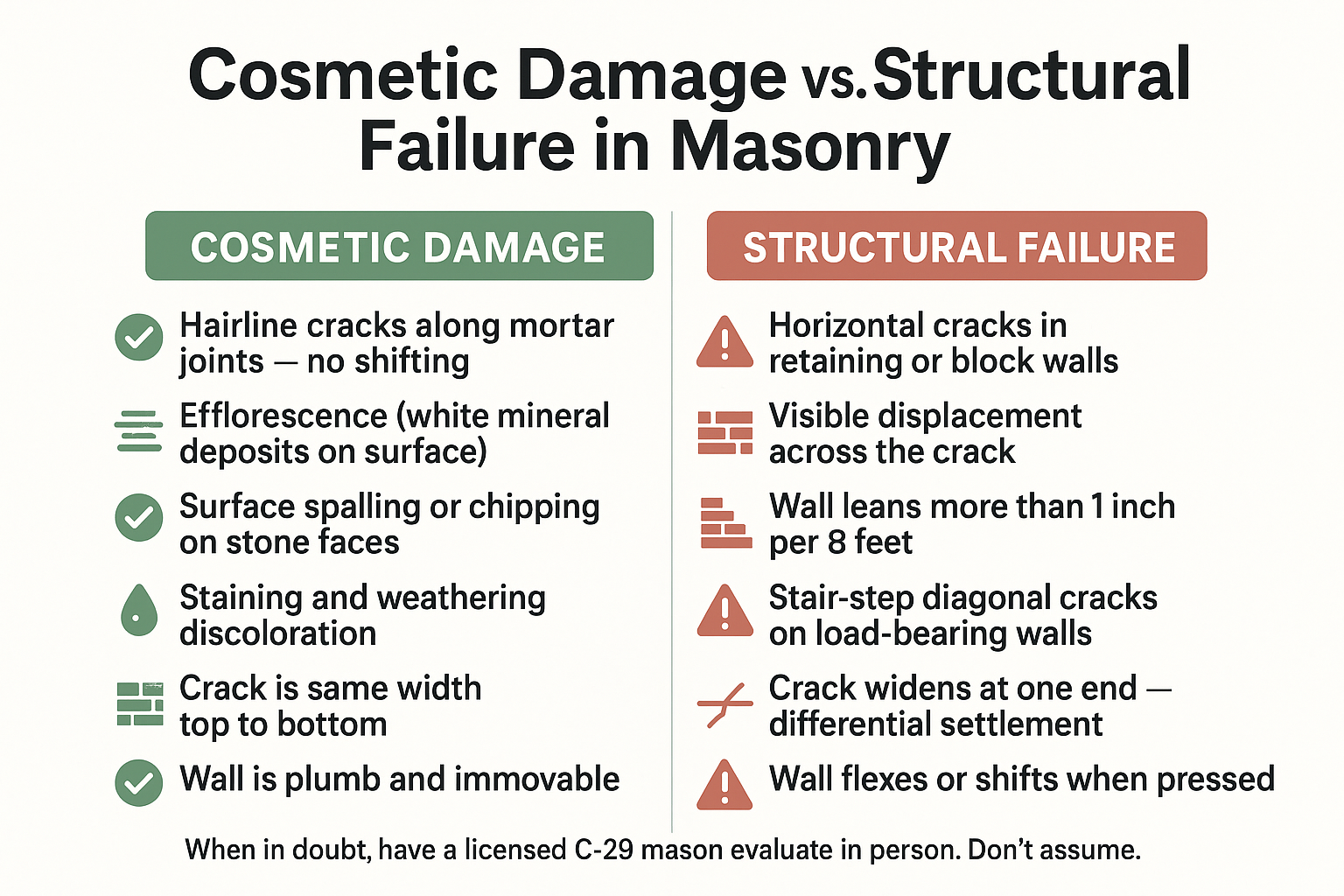
- Efflorescence — the white chalky deposits that appear when water moves through masonry and deposits mineral salts on the surface. Common on older brick and block in Pacific Grove and Carmel Valley homes. Ugly, but not dangerous.
- Hairline cracks in mortar joints — thin surface cracks that follow the mortar line and show no displacement between the stones or bricks on either side. These often develop from normal thermal expansion.
- Spalling on stone faces — when the surface layer of a stone chips or flakes, usually from freeze-thaw cycling or salt air exposure. The stone is weakened cosmetically but the wall itself isn’t moving.
- Staining and weathering — discoloration from water runoff, organic growth, or oxidation on metal hardware embedded in the masonry.
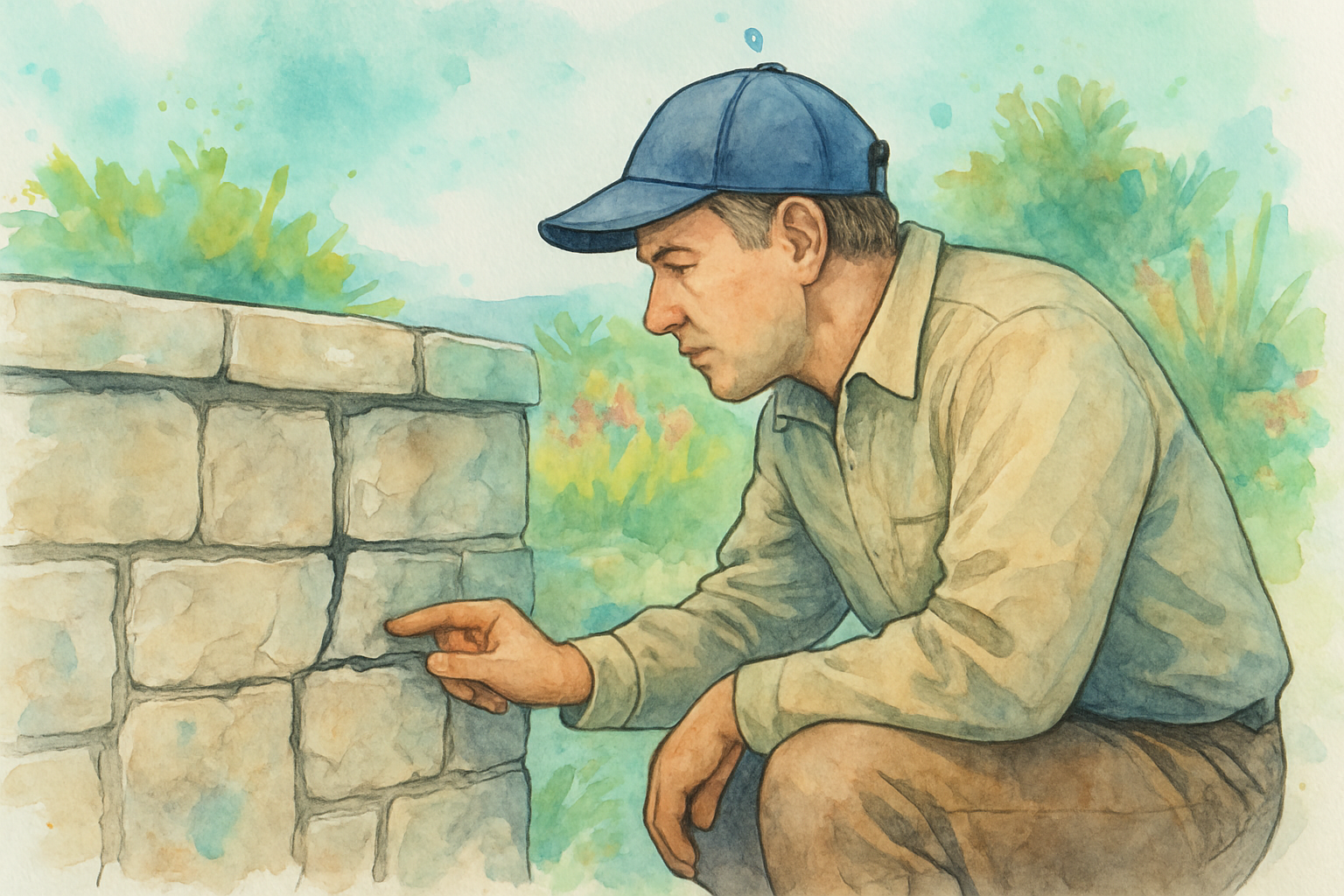
The key test for any of these: put your hand flat on both sides of the crack or damage and press. If nothing moves, nothing shifts, and the wall feels completely solid, you’re likely looking at a cosmetic issue. A masonry crack assessment starts with exactly that kind of hands-on evaluation.
The Signs That Point Toward Structural Failure
Structural failure in masonry means the assembly has lost — or is losing — its ability to perform its job. A retaining wall that’s supposed to hold back a hillside. A chimney that needs to stand plumb under its own weight. A block foundation wall supporting a floor load. When any of those start to move, the problem is no longer cosmetic.
Here’s what to actually look for:
- Horizontal cracks in retaining walls or block walls — this is one of the most serious signs. Horizontal cracking typically means the wall is experiencing lateral pressure it can’t resist. On hillside properties in Carmel Valley and the Salinas foothills, this pattern can develop when drainage behind a wall fails and soil pressure builds.
- Displacement at the crack — if you can see that one side of a crack has shifted relative to the other — even by a quarter inch — the wall is moving. That’s structural.
- Leaning or bowing — hold a level against a wall that you’re concerned about. A wall that’s leaning more than 1 inch out of plumb per 8 feet of height needs immediate evaluation.
- Cracks that are wide at the top and narrow at the bottom (or vice versa) — this pattern often points to differential settlement in the base, which is a foundation-level problem.
- Stair-step cracks following mortar joints diagonally — when these appear on load-bearing walls, they frequently indicate foundation movement or soil shifting beneath the structure.
Moisture is often the silent accelerant here. Because Monterey County’s coastal environment drives repeated wet-dry cycles through masonry, small cracks that admit water get larger every winter. What starts as a cosmetic crack in mortar can open enough over two or three seasons to allow water infiltration, freeze-thaw expansion (yes, even on the Central Coast during cold snaps), and eventually structural displacement.
If you’ve already noticed why patios and walkways sink or crack on your property, the same base and drainage principles that cause slab movement apply to walls and structural masonry.
Cosmetic vs. Structural Damage: A Field Comparison
This comparison covers the key indicators a mason uses to separate surface-level issues from problems that need urgent attention.
Why the Monterey Peninsula Environment Makes This Harder to Judge
One thing that makes masonry damage assessment genuinely more complicated on the Central Coast is that the environment here accelerates aging in ways that don’t always match what a crack looks like on the surface.
Salt air from Monterey Bay is corrosive. It attacks the calcium compounds in mortar, and over ten to fifteen years, it can soften mortar joints to the point where they fail the scratch test — you can drag a key across them and they powder — even though the wall looks fine from ten feet away. A wall with significantly deteriorated mortar can look cosmetically intact while its structural integrity is already compromised. This is why knowing how custom stonework actually holds up comes down heavily to material selection and initial installation quality.
The seismic environment adds another layer. Monterey County sits within the influence of several fault systems, and even minor seismic events — the kind that don’t make the news — can widen existing cracks slightly, shift unreinforced masonry assemblies, and accelerate drainage failures behind retaining walls. A crack that was cosmetic before a 3.5 magnitude event might be structural after it.
For commercial property owners specifically, the City of Monterey has an active URM (unreinforced masonry) hazard-reduction ordinance. If you own an older commercial building with brick or block construction, any cracking — even what looks cosmetic — should be evaluated against your compliance status. This is especially relevant for property managers dealing with facade concerns or post-event inspections.
Damage Type, Urgency Level, and Typical Repair Cost in Monterey County
These cost ranges reflect Central Coast labor and material rates as of 2025. Every project is different — scope, access, and material all affect final numbers.
| Damage Type | Urgency Level | Typical Repair Range |
|---|---|---|
| Efflorescence treatment and surface cleaning | Low — cosmetic only | $300 – $700 |
| Hairline mortar joint repointing (small area) | Low-medium — monitor and repair within 1-2 seasons | $500 – $1,500 |
| Surface spalling repair on stone or brick | Medium — prevents further water infiltration | $600 – $2,000 |
| Horizontal crack in retaining wall | High — evaluate immediately | $2,500 – $8,000+ |
| Leaning or displaced wall section | Urgent — do not delay | $4,000 – $15,000+ |
| Stair-step cracks on load-bearing wall | Urgent — may require engineer review | $3,000 – $12,000+ |
What Happens When Cosmetic Damage Gets Ignored Too Long
This is where the cost conversation gets real. Cosmetic masonry damage doesn’t stay cosmetic forever. The window between a surface problem and a structural one is mostly determined by how much water gets in — and how long it stays there.
A hairline mortar crack that admits moisture will widen through thermal cycling. Water sits in the crack, and when temperatures drop overnight — even to the low 40s that Salinas and Carmel Valley regularly see in winter — it expands slightly. Over two or three wet seasons, a 1mm crack becomes a 4mm gap. Now rainwater is getting behind the stone facing. Now the stone is moving.
The repair cost difference is significant. Repointing a section of deteriorated mortar joints on a stone wall might run $800 to $1,500 for a modest-sized repair handled before any displacement occurs. That same wall section, once stones have shifted and the base has been compromised by water infiltration, might require partial reconstruction at $4,000 to $8,000 or more — plus potential drainage work behind it.
That math is why masons consistently advise periodic walkthroughs rather than waiting for obvious problems. On the Monterey Peninsula, late fall before the rainy season is the best time to assess your masonry — stone walls, chimney crowns, patio edging, and any retaining walls on sloped properties. If you’re unsure what you’re looking at when you do that walkthrough, understanding how to evaluate a masonry crack before you call anyone gives you a real framework for that conversation.
For homeowners who’ve already had poor experiences with a previous contractor, it’s also worth understanding why two quotes for the same project can be wildly different — especially when one contractor is proposing cosmetic-only repair on damage that actually needs structural attention.
Frequently Asked Questions About Masonry Damage Assessment
Can I patch a crack myself and call it done?
For purely cosmetic surface cracks in mortar — no displacement, wall is solid and plumb — a DIY mortar patch from a hardware store can buy time. But matching the mortar mix to your existing masonry matters more than most people realize. The wrong mortar can be harder than the surrounding material, which forces future cracking to happen in the stone or brick itself rather than the joint. And if there’s any question about whether the crack is structural, don’t patch it yourself. Covering a structural problem makes it harder to evaluate later — and doesn’t stop the underlying movement.
How do I know if my retaining wall is actually leaning or if I’m imagining it?
Hold a 4-foot level flat against the face of the wall. If the bubble is off by more than 1 inch out of plumb over an 8-foot section, the lean is real. You can also drive a stake straight into the ground right at the base of the wall and measure the gap between the stake and the wall face at the top. Any visible gap that wasn’t there before is a sign the wall is moving outward. Either finding warrants a professional look — not because the wall is necessarily failing right now, but because catching outward movement early is the difference between a repair and a rebuild.
Do I need a permit to repair a cracked retaining wall in Monterey County?
It depends on the scope. Repointing mortar joints or patching surface damage typically doesn’t require a permit. But if the repair involves rebuilding a section of wall, adding drainage infrastructure behind the wall, or the wall is over 4 feet tall measured from the base of the footing, a building permit is usually required in Monterey County jurisdictions. The California 2025 Title 24 standards (effective January 1, 2026) also govern how permitted masonry work is designed and inspected. Requirements vary by city — Salinas, Carmel, and Pacific Grove each have their own planning departments. Always check with the local jurisdiction before starting any work you think might be in the gray zone.
Is stair-step cracking always a structural problem?
Not always, but it warrants closer attention than a straight vertical crack in mortar. Stair-step cracking follows the mortar joints diagonally and can result from minor differential settlement that stabilized years ago — in which case the crack may be inactive and cosmetic. But if the crack is still growing, if there’s displacement at the crack face, or if it appears on a load-bearing wall, it should be assessed by a licensed mason. An inactive stair-step crack on a garden wall is very different from a fresh one on a chimney or a structural block wall.
How do I verify that a masonry contractor in California is actually licensed to do this work?
Go directly to the CSLB’s official license check tool at cslb.ca.gov and search by license number or contractor name. A legitimate C-29 licensed mason will have an active license, and the classification, bond, and insurance status will all be visible. Never rely on a contractor’s word or a photocopy of a license card alone. The C-29 classification specifically covers masonry work — general contractor licenses (B classification) cover masonry only in limited circumstances. If you’re hiring someone to assess or repair structural masonry, the C-29 credential is the one that matters.
Not Sure What You’re Looking At?
If you’ve got a crack, a leaning wall, or masonry damage you can’t quite categorize, Stonecap Masonry Inc. offers on-site evaluations across the Monterey Peninsula — Salinas, Carmel, Pacific Grove, Carmel Valley, and Pebble Beach. Cande and the Stonecap team hold a CSLB C-29 license (#1073620) and have assessed masonry in this coastal environment long enough to give you a straight answer, not a sales pitch. Reach out at 831-262-0442 or visit stonecapmasonry.com to get the conversation started.
