
Direct Answer: A masonry crack needs repair if it’s wider than 1/4 inch, growing over time, letting in water, or located in a load-bearing wall. Cosmetic hairline cracks can often wait.
You notice a crack in your retaining wall, chimney, or patio steps and immediately wonder if you’re looking at a $200 fix or a $12,000 problem. That gap in your knowledge is exactly what some contractors exploit — and what leaves other homeowners ignoring damage that quietly gets worse every winter.
On the Monterey Peninsula, masonry takes a harder beating than most homeowners realize. The salt air off Monterey Bay accelerates mortar deterioration, the moisture cycling between wet winters and dry summers widens cracks year after year, and Monterey County’s seismic risk means some structural cracks carry real safety stakes — not just cosmetic ones.
This guide explains the difference between cracks you can monitor and cracks that need a licensed mason’s attention now. It won’t cover every possible scenario, but it will walk you through the two things that matter most: what the crack looks like, and where it sits in your structure.
What the Crack Looks Like: Size, Shape, and Pattern
The first thing to look at is width. A hairline crack — thinner than a credit card edge, roughly 1/16 inch or less — is almost always cosmetic in brick or stone veneer. These form during normal settling and temperature movement. They’re common on Carmel Valley homes that see bigger temperature swings than properties closer to the coast.
Once a crack reaches 1/4 inch wide, it crosses into territory that needs professional evaluation. At that width, water gets in. Water expands during freeze-thaw cycles, pushes mortar out, and makes the crack wider every season. What started as a minor gap can double in size within two or three wet winters.
The shape of the crack tells you a lot too:
- Vertical cracks in brick or block walls are often caused by settling or thermal expansion. They’re not always structural, but they need to be measured and monitored.
- Horizontal cracks in retaining walls or foundation walls are the most serious type. They can signal lateral soil pressure pushing the wall inward — a structural problem, not a cosmetic one.
- Stair-step cracks that follow the mortar joints diagonally are common in brick and block. They often mean differential settling underneath the structure.
- Diagonal cracks running from corners of openings — windows, doors, gate posts — usually indicate movement concentrated at that point.
If you’re seeing horizontal cracking in a block retaining wall, treat that as urgent. A wall that’s beginning to bow or lean even slightly is under load stress that gets worse, not better, on its own.
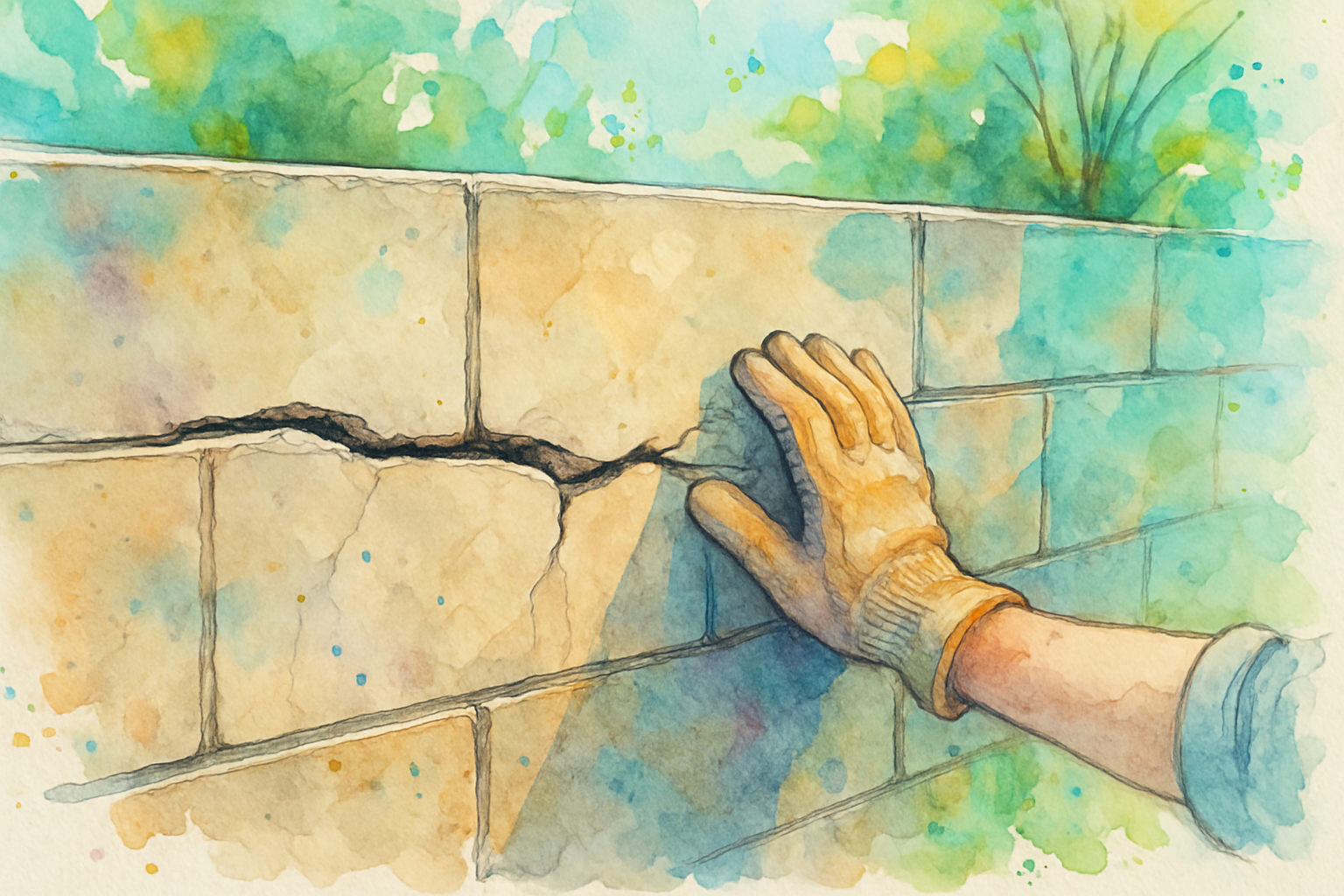
Where the Crack Is Located: Structural vs. Non-Structural Masonry
Location changes everything. The same 1/4-inch crack means something very different depending on whether it’s in a garden planter wall or a load-bearing chimney base.
Non-structural masonry includes:
- Decorative stone veneer on exterior walls
- Freestanding garden walls under 3 feet tall
- Patio surface pavers or flagstone with cracked mortar joints
- Brick facing around a fireplace opening (not the firebox itself)
Cracks in these areas are worth repairing — especially on the coast, where water intrusion accelerates damage — but they rarely carry safety risk. A masonry repair evaluation can confirm whether a patch or full repointing is the right call.
Structural masonry includes:
- Retaining walls holding back any significant grade change
- Chimney stacks and crowns above the roofline
- Foundation walls or basement block walls
- Load-bearing block or brick walls in older commercial buildings
Cracks in structural masonry need evaluation by a licensed C-29 masonry contractor — not a handyman, not a general landscaper. In Monterey County, where older unreinforced masonry (URM) commercial buildings are subject to the City of Monterey’s hazard-reduction code, this distinction has legal weight. If a structural crack is left unaddressed in a URM building and something happens, the liability exposure for the property owner is significant.
For homeowners with chimneys, a crack near the firebox or flue is a fire safety issue. The National Fire Protection Association is clear that cracked flues can allow heat and combustion gases to escape into framing. That’s not a wait-and-see situation.
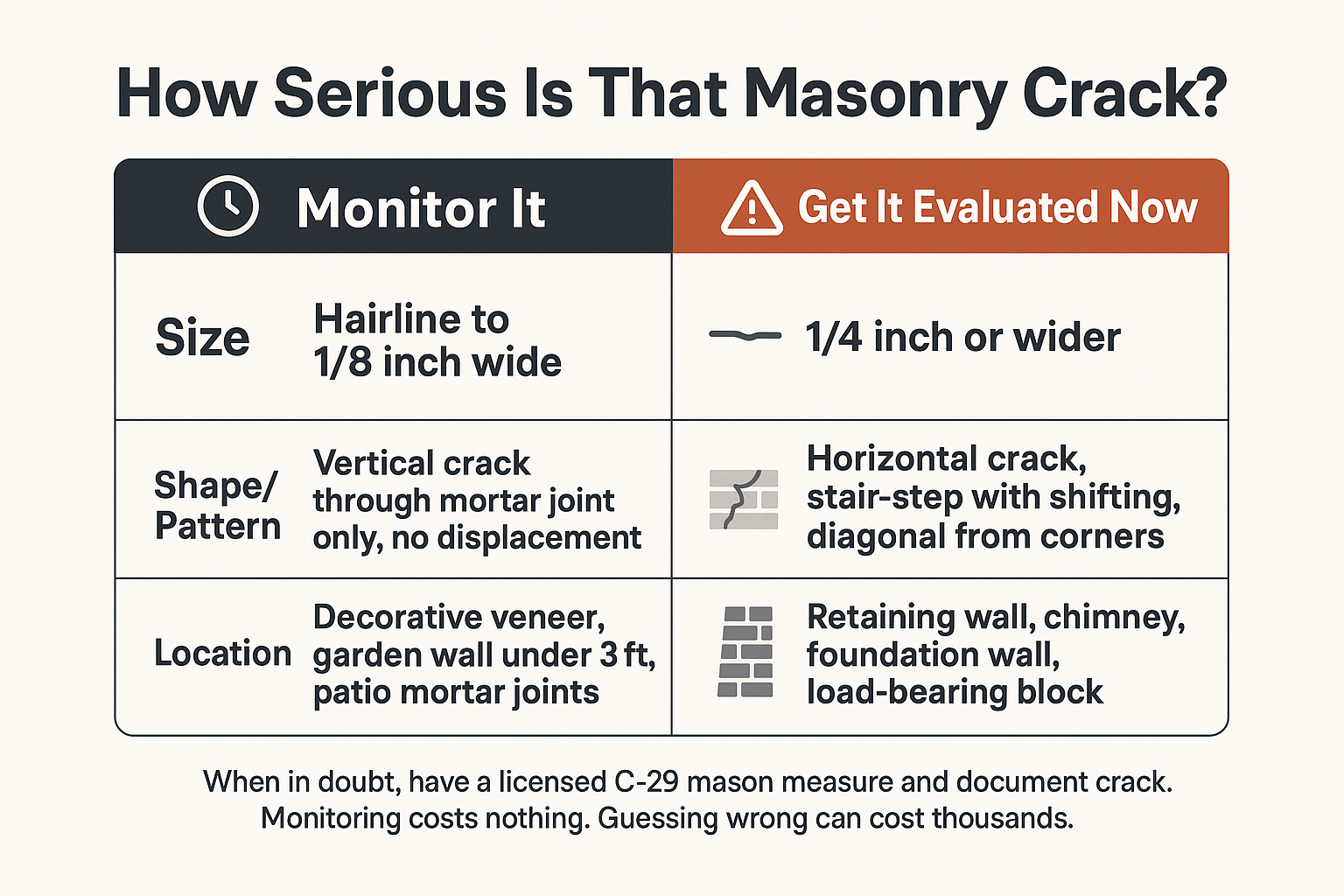
Masonry Crack Severity at a Glance
Use this quick reference to understand how crack characteristics map to urgency level before you call anyone.
The Coastal Factor: Why Monterey Peninsula Cracks Grow Faster
A crack on a Pebble Beach home isn’t the same as a crack on a home in Fresno — even if they look identical. Salt air from the Monterey Bay attacks mortar chemistry differently than dry inland air does. Portland cement-based mortars lose binding strength faster in marine environments, which means a small crack that might stay stable for five years inland can widen noticeably within two seasons here.
Moisture cycling is the other driver. Central Coast winters bring sustained moisture — not the heavy freeze-thaw swings you see in the Sierra — but repeated wet-dry cycles still work water into cracks and push masonry apart over time. A crack that stays wet through January, February, and March, then dries out completely by July, is being stressed every single year.
This is one of the reasons proper material selection for coastal conditions matters so much from the start. When a wall is built with the right mortar type for a salt-air environment, cracks form more slowly and repair more cleanly. When it isn’t, repairs are harder and recurrence is more likely.
Homeowners who have noticed cracks growing season over season should document them with dated photos. That record is genuinely useful — it shows a mason how fast the crack is moving, which helps determine whether the cause is ongoing movement or a settled, stable problem.
Crack Type Quick Reference: What It Usually Means
This table covers the most common masonry crack types homeowners on the Monterey Peninsula ask about. It’s a starting point, not a diagnosis — every structure is different.
| Crack Type | Common Cause | Urgency Level |
|---|---|---|
| Hairline vertical (mortar joint) | Thermal expansion, normal settling | Low — monitor with dated photos |
| Stair-step diagonal (mortar joints) | Differential settling, soil movement | Moderate — get measured within 6 months |
| Horizontal (block or brick wall) | Lateral soil pressure, wall failure | High — evaluate immediately |
| Wide vertical crack (through brick face) | Foundation movement, major settling | High — structural evaluation needed |
| Chimney crown cracking | Weather exposure, age, poor cap detail | Moderate-High — water intrusion risk |
| Patio mortar joint cracking | Base failure, frost, poor prep | Low-Moderate — repoint before water gets in |
When to Stop Monitoring and Make the Call
There’s nothing wrong with watching a crack for a season if it’s small, clearly cosmetic, and in a non-structural area. But there are specific signs that mean the wait-and-see window has closed.
Call a licensed mason when you see any of the following:
- The crack has grown wider or longer since you first noticed it
- There’s visible displacement — one side of the crack is higher or further out than the other
- You can feel air movement through a crack in a chimney or exterior wall
- Water is entering through the crack and showing up on interior surfaces
- A retaining wall is leaning or bowing, even slightly
- The crack is near a fireplace, firebox, or flue
For commercial property owners in Monterey with URM buildings, don’t wait for a crack to progress. The City of Monterey’s URM ordinance exists because unreinforced masonry structures carry documented seismic risk — and deferred maintenance on cracked masonry in those buildings is exactly the kind of thing that shows up in liability assessments.
Verifying that any contractor you hire holds an active CSLB license is a step worth taking before signing anything. California’s Contractors State License Board maintains a public license lookup at www.cslb.ca.gov where you can confirm a contractor’s classification, bond status, and insurance. A C-29 license — the designation covering the full scope of masonry work — is what you’re looking for. You can read more about what to look for when hiring a masonry contractor in California before making any decisions.
Frequently Asked Questions About Masonry Cracks
Can I fill a masonry crack myself with hydraulic cement or caulk from the hardware store?
For a small, clearly cosmetic crack in a non-structural surface — like a garden planter or decorative veneer — a matching mortar repair is sometimes a reasonable temporary fix. But hardware store caulk and hydraulic cement are not the right materials for most masonry joints. They don’t bond the same way, they don’t move with the masonry, and they often make professional repair harder later because the wrong material has to be removed first. If you’re not sure what caused the crack, patching over it without addressing the cause just hides the problem.
How much does masonry crack repair typically cost on the Monterey Peninsula?
Simple repointing of a small area — replacing deteriorated mortar in a chimney crown or a patio joint — might run $300 to $800 depending on access and scope. A retaining wall with structural cracking that needs repair and possible reinforcement can run $3,000 to $15,000 or more, depending on wall height, length, and what’s driving the movement. The wide range reflects how different the underlying causes can be. Two cracks that look similar on the surface can have completely different causes — and completely different price tags.
Do I need a permit to repair a cracked retaining wall in Monterey County?
It depends on the height of the wall and the scope of the repair. In Monterey County, retaining walls over 4 feet in height (measured from the base of the footing) typically require a permit for construction or major repair. Cosmetic repointing usually doesn’t trigger a permit requirement, but any repair that involves modifying the structure itself — adding reinforcement, replacing sections, changing drainage — is more likely to require one. Permit requirements also vary between incorporated cities and unincorporated county areas, so the rules in Salinas may differ from those in Carmel or Pacific Grove. A licensed contractor can tell you what applies to your specific project.
My chimney has a crack near the top. Is that a fire hazard?
It can be. Cracks in the chimney crown (the concrete cap at the top) primarily allow water in, which accelerates deterioration but isn’t an immediate fire risk. Cracks in the flue liner or firebox are a different matter — those can allow heat and combustion gases to reach wood framing, which is a documented fire hazard. If the crack is near or inside the firebox, or if you haven’t had the flue inspected recently, get a qualified mason to look at it before you use the fireplace again.
How do I monitor a crack to see if it’s growing?
The simplest method is to mark both ends of the crack with a pencil line and note the date. Photograph it next to a ruler or tape measure so you have a size reference. Check it again after the first major rain and again after a dry stretch in summer. If the width or length changes between those observations, the crack is active — meaning something is still moving — and that changes how urgent the repair is.
Does a stair-step crack always mean my foundation is failing?
Not always. Stair-step cracks in brick or block follow the mortar joints because mortar is the weakest point — that’s normal masonry behavior under stress. Minor differential settling is very common, especially in older Salinas and Monterey homes built before modern foundation standards. But a stair-step crack that’s wider than 1/4 inch, displacing blocks so one side is higher than the other, or growing visibly over time, needs professional evaluation. The crack pattern alone doesn’t tell you the severity — the cause and rate of movement do.
Not Sure What You’re Looking At?
If you’ve got a crack you’re not sure about — on a retaining wall, chimney, patio, or exterior block — Stonecap Masonry Inc. serves homeowners and commercial property owners across the Monterey Peninsula, from Salinas to Carmel Valley and Pacific Grove. Cande and the Stonecap team hold CSLB License #1073620 and bring hands-on C-29 masonry experience to every evaluation. You can reach them at 831-262-0442 or request a quote at stonecapmasonry.com.
