Direct Answer: A masonry chimney does three jobs: it pulls combustion gases out, carries several tons of load down to a footing, and shields the flue from weather. All three are code-governed.
Most homeowners I talk with about a fireplace want to talk about the stone. The facing, the mantel height, the color of the hearth. Those matter, but the part of the build that carries the most structural and code weight is the one nobody asks about.
The chimney is not a decorative stack added at the end. It is a reinforced masonry structure that has to sit on its own footing, resist seismic movement, and move hot gas out of your house without spilling smoke back into the room.
In Monterey County, CA, two local factors make that harder than it sounds: active seismic ground, and salt air with constant moisture cycling between coastal fog and dry inland afternoons. Both change how a chimney has to be built and what it is built from.
A Masonry Chimney Is Doing Three Jobs at Once
When people picture a chimney, they picture smoke going up. That is one job out of three, and it is the one that depends on the other two being right.
Here is what a chimney is actually responsible for in masonry fireplace construction:
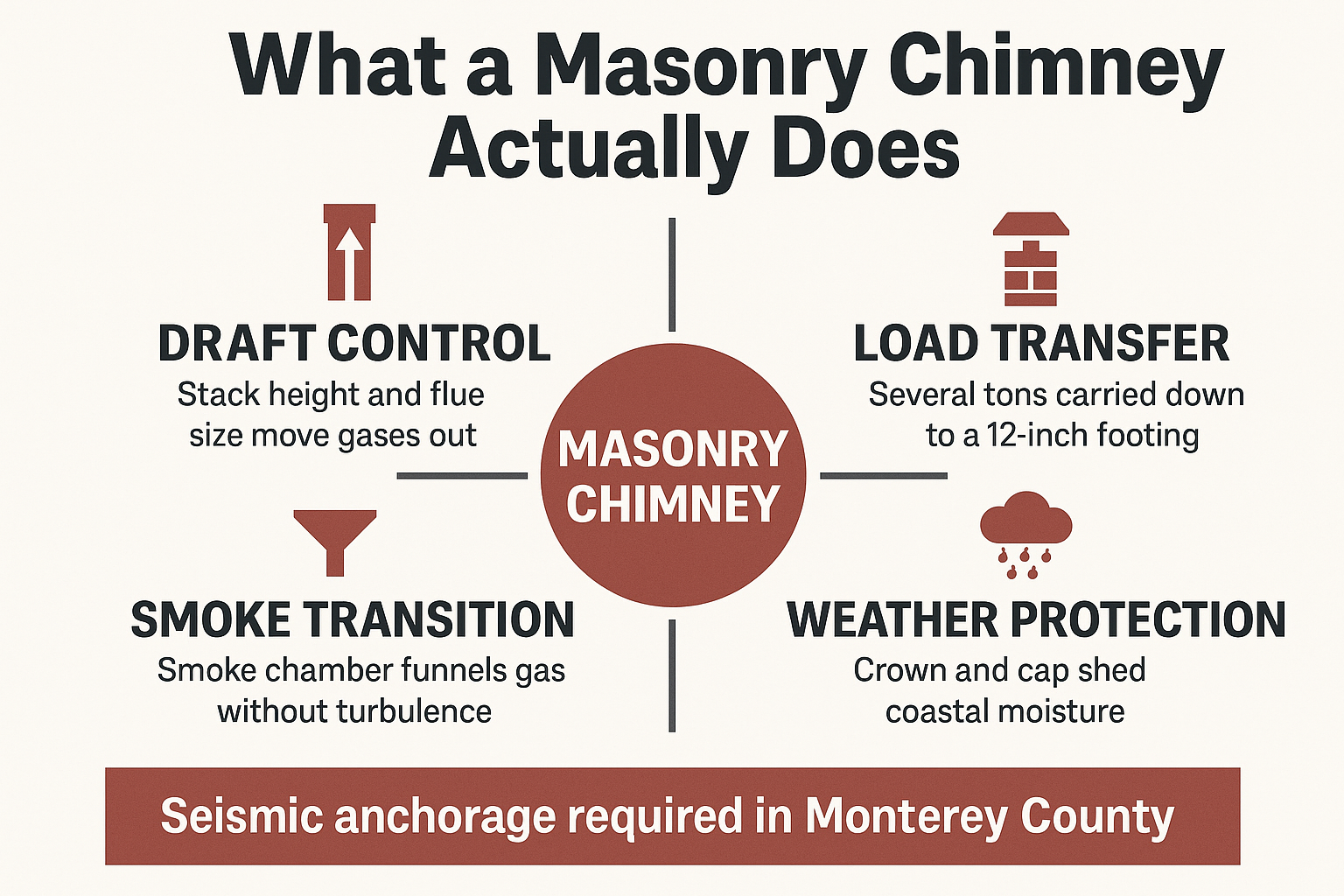
- Draft management. The height of the stack and the size of the flue determine how strongly combustion gases pull out of the firebox. Undersize the flue or cut the height short and you get smoke rolling into the room.
- Structural load transfer. A full masonry chimney can weigh several tons. That weight has to travel straight down through the stack into a footing sized to hold it on undisturbed soil.
- Gas transition. The smoke chamber is the sloped section between the top of the firebox opening and the bottom of the flue. Its job is to funnel gases upward smoothly, without turbulence.
That third one is where I see the most quiet failures. A smoke chamber built with rough, uneven corbeling creates turbulence, the draw suffers, and over years the joints at the transition start to crack from heat and movement.
These three jobs are not interchangeable design choices. If you want the sequence of how the whole assembly comes together, I walked through it in how a masonry fireplace actually gets built, from footing to firebox.
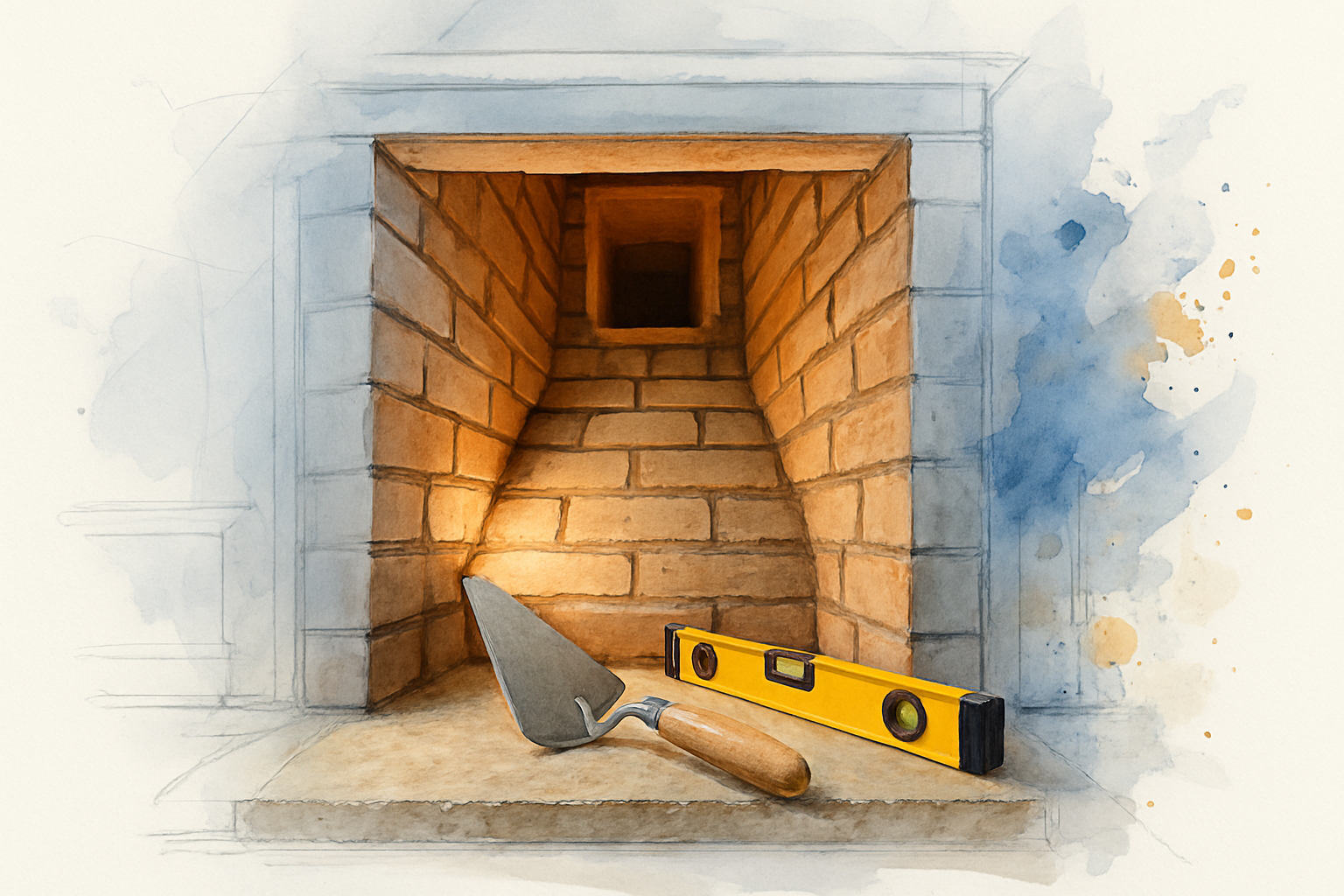
The Chimney Starts at the Footing, Not the Roofline
This is the single biggest misread I run into. Homeowners think of the chimney as something that begins where the firebox ends. In practice, it begins in the ground.
Under California’s 2025 Title 24 building standards, effective January 1, 2026, a masonry fireplace and its chimney have to sit on a footing of concrete or solid masonry that is at least 12 inches thick, extending at least 6 inches past the face of the fireplace or support wall on all sides, and bearing on undisturbed earth or engineered fill.
Read that plainly: the code treats the chimney as a foundation-dependent structure. You cannot build one correctly on a slab that was never designed to carry it.
A few things that changes on real jobs around Salinas and the Peninsula:
- Soil matters. Fill soil, old landscape backfill, or a slope near a retaining wall may need excavation down to competent ground.
- Existing slabs rarely qualify. A patio pour is not a fireplace footing, and cutting one open is normal scope on an outdoor build.
- Footing size follows chimney height. A taller stack means more dead load, and the footing has to be sized for it before anyone orders stone.
When a bid looks unusually cheap, the footing is often where the corners got cut. I explained more of that in how a masonry fireplace foundation changes everything.
The Four Jobs a Chimney Has to Handle
A quick visual breakdown of what the chimney above a masonry fireplace is actually responsible for, from the footing up.
Seismic Design Category Is Not Optional Here
Monterey County sits in active seismic territory. Historical records show the county averages roughly 33 earthquakes of magnitude 3 or higher per year, and it has seen at least three magnitude 7 or greater events since 1900.
That exposure puts nearly every property on the Peninsula in one of the higher Seismic Design Categories. California code requires masonry chimneys in Seismic Design Category C, D0, D1, or D2 to be anchored, supported, and reinforced according to the masonry provisions of the building code.
In practice, that means vertical steel running the height of the stack, horizontal ties at set spacing, and anchorage connecting the chimney to the framing at floor and roof levels. None of that is visible once the stone goes on.
I am not trying to alarm anyone. A chimney built to current code in this region is a reinforced structure, and that is the normal, expected standard. The reason it matters to you as a buyer is that reinforcement is invisible in a finished photo and easy to leave out of a low bid.
If you want the load-side reasoning in more detail, the structural decisions inside every masonry fireplace build covers the firebox and framing side of the same conversation.
Crowns and Caps Fail Faster on the Peninsula
Here is a pattern I see repeatedly from Pacific Grove out to Carmel Valley: chimneys where the stone body is fine but the top has come apart.
The crown is the sloped mortar or concrete cap at the very top of the stack that sheds water away from the flue and the masonry below it. On the coast, that surface takes damp fog most mornings and dries out in warmer inland air by afternoon. That daily wet-dry cycling works on mortar far harder than steady inland weather does.
What that means for material decisions at the top courses:
- Crown mix and thickness should be specified for exposure and movement, not just poured flat as a finish detail.
- Overhang and drip edge keep runoff off the face of the stone instead of letting it sheet down the joints.
- A cap or spark arrestor keeps direct rain out of the flue, which slows deterioration inside the liner.
- Sealants and flashing at the roof line need to handle salt exposure, since coastal air is unkind to fasteners and metal.
This is a real part of why masonry on the Monterey Peninsula is a different conversation than the same work inland. Peninsula climate changes the planning on outdoor builds in ways that surprise people who moved here from drier parts of the state.
Chimney Components and What Goes Wrong
A reference for the parts of a chimney most homeowners never think about, and the failure I associate with each one locally.
| Component | What it does | Common failure on the Peninsula |
|---|---|---|
| Footing | Carries the full dead load to undisturbed soil | Undersized or poured on fill, leading to settlement cracks |
| Reinforcing steel and anchorage | Resists seismic movement, ties stack to framing | Left out or under-spaced on unpermitted work |
| Smoke chamber | Transitions gases from firebox to flue | Rough corbeling that causes turbulence and poor draw |
| Flue liner | Contains hot gases, protects surrounding masonry | Sized wrong for the firebox opening, causing smoke spillage |
| Crown | Sheds water away from the top of the stack | Cracking from coastal wet-dry cycling and no drip edge |
| Cap and flashing | Keeps rain and debris out of the flue and roof joint | Corrosion and loose fasteners from salt air exposure |
The Chimney Is Its Own Inspection Checkpoint
One thing homeowners often do not expect: the chimney is inspected separately from the firebox.
The firebox rough inspection happens at one stage. The chimney, its reinforcement, and its anchorage may be signed off at a different point in the build, sometimes more than once as the stack rises. Jurisdictions in Monterey County set their own sequencing.
What that means for your schedule:
- Work stops at each checkpoint until an inspector signs off.
- Covering reinforcement before inspection can mean opening it back up.
- Permit requirements vary by jurisdiction and project type. Carmel, Monterey, Pacific Grove, and unincorporated county areas do not all handle it identically.
Always confirm the specifics with your local building department before work starts. The California Residential Code, Chapter 10, is the governing framework for fireplaces and chimneys, and it is what your inspector is working from.
Several homeowners who reach out to me ask directly for license and insurance confirmation before scheduling a site visit, which I think is exactly the right instinct. Any California contractor’s license can be checked through the CSLB’s official license lookup, and it takes about a minute. For more on where the stops fall, see the inspection points inside a masonry fireplace build.
Frequently Asked Questions About Masonry Chimneys
Why does my fireplace smoke into the room even though the chimney is clear?
Usually it is a draft problem, not a blockage. The flue may be undersized for the firebox opening, the stack may be too short relative to the roof, or the smoke chamber may be built rough enough to cause turbulence. A clean flue with the wrong proportions still draws poorly.
Can I add a masonry chimney to an existing outdoor fireplace slab?
Often not without work below grade. Code calls for a footing at least 12 inches thick extending 6 inches past the structure on all sides, bearing on undisturbed earth or engineered fill. A standard patio slab was not poured for that load, so the honest answer usually involves cutting in a proper footing first.
Does seismic reinforcement really apply to a chimney on my house in Carmel?
Yes. Nearly all of the Monterey Peninsula falls into the higher Seismic Design Categories, and code requires masonry chimneys in those categories to be anchored, supported, and reinforced to the masonry provisions. It is standard practice here, not an upgrade.
How often should a chimney crown be looked at on the coast?
I would look at it once a year, ideally after winter. Coastal fog and dry inland afternoons cycle moisture through that surface constantly, and hairline crown cracks are much cheaper to address before water gets into the top courses.
Do I need a permit just for chimney repair?
It depends on the scope and the jurisdiction. Cosmetic repointing at the top courses is treated differently than rebuilding a stack or altering reinforcement. Permit requirements vary by jurisdiction and project type, so confirm with your local building department before starting.
Thinking through a fireplace or chimney project on the Peninsula?
If you are weighing a new fireplace, a chimney repair, or a stone facing on an existing stack anywhere in Monterey County, CA, it helps to have someone walk the site and look at the footing and the top courses before you decide anything. Stonecap Masonry works throughout Salinas, Carmel, Pebble Beach, Carmel Valley, and Pacific Grove, and questions about scope or code are welcome at 831-262-0442 or stonecapmasonry.com. CSLB License #1073620, and you are always welcome to verify it.
