
Direct Answer: A strong El Niño winter puts masonry under stress through sustained soil saturation, moisture cycling, and drainage failure — retaining walls, mortar joints, and hardscape bases are the first things to show damage.
In June 2026, NOAA officially confirmed that El Niño has formed — and forecasters are putting the odds at 63% that it intensifies to a very strong event, defined as sea surface temperatures running more than 2.0°C above average. For the Monterey Peninsula, that means the subtropical jet stream shifts south and steers Pacific storm systems directly at us. Central Coast meteorologists are already flagging the possibility of atmospheric river events arriving earlier than usual this fall, with the heaviest rainfall window expected between November 2026 and February 2027.
The last time forecasters talked like this, they were pointing at 1997–98 — a winter when parts of the Central Coast that normally see 14 to 24 inches of rain annually ended up with double that, compressed into a few brutal storm months. I’ve talked to homeowners who still reference that winter when describing damage they found afterward: retaining wall footings that shifted, patio stones that heaved, mortar that crumbled out of joints they hadn’t looked at in years.
This article isn’t meant to alarm anyone. But if you own a property on the Monterey Peninsula with stone or block masonry, a retaining wall, or a hardscape patio on a sloped lot, right now is the time to think about what a sustained high-rainfall season actually does to those structures — and what’s worth looking at before the first storm arrives.
What Saturated Soil Does to a Retaining Wall
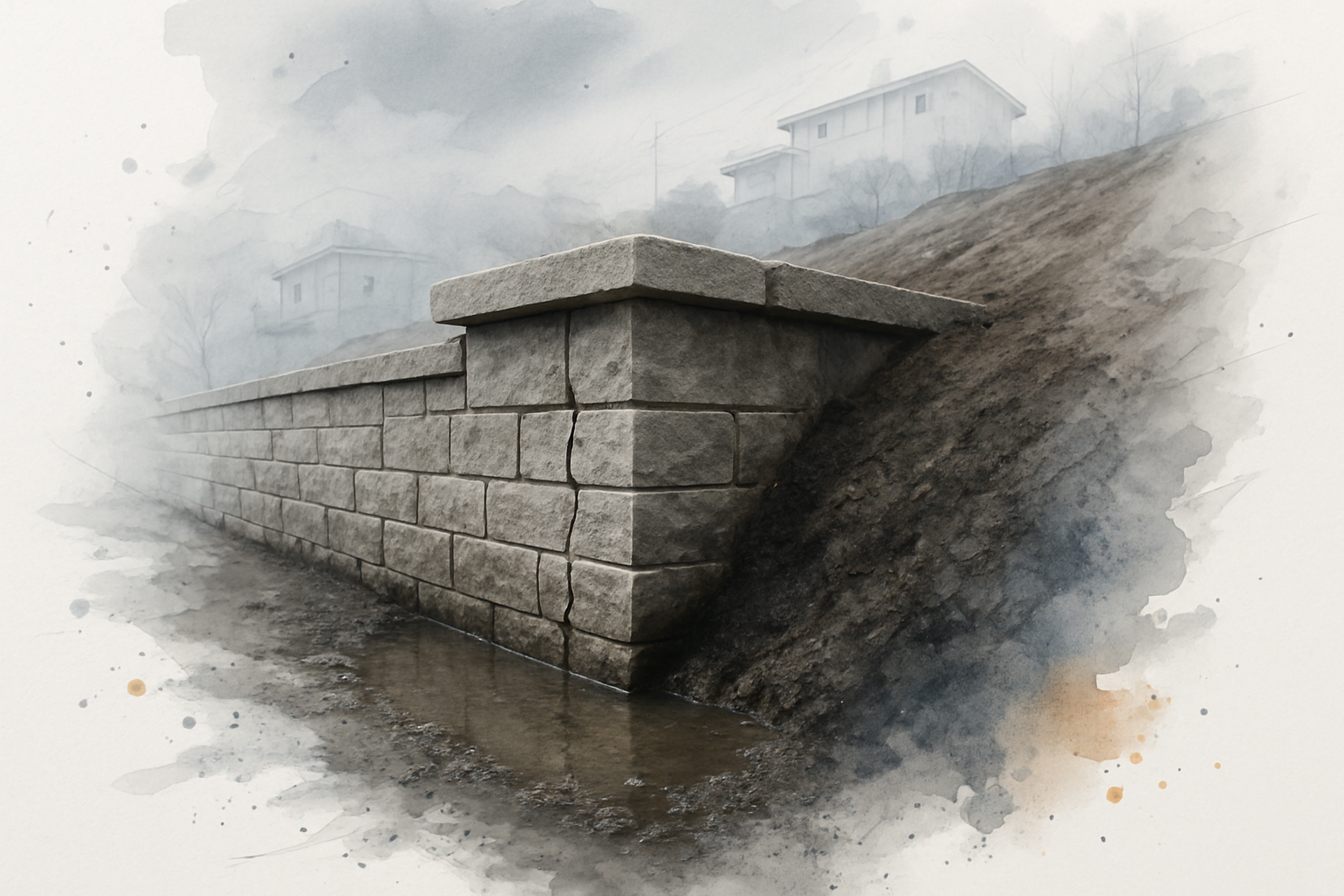
Most retaining walls on the Monterey Peninsula were built to handle normal wet seasons. A few weeks of rain, some drainage through the gravel backfill, and the wall dries out between storms. A strong El Niño winter doesn’t work that way. The soil behind a wall can stay saturated for weeks at a time — and that changes the physics entirely.
When soil is saturated, the lateral pressure it exerts on a wall increases significantly compared to dry or moist soil. A block wall that has held up fine for a decade might be facing a different load scenario than it was designed for. I’ve seen this play out on properties in the Carmel Valley corridor and the Salinas foothills, where sloped lots concentrate drainage behind walls in ways that aren’t obvious until there’s a problem.
The warning signs are usually visible before a wall actually moves. When I’m assessing a wall ahead of a wet season, these are the things I look for first:
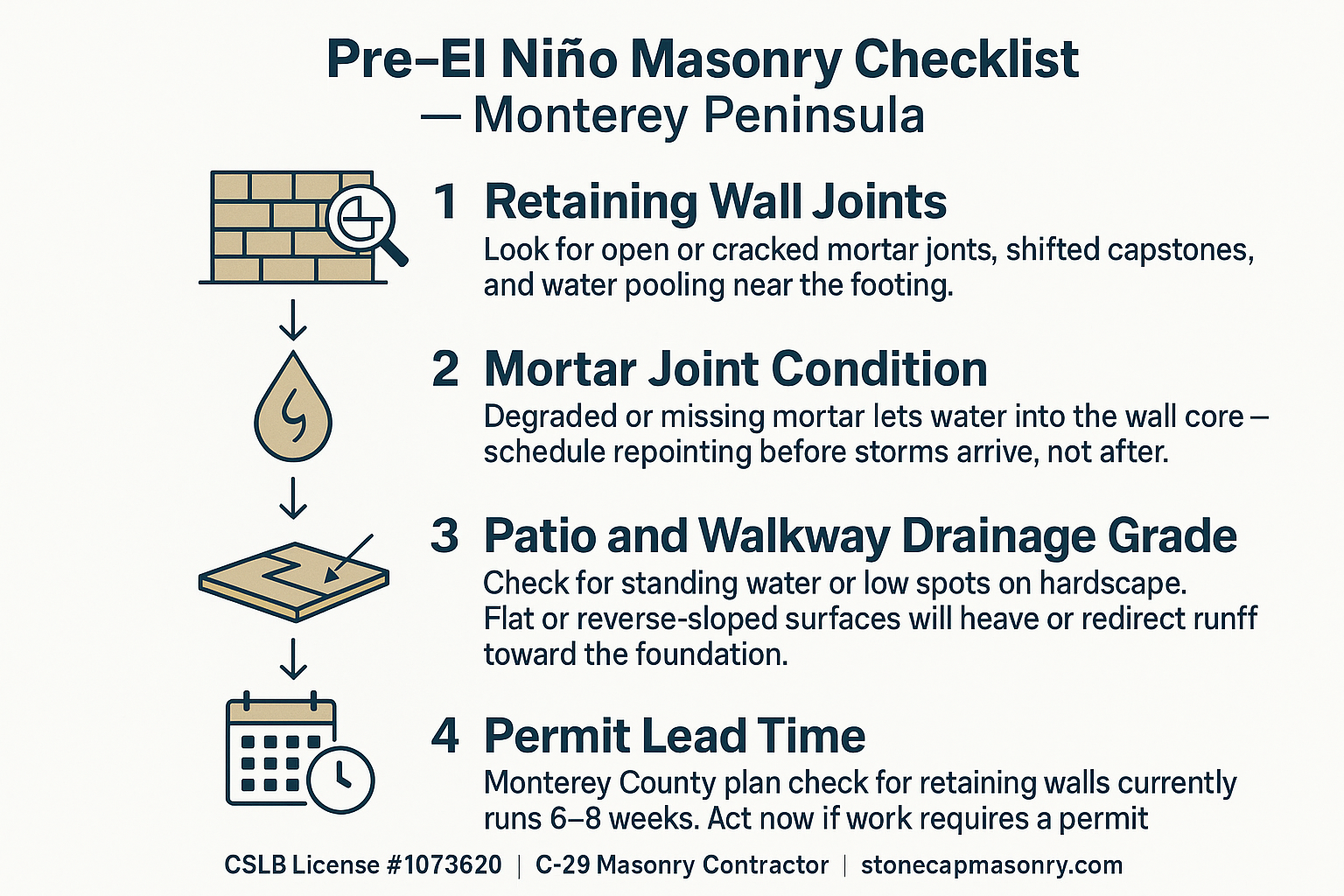
- Standing water pooling near the footing — drainage isn’t working the way it should
- Mortar joints that have opened or widened since the previous winter
- Capstones that have shifted, even slightly — this often signals movement in the courses below
- Horizontal cracking along one or more courses — a classic indicator of lateral pressure buildup
- Bulging or bowing in the wall face — this is further along the stress curve
We recently received an inquiry from a homeowner in Moss Landing whose concrete block wall had been struck by a utility vehicle. The corner column had displaced blocks and a shifted capstone — but what was notable was the homeowner’s instinct to ask us to inspect the surrounding courses for base or footing issues, not just fix the visible damage. That kind of thinking is exactly right. A wall with a compromised base is a wall that a heavy rain season will expose. You can read more about what separates routine wall maintenance from a genuine structural situation in this piece on when a retaining wall needs a contractor, not a handyman.
Mortar Joints: The Part Nobody Checks Until It’s Too Late
Mortar joints are easy to overlook because they don’t look dramatic when they start to fail. A small crack, a bit of crumbling at the surface — homeowners tend to assume it’s cosmetic. But during a high-rainfall winter, degraded mortar joints become direct water pathways into the wall core.
The Monterey Peninsula already puts masonry under moisture stress in a normal year. Salt air off the Monterey Bay, heavy fog cycles, and the constant wet-dry swings we see from October through April are harder on mortar than most people realize. An El Niño winter compounds all of that with sustained rainfall and extended saturation. Once water gets inside a CMU block wall or behind stone veneer, even a mild coastal freeze — and we do get them, especially in Carmel Valley and the Salinas foothills — causes the water to expand. That freeze-thaw cycle accelerates spalling and cracking in ways that can multiply the repair scope quickly.
The fix is repointing — a process that involves removing degraded mortar from the joint to a specific depth (typically ¾ inch or more, depending on the joint condition and wall type) and replacing it with fresh mortar that’s correctly specified for the application. The mortar mix matters: using the wrong type or strength can actually cause more damage by creating a joint that’s harder than the surrounding masonry. Repointing is a pre-storm repair, not a post-storm one. Once water has gotten in and the freeze-thaw cycle has done its work, you’re often looking at stone replacement, not just repointing.
If you’ve noticed cracking in your masonry and aren’t sure whether it’s surface-level or something deeper, this article on whether cracking masonry is a warning sign or normal settling walks through what to look for.
A Pre-Storm Masonry Inspection Checklist
Before the first atmospheric river of the season arrives, these are the four areas worth walking through on any Monterey Peninsula property with masonry or hardscape.
Why Your Patio’s Base Matters More Than Its Surface
One of the most common questions I hear from homeowners goes something like this: I got two quotes for a stone patio — same materials, similar square footage, very different prices. What am I actually paying for? The answer, most of the time, is what’s underneath.
A patio or walkway installed without proper base compaction, a gravel drainage layer, and slope-away grade isn’t just going to look bad after a heavy season — it’s going to direct water toward your foundation. On a sloped lot in Pacific Grove or the hills above Carmel, that’s not a hypothetical. On a properly built patio, you’d typically expect:
- 4 to 6 inches of compacted aggregate base, depending on soil type and load
- A gravel drainage layer beneath the base course to allow water to move through rather than pool
- Slope-away grade of at least 1% to 2% (roughly ⅛ inch per foot) away from any structure
- Correct setting bed depth for the stone or paver type being used
When base depth is cut short or the drainage layer is skipped to reduce cost, the surface may look fine for a season or two. But a wet year — especially one where rain comes in sustained events rather than isolated storms — will find every shortcut. Stones heave. Pavers settle unevenly. And in the worst cases, runoff gets redirected toward the home’s foundation rather than away from it.
The difference between a solid hardscape installation and one that fails early almost always comes down to base preparation. It’s invisible once the job is done — which is exactly why it’s where corners get cut.
What El Niño Stress Looks Like Across Common Masonry Types
Different masonry features on a Monterey Peninsula property face different failure modes in a high-rainfall season. Here’s how to think about each one.
| Masonry Feature | Primary El Niño Risk | What to Look for Before the Season |
|---|---|---|
| Retaining Wall (CMU block or stone) | Lateral pressure from saturated soil; footing undermining | Open mortar joints, shifted capstones, water pooling at base, horizontal cracking |
| Stone or Paver Patio | Base heaving, uneven settling, drainage redirection toward foundation | Low spots holding water, loose or rocking stones, gaps opening at edges |
| Stone Veneer (exterior) | Water infiltration behind facing; freeze-thaw spalling | Cracked or missing mortar joints, efflorescence (white mineral staining), loose stones |
| Outdoor Fire Pit or BBQ Surround | Mortar cracking from thermal cycling compounded by moisture | Joint gaps around the firebox opening, loose capstones, any visible spalling on face stone |
| Walkways and Steps | Setting bed erosion beneath surface; heaving on sloped runs | Rocking or raised individual units, gaps at riser joints, water pooling on treads |
Permit Timing: Why the Window to Act Is Now
If a retaining wall inspection reveals that a wall needs to be rebuilt or significantly repaired, the permit timeline becomes a real scheduling constraint. In Monterey County, a retaining wall permit is required for any wall 4 feet or taller, measured from the bottom of the footing to the top of the wall — or for any wall of any height that supports a surcharge (meaning additional load from a slope above, a structure, or a vehicle path).
Plan check at the County currently runs 6 to 8 weeks by the department’s own estimate. That means a homeowner who discovers a compromised wall in October and submits for permits immediately is looking at permitted construction starting no earlier than late November or December — right in the middle of the projected storm window.
Permit requirements vary by jurisdiction and project type, and the rules in the City of Monterey, Carmel, or Pacific Grove may differ from unincorporated Monterey County. A licensed C-29 masonry contractor can help you understand what your specific project requires. The point isn’t to alarm anyone about bureaucratic timelines — it’s to point out that if you’re planning work that needs a permit, starting the process now is the only realistic path to having it done before the rains arrive.
For anyone navigating the broader question of when a wall repair crosses from a maintenance task into a permitted structural project, the article on warning signs your retaining wall is under more stress than it looks covers the distinction in practical terms.
Frequently Asked Questions About El Niño and Masonry on the Monterey Peninsula
My retaining wall has been fine for years. Do I really need to worry about one wet winter?
A normal wet season and a strong El Niño winter put fundamentally different loads on a wall. The issue isn’t rainfall volume alone — it’s how long the soil behind the wall stays saturated. Dry soil and saturated soil exert very different lateral pressure. A wall that was built with adequate drainage and a sound footing will typically handle it well. But a wall with degraded mortar joints, a shallow or undraining backfill, or a footing that was never properly set is a different story. If your wall hasn’t been looked at since it was installed, a wet year is the right time to have someone check it before the season starts.
What is repointing and how do I know if my masonry needs it?
Repointing means removing deteriorated mortar from existing joints to a set depth — usually at least ¾ inch — and replacing it with fresh mortar that’s correctly specified for the wall type and exposure. You need it when joints are cracking, crumbling, recessed, or visibly open. On the Monterey Peninsula, salt air and moisture cycling degrade mortar faster than in drier inland climates. If you can see gaps in the joint lines or if the mortar surface is soft and powdery when you press it, it’s past due.
Can I inspect my own retaining wall, or do I need a professional?
You can do a basic visual walk-around yourself — looking for open joints, shifted capstones, water pooling at the base, or visible cracking. But the things that actually cause walls to fail are often below grade or inside the wall structure, which isn’t visible from the surface. A licensed C-29 masonry contractor can assess footing condition, drainage performance, and structural integrity in ways a visual scan can’t. For walls on sloped lots or walls that support a surcharge, a professional assessment before a high-rainfall season is worth the time.
How much does masonry repair cost on the Monterey Peninsula before a storm season?
Costs vary a lot depending on the scope — repointing a section of wall is a very different job than rebuilding a corner column or replacing a failed footing. Many Monterey County homeowners find that pre-storm repair estimates are substantially lower than post-storm repair estimates for the same structure, because water infiltration and freeze-thaw cycling tend to expand the damage scope over a season. For a specific number, the right step is to have a licensed contractor look at the actual structure. Stonecap Masonry can be reached at 831-262-0442 or through stonecapmasonry.com to schedule a site visit.
Does an outdoor fire pit or BBQ surround need attention before a wet season?
Yes — mortar around fire features is subject to thermal cycling every time the feature is used, which opens joints over time. When sustained rainfall follows, those open joints become water pathways. Mortar that’s been patched with the wrong mix is especially vulnerable. Before a heavy rain season, check the joints around the firebox opening, look for any loose capstones, and note any spalling on the face stone. A homeowner in Salinas recently reached out about a project that included a fire pit, outdoor BBQ, and paver work — all features that need drainage-aware base construction to hold up through a wet year. You can read more about what goes into building a fire feature correctly in the mason’s guide to building a fire pit.
Where can I verify a masonry contractor’s license before hiring someone for this kind of work?
The California Contractors State License Board maintains a public lookup tool at cslb.ca.gov where you can verify any contractor’s license number, classification, bonding, and insurance status. For masonry work, look for a C-29 classification, which covers the full scope of masonry contracting in California. Stonecap Masonry holds CSLB License #1073620 — verifiable through that same tool.
Ready to Have Your Masonry Assessed Before the Season Starts?
If you have a retaining wall, stone patio, fire feature, or hardscape on a sloped lot anywhere on the Monterey Peninsula, the time to take a look is before the first atmospheric river of the fall — not after. Stonecap Masonry Inc. holds CSLB License #1073620 (C-29, verifiable at cslb.ca.gov) and serves homeowners throughout Salinas, Carmel Valley, Pacific Grove, Pebble Beach, and the surrounding area. To schedule a site visit or request a quote, call 831-262-0442 or visit stonecapmasonry.com.
