Direct Answer: For a coastal patio in Monterey County, denser stone like granite or basalt absorbs less water and stays safer underfoot. Pavers are easier to repair. Absorption and finish matter more than looks.
You are standing in a stone yard holding a dry sample under bright indoor light, and it looks perfect. The problem is that the sample is not going to live there. It is going to live under fog drip in Pacific Grove, salt air off the water in Pebble Beach, or full inland heat in a Salinas backyard two ridges away.
I get asked about flagstone vs pavers for a coastal patio more than almost any other material question. And the honest answer has very little to do with how the stone looks dry in your hand.
What predicts how a patio ages here is water absorption, surface finish, and how the stone was set. This article walks through all three, plus what actually moves the price and how to keep a new patio from reading as an obvious add-on.
Water Absorption Tells You More Than the Color Chart
Every stone takes on some water. The question is how much, and how long it holds it.
On the Peninsula, that matters because we do not get one soaking and then a week of drying. We get marine layer most mornings, cool temperatures, and shaded yards that never fully dry out between events.
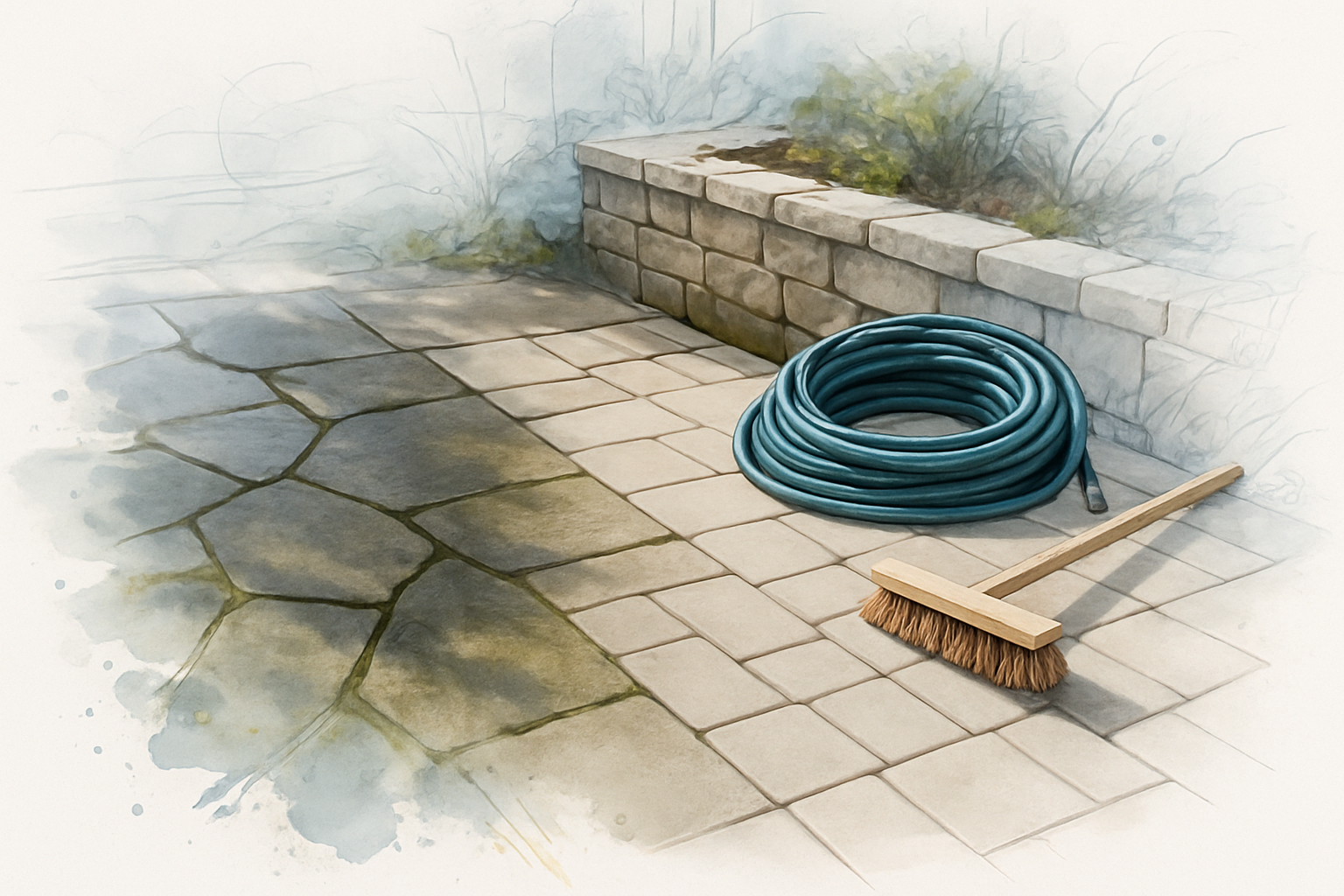
A soft, porous stone in a north-facing yard can stay damp for days. That is exactly where moss, algae, and a slick surface get their start. I have walked patios in Carmel Valley where the sunny half looked new and the shaded half was green and slippery, same stone, same installer, same year.
Here is what I look at before anything else:
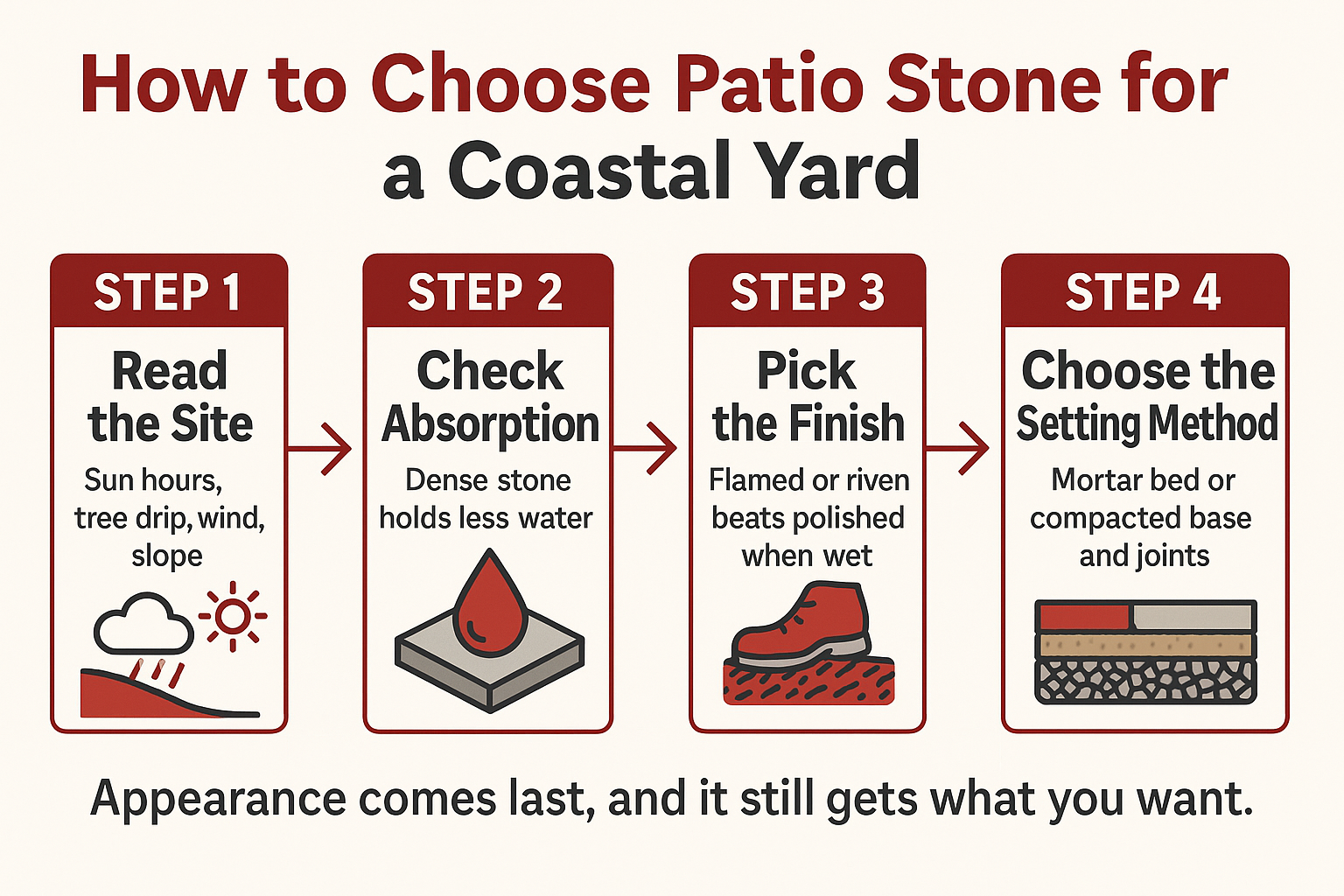
- How much sun the area gets between 10am and 3pm in winter, not summer
- Whether the patio sits under trees that drip long after the fog burns off
- Which way water moves across the surface and where it ends up
- How close the property is to open water and steady salt-laden wind
None of that shows up in a showroom. All of it shows up in year three.
Salt adds another layer. It works into porous material and into joints, and it does not stop. I wrote more about that in how salt air changes the way mortar joints fail on the Peninsula, because the joints usually go before the stone does.
The Stone Families, in Plain Terms
I do not think of stone as good or bad. I think of it as a trade between look, upkeep, and traction. Pick two and you will live with the third.
Denser stone takes on less water and generally needs less babying:
- Granite is about as durable as it gets outdoors, holds color, and shrugs off salt air
- Basalt is dense, dark, and handles moisture well
- Slate sheds water and gives a natural cleft texture, though quality varies a lot by source
More absorptive stone can still work beautifully, but it depends on sealing and a maintenance rhythm:
- Limestone looks warm and soft and stains more easily
- Travertine stays cool underfoot, which people love around pools, but it is porous by nature
- Sandstone varies enormously, some is fine here and some is not
Then there are concrete pavers, which are manufactured to a consistent thickness and absorption rate. They are predictable, and a damaged one lifts out and gets replaced without patching a joint line.
Finish matters as much as species. A polished surface photographs beautifully and turns genuinely slippery once fog settles on it. Flamed, thermal, riven, or bush-hammered finishes give a wet patio real footing.
If there is one thing I push people on, it is this. A patio you are afraid to walk on in January is not a patio you actually own.
How Common Patio Materials Behave in a Marine Climate
This is a general comparison based on what I see holding up around Monterey County, not a ranking. Actual performance depends on the specific quarry, the finish, and the install.
| Material | Behavior in fog and salt air | What it asks of you |
|---|---|---|
| Granite | Low absorption, very stable outdoors | Choose a flamed or thermal finish for traction |
| Basalt | Dense, handles moisture cycling well | Shows water spotting on smooth finishes |
| Slate | Sheds water, natural cleft texture | Quality varies by source, some slates flake |
| Flagstone (sandstone type) | Varies widely, some hold moisture in shade | Sealing and periodic cleaning in shaded areas |
| Limestone | More absorptive, can stain and darken | Regular sealing schedule, watch planter runoff |
| Travertine | Porous, stays cool, popular at pool decks | Sealing and joint maintenance |
| Concrete pavers | Consistent, predictable absorption | Easiest single-unit repair, joint sand upkeep |
The Order I Work Through a Patio Material Decision
Most homeowners start with appearance and back into the practical questions. I run it the other way.
The Setting Method Quietly Decides How It Ages
The same flagstone can go down two completely different ways, and they age nothing alike.
Mortared over a concrete slab gives you a rigid, locked surface. It looks clean and it stays put. But when water finds a way underneath, it has nowhere to go, and joint cracking usually follows. Repairs mean cutting and patching, and the patch is visible if the mortar color is not matched carefully.
Set on compacted base with bedding sand gives you a flexible system. It moves a little with seasonal soil changes instead of cracking. A settled area gets lifted, re-graded, and reset without touching the rest of the patio.
Neither is the right answer everywhere. What decides it is the soil, the slope, the drainage, and what you want the repair path to look like in ten years.
Drainage is where I spend the most time on a Peninsula job:
- Where does surface runoff go once the patio replaces soil or turf
- Is there a slope away from the house of roughly a quarter inch per foot
- Does the base breathe or does it trap water under the stone
- Do the joints let water through, or do they shed all of it to one low corner
A lot of homeowners here are looking at permeable joints and open-graded base for exactly that reason. Between water conservation pressure and runoff sensitivity around the bay, a patio that lets water soak in on site is often the easier plan to live with. I covered that thinking in how Peninsula water rules shape a hardscape plan.
One more reason to get this right before winter. NOAA forecasters have described El Nino conditions with a storm track shifted south, and a wet winter is the real stress test for whatever you picked in the fall.
What Actually Moves the Price (It Is Rarely the Stone Species)
I will not throw dollar figures at you, because ranges swing hard depending on material availability and how a truck gets to your backyard.
But I can tell you what moves the number:
- Thickness of the stone and what that means for base and handling
- Sourcing, meaning how far the material travels and whether it is in stock
- Slab or piece size, since bigger units cost more and need more equipment
- Cut and fabrication work, especially curves, edges, and custom shapes
- Waste, or how much stone gets cut away to reach the finished shape
- Site access, because a wheelbarrow route through a side gate changes labor
One homeowner wrote in asking about a custom outdoor stone base for a sundial. They had found a granite slab they loved, said the color complemented the house, and pointed out correctly that granite holds up outdoors. Their issue was that the slab was too large for what they needed and the price was more than the project justified.
That is the whole lesson in one message. The species was not the cost problem. The size and the fabrication were.
If you want the layer-by-layer version of where money goes on a patio, I broke it down in how a stone patio is priced, from the base up. An exact figure for your property still comes from a walkthrough.
Matching What Is Already There
For repeat remodelers in Carmel, Carmel Valley, and Pebble Beach, this is usually the deciding factor. There is already stone on the house, a pool deck, or a front walkway.
These homeowners are not shopping for the cheapest option. They are trying to avoid a patio that looks bolted on.
Matching is its own skill. It involves stone source, cut pattern, joint width, mortar color, and how the new material will weather compared to stone that has already been sitting in salt air for fifteen years. A perfect match on day one that drifts in tone by year two is not a match.
One Carmel Valley homeowner put it plainly in a review after a pool area project: “Cande demolished it and created a nice sitting area at the pools edge and matched the stone hardscape around the pool perfectly.”
If blending into existing work is your main worry, matching new stone to old goes deeper on what makes a repair or addition disappear into the original.
Frequently Asked Questions About Coastal Patio Stone
Is flagstone or pavers better for a patio near the ocean?
It depends on the flagstone. A dense flagstone with a riven finish does fine near the water, while a soft, absorptive one in a shaded yard will hold moisture and grow algae. Concrete pavers are the more predictable choice because absorption and thickness are consistent, and a damaged unit lifts out and gets replaced without patching.
Do I have to seal a stone patio on the Monterey Peninsula?
Denser stone like granite, basalt, and good slate usually gets by without it. More absorptive material such as limestone, travertine, and many sandstones generally depends on sealing and a repeat schedule to stay looking right, often every couple of years depending on exposure. Ask what the specific stone you picked actually needs before you buy it.
Why does my patio get slippery in winter?
Two reasons, usually. The finish is too smooth for a wet climate, or the area stays damp long enough for algae and moss to take hold in shade. Flamed, thermal, riven, and bush-hammered finishes give far better footing when fog settles.
Do I need a permit for a patio in Monterey County?
It varies by jurisdiction and by project. A ground-level patio is often treated differently than a raised deck, a retaining wall over a certain height, or anything involving gas or drainage changes. Check with your local planning or building department before work starts, since Carmel, Pacific Grove, Monterey, and the county unincorporated areas do not all handle it the same way.
Can the same stone be used for a patio and a seating wall?
Often yes, and it usually looks better that way. The wall cap and the patio field can share a source while using different thicknesses and cuts. There is more on how those two elements are built together in a seating wall project.
Thinking Through a Patio Material Decision?
On our jobs, material review and recommendation is its own step between the quote and site preparation, not something settled at the counter of a stone yard. We are a C-29 masonry contractor working under CSLB License #1073620, and any California contractor’s license can be checked through the CSLB license lookup before you hire anyone. If you are weighing options for a patio in Salinas, Carmel, Pebble Beach, or anywhere on the Monterey Peninsula, Stonecap Masonry can be reached at 831-262-0442 or through stonecapmasonry.com.
