
Direct Answer: Salt from ocean air pulls moisture into mortar joints and keeps them damp, so coastal joints crumble and recede faster than inland ones. The fix is repointing with a correctly matched, breathable mortar.
You run a finger along the mortar between the stones and it comes away chalky. The joints sit deeper than they used to, and small piles of gray grit collect at the base of the wall after a windy week.
Most homeowners chalk that up to age. But if your property sits in Pacific Grove, Carmel, Pebble Beach, or anywhere the marine layer rolls in most mornings, age is not the main driver here. Salt is.
I have repaired walls ten miles inland in the Salinas Valley that look better at forty years old than coastal walls at fifteen. Below I want to explain what salt air actually does inside a mortar joint, why mortar selection matters more than technique on a coastal repair, and why the sealer aisle at the hardware store is usually the wrong answer.
Why Coastal Mortar Joints Never Get a Chance to Dry
Ocean air carries fine salt particles. They land on stone, brick, and block, and they stay there until rain or a hose washes them off. On the Peninsula, that deposit is constant.
Here is the part that catches people off guard: salt is hygroscopic, meaning it pulls moisture out of the air. A wall coated in marine salt will draw dampness on a dry, sunny afternoon in Carmel Valley because the salt itself is doing the work.
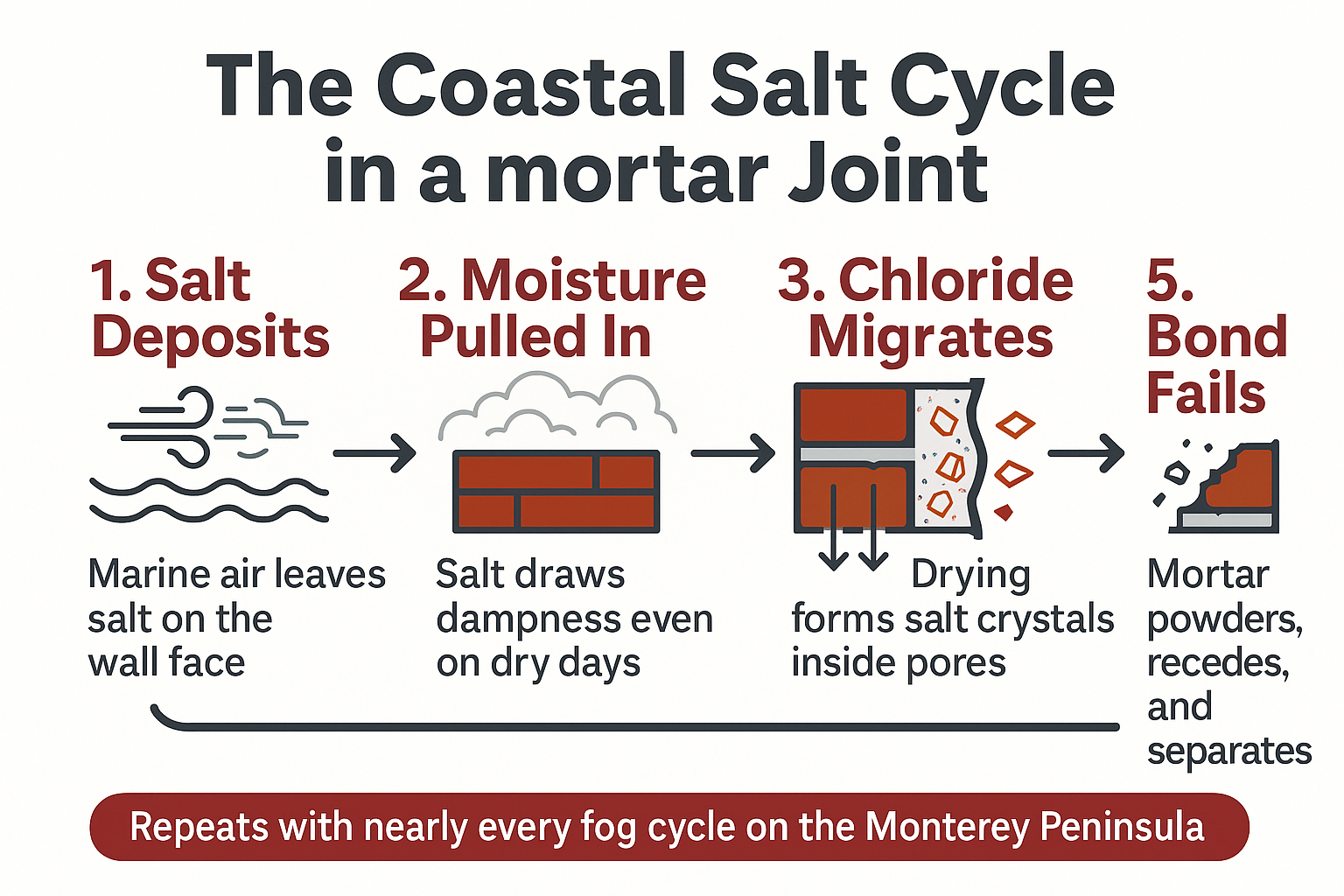
So the wall cycles like this:
- Marine layer wets the surface overnight
- Afternoon sun and wind pull moisture back out
- Salt stays behind and concentrates a little more
- The next fog cycle starts the process again
That happens most days of the year here, not a handful of times per season. Peer-reviewed work on salt weathering found that wind speeds up the damage by driving both erosion and evaporation at the surface, which matches what I see on exposed walls facing the water. You can read the research on salt weathering and wind-driven decay if you want the technical version.
The short version: a wall in Pebble Beach is running through thousands more wet-dry cycles than the same wall built in Gonzales.
What Chloride Does Inside the Joint
The chemical agent behind most of this is chloride from marine aerosols. It rides into the joint with moisture, then stays when the water leaves.
Mortar is porous by design. Each wetting cycle carries chloride a little deeper, and each drying cycle lets salt crystals form and expand inside those pores. That expansion pries the mortar apart from the inside.
What you see on the surface, in order:
- Powdering, where the joint face rubs off like sidewalk chalk
- Recession, where joints sit 1/8 to 1/2 inch behind the stone face
- Loss of bond, where mortar separates cleanly from the stone edge
- Spalling, where flakes of stone or brick face pop off entirely
The damage that matters most is the third one. Once the bond between mortar and stone breaks, water moves freely into the wall core, and now you are dealing with the substrate and not just the joint.
I have looked at walls in Pacific Grove where the deterioration was running roughly two to three times faster than a comparable inland wall of the same age. Same mortar, same mason, different air. If you are not sure whether what you are seeing is cosmetic or structural, this piece on how to tell if a masonry crack actually needs repair walks through the distinction.
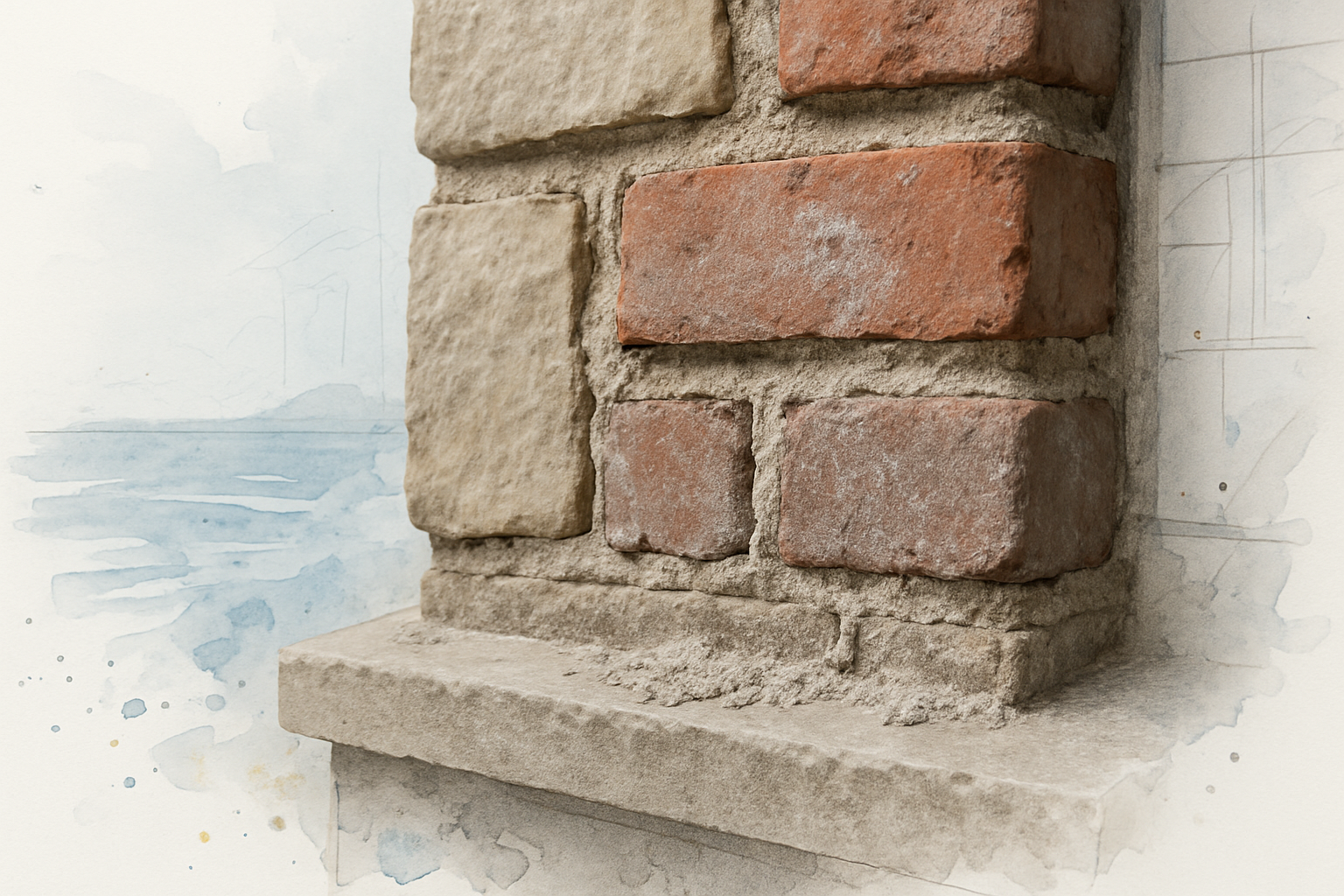
The Salt Cycle That Breaks Down Coastal Joints
This is the loop that repeats on Peninsula masonry almost daily, and why coastal joints age on a different clock.
Repointing Is the Repair, but the Mortar Choice Decides How Long It Lasts
Repointing means cutting out the failed mortar to a set depth and packing in new mortar. Common practice is to remove to roughly two to two and a half times the joint width, so a 1/2 inch joint gets cut back around 1 to 1 1/4 inches, then filled in layers rather than one heavy pass.
That part is standard. The part that separates a repair that holds from one that fails in five years is which mortar goes back in.
Here is the rule I work by: the mortar must always be softer than the stone or brick around it. Mortar is meant to be the sacrificial part of the wall. It takes the movement, the moisture, and the salt so the units do not have to.
When a mason packs a high-portland, high-strength mortar into an older stone or soft brick wall, the mortar becomes more rigid than the substrate. Now the wall still has to move, and something has to give. What gives is the stone face.
I have seen it on older Peninsula walls repointed by someone using a bag mix off the shelf:
- Hairline cracks running through stone faces instead of through joints
- Brick faces popping off in sheets a few winters later
- New joints looking sharp while the wall itself quietly falls apart
That damage is not reversible. You can always replace mortar. You cannot un-crack a stone. Cost swings on repointing come largely from this kind of judgment work, and this breakdown of what repointing masonry actually costs and what drives the price covers the variables in detail.
Reading the Joint: What You Are Actually Looking At
A quick reference for what different joint conditions usually mean on a coastal wall. This is a starting point for conversation, not a substitute for someone putting hands on the wall.
| What You See | Likely Cause | General Direction |
|---|---|---|
| Chalky dust on your fingers, joint still full | Early surface salt attack | Monitor, wash off salt, plan repointing |
| Joints recessed 1/4 inch or more | Advancing chloride damage and erosion | Repointing, matched soft mortar |
| Mortar pulling cleanly away from stone | Bond failure, water entering wall core | Inspect substrate before repointing |
| White powdery bloom on the face | Salt migrating out through the masonry | Find the moisture source first |
| Stone or brick faces flaking off | Mortar too hard, or long-term saturation | Assess units, not just joints |
| Stair-step cracking through joints and units | Possible movement or footing issue | Structural evaluation before any patching |
Why Sealing a Coastal Wall Often Makes It Worse
This one comes up on almost every coastal repair call. Someone wants to know if a waterproof coating will stop the problem.
On most stone and brick masonry near the water, my answer is no, and often the opposite.
A non-breathable coating does stop liquid water at the surface. But moisture and salt already inside the wall now have nowhere to go. Vapor that used to escape through the joint face gets trapped behind the film.
What follows:
- Salt crystallizes behind the coating instead of at the surface
- Damage moves deeper into the joint and the unit
- The wall looks fine from the street while it hollows out
- The coating eventually peels, taking stone face with it
For most Peninsula masonry, the better answer is no coating at all, or a vapor-permeable product chosen for that specific substrate. A wall that can breathe dries out. A wall that cannot just holds the problem in.
Winter storm cycles make this worse fast, which I get into in this look at what a strong El Niño winter actually does to masonry.
Repair the Wall, Not Just the Spot That Got Your Attention
One homeowner near Moss Landing reached out after a utility vehicle clipped the corner of a block retaining wall. Blocks were cracked, a capstone had shifted, debris was on the ground.
What stood out to me was the request. They did not just want the broken corner rebuilt. They asked us to inspect the surrounding courses and check for a base or footing issue.
That instinct is correct, and it applies to salt damage just as much as impact damage. The visible failure is usually the last symptom, not the first problem.
When I look at a coastal wall, I am checking:
- Joint condition above and below the obvious damage
- Whether the bed joints have lost bond across a wider area
- Drainage behind retaining walls, since trapped water carries salt
- Footing depth and any sign of movement or settlement
- Whether stone or block units themselves are still sound
Repointing a two-foot section in the middle of a wall that is failing across twenty feet buys you a season. That is where a lot of bad repair experiences come from, and it is the same gap covered in this article on the real difference between a cosmetic fix and a masonry repair.
Costs vary widely based on wall height, access, stone type, and how far the damage has traveled, so a real number only comes from someone standing at the wall.
Frequently Asked Questions About Coastal Mortar Joint Repair
How often do mortar joints need repointing on a Monterey Peninsula property?
There is no fixed schedule, but coastal walls generally need attention sooner than inland ones. I tell homeowners to look at their joints once a year, usually after winter, and check for powdering or recession. Catching it while joints are still full is far cheaper than waiting until the bond fails.
Can I just rinse the salt off my walls?
Washing salt deposits off with fresh water does help, especially on walls that face the water and never get direct rain. It slows the buildup. It will not reverse damage already inside the joint, and high-pressure washing can blow out weakened mortar, so keep the pressure low.
Why did my previous repointing job fail after a few years?
Two usual reasons. The mortar was too hard for the wall, so it cracked the units or debonded, or the joints were only cut back a half inch and the new mortar had nothing to grip. A shallow smear of mortar over failed joints is a patch, not a repair.
Does salt damage affect concrete block retaining walls too?
Yes. Block walls near the coast take salt through the joints and the block face, and retaining walls have the added issue of moisture pushing from the soil side. Drainage behind the wall matters as much as the joints in front of it.
Do I need a permit for mortar joint repair?
It depends on the jurisdiction and the scope. Straight repointing on a non-structural garden wall usually differs from rebuilding a structural or retaining wall, and requirements are not the same in Monterey, Carmel, and unincorporated county areas. Your local planning or building department is the one to confirm with.
Thinking Through a Coastal Mortar Repair?
Salt-driven joint failure on the Monterey Peninsula follows a pattern, and reading that pattern correctly before any mortar goes in is most of the job. Stonecap Masonry works on stone, brick, and block repair throughout Salinas, Carmel, Pebble Beach, Carmel Valley, and Pacific Grove, and CSLB License #1073620 can be verified through the state’s license lookup. If you want a set of eyes on a wall, the number is 831-262-0442 or stonecapmasonry.com.
