
Direct Answer: Under MPWMD Rule 142.1, patios, stone walks, driveways and other hardscape are excluded from the Landscape Area used for water budget math. Requirements still vary by jurisdiction and project type.
Most yard conversations I have on the Peninsula start the same way. The lawn is tired, the water bill stings, and someone in the house has already picked a paver out of a photo.
What almost nobody has looked at yet is how the water rules treat that swap. The Monterey Peninsula Water Management District enforces its own water efficient landscape requirements under Rule 142.1, and the district says its rule is stronger than the state’s model ordinance.
That rule was amended again by district ordinance in November 2025, so a homeowner working off a 2019 blog post about turf removal is working from stale information. This piece covers what I think matters most before a design gets drawn: how hardscape is counted, what happens to drainage once the lawn is gone, and where masonry work starts and stops.
Why the water rules belong at the front of a hardscape plan, not the end
I have watched more than one project stall because the paperwork question came up after the design was final. Moving a patio line on paper costs nothing. Moving it after material is ordered costs real money.
On the Peninsula, landscape water use is governed locally, not just by the state. The district’s rule applies to new landscapes and to rehabilitated ones, and the trigger points and documentation depend on the scope of what you are doing.
A few things worth sorting out early:
- Whether your project reads as a new landscape or a rehabilitation of an existing one
- Which agency reviews it, since your city or county planning counter and the district are separate stops
- Whether any permit is needed for the structural pieces, like a taller retaining wall or a gas fire feature
- How much of the yard is actually being converted, measured in square feet, not in guesses
Requirements vary by jurisdiction and by project type, so I always tell homeowners to make one phone call to their planning counter and one to the district before the design gets locked. Ten minutes of asking beats a redesign every time I have seen it play out.
The definition that changes the math: what counts as Landscape Area
Here is the detail that does the most work in a turf to hardscape conversion, and the one homeowners almost never hear about.
Under Rule 142.1’s definitions, the Landscape Area used for water budget calculations does not include the footprints of buildings or structures, sidewalks, driveways, parking lots, decks, patios, gravel or stone walks, or other pervious and non-pervious hardscape. You can read the district’s own language in the MPWMD Rule 142.1 text.
In plain terms: planted square footage and converted square footage are not treated the same way on paper. A thousand square feet of lawn carries a water budget. A thousand square feet of stone patio sitting in that same spot is, by the definition, not part of that area.
Two honest caveats, because I am not going to oversell this:
- That is a definition inside the district’s rules. It is not a promise about how any specific project will be reviewed or approved.
- Whether your job is treated as new or as a rehabilitation changes what documentation applies, and your local planning department may have its own layer on top.
So use the definition to plan smarter, then confirm your particular scope with the district and your planning counter before you commit.
How the rule’s definition sorts a converted yard
This is a simplified read of the Landscape Area definition, meant to help you plan a conversation, not to replace one.
| Yard element | How the definition treats it | What that means when you plan |
|---|---|---|
| Lawn, shrubs, planting beds | Counted as Landscape Area | Plant selection and irrigation efficiency drive the numbers here |
| Stone or paver patio | Excluded as hardscape | Converted square footage does not behave like planted square footage |
| Gravel or stone walkway | Excluded, listed by name in the definition | A stone path reads differently than a planted border of the same width |
| Driveway, parking area, deck | Excluded | Existing hard surfaces already sit outside the area |
| Building or structure footprint | Excluded | The house pad is not part of the calculation |
| Pools and water features | Handled separately in the district’s rules | Confirm the specifics with the district before designing a feature |
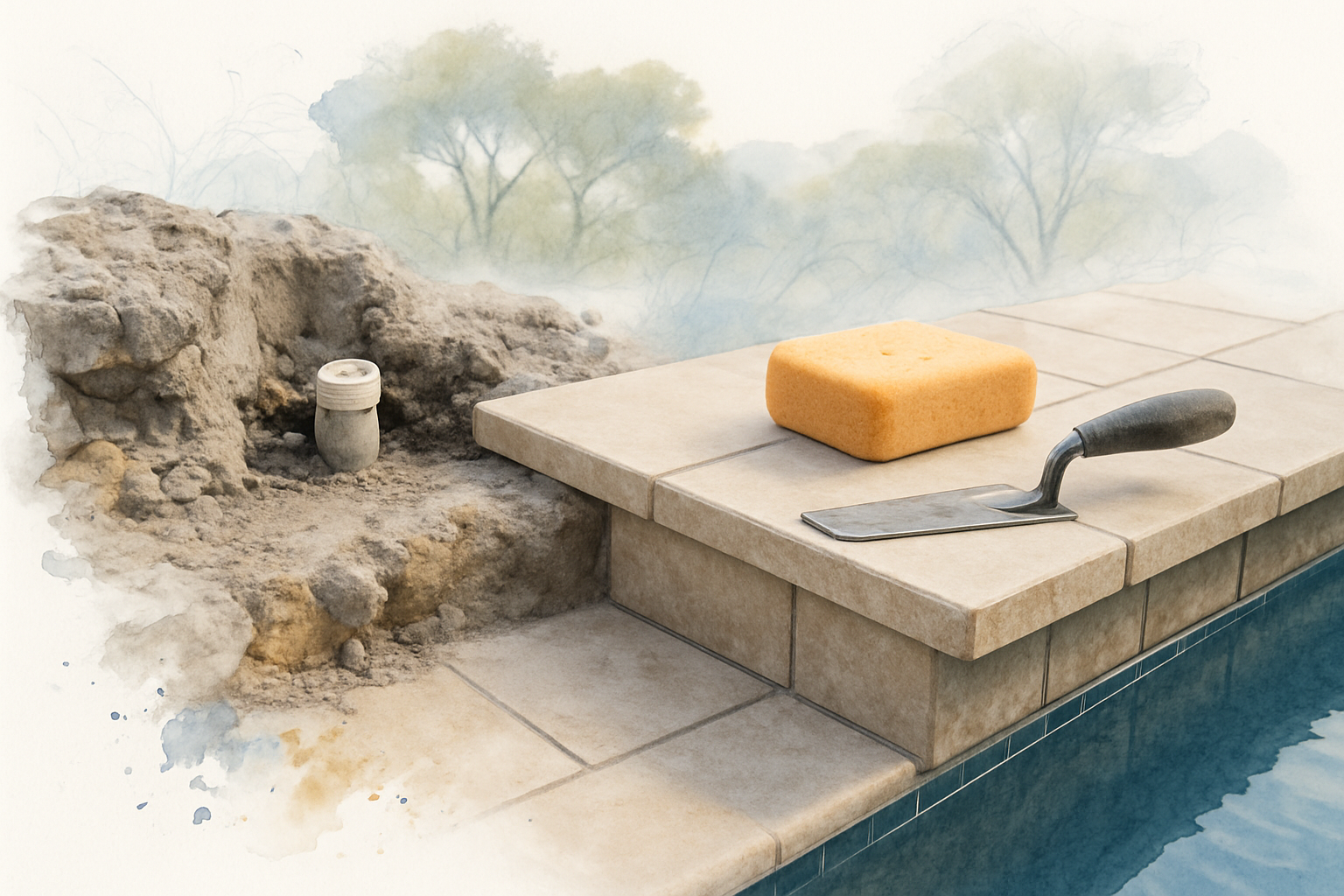
Pulling out a water feature is a masonry job, not just a demo job
Water features are their own conversation on the Peninsula. A recirculating waterfall looks efficient until you stand next to it on a warm Carmel Valley afternoon and watch what leaves as vapor.
A homeowner in Carmel Valley put it plainly in a review: “The first was the deconstruction of an old waterfall that fed the pool. It caused a tremendous amount of evaporation so it was time for it to go.” The stone hardscape around that pool was rebuilt into a sitting area at the water’s edge.
When I scope a removal like that, the demolition is the easy part. The work that decides whether it looks right five years later is what comes after:
- Disposal and haul off, since old feature rock and concrete add up fast in weight
- Whatever is buried underneath, usually a footing, a pump line, and conduit that has to be cut back, capped, and handled by the right licensed trade
- Rebuilding the deck plane so the new section drains the same direction as the old one
- Matching the stone, which means color, thickness, joint width, and how the cut edges were finished
That last one is the difference between a finished sitting area and an obvious patch. I wrote more about that in matching new stone to old, because blending is a sourcing and layout problem more than a skill problem.
Taking out irrigation does not take out water management
This is where cheap conversions fail, and it has nothing to do with the rules. A lawn soaked up rain slowly. A patio sheds it all at once.
When that water has nowhere to go, it finds a foundation, a retaining wall footing, or the neighbor’s slope below you. On the Peninsula the pattern is specific: months of fog drip that keeps the base damp, then a concentrated winter rain season that dumps the year’s volume in a handful of storms.
A conversion that holds up accounts for:
- Compacted base depth appropriate for the soil and the traffic, placed in lifts and compacted, not dumped and raked
- Slope away from structures, usually a consistent pitch across the field rather than a dip at the low corner
- Edge restraint so the perimeter pavers do not creep and open joints
- A termination point, meaning the water actually goes somewhere you chose
- Permeable paving with an open-graded base where the soil and the site can take the infiltration
Permeable systems are attractive on a conversion because they hold water on site instead of pushing it downhill. They are not right everywhere. Heavy clay or a tight slope can make them a poor fit, which is a site call, not a catalog call.
Base work is also the single biggest reason two bids differ, something I broke down in how a stone patio is priced from the base up. Local soil behavior matters too, covered in is your hardscape project ready for Salinas soil and weather.
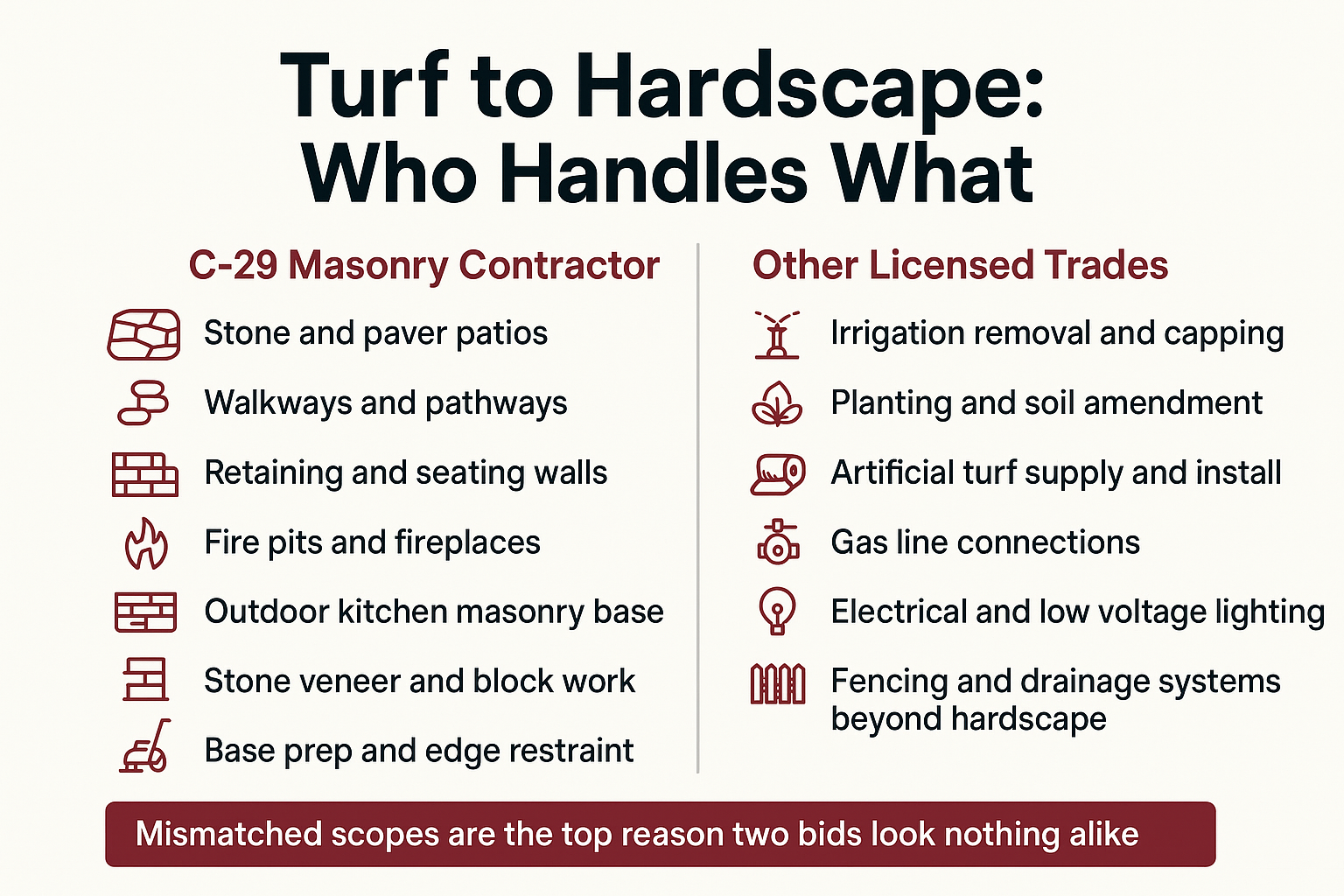
Who handles what in a turf to hardscape conversion
Most wish lists cross more than one trade. Knowing the split before you collect bids keeps the quotes comparable.
Where masonry starts and stops on a mixed-scope yard
Homeowners rarely ask for one thing. One request that came through our form from a Salinas homeowner read, in full, as fire pit, outdoor bbq, pavers and artificial turf. That one sentence spans several trades.
A C-29 masonry contractor classification covers the stone, block, paver, and fire feature work. That includes the patio field, the walkways, the retaining or seating walls, the fire pit, and the masonry structure a grill drops into.
It does not cover irrigation removal, planting, artificial turf products, gas line connections, or electrical. Those sit with other licensed trades, and on our jobs the gas connection gets coordinated with a licensed pro rather than absorbed into the masonry scope.
Why this matters when you are comparing quotes: if one bid includes turf and irrigation capping and the other covers only the stone, the two numbers are not describing the same project. Ask each bidder to list what they are not doing, and the comparison gets honest fast. There is more on how custom work differs from a packaged product in what separates custom stonework from off-the-shelf hardscape.
Frequently Asked Questions About Turf to Hardscape Conversions on the Peninsula
Does replacing lawn with a stone patio reduce my landscape water budget?
Under Rule 142.1’s definitions, patios and stone walks are not included in the Landscape Area used for water budget math, so converted square footage is handled differently than planted square footage. That is a definition, not a guarantee about how your specific project gets reviewed. Confirm your scope with the district and your local planning counter.
Do I need a permit to convert my lawn to pavers?
It depends on the jurisdiction and the scope. A ground-level paver field is treated differently than a retaining wall over a certain height or a gas fire feature, and Salinas, Carmel, Pacific Grove and the county each run their own counter. One call before design saves a redesign later.
Is permeable paving always the better choice for a conversion?
No. Permeable systems with an open-graded base work well where the soil drains and the slope cooperates. On tight clay or a steep lot, a conventional base with a planned discharge point often performs better. It is a site-by-site call.
What happens to the plumbing under an old water feature when it comes out?
The feature usually sits on a concrete footing with a pump line and conduit buried under it. That line has to be cut back and capped properly by the right trade, the footing has to come out or be worked around, and the deck plane has to be rebuilt so it drains the way the rest of the pool surround does.
How do I know a contractor is licensed for this work?
Look for the C-29 masonry classification and a license number, then run that number through the CSLB’s check a license tool. It shows license status, bonding, and workers compensation coverage in a few seconds, and it is free.
Planning a yard conversion on the Monterey Peninsula?
Stonecap Masonry holds CSLB License #1073620 as a C-29 masonry contractor, and that classification is what defines the stone, paver, block, and fire feature work our team can perform on a conversion in Monterey County, CA. Any California contractor’s license status can be checked through the CSLB’s check a license tool before you sign anything. We take consultations on Peninsula hardscape projects, and if you want to talk through a specific site, the number is 831-262-0442 or stonecapmasonry.com.
