Direct Answer: Real custom stonework starts with site-specific material selection and base engineering, not just picking a stone color. That difference determines whether your hardscape holds up for decades or starts failing within a few seasons.
The word “custom” gets used loosely in the hardscape industry. Sometimes it just means someone let you pick the color from a catalog. If you’ve gotten multiple bids for a patio, walkway, or outdoor living area and wondered why the prices are so far apart, the answer usually comes down to what’s actually included in that word.
On the Monterey Peninsula, where coastal soil conditions, salt air, and seismic risk all work against hardscape that’s built to a generic spec, the gap between real custom stonework and a commodity installation isn’t cosmetic. It shows up in how the work performs over five, ten, and twenty years.
I’ve worked through this distinction with homeowners across Salinas, Carmel Valley, Pacific Grove, and Pebble Beach, and the questions are almost always the same: what am I actually paying for, and how do I know the difference? This article lays out the two things that matter most: material selection and base preparation. Everything else follows from getting those right.
Why Material Selection Is a Decision, Not a Preference
When a homeowner asks for a specific stone, the first question I ask isn’t about color or budget. It’s about the exposure conditions at that exact property.
Not all natural stone performs the same way in coastal environments. On the Monterey Peninsula, marine fog and salt air are persistent, sometimes for weeks at a stretch. Stone with high porosity absorbs that moisture and, over time, will spall, stain, or erode at the surface. A stone that looks beautiful in a showroom or a photo from a drier climate may not hold up the same way three miles from Monterey Bay.
We had a homeowner in Carmel reach out about a custom outdoor sundial base. They’d already identified a granite product they liked, specifically because of the color compatibility with their home’s exterior and because they knew granite is dense and durable outdoors. That’s exactly the right thinking. The conversation that followed got into stone density, moisture absorption rates, and how the fabrication would handle the dimensional requirements of the finished piece. Those aren’t upsell conversations, they’re the actual work of custom stonework.
The factors that drive material selection for any outdoor masonry project include:
- Salt air and fog exposure, which favors low-porosity stone like dense granite or certain quartzites
- Freeze-thaw cycling, which matters more than people expect even in a mild coastal climate during cold inland nights in Carmel Valley
- Surface finish, since honed or rough-textured stone sheds moisture differently than polished faces
- Weight and load requirements, especially for structural applications like retaining walls or raised platforms
- Aesthetic continuity with existing materials already on the property
That last point matters more than it sounds. A mason who can match new stonework to existing hardscape is making dozens of small decisions, not just sourcing a similar-looking product. Andy Stoddard, a homeowner in Carmel Valley, described it well after Stonecap Masonry completed a pool area rebuild: “Cande demolished it and created a nice sitting area at the pool’s edge and matched the stone hardscape around the pool perfectly.” That kind of continuity doesn’t happen by accident.
What Base Preparation Actually Means, and Why It’s Invisible Until It Fails
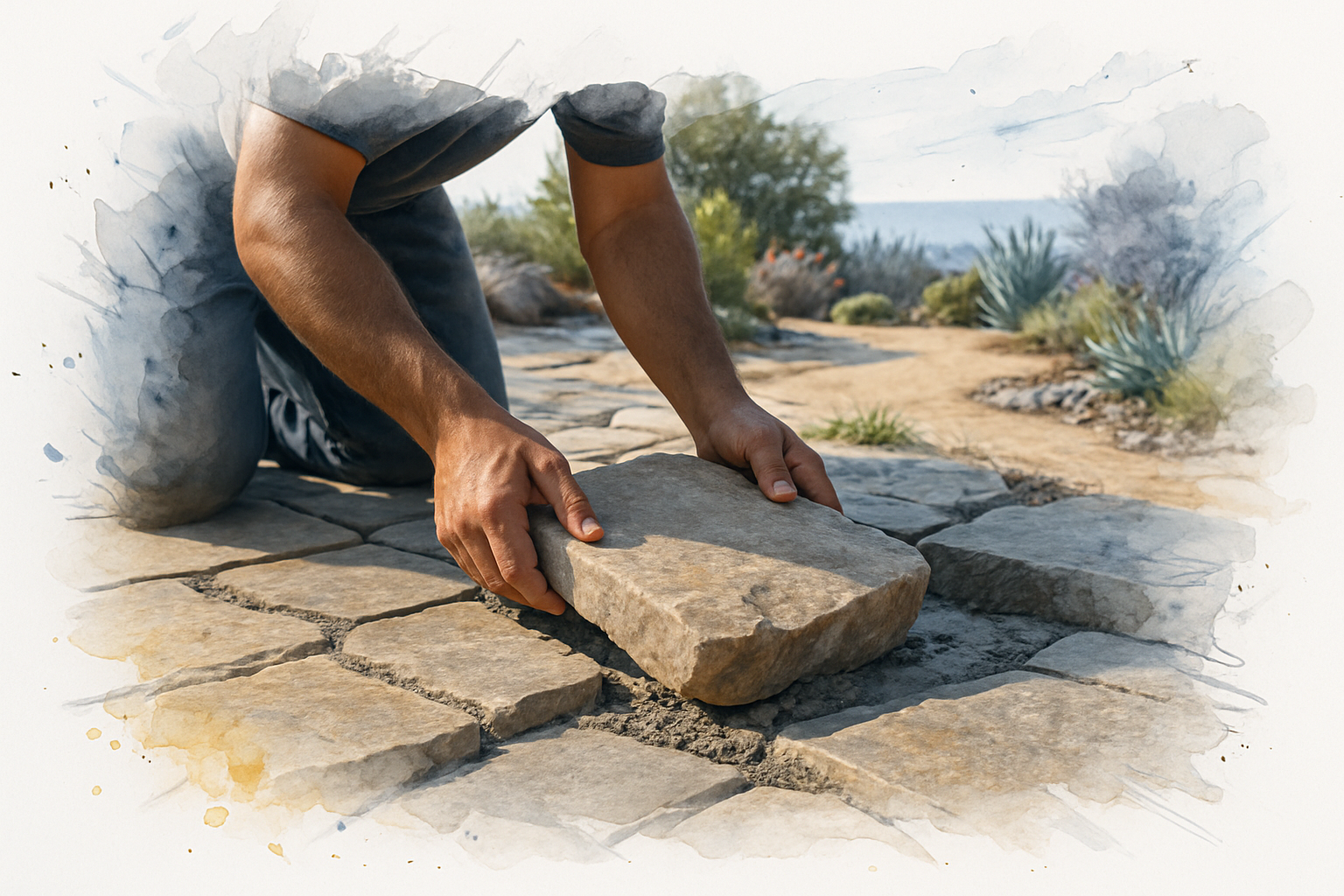
If material selection is the first place custom stonework separates from commodity hardscape, base preparation is where that gap becomes expensive.
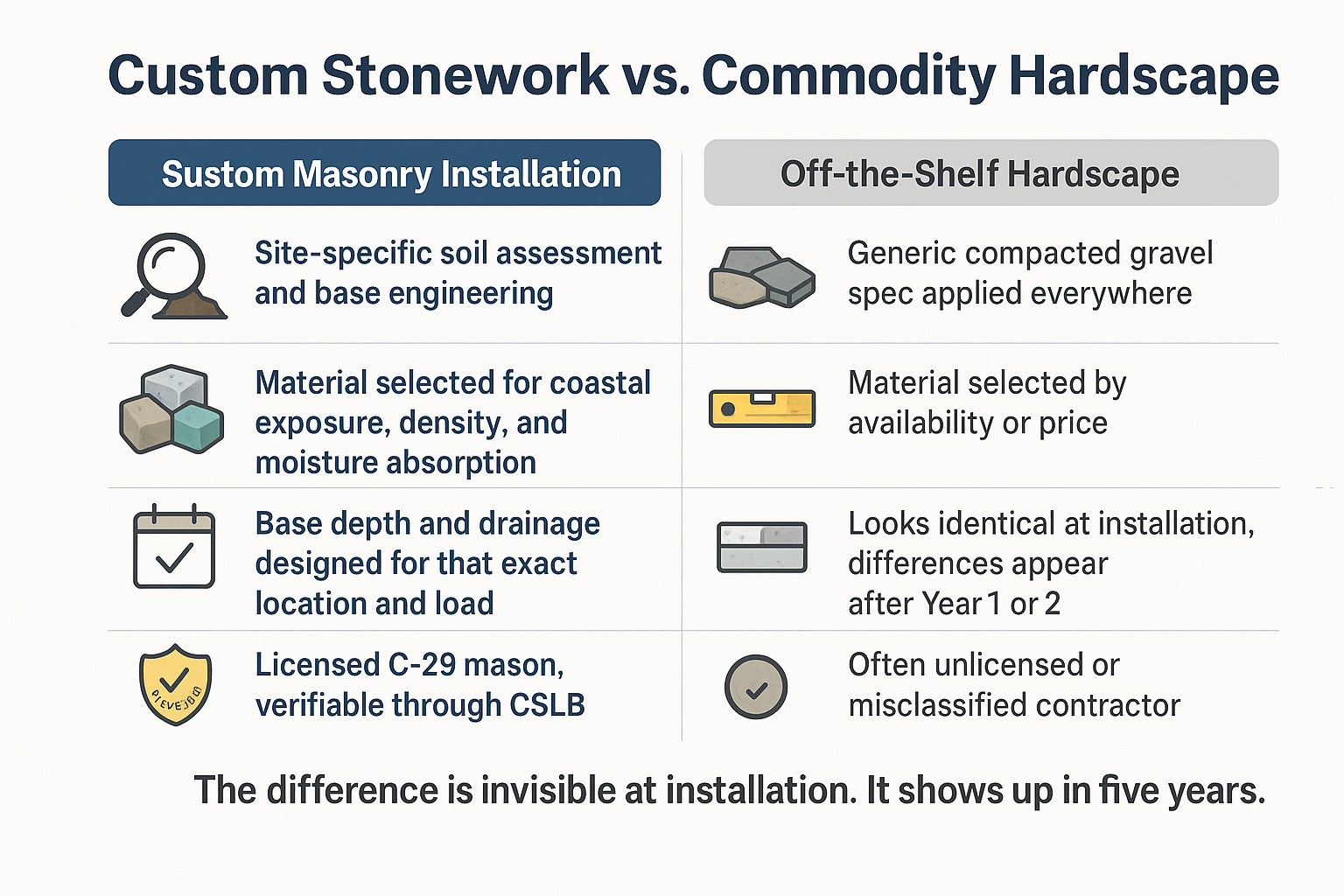
Pre-fabricated paver systems installed over compacted gravel by an unlicensed operator look identical to a properly engineered installation for the first year or two. You won’t see the difference in a photo. The difference shows up after a significant rainfall, a wet winter, or a seismic event, because the base either holds or it doesn’t.
On the Monterey Peninsula, this isn’t theoretical. Areas around Carmel Valley, Pacific Grove, and parts of Salinas have clay-heavy or expansive soils that move with seasonal moisture. When soil absorbs water, it expands. When it dries out, it contracts. A patio or walkway base that doesn’t account for that movement will develop uneven settling, cracked mortar joints, and lifted units within a few seasons. The California Geological Survey has documented expansive soil conditions across Monterey County as a known risk factor for foundation and hardscape performance, this is real geology, not contractor caution talk.
What a skilled mason does before the first stone goes down:
- Reads the soil, texture, drainage pattern, moisture retention, and load-bearing capacity
- Designs the base depth and composition for that specific location, not a generic spec
- Accounts for drainage so water moves away from the structure rather than pooling beneath it
- Considers the load, foot traffic only, or will there be a grill, outdoor kitchen, or seating wall adding weight?
- Plans for seismic movement, since Monterey County sits in an active seismic region and base systems that can flex slightly outperform rigid ones over time
This is also why I’d encourage anyone researching hardscape to read what actually separates a solid hardscape installation from one that fails early, the base engineering discussion there lines up with everything I’m describing here. And if you’re specifically worried about how Salinas-area soil conditions might affect your project, this breakdown of local soil and weather factors is worth reading before you get bids.
The honest reality is that a homeowner standing in their backyard on installation day has no way to see what’s under the stone. That’s why the contractor’s process, and their license, matters so much.
Custom Stonework vs. Commodity Hardscape: What’s Actually Different
This comparison lays out the real differences between a custom masonry installation and a standard off-the-shelf hardscape job, at each stage of the project.
The Contractor’s License Is Part of the Quality Equation
One thing I see homeowners overlook when comparing bids is the license classification. In California, a C-29 masonry contractor license is the specific credential that covers structural and custom stonework. It’s not a general contractor’s license with masonry added on, and it’s not the same as a landscaper who installs pavers.
The CSLB, California’s Contractors State License Board, maintains a public license lookup tool where anyone can verify a contractor’s name, license number, classification, bonding status, and insurance. For a job that’s going under your property’s surface and bonded to your home or landscape, verifying that credential before signing anything takes about two minutes and matters a great deal.
For context, we hold CSLB License #1073620 under the C-29 classification. I mention this not to sell anything, but because I think every homeowner asking a mason for a bid should check that box for every contractor on their list, including us.
The permit picture adds another layer. Depending on the scope and location of a masonry project in Monterey County, permits may be required, particularly for retaining walls above a certain height, structural work, or any project that touches a structure. Requirements vary by jurisdiction and project type, so it’s worth asking your contractor directly and confirming with your local planning department. A contractor who brushes off permit questions is telling you something important about how they work.
What Drives Cost in Custom Stonework Projects
Custom masonry pricing varies significantly based on the factors below. Most Monterey County homeowners find that custom stonework is priced differently than commodity paver installs, understanding why helps when comparing bids.
| Cost Factor | What It Affects | Why It Varies Locally |
|---|---|---|
| Stone material type | Material cost per square foot or linear foot | Dense, low-porosity stone suited for coastal exposure costs more than standard landscape stone |
| Base depth and engineering | Labor and material for excavation and base prep | Clay-heavy soils in Carmel Valley and parts of Salinas require more base work than sandy or stable ground |
| Project complexity | Labor hours and skill level required | Custom cuts, curves, level changes, and pattern matching take significantly more time than straight runs |
| Site access | Equipment and logistics | Narrow Pebble Beach or Carmel lots with limited access increase labor time and setup costs |
| Permits and inspections | Soft costs added to project total | Retaining walls, structural work, and some hardscape projects in Monterey County require permits that add cost and timeline |
| Material sourcing and matching | Time spent selecting compatible stone | Matching new stone to existing hardscape requires sourcing decisions that generic installs skip entirely |
What the Work Should Look Like When It’s Done Right
A well-executed custom masonry project has a few visible qualities that are easy to recognize once you know what to look for.
Joints are consistent and properly tooled, not filled in with excess mortar that was pushed around to hide gaps. Stone units sit level with each other and with the grade, without rocking or hollow sounds underfoot. Transitions to adjacent materials, a lawn edge, a door threshold, an existing retaining wall, are tight and intentional rather than approximate.
But a lot of what makes a custom installation hold up is completely invisible. The base is the right depth for the soil and load. Drainage has been accounted for. Material was selected for the exposure conditions, not just the look. None of that shows in a photo, which is why a mason’s track record and license are the only proxies a homeowner has before the work begins.
For projects that include fire features alongside stonework, there are additional planning considerations specific to the Monterey Peninsula climate. The outdoor fireplace planning guide covers what changes when you’re building in a coastal environment rather than a standard inland setting. And for stone veneer applications specifically, understanding where most installation problems actually start is worth reading before you go into any bid conversation.
Frequently Asked Questions About Custom Stonework
How is custom stonework priced differently from a standard paver install?
Custom masonry takes more time at every stage, site assessment, material sourcing, base engineering, and installation. A commodity paver job might move quickly because it follows a standard template. Custom work involves decisions specific to your property, which adds labor and skill. Most Monterey County homeowners find that custom stonework costs meaningfully more per square foot than a basic paver install, though the range varies based on stone type, site conditions, project complexity, and permit requirements. Getting multiple bids and asking each contractor how they handle base prep and material selection will tell you more than the number alone.
Do I need a permit for a stone patio or walkway in Salinas?
It depends on the scope and location. Simple ground-level patios often don’t require permits, but retaining walls above certain heights, structural elements, and projects near property lines or drainage areas typically do. Requirements vary by jurisdiction, the City of Salinas and Monterey County have their own planning and building departments. Always confirm with the relevant agency before work starts, and be cautious of any contractor who tells you permits are never needed without knowing your specific project.
Can new stonework be matched to existing hardscape on a property?
Yes, and an experienced mason will make this a central part of the material selection conversation. It requires sourcing stone that matches the existing material’s color, texture, and finish, not just finding something close. The Carmel Valley project mentioned earlier, where demolished waterfall materials were matched to the surrounding pool hardscape, is a good example of what intentional material continuity looks like in practice.
What should I look for when comparing masonry bids?
Ask these questions directly: How do you assess the base before installation? What stone are you recommending and why? Do you hold a CSLB C-29 license, and can I verify it? Will permits be required for this project, and who is responsible for pulling them? A contractor who answers all of these specifically and clearly is demonstrating the process transparency that separates good work from cheap work.
What masonry problems are common after a wet Monterey County winter?
Cracked mortar joints, lifted paver units, and surface spalling are the most common failures that show up after wet winters, especially in areas with expansive clay soils. Most of these trace back to inadequate base preparation or the wrong stone material for the moisture exposure. What a strong El Niño winter actually does to masonry covers this in more detail if you want to understand the mechanism.
Ready to Talk Through a Stonework Project?
If you’re planning a patio, walkway, outdoor kitchen, or other stone hardscape on the Monterey Peninsula, Stonecap Masonry is available to walk through the site conditions, material options, and what the base work actually involves for your specific property. You can reach the team at 831-262-0442 or visit stonecapmasonry.com to request a quote and start the conversation.
