Direct Answer: New stone blends in when the structural tie-in is right, salvaged original stone goes on the most visible face, and the mortar color, joint width, and tooling profile match the existing work.
A homeowner in Moss Landing reached out to us after a utility vehicle clipped the corner of their block retaining wall. Several blocks were cracked and pushed out of line, the corner capstone had shifted and lost its support, and the rest of the curved wall looked untouched.
Their first question was not about price. It was whether the rebuilt corner would look like the rest of the wall or like an obvious patch.
That is the hardest kind of match there is, because brand new material has to sit next to material that has been weathering on the coast for years. Here is how I think about matching new stonework to existing stone, what actually gives a repair away, and what to do when a perfect match is off the table.
The match only works if the structure underneath is right
I understand why homeowners jump straight to color. But a repair that looks good and moves later will look worse in two years than a slight color difference ever would.
On a struck wall like that Moss Landing job, the scope almost always includes work you cannot see in a finished photo:
- Removing loose and cracked units back to sound masonry instead of patching over damage
- Rebuilding the corner or column so it ties into the adjacent courses correctly
- Resetting and securing the capstones so they sit fully supported
- Realigning the top course so it reads level and continuous across the whole wall
- Checking the neighboring sections and the footing for movement the impact may have caused
That last one matters more than people expect. An impact loads more of the wall than the part that broke, and a base or footing issue found after the new stone is set means doing it twice.
We walk through this in more detail in When a Vehicle Hits Your Block Wall: How That Repair Gets Scoped. The short version is that the visual match is only convincing once the structural tie-in is solid.
Why an exact match is harder than most homeowners expect
People assume you can drive to a yard and buy more of whatever is already on the wall. Sometimes you can. Often you cannot, and there are real reasons for it.
- Quarries close, or they move to a different bed with different mineral content
- Manufactured veneer lines get discontinued or reformulated every few years
- Even natural stone from the same quarry comes in different color runs, so two pallets bought five years apart rarely read the same
- Older pavers and block get replaced by a similar profile that is a quarter inch off in size
So the work shifts from shopping to strategy. A few things I do on nearly every matching job:
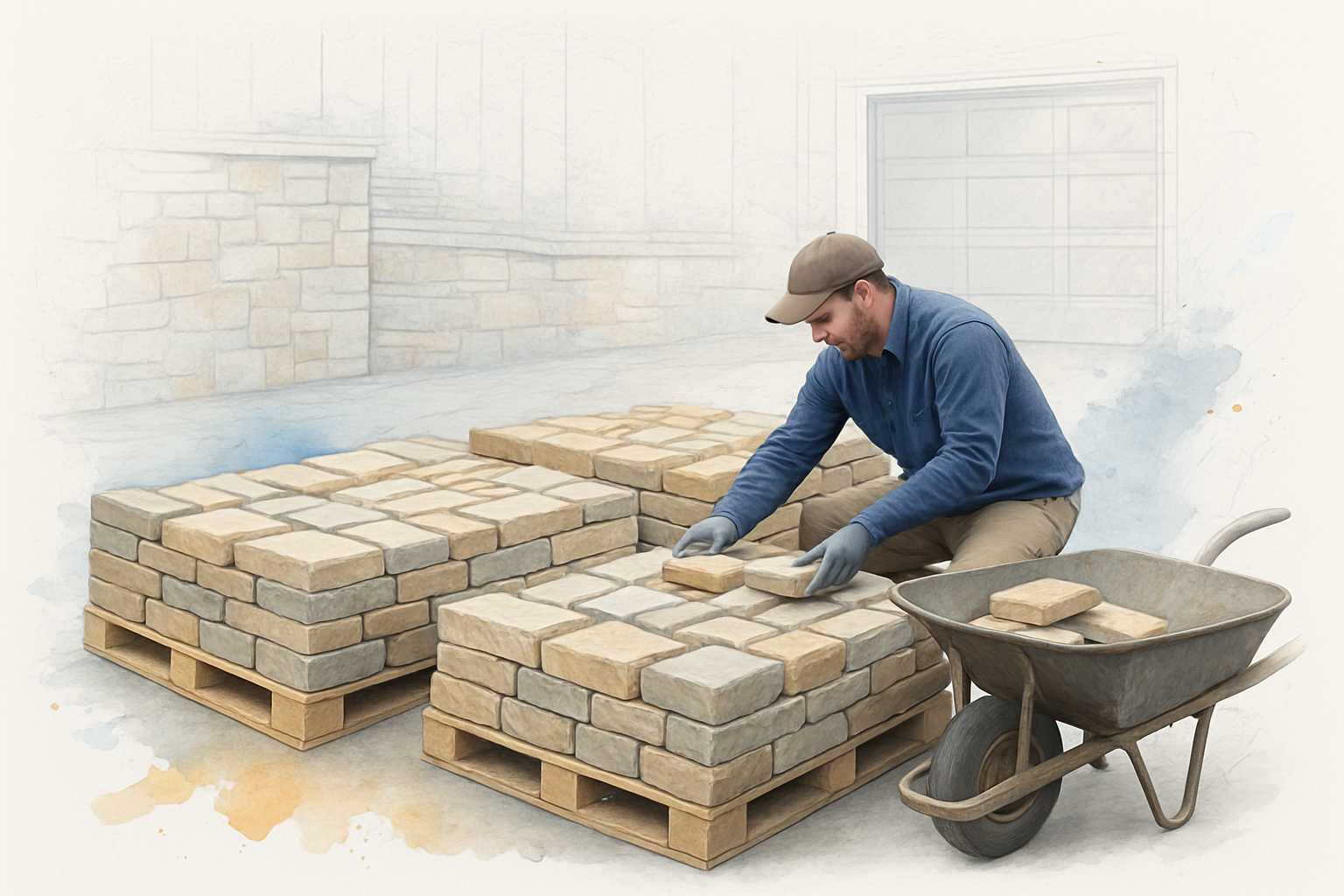
- Salvage aggressively. Sound stone pulled out of the damaged area gets cleaned and reused on the most visible face, because it already carries the right age and patina.
- Push new material where the eye does not go. Ends of a wall, the back side, low courses behind planting, the section nobody looks at from the patio.
- Blend from several pallets at once. Working straight through one pallet is how a new section ends up reading as a stripe. Pulling from three or four and mixing as you go spreads the variation out.
That habit of sorting and mixing is a big part of what separates handset work from a kit, something we cover in What Separates Custom Stonework From Off-the-Shelf Hardscape.
Mortar, not stone, is usually what gives a repair away
Ask most homeowners what makes a patch obvious and they say the stone. In my experience it is the joints almost every time.
Three things have to line up:
- Joint color. Sand drives most of the color in a mortar, so matching the sand source matters more than the bag on the pallet.
- Joint width. A repair run at three eighths of an inch next to original joints at five eighths will stand out from across the yard.
- Tooling profile. Concave, raked, flush, and weathered joints each catch light differently. Mixing profiles on one wall is instantly visible in late afternoon sun.
The trap is color. Mortar cures much lighter than it looks wet, so a color chosen off a damp sample is frequently wrong. I build a small test panel or a sample joint in an out of the way spot and let it cure before committing to a mix.
There is also a rule I do not bend: repair mortar should never be harder than the original masonry. A too-strong mix does not flex, so it pushes stress into the surrounding stone and starts cracking the units instead of the joints. The National Park Service covers that principle well in its guidance on repointing mortar joints, and it applies just as much to a 2005 block wall as it does to a historic building.
What Actually Makes a Repair Visible
When a homeowner tells me a past repair looks obvious, it usually traces back to one of these. Here is what each one looks like in the field and how it gets handled.
| What gives it away | How it shows up | How it gets handled |
|---|---|---|
| Mortar color | New joints read gray or bright white against aged joints | Match the sand source, cure a test panel before committing |
| Joint width | A tight or fat band of joints across the repaired area | Set the width off the existing work, not off habit |
| Tooling profile | Shadow lines change direction where the new work starts | Tool the repair to the same profile as the original |
| Stone placement | All the new material grouped in one visible block | Salvage originals for the face, blend new from several pallets |
| Surface treatment | A sheen or clean spot only on the repaired section | Treat the whole elevation the same way, or leave it alone |
| Structural alignment | Capstones or top course no longer reading level | Reset and realign before any facing work begins |
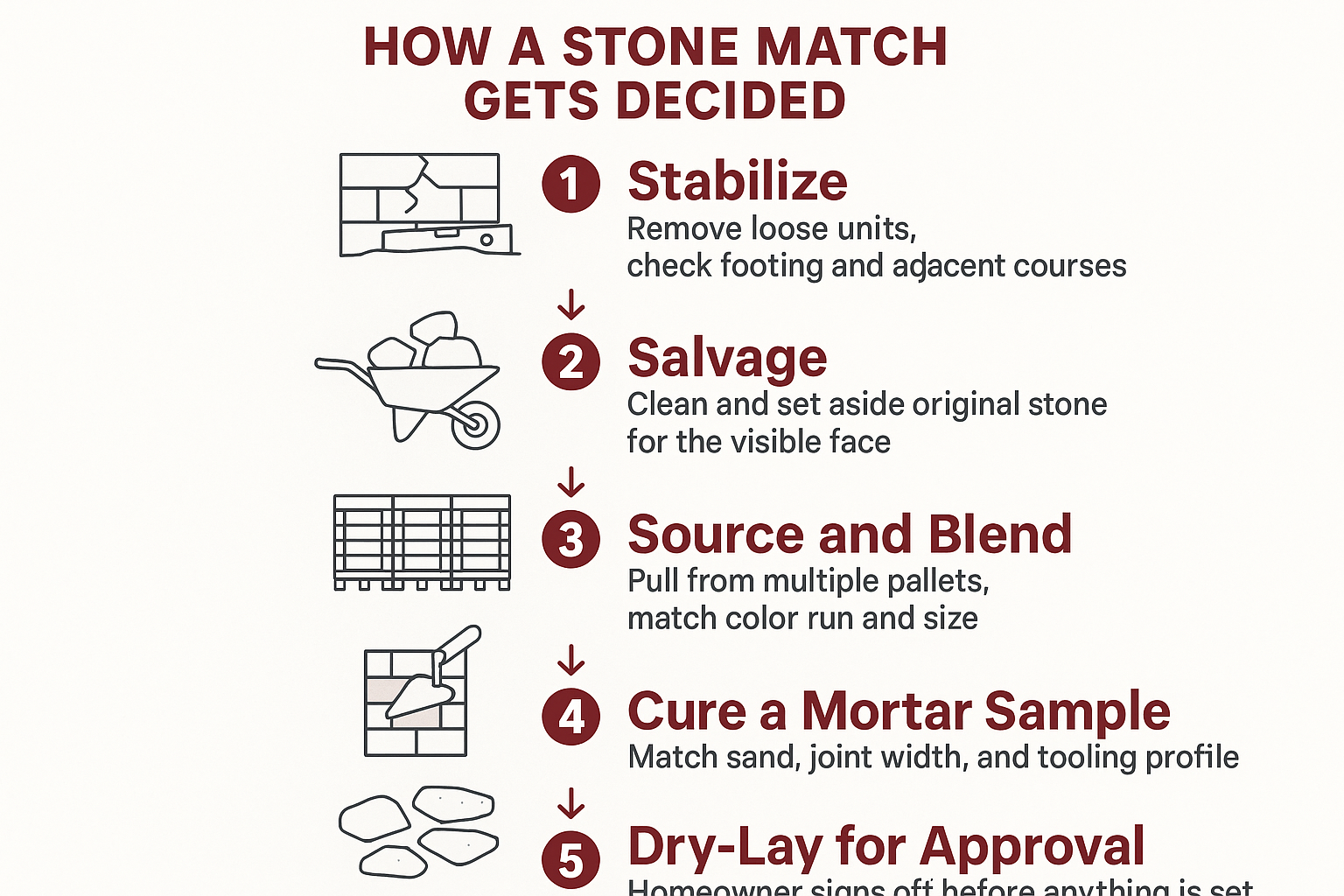
How a Matching Repair Gets Sequenced
Match decisions happen in a specific order. Getting them out of order is how repairs end up looking like patches.
Salt air changes the match after you leave
This is the part out-of-area advice misses. The Monterey Peninsula ages stone and joints on its own schedule.
Marine fog, salt air, and constant wet-dry cycling darken exposed faces and soften joint edges. A wall in Pacific Grove or Pebble Beach weathers differently than the same wall a few miles inland in Salinas, where it stays drier and the color holds longer.
So new work almost always reads brighter and cleaner on day one, then settles over the following seasons. I plan for that drift instead of chasing a perfect day-one match, because a repair tinted to match aged stone exactly today will look too dark in two years.
One warning worth repeating. Do not seal or pressure wash only the repaired section. A sheen difference or a bright clean patch next to weathered stone is far more obvious than any color difference, and it does not fade. If a surface treatment goes on, it goes on the whole elevation.
Matching across a property, not just patching a hole
Most of these calls are not damage repairs at all. They are additions, and the goal is for the new piece to look like it was always there.
Common versions I see on the Peninsula:
- A seating wall added along an existing paver patio
- A fire feature tied into the same stone used on the house facade
- One element of a pool surround rebuilt while the rest stays
- A walkway extended years after the original was laid
A homeowner in Carmel Valley had us remove an old pool waterfall that was driving heavy evaporation, then build a sitting area at the pool’s edge. What mattered to them was that the new work did not read as an addition. Their review said it “matched the stone hardscape around the pool perfectly,” and that was the whole job description.
Cost is the other question here, and match difficulty is what moves it. Levers that change the number include remnant and offcut sourcing, a thinner profile on a face that carries no load, an alternate quarry with similar mineral color, and how much original material survives demolition in reusable shape.
One Carmel homeowner wanted a granite base for a sundial and had picked a slab because the color complemented the house, but the slab was bigger and pricier than a 30 inch base needed. That is a textbook remnant job. There are more cost drivers laid out in What Drives the Cost of a Masonry Repair, but a real number comes from a site visit, because match difficulty gets judged in person.
When a perfect match is not possible, say so
Sometimes the original material is simply gone. A mason who promises an invisible match anyway is setting you up to be disappointed.
When I hit that wall, I bring options instead:
- Stop the new work at a natural break like a corner, a step, or a column, so the eye never compares two faces directly
- Introduce a deliberate banded or contrasting course so the difference reads as a design choice rather than a repair
- Reface one full elevation with the new material so the change happens at a logical edge
And before anything gets set in mortar, I dry-lay the stone and have the homeowner look at it. Five minutes of standing in the yard moving pieces around prevents almost every regret I have seen on this kind of work. It is the same principle behind how a stone patio is priced from the base up: decisions made early cost almost nothing, and decisions made late cost a rebuild.
Frequently Asked Questions About Matching New Stone to Old
Can you match stone if the original is 20 years old and the quarry closed?
Often yes, but not by buying identical material. The approach becomes salvaging original stone for the most visible face, sourcing an alternate with similar mineral color for hidden areas, and matching the mortar joints carefully. The joints do more of the work than the stone does.
Why does the new mortar look so much lighter than the old joints?
Two reasons. Mortar cures lighter than it looks when wet, so samples judged damp mislead people constantly. And the existing joints have years of coastal weathering on them. A cured test panel before the work starts solves the first problem, and time solves the second.
Should I clean the old stone so it matches the new work?
Be careful with that. Cleaning only part of a wall usually creates a more obvious line than the color difference did, and some cleaners etch stone or strip mortar joints. If cleaning happens, it should cover the full elevation and be tested in a hidden spot first.
Will insurance cover a matching repair after someone damages my wall?
That depends entirely on the policy and the claim, and it is between you and the adjuster or the responsible party. What I can tell you is that a written scope showing the structural work, the salvage plan, and the match approach helps those conversations go smoother than a one-line estimate.
How do I know a contractor is licensed to do structural masonry?
California masonry work falls under the C-29 classification, and you can verify any contractor’s license, bond, and insurance through the CSLB check-a-license tool. Our license number is CSLB #1073620. Checking takes about a minute and is worth doing on any bid you receive.
Thinking through a match on your own property?
Our project sequence includes a material review and recommendation step before any construction starts, which is exactly where match decisions get settled. The team takes on matching repairs and additions across Salinas, Carmel, Carmel Valley, Pebble Beach, and Pacific Grove, and the person judging the stone match is the person laying it. If you want a set of eyes on an existing wall or patio, the number is 831-262-0442 and the site is stonecapmasonry.com.
