
Direct Answer: A commercial block wall needs more than a patch when cracks run horizontally along mortar joints, the wall bulges or leans, or block is displaced. Those signs point to structural causes, not surface damage.
Most block wall problems get noticed on a walk-through. A property manager sees a crack that was not there last year, or a section of wall that looks like it is leaning a little more than the rest, and the first question is always the same: can we just patch it?
Sometimes yes. But on CMU walls, which is the standard gray concrete block used on almost every commercial site in Monterey County, the visible crack is usually the last part of the problem to show up. What caused it has been working on that wall for a while.
I want to walk through how I read a damaged commercial block wall in the field, what separates a real repair from a cosmetic one, and what a property owner here should have lined up before bids come in.
What the Crack Pattern on a Block Wall Is Actually Telling You
Block walls fail in patterns. Once you know the patterns, you can tell a contractor something useful instead of just pointing at the wall.
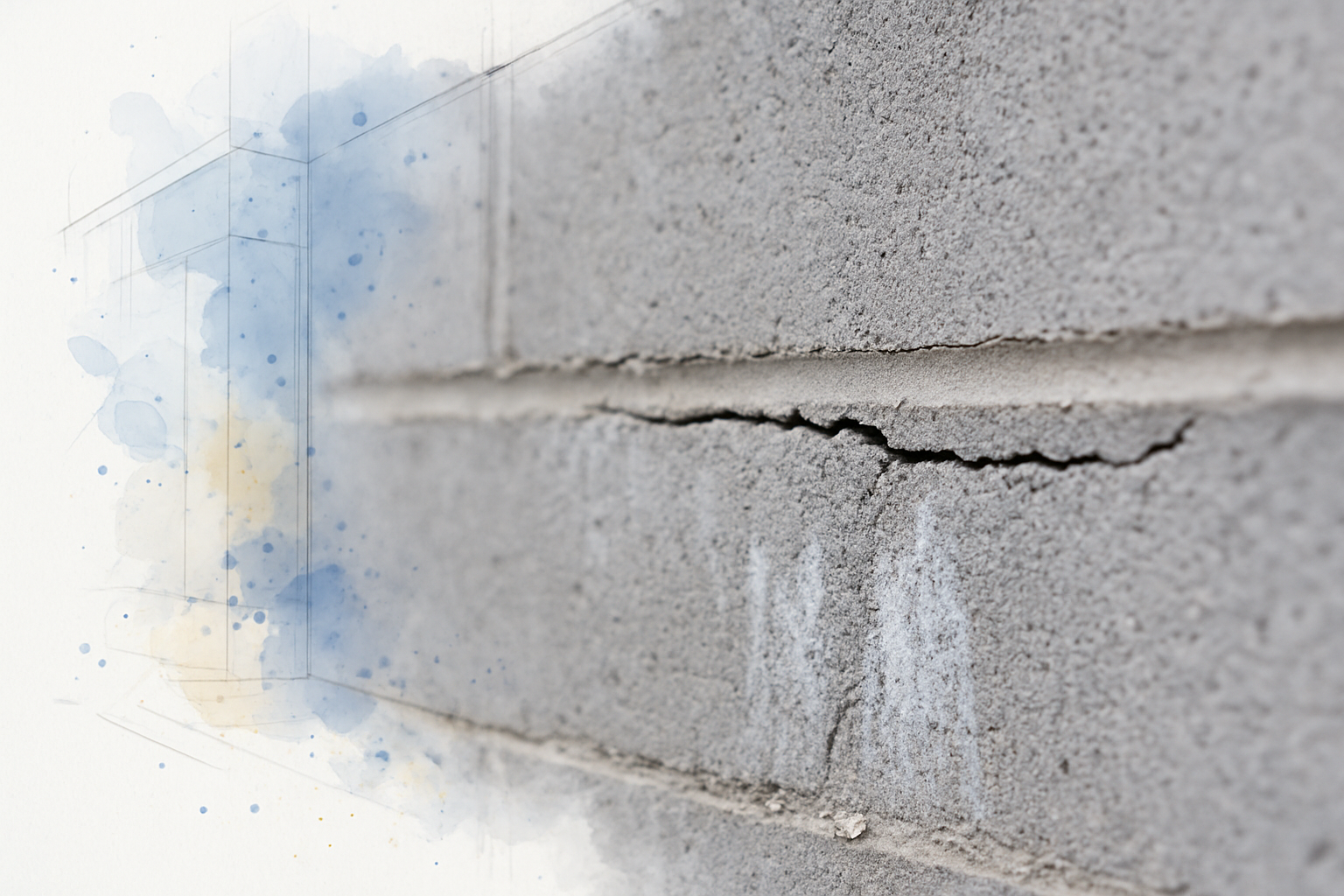
- Horizontal cracking along a mortar joint. This is the one I take most seriously. A crack running level through the bed joint usually means lateral pressure pushing on the wall, or settlement below it. Soil load, saturated backfill, and poor drainage are common causes on sloped Monterey Peninsula lots.
- Vertical or stair-step cracking at corners and openings. This points to differential movement. One part of the wall is moving at a different rate than the part next to it, often because of an unequal footing or a section that was added later.
- Efflorescence, the white powdery staining. That is mineral salt left behind as water passes through the block and evaporates. It is not a stain problem. It is a water problem, and water moving through block cells attacks the rebar and grout inside.
- Bulging or leaning in the wall face. At that point the block is no longer working as a single unit. Surface repair does nothing here.
One pattern I see constantly along the coast is efflorescence paired with soft, crumbling mortar joints. Salt air and the moisture cycling we get in Pacific Grove and Monterey work on joints faster than they do inland. If you are unsure whether what you are looking at is serious, this breakdown of normal settling versus a real warning sign is a good starting point.
Patch, Partial Rebuild, or Structural Evaluation
This is the decision that carries real dollars, so it is worth being honest about how it gets made.
A patch is appropriate when the damage stops at the surface. Spalled block faces, a short section of failed mortar joint, or a hairline crack that has not moved in years. Repointing and localized joint work handle that well.
A partial rebuild is what most impact damage and most corner cracking ends up needing. You take the wall apart down past the damage, check what is underneath, and rebuild with proper coursing and tie-in to the sections you kept.
A structural evaluation comes first when the wall is leaning, when horizontal cracks run through multiple joints, or when the wall is holding back soil. Nobody should be quoting block repair on a retaining wall before somebody has looked at drainage and footing behavior. The difference between a cosmetic fix and a masonry repair is mostly a question of whether the cause got addressed or just covered.
The honest test I use: if I cannot explain what made the wall crack, I am not ready to quote fixing it.
Reading the Signs Before You Call for Bids
This is roughly how I sort what I see on a first walk of a commercial block wall.
| What You See | Likely Cause | Where the Scope Usually Lands |
|---|---|---|
| Horizontal crack along a bed joint | Lateral soil pressure or settlement | Structural look at footing and drainage before any repair |
| Stair-step or vertical crack at a corner or opening | Differential movement between wall sections | Partial rebuild with the tie-in checked on both sides |
| White powdery staining on the block | Chronic water moving through the wall | Fix the water path and cap first, then repair the masonry |
| Bulge or lean in the wall face | Grout or reinforcement failure inside the cells | Engineering review, not a surface fix |
| Broken and displaced block after a strike | Vehicle or equipment impact | Demo of loose material, footing check, rebuild with correct coursing |
| Soft, crumbling mortar joints | Age plus coastal salt and moisture cycling | Repointing, sometimes across a wider area than expected |
How Repair Scope Gets Set on a Damaged Block Wall
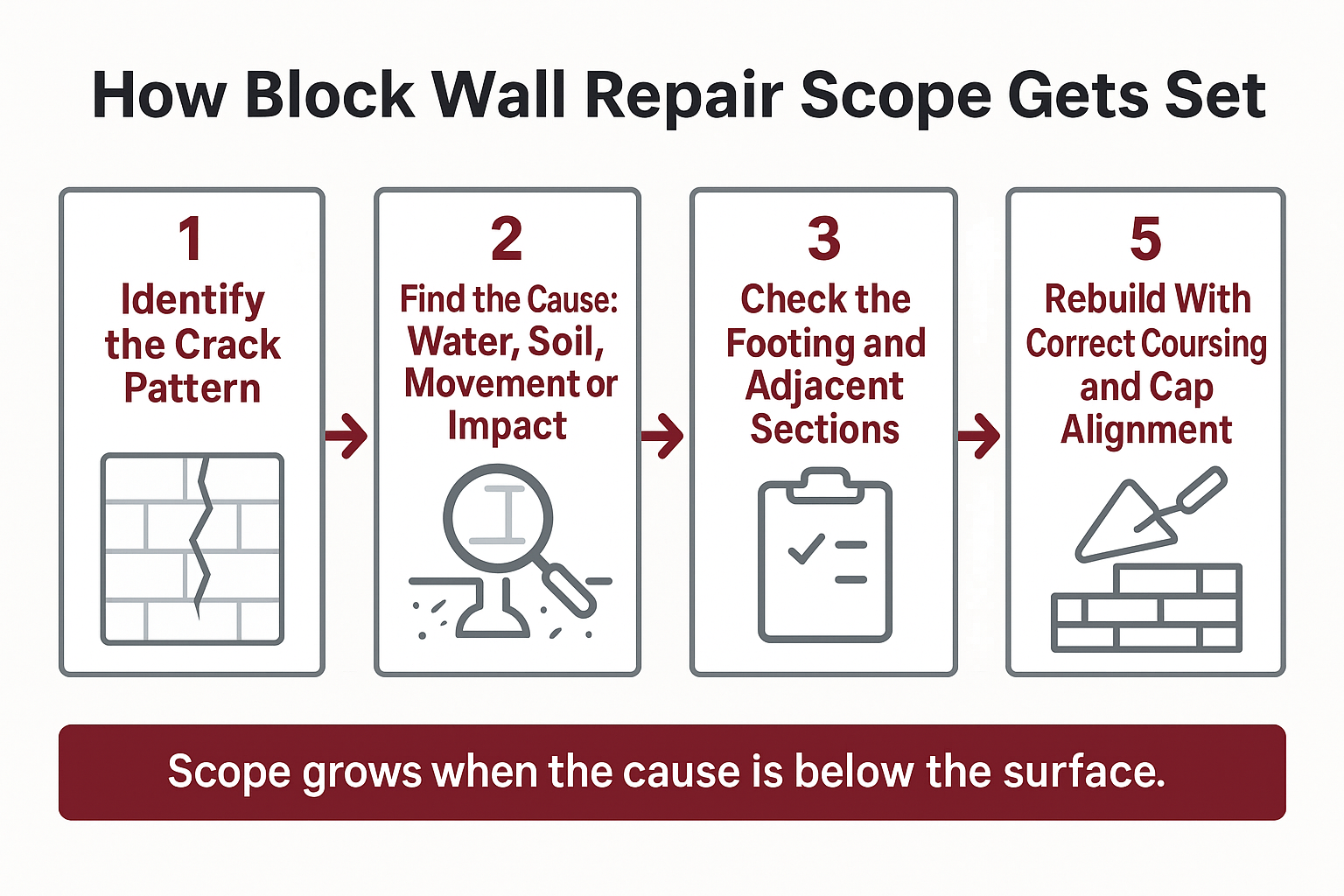
Scope is not guesswork. It follows a sequence, and every step can change the size of the job.
Why Impact Damage Is Almost Never a Small Job
A property owner up near Moss Landing reached out to us after a third party’s utility vehicle hit the corner of a block wall. Several blocks at the corner column were cracked and pushed out of place, pieces were on the ground, and the cap stone at the corner was shifted and sitting partly unsupported.
That is a textbook example of a job that looks like one corner and is not. The real scope on a strike like that looks like this:
- Remove all loose and fractured masonry, not just what is obviously broken
- Look at the footing for movement, because impact energy travels down
- Rebuild the column with correct coursing so the new work locks into the old
- Reset the cap stones so the top course sits level and continuous again
- Inspect the adjacent runs for hidden displacement that has not opened up yet
That last step is the one people skip. A strike can shove a wall a fraction of an inch and the crack does not show up until the next wet winter.
When a third party is paying, documentation of the repair scope matters as much as the repair itself. Written scope, photos before and after, and a licensed contractor’s name on the paperwork are what make a claim go smoothly.
The Compliance Piece Commercial Owners Miss
Two things specific to this area are worth knowing before you sign anything.
First, the City of Monterey has an earthquake hazard reduction framework for unreinforced masonry buildings. It puts the responsibility on the building owner to get a professional structural analysis when a URM structure shows deficiencies like listing walls, large cracks, or roof deflection. City Building and Safety records have identified at least 18 URM buildings in Monterey that had not been fully retrofitted. If you own a pre-1977 brick or block structure here, a visible crack is not filed under cosmetic.
Second, California’s 2025 Title 24 code takes effect January 1, 2026, and it updated evaluation criteria for seismic strengthening of existing masonry buildings. Any permitted repair or renovation now runs through plan check against those updated references. A contractor working off old references can get drawings kicked back and add weeks to your timeline.
Permit requirements vary by jurisdiction and by project type, so Salinas, Carmel, and Monterey will not all treat the same wall the same way. That call belongs to your local building department. For more on how ground movement shapes what gets built here, seismic risk changes commercial masonry construction covers it in detail.
Verify the License Before You Compare the Bids
Structural block work falls under California’s C-29 masonry contractor classification. That covers block wall repair and reconstruction, and it is not a job class where an unlicensed handyman quote gives you anything to fall back on.
Before you compare numbers, confirm three things:
- The contractor holds an active C-29 classification, which you can check yourself through the CSLB license check tool
- General liability coverage is current, with a certificate you can keep on file
- Workers’ compensation is in force for everyone who will be on your property
On cost, I will not throw out a number I cannot stand behind. What I can tell you is what moves the price on commercial block repair around Monterey County: wall height, whether the cells are grouted and reinforced, site access for equipment, whether engineering is required, matching aging block color, and traffic control on an active commercial lot. Two walls with the same crack can price very differently once those factors land.
Get an on-site look and a written scope. That is the only way the number means anything. The habits that keep these walls out of trouble are covered in what commercial property owners get wrong about masonry maintenance.
Frequently Asked Questions About Commercial Block Wall Repair
Can I just fill the cracks in my block wall and repaint it?
Only if the crack is stable and surface-level. Filling a crack caused by settlement, soil pressure, or water intrusion hides the problem for a season and then it comes back wider. Find the cause first.
How do I know if my wall needs an engineer?
Leaning, bulging, horizontal cracks through multiple joints, or a wall that retains soil are all reasons to get a structural opinion before repair work is scoped. On a URM building in Monterey, the local hazard reduction framework already puts that responsibility on the owner when those deficiencies show up.
Does block wall repair need a permit in Monterey County?
It depends on the jurisdiction, the wall height, and whether the work is structural. Salinas, Carmel, and Monterey each handle it differently, so check with the local building department before work starts. A contractor who works here regularly should be able to tell you what to expect from plan check.
The damage was caused by someone else’s vehicle. Does that change anything?
It changes the paperwork more than the masonry. You want a written scope, photos, and a licensed and insured contractor’s name on the documentation so the third party’s carrier has something clear to work from.
Why does efflorescence keep coming back after cleaning?
Because cleaning removes the salt, not the water carrying it. Until the drainage, cap, or flashing issue gets corrected, the staining returns. On coastal walls here it comes back fast.
Looking at a Block Wall and Not Sure What It Needs?
If you manage property in Salinas, Monterey, Carmel, or anywhere on the Peninsula and you have a block wall showing cracks, movement, or impact damage, a site walk and a written scope will tell you more than three phone bids ever will. Stonecap Masonry works on commercial block repair across Monterey County and can be reached at 831-262-0442 or at stonecapmasonry.com. CSLB License #1073620, C-29 masonry classification, and you are welcome to verify it yourself.
