
Direct Answer: Yes, a damaged section can often be rebuilt while the rest of the wall stands. It depends on whether the footing and base course are sound and whether the courses beside the damage have moved.
Something hit your wall. A delivery truck backed into the corner, a car clipped the column, and now you have a pile of broken block at the base and a capstone sitting on nothing. The rest of the wall looks fine, and you are bracing for someone to tell you the whole thing has to come out.
Most of the time, that is not the answer. A partial rebuild is often possible and often the right call. But whether it holds depends almost entirely on what is happening under the wall, not on the blocks you can see.
I have scoped these across Monterey County, from Moss Landing down through Carmel Valley. Here is what I look at before I tell a homeowner whether a section can be saved, and what separates a repair you stop noticing from one you see every single day.
Can One Section Be Rebuilt While the Rest of the Wall Stays Standing?
Usually, yes. Block and stone walls are built in courses, and courses can be taken apart in a controlled way if you know where to stop.
The real question is where a clean vertical break can be made without unzipping the courses past it. On a segmental block wall, that means finding a point where the units are not locked into the damaged run and where removing a unit does not pull its neighbors loose.
Here is what I am checking on a first visit:
- How the units are interlocked and tied in. Running bond, pins, lips, or geogrid buried in the backfill all change how far the demolition has to extend.
- Whether the courses on either side of the damage have shifted. If the next two or three units have rotated or opened at the joints, the break point moves outward.
- Whether the cap is still bearing. A capstone that is partially unsupported is telling you the course beneath it has moved, not just cracked.
- Whether the base course is still level and tight. This is the one that decides everything.
One homeowner who reached out about a struck corner wrote it better than most contractors would: “I’d like someone to inspect the surrounding courses to make sure there isn’t additional movement or a base/footing issue.” That is exactly the right instinct. The damage you can see is the easy part.
Impact Damage and Movement Damage Are Two Different Problems
Impact damage is local. A vehicle hits a corner, units crack, pieces break off, the cap shifts. The wall on either side is still doing its job. That is the best case for a section rebuild, and the repair is usually modest relative to a new wall.
Movement damage is a different animal. It means the wall is losing a slow argument with water and soil, and it rarely stays in one place.
What movement looks like:
- Bulging in the middle of a run, where the face bellies out toward you
- Course separation, where horizontal joints open up and no longer line up
- Leaning out of plumb along a length of wall, not just at one point
- Stair-step cracking that climbs diagonally through the block or mortar
Water is behind nearly every masonry failure I see around here. Salinas and Prunedale clay swells when it is wet and shrinks when it dries, and that cycle loads a wall from behind every winter. If you want the longer version of that, I wrote about why retaining walls fail on Salinas clay soil.
Three things you can check yourself before anyone shows up:
- Sight down the top course from one end. Is it still straight along its length, or does it wander?
- Look for weep holes at the base. Are they there, and did anything come out of them during the last rain?
- Check whether the soil behind the wall has settled or sunk near the top. That usually means material is washing out somewhere.
If the footing has settled, the base course is out of level, or water has been sitting behind the wall with nowhere to go, rebuilding the visible section just resets the clock on the same failure. That is the honest version, and it is why the drainage layer behind a wall matters more than the face does.
What Points Toward a Partial Rebuild and What Points Toward Full Replacement
This is roughly how I sort a wall on a first walk. No single sign decides it, but the pattern usually does.
| What You See | Likely Scope | Why |
|---|---|---|
| Cracked and displaced units at one corner, rest of run straight | Partial rebuild | Damage is local and the base is likely intact |
| Capstone shifted and partly unsupported at impact point | Partial rebuild, cap reset | Top course moved, but only where it was struck |
| Bulge in the middle of a long run | Section rebuild to full replacement | Pressure from behind, often a drainage failure |
| Base course out of level across several feet | Full replacement of that run | Footing has settled, rebuilding above it repeats the failure |
| Wall leaning out of plumb along its whole length | Full replacement | The system is overloaded, not just damaged |
| Water staining, washed-out soil, no working weep holes | Rebuild with drainage redesign | The cause is still active behind the wall |
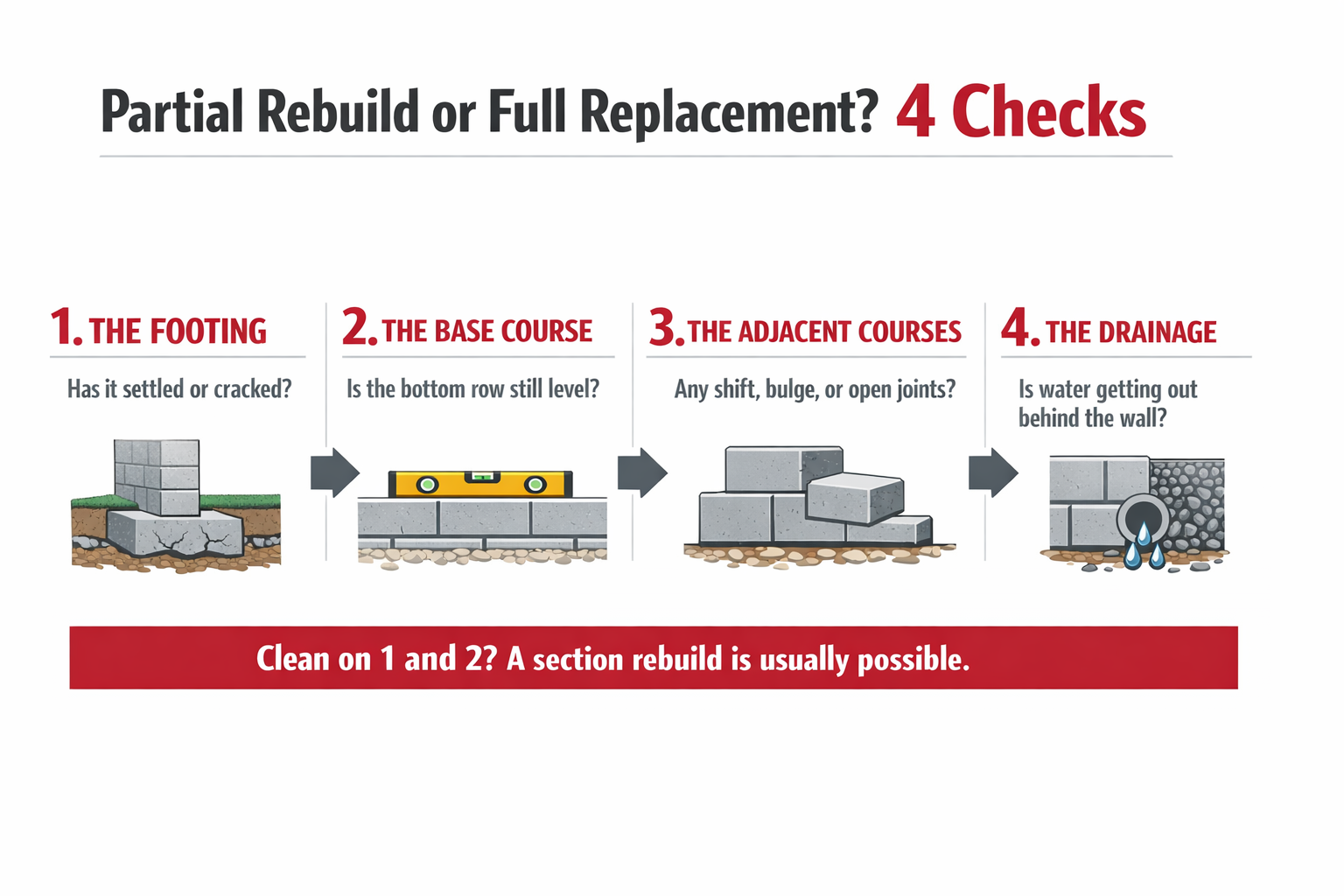
The Four Checks That Decide Partial Rebuild or Full Replacement
These are the four questions I work through in order on a damaged wall. If the first two come back clean, a section rebuild is usually on the table.
The Seam Is the Part You Will Look At Forever
Every partial rebuild has a join between old work and new work. The quality of that seam is what separates a repair you notice every time you walk past it from one you stop seeing after a month.
Three things make or break it.
Color and weathering. Block and stone that has spent ten years in coastal air does not look like what comes off the pallet. New units are cleaner, brighter, and sharper at the edges. Pulling units from a less visible part of the wall for the face of the repair, and putting the new material where it is least seen, does more for the finish than any sealer.
The capstone. Caps get reset and secured, not dropped back into place. If a cap shifted during the impact, the bedding under it has to come out and go back in clean, and the cap has to bear evenly across the course below.
The top course. It has to come back level and continuous across the join. Your eye reads a wall along its top line before it reads anything else, so a top course that steps up or down by a quarter inch at the seam will bother you for years.
One Carmel Valley homeowner described a project where we rebuilt a pool-edge sitting area and “matched the stone hardscape around the pool perfectly.” That is the standard a seam should hit. If you want more on material matching specifically, there is a deeper piece on matching new stone to old.
When a Section Rebuild Stops Being a Section Rebuild
Two situations change the job, and both change the paperwork more than the masonry.
The repair changes height, loading, or geometry. If a rebuild raises the wall, changes the slope behind it, or alters how the run ties into a corner or a terrace, you may be building something new in the eyes of the building department. Permit and engineering requirements vary by jurisdiction and project type in Monterey County, so the specific wall and the specific scope should be confirmed with your local building department. I covered the thresholds in when a retaining wall needs an engineer in California.
A third party or an insurer is paying. When a company’s vehicle caused the damage, the scope has to be itemized line by line. The clearest request I have received on this listed its own four parts: remove loose masonry and clear debris, rebuild the damaged corner and column, reset and secure the capstones so the top course sits level and continuous, and check the adjacent section for stability and tie-in. That kind of breakdown makes everyone’s life easier.
That same homeowner asked for license and insurance confirmation before scheduling. Good habit. Any California property owner can verify a contractor’s license, bond, and workers’ compensation status through the CSLB check-a-license tool before work starts.
Why Timing Matters More This Fall Than Most
A compromised section is a worse thing to leave standing through January than through July. That has always been true here, and the odds have shifted this year.
NOAA’s Climate Prediction Center currently has an El Nino Advisory in effect, with forecasters putting the chance of a very strong event above 90% through fall and winter and a 75% chance of an event during October through December exceeding anything on record back to 1950. You can read the discussion directly from the Climate Prediction Center ENSO advisory.
Forecasters are clear that strong events shift probabilities rather than guarantee storms. Still, odds are odds.
What that means practically on the Peninsula:
- A partial rebuild in dry ground is a cleaner excavation, and cleaner excavation usually means a lower number
- Saturated clay has to be handled, shored, and hauled, which adds cost and time
- Masonry calendars around here tighten the week after the first real storm, because that is when everyone calls
Costs vary a lot by access, wall height, and how much drainage work comes with the repair, so I would not put a number on your wall without seeing it. How a retaining wall quote gets built walks through the pieces that actually move the price.
Frequently Asked Questions About Partial Retaining Wall Rebuilds
How much of the wall has to come apart to fix one damaged corner?
Usually a little more than the visible damage. I take it back to the first unit that is still tight, level, and properly tied in, which often means one to three units past the break on each side. On a pinned or geogrid-reinforced wall it can be more, because pulling one unit can loosen the reinforcement behind it.
Will the repaired section match the rest of the wall?
It can get very close, but it will not be invisible on day one. Older units have weathered in coastal air and new ones have not. Pulling existing units forward to the visible face and tucking new material where it is least seen closes most of the gap, and the rest evens out over a few seasons.
The wall was hit by someone else’s vehicle. Does that change anything?
It changes the documentation, not the masonry. The scope has to be itemized clearly enough for an insurer or the responsible company to review it, which usually means separating debris removal, the rebuild itself, cap resetting, and any inspection of adjacent sections. There is a fuller walkthrough of how vehicle damage repairs get scoped.
Can I just reset the capstone myself and deal with the rest later?
I would not. A cap that shifted is a signal that the course under it moved, and setting it back down hides the thing you need to see. It is also heavy, and an unsupported cap over a broken column is a real hazard.
How do I know whether the problem is the blocks or the base?
Sight down the top of the wall from one end. If the line is straight everywhere except the impact point, the base is probably fine. If the line wanders, bellies, or dips along a run, the trouble is underneath, and a section rebuild alone will not hold.
Looking at One Broken Section and Wondering What It Really Needs?
Section rebuilds are small jobs where the diagnosis has to be right, which is a good fit for a licensed, bonded, and insured C-29 masonry contractor working as a two-generation crew rather than a volume outfit. Stonecap Masonry takes on section rebuilds and repair scoping across Salinas, Carmel Valley, Pacific Grove, and the Moss Landing area, CSLB License #1073620. The number is 831-262-0442, and details are at stonecapmasonry.com.
