
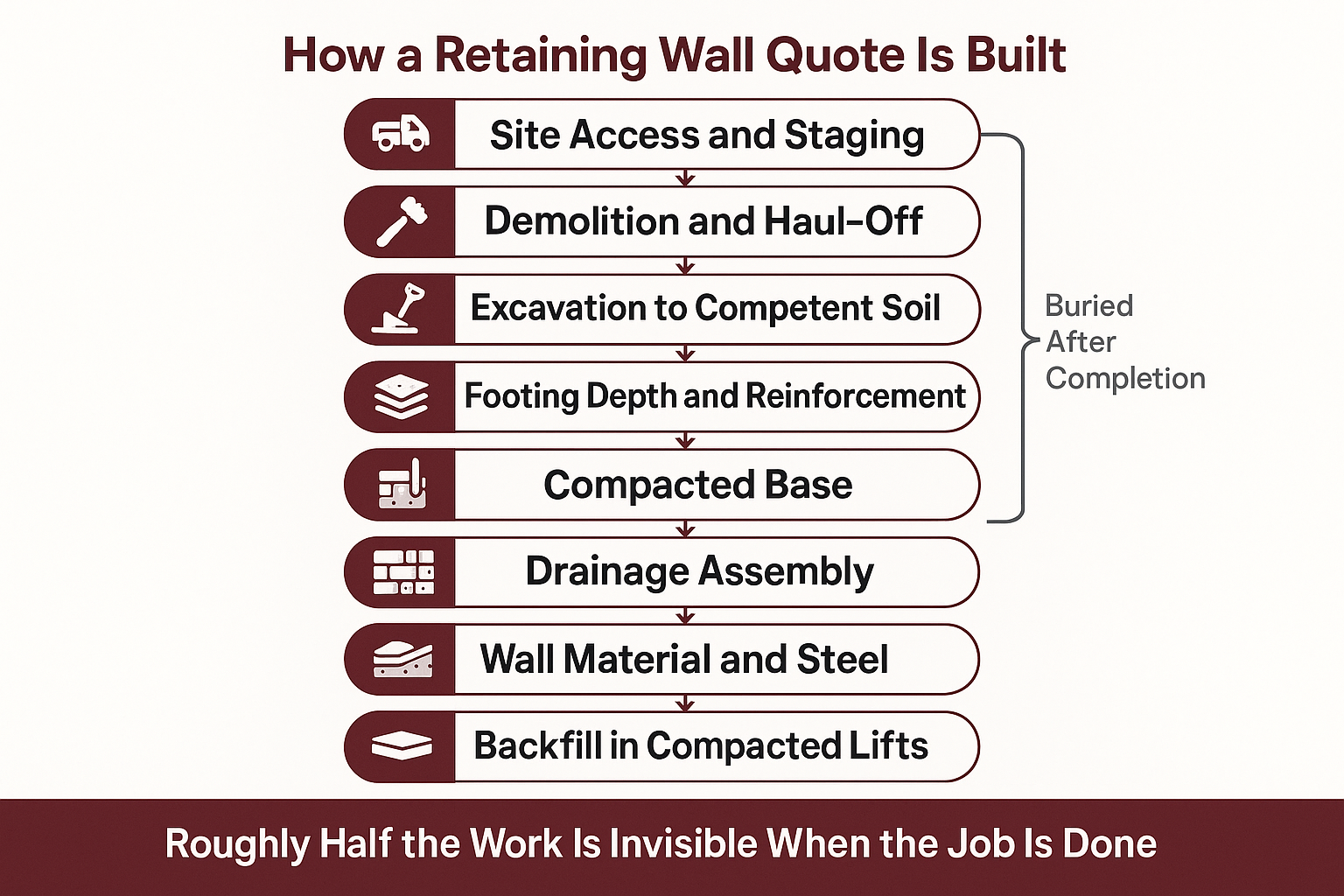
Direct Answer: A retaining wall quote is built in the order the work happens: access, demolition, excavation, footing, base, drainage, wall material, backfill, cap, permit, and cleanup. Half of that ends up buried.
You asked three masons to price the same failing wall. One number came back low, one came back in the middle, and one came back high enough that you assumed somebody was padding it.
Almost nobody calls me because the price is high. They call because the spread between bids makes no sense, and no one explained why.
Here is how a retaining wall quote actually gets built, in the order the money gets spent. Once you can see the line items, a higher number usually stops looking like a markup and starts looking like more wall.
Why the same wall gets three different numbers
A retaining wall is not a stack of block. It is a soil-holding structure, and most of what makes it work sits underground where you will never see it again.
That is the whole problem with comparing quotes. Two walls can look identical the day they are finished and behave completely differently five winters later.
The low bid is rarely dishonest. It is usually less scope, priced honestly. Common things that quietly fall out of a cheap number:
- Excavating down to soil that can actually carry load instead of stopping at the first firm layer
- A footing sized for the wall height and the slope behind it
- Steel reinforcement in the footing and the wall cells
- A real drainage assembly instead of a few weep holes
- Backfill placed in lifts and compacted, rather than dumped and left to settle
On the Monterey Peninsula, the drainage line is the one I watch most. Our rain arrives in short heavy stretches, and saturated soil behind a wall gets dramatically heavier than dry soil.
I have rebuilt walls in Carmel Valley and Salinas that failed for exactly one reason: water had nowhere to go. If you want the long version of that, we broke it down in the drainage layer a retaining wall cannot work without.
The line items, in build order
Money gets spent in a sequence. Reading a quote in that same sequence is the fastest way to spot a gap.
- Site access and staging. Where the truck parks, where material gets stockpiled, how spoils leave.
- Demolition and haul-off. Breaking out the failed wall and getting the debris to a transfer station.
- Excavation to competent soil. Digging until the base is something you would trust, not just something that looks solid.
- Footing depth and reinforcement. Width, depth, and steel sized to the wall and the load behind it.
- Compacted base. Aggregate placed and compacted so the footing is not sitting on fluff.
- The drainage assembly. Clean gravel, perforated pipe, filter fabric, weeps, and an outlet that actually daylights somewhere useful.
- Wall material and reinforcement. Stone, CMU block, or brick, plus grout and steel where the design calls for it.
- Backfill in lifts. Placed in layers and compacted, not dumped in one pass.
- Cap and finish. Capstone, coping, or veneer face.
- Permit and inspection. Application, plan review if required, and scheduling.
- Final cleanup. Site left usable, not left for you.
Count how many of those are invisible after the last stone is set. Roughly half. That is exactly why a thin bid can leave them out and still describe something that sounds complete.
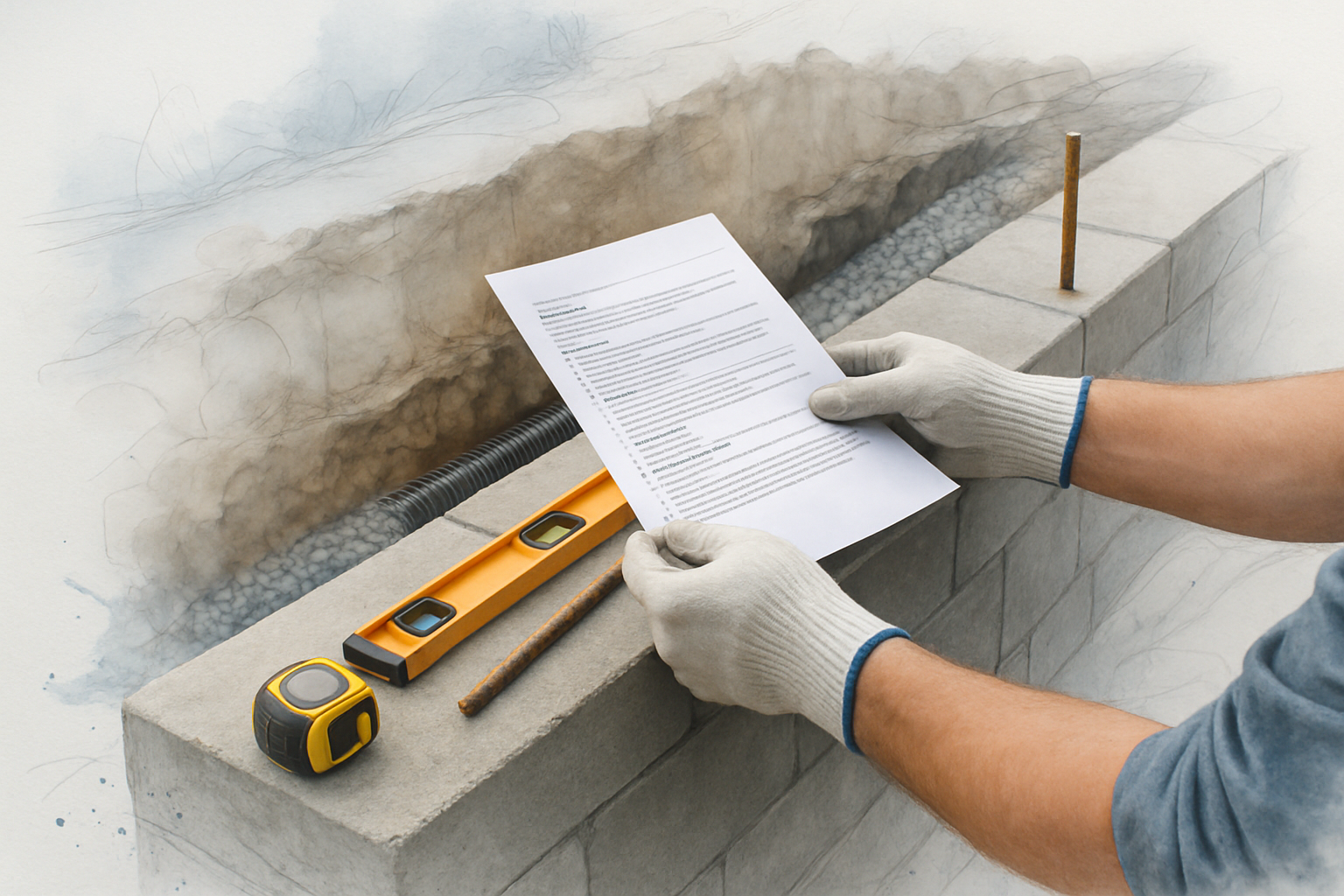
Site access is the multiplier nobody explains
This is the single biggest reason two honest quotes land far apart, and almost no one writes it down.
A hillside wall in Carmel Valley or Corral de Tierra with no equipment path is a wheelbarrow job. Every yard of spoil comes out by hand and every yard of gravel goes in the same way.
That same wall on a flat lot off Blanco Road in Salinas is a machine job. Identical square footage, very different labor hours.
Things that push a project toward hand work:
- Gates or side yards narrower than a compact machine
- Steep grade, soft soil, or a driveway that will not carry equipment weight
- Mature trees, irrigation, or existing hardscape that has to be protected
- Long carry distance from the street to the work area
- Neighborhood parking limits in Pacific Grove or Carmel that shrink staging space
When you get two quotes far apart, ask both contractors how they plan to move material. If one priced a machine and the other priced a crew with wheelbarrows, you just found most of your gap.
It also tells you something about who walked the site carefully. A wall that needs real structural judgment usually needs a real site visit, which is part of why a retaining wall often needs a contractor rather than a handyman.
Material choice as a cost and durability trade
Material is the line item homeowners focus on first, and it does move the number. It also changes how the wall ages in salt air.
| Material | Where it fits best | Relative cost driver | How it behaves near the coast |
|---|---|---|---|
| Natural stone | High-end visible walls in Carmel, Pebble Beach, Carmel Valley | Highest labor hours, skilled hand fitting | Excellent durability, no metal ties to corrode in salt air |
| CMU block | Structural and heavy-load walls in Salinas, commercial sites | Moderate, faster to build, steel and grout add cost | Solid performer when given a proper waterproofing coat on the soil side |
| Brick | Garden walls and lower retaining structures in Pacific Grove’s older neighborhoods | Varies with pattern and joint work | Mortar selection matters more than most people expect this close to the water |
What a complete retaining wall quote covers
This is the same build order I walk homeowners through when two quotes do not match. Print it and read your bids against it.
Five things that should be itemized in writing
You cannot compare two quotes on square footage alone. These five details decide whether the wall lasts, and they are simple to ask for.
- Footing depth and width. Along with whether steel is included and what size.
- Drainage components. Gravel type and depth, perforated pipe, filter fabric, weeps, and where the water outlets.
- Backfill and compaction method. What material goes behind the wall, in what lift thickness, and compacted with what.
- Who pulls the permit. Requirements vary by jurisdiction and by project type, so this needs a name attached to it.
- Who schedules inspection. If a permit is involved, someone has to call it in and be there.
If those five items are not in writing, two quotes are not comparable no matter how detailed the rest of the page looks.
Height and surcharge matter here too. A wall holding a driveway, a slope, or a structure above it is a different animal than a garden wall, and it may need a stamped design. We covered where that line usually falls in when a retaining wall needs an engineer in California.
Verify the contractor before you compare the numbers
One homeowner near Moss Landing wrote in about a block wall corner that a utility vehicle had struck, with cracked blocks, a shifted capstone, and debris at the base. A third party was paying for the repair.
Before scheduling anything, they asked us to confirm license and insurance in writing. That is a smart request, and more people should make it.
California lets you check any contractor yourself. Run the license number through the state’s check a license tool and you will see classification, status, bond, and workers’ compensation.
For masonry, the classification you want is C-29. Our license is CSLB #1073620, published so anyone can verify it in about a minute.
Plenty of contractors mention the CSLB and never publish a number. A number you can look up is a different thing than a claim on a homepage.
Frequently Asked Questions About Retaining Wall Quotes
Why is one quote so much higher than the others?
Usually scope or access, not markup. The higher bid often includes deeper excavation, a larger footing, a full drainage assembly, and compacted backfill, or it accounts for hand-moving material on a site a machine cannot reach. Ask both contractors to itemize footing depth, drainage, and backfill method and the gap normally explains itself.
What does a retaining wall cost in Monterey County?
There is no honest flat number, and anyone who gives you one over the phone is guessing. Cost moves with wall height, what is behind it, soil conditions, access, material, and whether a permit and engineering are involved. A site visit and a written scope is the only way to get a real figure.
Do I need a permit for a retaining wall?
It depends on your jurisdiction and the project. Requirements differ between the county, Salinas, Monterey, Pacific Grove, and Carmel, and height plus any load sitting above the wall are usually part of the trigger. Your quote should say plainly who is pulling the permit and who is scheduling inspection.
Can a bad wall just be repaired instead of rebuilt?
Sometimes. Localized damage from an impact, a shifted cap, or a small section of displaced block can often be rebuilt and tied back in. But if the wall is leaning, bulging, or cracking along its length, the problem is usually the footing or the drainage, and patching the face does nothing for either.
How long does a retaining wall project take?
Most residential walls run somewhere in the range of one to three weeks of active work, depending on length, height, and access. Permit review and inspection scheduling can add time on top of that, and winter rain in Monterey County can pause excavation entirely.
Reading two quotes that do not match?
If you have bids in hand and the spread does not make sense, walking the site and putting footing depth, drainage, and backfill in writing is what makes them comparable. Stonecap Masonry works throughout Salinas, Carmel, Carmel Valley, Pebble Beach, and Pacific Grove, and the schedule for site visits is usually open a couple of weeks out. Reach us at 831-262-0442 or stonecapmasonry.com, CSLB #1073620.
