
Direct Answer: Most retaining walls in Salinas fail because expansive clay swells when it gets wet and pushes on the wall. Proper drainage relieves that pressure, but only if it has a real outlet.
A wall that looked perfectly straight in September starts leaning by February. That is the call I get most often, and it almost never comes in during the dry months. It shows up after the first few real storms of the season.
Homeowners usually assume the blocks were bad or the mortar was weak. In Monterey County, the problem is almost always underneath and behind the wall, not in the wall itself. Expansive clay soil plus trapped water is the combination that does the damage.
Below I want to walk through the soils that actually move walls around Salinas, why our rainfall pattern makes it worse, and how a drainage system is supposed to be assembled. That last part is where I see the most expensive mistakes.
Not all Salinas clay is the same, and that matters
You will read a lot of generic advice that says “Salinas has clay soil.” That is true and also not very useful, because the clays around here behave very differently from one another.
The soils mapped in this area that give retaining walls the most trouble are Cropley clay and Diablo clay. Cropley is classified as a Vertisol, which is soil science language for ground that contains smectite clay. Smectite swells when it takes on water and shrinks when it dries out.
Clay content in Cropley runs roughly 27 to 60 percent. The official soil series description also notes intersecting slickensides, which are polished shear planes formed when the soil repeatedly slides against itself through swell and shrink cycles. Put plainly, that is a record of the ground physically moving.
Here is the part almost nobody gets right. The Salinas series itself is a well-drained clay loam, not an expansive Vertisol. So a property sitting on Salinas clay loam and a property sitting on Cropley or Diablo clay are two different engineering problems, even a mile apart.
You can look up what is mapped under a given address through the USDA’s Web Soil Survey. Just know that mapped soil is a starting point, not a substitute for a real soils report on your specific lot.
Water is the mechanism, clay is just the material
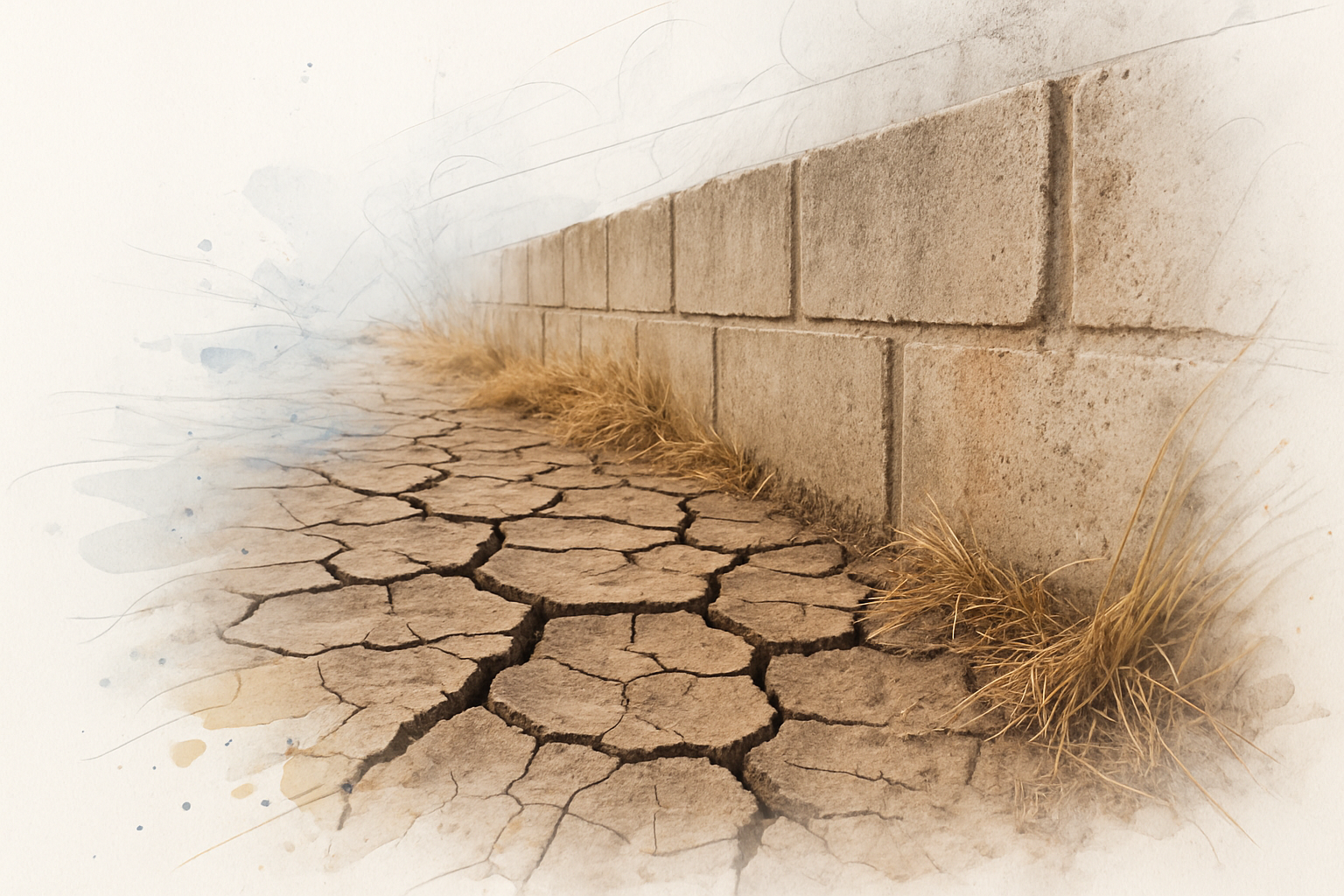
Clay by itself does not knock walls over. Water moving into and out of clay is what does it, and our local rainfall pattern is close to the worst case.
Mean annual precipitation around Salinas runs about 16 inches, and almost all of it arrives in a short wet season. That gives us a long dry summer followed by weeks of saturating rain.
Here is the sequence I see play out on real properties:
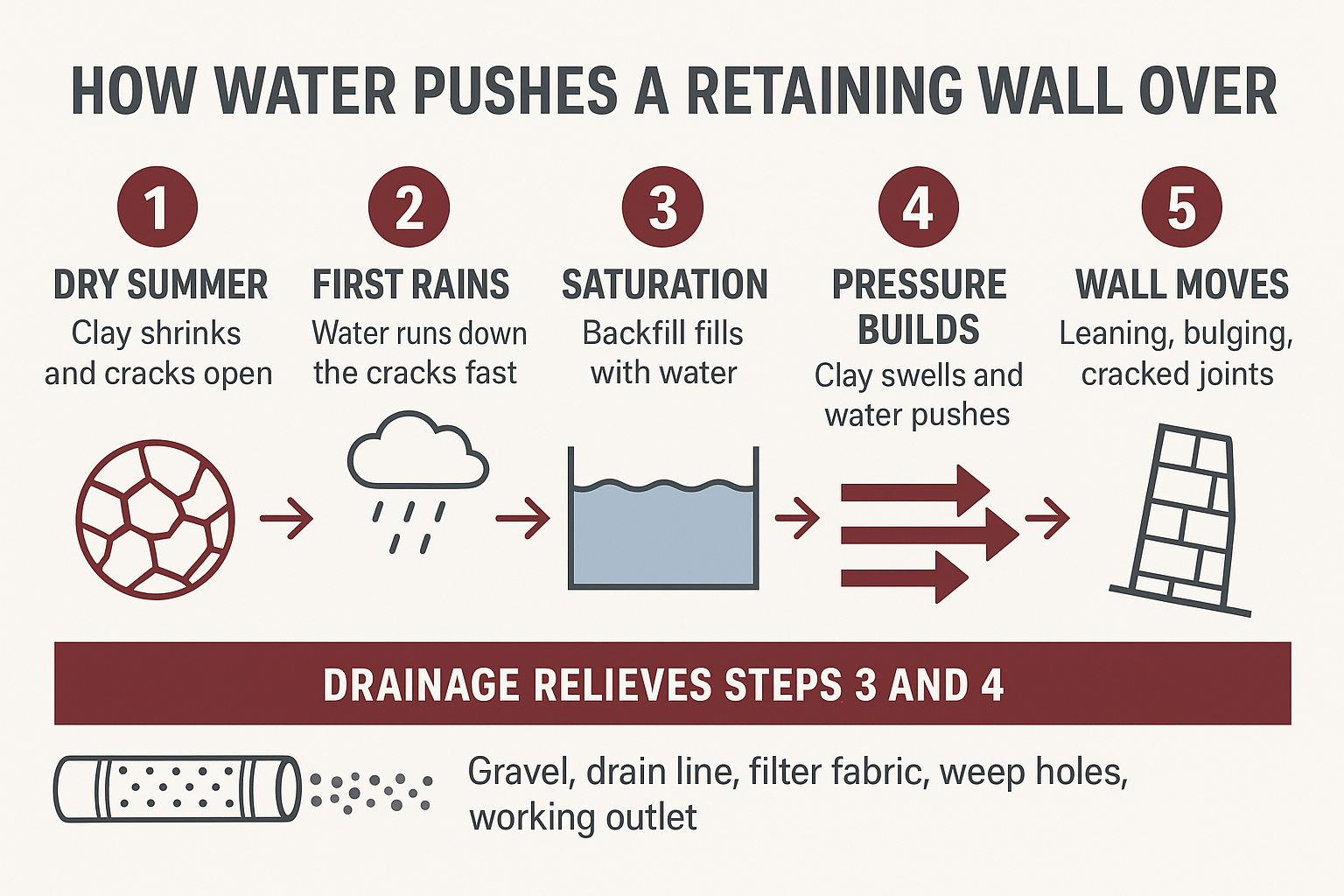
- Summer: the clay dries, shrinks, and opens cracks that can run deep into the soil profile
- First storms: water runs straight down those cracks instead of soaking in evenly
- Mid-winter: the soil behind the wall reaches saturation and starts to swell
- Result: the wall carries both swelling pressure from the clay and water pressure from the saturated backfill
A wall designed only for soil weight is now holding back something much heavier and much more aggressive. That is why a wall can stand for six or eight years and then move noticeably in a single wet winter, which is exactly what happens during a strong El Niño season. I wrote more about that pattern in what a strong El Niño winter does to a wall built without drainage.
How Water Pushes a Wall Over, Step by Step
This is the failure sequence I describe to homeowners on almost every site visit in Monterey County.
Drainage is an assembly, and the outlet is what usually fails
When people say a wall “has drainage,” they usually mean somebody put gravel behind it. Real drainage is a system of parts, and every part has a job.
- Free-draining gravel behind the wall so water can move down instead of sitting against the block
- A perforated drain line at the base of the backfill to collect that water
- Filter fabric between the native clay and the gravel so fines do not migrate in and plug it up
- Weep holes through the face of the wall at intervals to relieve pressure
- An outlet that actually daylights somewhere, downhill and clear
That last item is the one I find broken most often. The most common real-world failure I run into is not missing drainage. It is drainage with no outlet.
Think about what that does. You have built a system that collects water efficiently and then holds it in a gravel trench with nowhere to go. Now the pressure is concentrated behind the wall instead of relieved.
I have opened up walls where the pipe was there, the gravel was there, and the outlet had been buried under a later landscape project or was simply never run to daylight. If you want the longer version of how that layer is built, see the drainage layer a retaining wall cannot work without.
What Your Wall Is Trying to Tell You
These are the symptoms homeowners describe when they call, and what they usually mean on expansive clay.
| What you see | Likely cause | Where drainage fits in |
|---|---|---|
| Wall leans out at the top | Soil and water pressure exceeding design | Saturated backfill added load the wall was never built for |
| Bulge in the middle of a long run | Localized pressure, often a blocked drain path | Water is pooling in one section instead of draining out |
| Stair-step cracking through joints | Differential movement from swell and shrink | Moisture cycling in the clay is not being controlled |
| Weep holes dry during heavy rain | Clogged gravel or plugged drain line | Water is being collected but cannot exit |
| Wet ground, moss, or efflorescence at the base | Water is exiting through the wall face | There is no functioning outlet, so the wall became the drain |
| Capstones shifted or unsupported | Movement in the courses below | Base or footing likely disturbed by soil movement |
The honest answer about soil testing on your specific lot
I get asked all the time whether a property has “bad soil.” I can tell you what is generally mapped in an area and what I see when we dig, and that is genuinely useful information. But it is not a soils report.
Site conditions change lot to lot, and sometimes within a single backyard. Slope, uphill water, past grading, and depth to firmer material all change the answer.
So here is our scope, stated plainly: we do not perform soil testing or drainage engineering. For those, homeowners should coordinate with a licensed soil engineer or the appropriate design professional, and we build to what that plan calls for.
Saying that out loud has never cost us a job. It usually does the opposite, because homeowners who have been burned before recognize the difference between a contractor who claims everything and one who tells them where the line is. If you are wondering whether your project crosses into engineered territory, when a retaining wall needs an engineer in California covers the thresholds and why permit requirements vary by jurisdiction and project type.
One more thing worth knowing. A homeowner near the coast recently asked us to confirm license and insurance before scheduling a site visit for a damaged block wall, which is exactly the right instinct. Any California contractor’s license can be verified through the CSLB’s check-a-license tool, and a C-29 masonry classification is what covers this scope of work.
What good base and drainage work costs you up front
Base preparation and drainage are invisible once the wall is finished, which is why they are the first things cut from a cheap bid. That is also why two quotes for the “same” wall can be far apart.
Costs vary a lot by site, but in Monterey County the factors that move the number most are:
- Footing depth and how much of it has to be dug through hard or wet clay
- Wall height, which drives both structure and whether engineering is required
- Access, since hand-carrying material into a Carmel Valley backyard is not the same as a driveway drop
- Drainage runs, including how far the outlet has to travel to daylight
- Material choice, from CMU block to natural stone facing
- Export of spoils, which is a real line item when you are removing tons of clay
Skipping drainage might save a modest amount on day one. Rebuilding a failed wall means demolition, disposal, new excavation, and starting the whole assembly over, and that is almost always the more expensive path. How a retaining wall quote is built breaks the line items down further.
Frequently Asked Questions About Retaining Wall Failure on Clay Soil
How do I know if my property has expansive clay?
Mapped soil data will tell you what is likely, and Cropley and Diablo clays are the expansive ones to watch for around Salinas. But the only reliable answer for a specific lot comes from a soils report or a licensed soil engineer. Deep polygon cracking in the yard during late summer is a strong field clue.
Can drainage be added to a wall that is already leaning?
Sometimes, and sometimes not. If the wall has only settled slightly and the structure is sound, improving drainage and relieving the water load can be part of the fix. Once a wall has rotated at the top or the courses have separated, you are usually looking at a rebuild of that section, because the internal alignment is gone.
My weep holes stay dry even in heavy rain. Is that good?
It is usually a warning sign. Dry weep holes during a storm often mean the gravel behind them has clogged with fines or the drain line is plugged, so water is backing up somewhere you cannot see. That is worth having someone look at before the next wet season.
How long should a properly built retaining wall last on clay soil?
A wall built on a proper base with working drainage should serve for decades in this climate. The failures I get called out to are rarely old walls that wore out. They are newer walls where the base, the backfill, or the outlet was shortcut.
Do I need a permit for a retaining wall in Monterey County?
It depends on height, location, surcharge, and the jurisdiction. Requirements differ between the county and cities like Monterey, Pacific Grove, and Carmel, so the local planning or building department is the right first call. Never assume a wall is exempt because a neighbor’s was.
Thinking through a wall on clay soil?
If you are planning a retaining wall in Salinas, Carmel Valley, or anywhere on the Monterey Peninsula, understanding your soil and your drainage outlet before anything gets built saves the most money. Our team works from soils and drainage plans prepared by the appropriate professionals, and handles the masonry side, from footing to cap. Stonecap Masonry can be reached at 831-262-0442 or at stonecapmasonry.com if you would like to talk through a project.