Direct Answer: Granite handles heat and moisture best near the firebox. Limestone and sandstone look softer but stain and absorb water. Manufactured veneer is light and affordable, with repeating patterns a careful eye notices.
Most people call me after they have already fallen for a sample. They saw a pale honed limestone at a stone yard in Monterey County, loved it, and now they want to know if it will work around a fireplace that actually gets used.
That question has a real answer, and it has almost nothing to do with looks. It comes down to density, porosity, and where on the fireplace the stone is going to sit.
This guide walks through limestone, granite, sandstone, full-bed natural stone, brick, and manufactured veneer the way I would talk through them standing in your living room. What each one does well, how it ages, and where it tends to let people down about five years in.
The heat zone and the field are two different problems
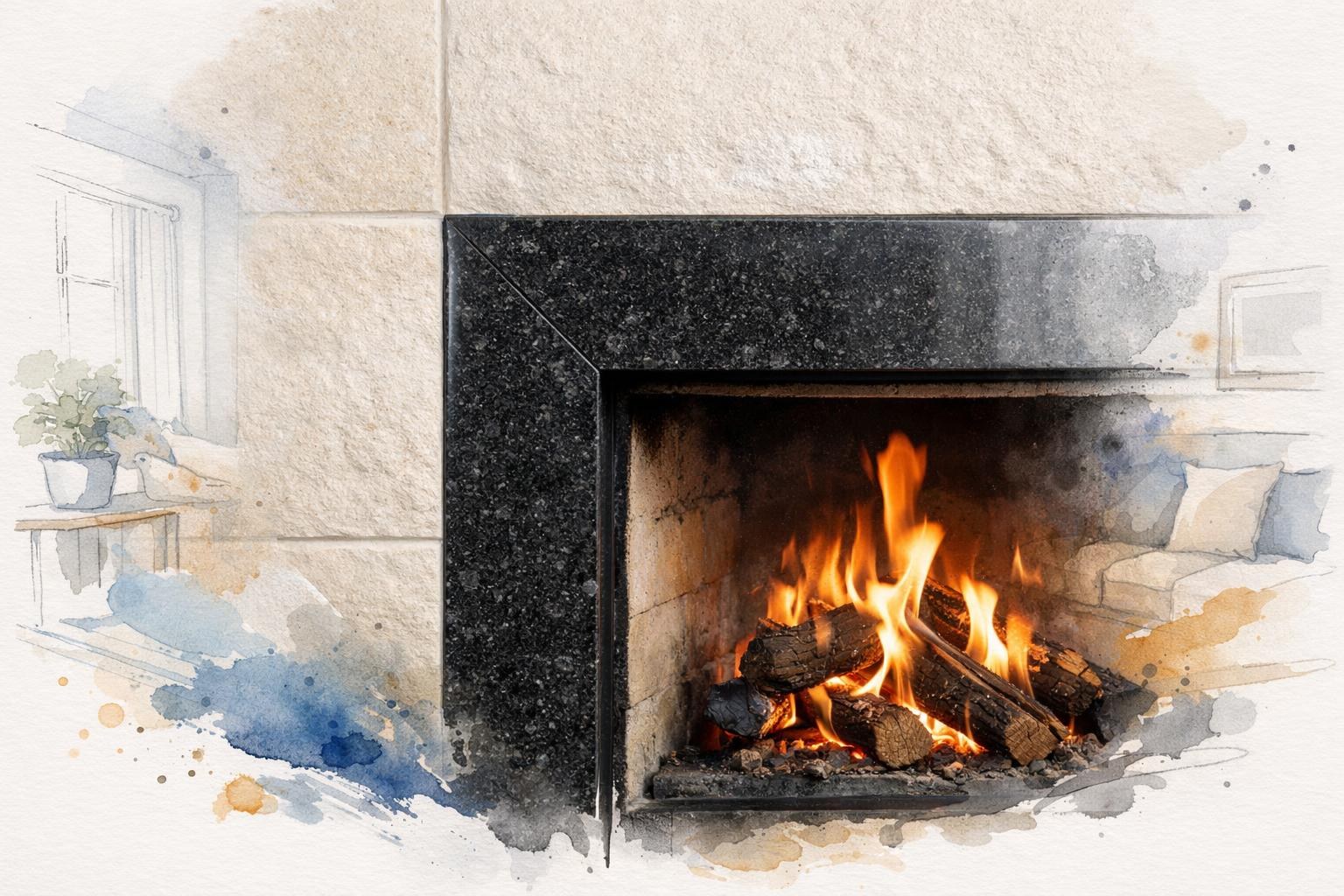
Picture a line a few inches out from the firebox opening. Inside that line, the stone takes direct radiant heat, repeated heating and cooling, and soot. Outside it, the stone is mostly decoration.
Those two areas do not have to be the same material. On plenty of Peninsula fireplaces they should not be.
A dense stone right at the opening shrugs off thermal cycling and wipes clean. A porous stone in that same spot pulls soot into the surface and holds it. Once soot is in limestone, it is in there.
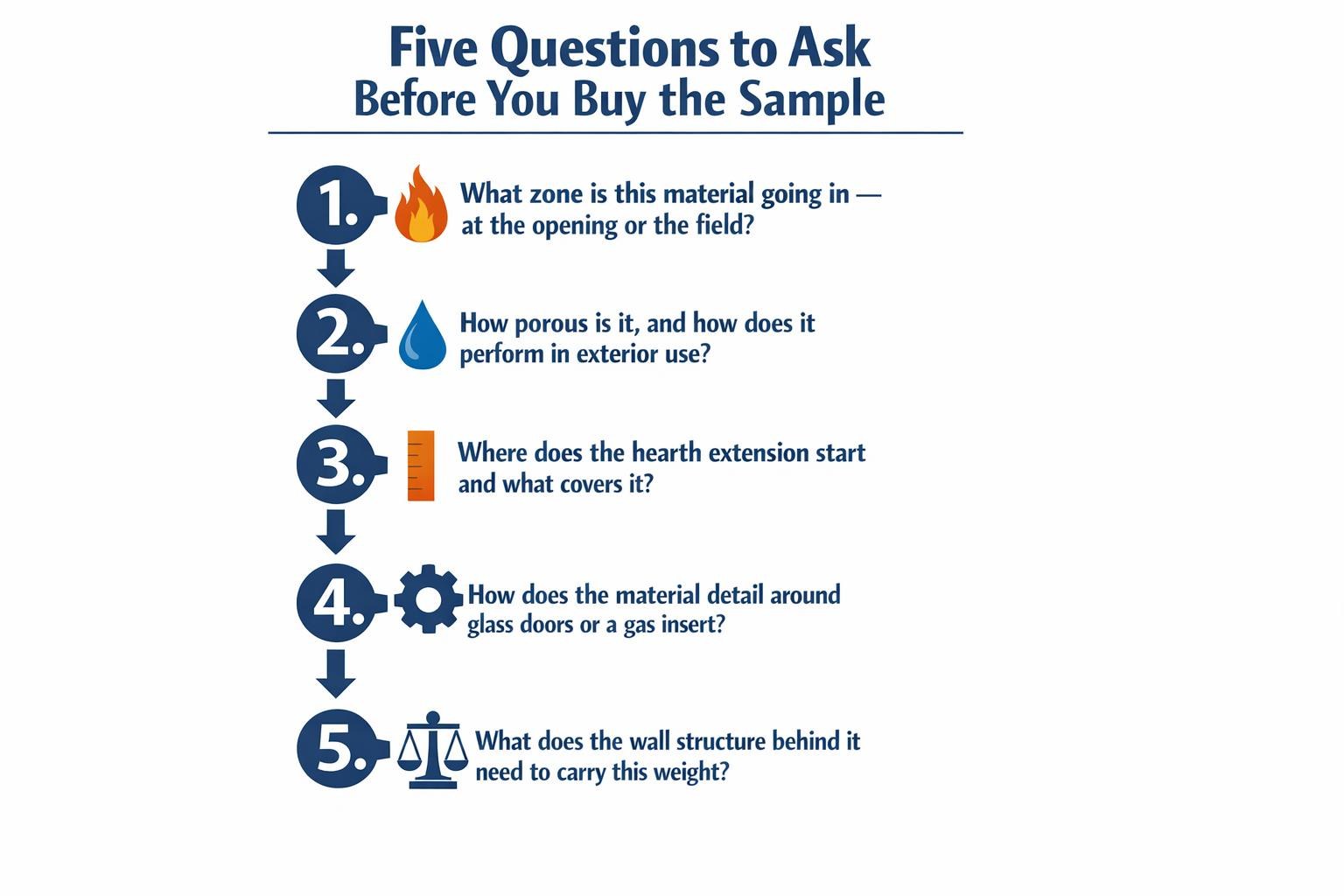
So at the stone yard, ask two separate questions:
- What is going directly around the opening, where heat and smoke touch it?
- What is going on the field, the larger wall area above and beside it?
- Where exactly does the hearth extension start, and what material covers it?
There is a code piece here too. The 2025 California Energy Code requires masonry fireplaces to have closable metal or glass doors covering the full firebox opening, plus a combustion air intake. The surround has to be detailed around that hardware, which means your opening dimensions and your material choice are not independent decisions.
How each material behaves once it is installed
Here is the plain version of what I have watched happen to each of these on real fireplaces around Salinas, Carmel, and Pacific Grove.
Granite. Dense, tight, almost no absorption. It handles heat right at the opening better than anything else on this list and cleans up with a damp rag. It cuts hard and slow, which shows up in labor, and the polished slab look reads modern. In a honed or flamed finish it softens considerably.
Limestone. Beautiful, warm, easy to work, and the material most Peninsula homeowners show me first. It is also soft and porous. Near the firebox it stains from soot, and outdoors it drinks water. I have seen limestone surrounds that looked perfect at install and tired after two wet winters. It is a fine field material indoors on a fireplace that is used lightly. It is a poor choice at the opening of a fireplace that burns wood every week.
Sandstone. Similar story to limestone with more variation. Some sandstone is reasonably tight, some sheds grain off the face when it cycles wet and dry. Ask the yard where the stone was quarried and how it performs in exterior use before you commit.
Full-bed natural stone. Real stone at full thickness, typically three to five inches. It looks like stone because it is stone, with actual depth at the edges and returns. It is heavy, so the structure behind it has to carry the load and the anchorage has to be right. That is a build decision, not a finish decision, and it is covered in more detail in what the structure behind a veneer reface decides first.
Brick. Underrated. It handles heat, it is dimensionally predictable, it cuts cleanly, and it ages gracefully. The limitation is the look, which is firmly traditional unless you get creative with bond pattern and mortar color.
Manufactured veneer. Lightweight concrete cast in molds, colored through. It is lighter, faster to set, and easier on a wall that was not built for stone weight. The honest drawback is the mold count. Any given profile has a limited number of repeating shapes, and on a large field a careful eye eventually picks out the same rock three times. Good installers break up the pattern deliberately. It is also less forgiving outdoors in heavy fog exposure, where the color coat can fade unevenly.
Fireplace surround materials at a glance
A quick comparison of how these materials behave in the two zones that matter.
| Material | At the firebox opening | Where it disappoints later |
|---|---|---|
| Granite | Excellent, dense and heat tolerant | Cut time and weight drive labor up |
| Limestone | Risky, porous and stains from soot | Soot marks indoors, water staining outdoors |
| Sandstone | Varies by quarry, often too soft | Face flaking after wet and dry cycling |
| Full-bed natural stone | Strong, depends on the stone type | Needs real support and anchorage behind it |
| Brick | Very good, predictable under heat | Look is traditional and hard to modernize |
| Manufactured veneer | Acceptable outside the direct heat zone | Repeating molds become visible over time |
Five questions to ask before you buy the sample
Bring this list with you to the stone yard. It will keep the conversation on performance instead of color.
Outdoor surrounds here are a water problem, not a heat problem
This is the part out-of-area advice gets wrong. For an outdoor fireplace on the Monterey Peninsula, moisture decides the material, not fire.
Fog drip in Carmel and Pacific Grove soaks a wall overnight even in July. Closer to the water, salt comes with it. Then December through March arrives and the stone stays wet for weeks at a stretch, with forecasters pointing to El Niño conditions holding into early spring 2027.
Water is the mechanism behind nearly every masonry failure I get called out for. On a porous surround it shows up as:
- Dark water staining that never fully dries out
- Face flaking where the surface sheds in thin layers
- Efflorescence, the white powdery salt bloom that comes through the joints
- A sealer that needs redoing in a year or two instead of five
A limestone that looks fantastic on an inland Carmel Valley patio can look worn out a few blocks from the beach. The honest fix is usually a denser stone or a shorter sealing schedule, not a different style. There is more on how our microclimate shifts these calls in planning an outdoor fireplace around the Peninsula’s climate.
The hardest part is matching what is already there
For most of the homeowners I work with, picking a stone in isolation is not the real problem. The surround has to agree with the hardscape, the pool coping, or the exterior veneer that is already on the property.
A surround that does not match reads as an add-on forever. People notice, even when they cannot say why.
A Carmel Valley customer put it plainly in a review after we rebuilt a pool-edge area: “Cande demolished it and created a nice sitting area at the pools edge and matched the stone hardscape around the pool perfectly.” That matching is the work.
Practical direction for the yard visit:
- Bring an actual piece of the existing stone, not a phone photo
- Look at every sample wet and dry, because wet is what fog and rain give you
- Carry samples outside into Peninsula overcast light, not showroom light
- Expect color to shift as the stone weathers, usually a shade or two
If you are blending new work into old, what makes a repair or addition blend in goes deeper on the technique.
Why two bids on the same fireplace differ by thousands
Pricing confusion comes up constantly, and the price per square foot on the sample tag explains almost none of it. The spread comes from thickness, weight, and cut time.
The levers that actually move a number:
- Square footage of the surround and whether it runs full height to the ceiling
- Material weight and what that demands structurally behind the face
- How much cutting the pattern needs, especially irregular stone fit around an opening and a mantel
- Whether the existing facing has to come off first, and what is found behind it
- Whether glass doors or a gas insert change the detailing at the opening
Ask any bidder which of these their number assumes. A quote that does not mention demo or anchorage is a quote with a hole in it.
Costs in Monterey County vary widely by material and access, so treat any figure you read online as context only and get an exact number from a mason who has stood in front of your fireplace. Why masonry fireplace costs vary so widely breaks the levers down further.
Frequently Asked Questions About Stone Fireplace Surrounds
Can I use limestone around my fireplace at all?
Yes, with limits. Limestone works well on the field area of an indoor surround, away from the opening, on a fireplace that is used occasionally. I would steer away from it right at the firebox on a hard-burning wood fireplace, and I would think hard before putting it outdoors within fog range of the water.
Is manufactured veneer a cheap substitute for real stone?
Not cheap, just different. It is lighter, which matters when the wall behind it was not built to carry full-bed stone, and it installs faster. The honest tradeoff is the repeating mold pattern, which a careful eye picks up over time on a large wall.
Do I need a permit to reface a fireplace surround?
It depends on the jurisdiction and the scope. A cosmetic reface is often handled differently than structural work or anything touching the firebox or venting. Requirements vary between Salinas, Carmel, Pacific Grove, and unincorporated Monterey County, so check with the local building department before work starts.
How often does an outdoor stone surround need resealing here?
Far more often than the product label suggests. Fog drip, salt air, and a long wet season push porous stone harder than inland conditions do. Dense stone buys you time. Soft stone near the coast may want attention yearly.
How do I check that a masonry contractor is actually licensed?
Use the CSLB check-a-license tool on the state’s website. You can confirm the license number, the classification, and whether the bond and insurance are current. For masonry, you are looking for a C-29 classification. Do that before a single sample gets ordered.
Still deciding between two samples?
Material questions like this one get easier when someone has set natural stone, brick, and veneer on Peninsula fireplaces and watched how each aged in fog and salt air. Stonecap Masonry is a licensed C-29 contractor in Monterey County, CSLB #1073620, and the team is reachable at 831-262-0442 or stonecapmasonry.com when you want a second opinion on what you are holding.
