
Direct Answer: Mortar is meant to be softer than the brick around it. When a repair mix is harder than the original units, moisture and movement stress move into the brick faces instead of the joints.
You run a finger along the joint of an old brick wall or chimney and sand falls out. That is usually when the calls start coming in, and the first question is almost always the same: can this be patched, or is the whole thing going?
Most of the time it can be repaired. But I have seen plenty of walls around Salinas and Pacific Grove where somebody already repointed once, used a bag of high-strength mix off the shelf, and made the wall worse than it was before.
This is about mortar repair compatibility: why the new mix has to match the old wall instead of beating it, how that mix gets chosen, and what to look for in a repair plan before anyone touches a joint.
Mortar Is Supposed to Be the Weak Part of the Wall
Masonry walls move. They expand in heat, contract in cold, take on moisture in a wet week, and shift a little in a seismic area like ours.
Mortar is designed to absorb that. It is the sacrificial layer, softer than the brick or stone so that when something has to give, it gives in the joint where it can be replaced for a fraction of the cost of the units.
Put a harder mix in that joint and the physics flip. The pressure still has to go somewhere, and the only path left is through the brick face. That is where you get:
- Spalling, where the face pops or flakes off the brick
- Hairline cracking that runs through units instead of along joints
- Trapped moisture, because dense mortar does not let the wall dry the way it used to
- Salt deposits pushing out through the brick rather than the joint
The National Park Service put this plainly decades ago in its guidance on repointing historic masonry: new mortar should match the original in strength, composition, and look, and it should never be stronger than the units around it.
If faces are already flaking on your wall, that is a related but separate problem, and I covered it in detail in the piece on spalling brick on Peninsula homes.
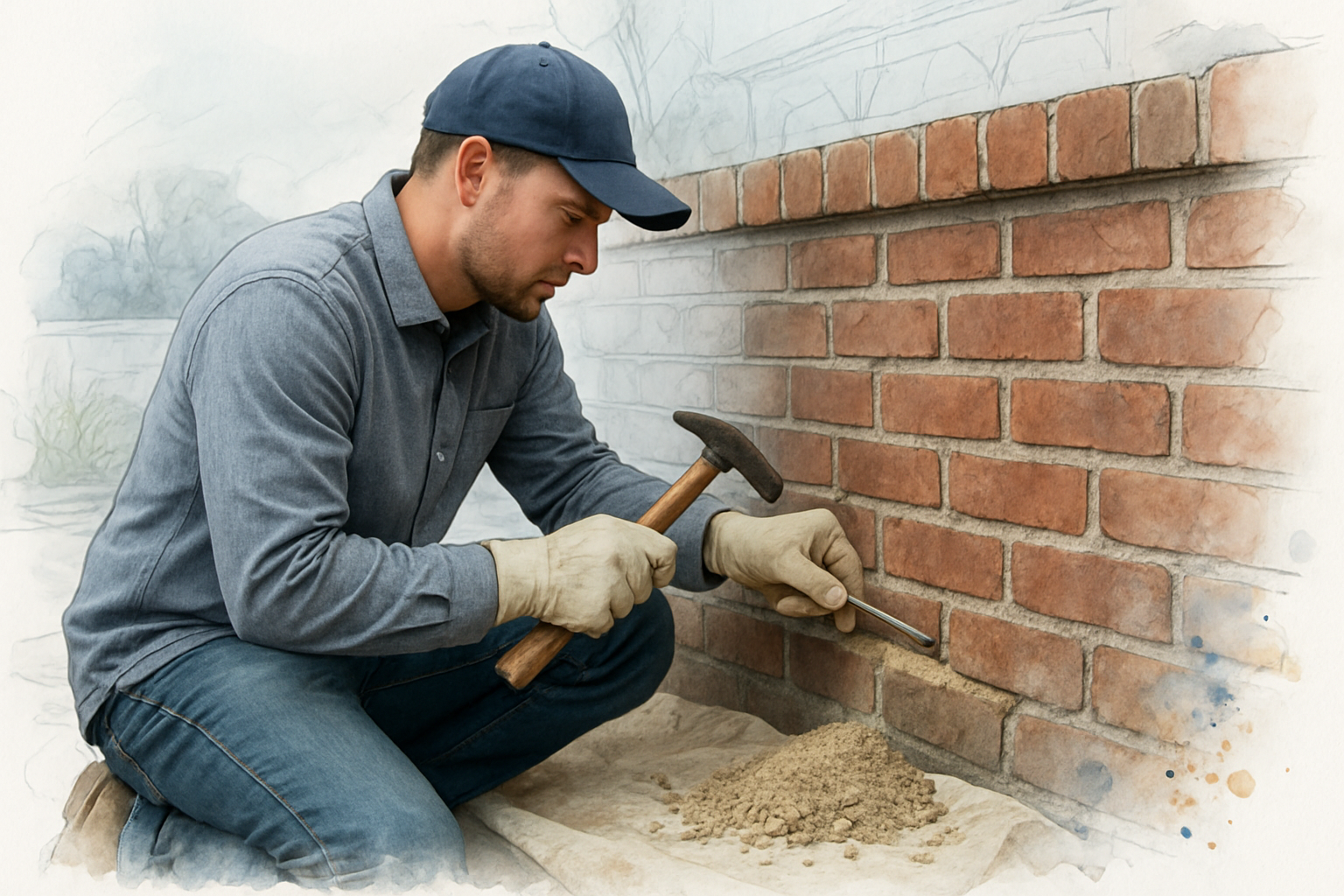
Why Older Monterey County Brick Needs a Softer Mix
A lot of the owner-occupied housing in and around Salinas went up between the 1940s and the 1970s, with plenty of older stock on the Peninsula ahead of that. None of it was laid with the kind of high-strength mortar sold on a pallet today.
Older brick is often softer and more porous than modern units, especially anything made locally before mid-century. Pair that soft brick with a modern hard mix and you have built a trap.
So when I look at a repair, the mix decision comes from a few things:
- Age of the wall and what the original mortar looks like under a scratch test
- Hardness of the brick or block itself, not just the joint
- Exposure, meaning sun, prevailing wind, roof runoff, and how close the wall sits to the coast
- Whether the wall is structural or veneer, which changes what the joint has to carry
- What the existing joint looks like once a small area is raked out
If a mason asks how old the house is before quoting a joint repair, that is not small talk. That question drives the whole spec.
And on the Peninsula there is a second layer to it. Salt in the air attacks joints in its own particular way, which I walked through in how salt air changes mortar joint failure.
Mortar Types in Plain Language
Mortar is classified by relative strength. Higher is not better. Here is the short version of what each type is generally suited for, with the understanding that any real spec comes from looking at the actual wall.
| Type | Relative Strength | Generally Used For |
|---|---|---|
| Type M | Highest | Below-grade and heavy structural work, rarely right for old brick |
| Type S | High | Foundations, retaining walls, work resisting soil or lateral load |
| Type N | Medium | Common general-purpose mix for above-grade walls and many veneers |
| Type O | Low | Repointing softer, older interior or low-stress masonry |
| Lime-rich custom blends | Lowest | Historic or very soft brick where flexibility matters more than strength |
Find the Water Before You Fill the Joint
Repointing a wall without finding the water source is money spent twice. The preservation guidance is blunt about this, and so am I: leaking gutters and drainage faults get corrected first, or the new joints fail on the same schedule as the old ones.
On Peninsula homes the usual suspects are not exotic:
- A downspout dumping and splashing against the base of a wall
- Roof runoff with no gutter at all, sheeting straight down the face
- Planter beds holding wet soil against brick with no capillary break
- Irrigation spray hitting the same three feet of wall every morning
- Fog-driven moisture on a shaded north face that never fully dries out
White chalky powder on the surface is a tell. That is salt carried out of the wall by moving water, and I broke that down in white powder on brick and block.
The timing matters right now. NOAA’s Climate Prediction Center has carried an El Nino advisory with strong odds of the pattern holding through early spring, which tilts the Central Coast toward more frequent atmospheric river events. That shifts the odds, it does not promise a flood winter, but it is a decent argument for fixing a splashing downspout in October rather than February.
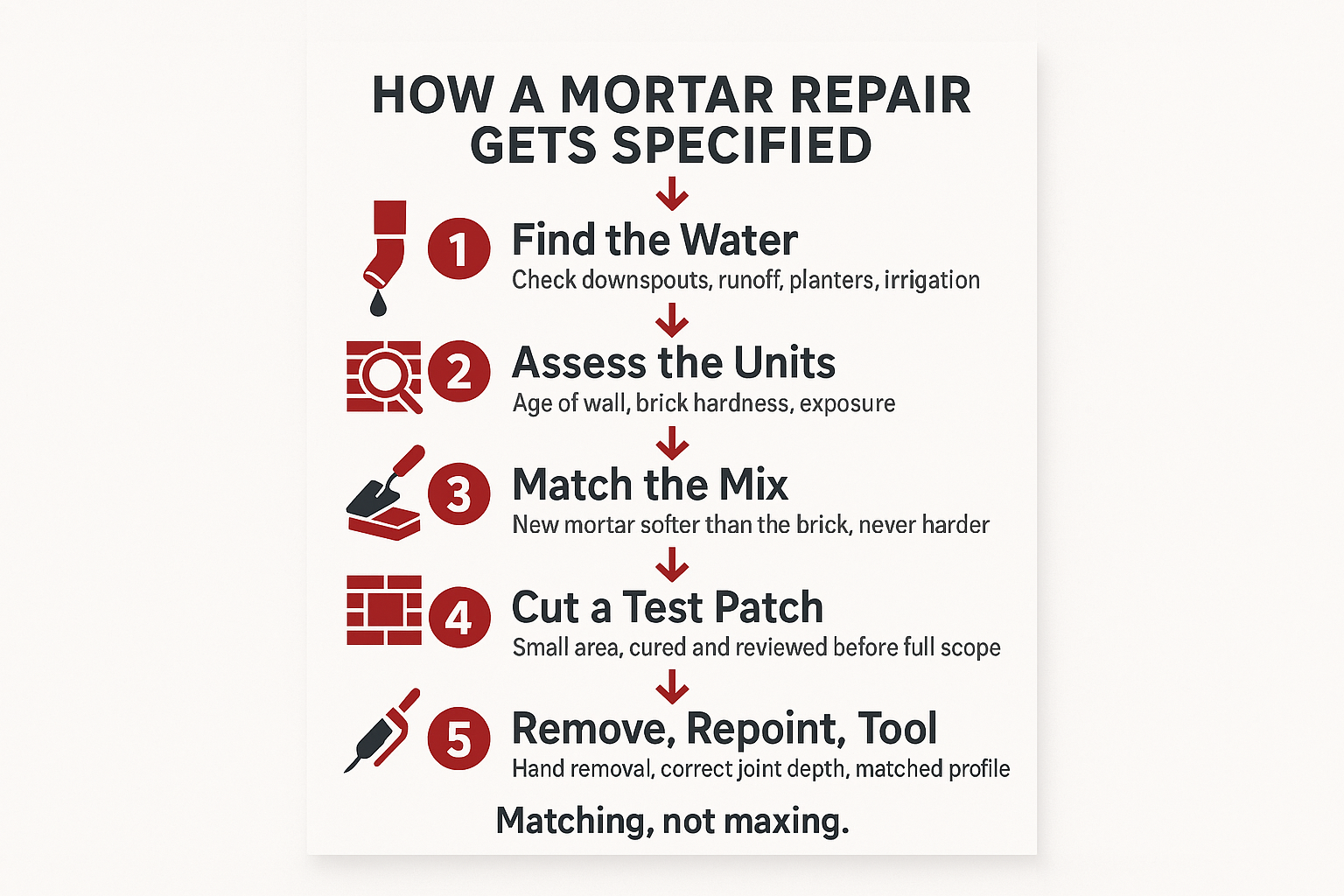
How a Mortar Repair Gets Specified
Here is the order a careful joint repair actually follows, before any new mortar goes into the wall.
Two Quotes on the Same Wall Can Describe Two Different Jobs
Homeowners call me all the time holding two bids that are thousands apart and no way to tell what the gap is buying. With joint work, the difference almost never sits in the labor rate. It sits in removal method, joint depth, and mix spec.
Four questions worth asking any bidder:
- How will old mortar be removed? Hand chisels are slower. Angle grinders run fast and, in the wrong hands, widen joints and chip brick edges permanently.
- How deep will the joint be cut? The usual target is roughly two to two and a half times the joint width, cut square, not feathered over soft material.
- What mix are you specifying, and why that one? A straight answer references the existing wall, not a brand name.
- Will a small test area go in first? A cured patch tells you about color and bond before the whole elevation is committed.
Cost moves with those answers more than with square footage. Many Monterey County homeowners see joint repair quoted per square foot of wall face, and the range widens quickly with height, access, scaffolding, chimney work, and how much hand removal is involved. An exact number only comes from someone standing at the wall.
I went deeper on the whole pricing picture in what drives the cost of a masonry repair.
The Part You Actually Look At Every Day
A structurally sound repair that reads as a gray stripe across a wall you have looked at for twenty years is still a disappointment. Color and profile are craft work, not product selection.
What I am matching is mostly three things:
- Aggregate, meaning the sand color and grain size, which drives the finished tone more than the cement does
- Joint width, which changes if removal was sloppy and cannot be put back
- Profile, how the joint is struck: concave, raked, weathered, flush
Sand gets blended and sample boards get made, and the color is judged dry and cured, never wet. A repair that disappears takes more setup time on the front end than one that stands out.
One Carmel Valley homeowner wrote that we “matched the stone hardscape around the pool perfectly,” and that is the standard I want on joint work too. There is more on the matching process in matching new stone to old.
Frequently Asked Questions About Mortar Repair
Can I just use a bag of premixed mortar from the hardware store?
On an older brick wall, usually not. Most off-the-shelf bags are blended on the stronger side, and stronger than the brick is the exact failure mode you are trying to avoid. Beyond that, repointing structural masonry is not a weekend project, and a bad joint depth is worse than no repair.
How do I know if my joints actually need repair or if they just look old?
A reasonable field test is to press a key or screwdriver into the joint. If it crumbles out or you can push in more than about a quarter inch without much effort, the joint has lost its binder. Scattered surface weathering with sound mortar underneath often does not need anything yet.
Does mortar repair need a permit in Monterey County?
It depends on the jurisdiction and what the wall does. Cosmetic joint repair on a garden wall is usually a different conversation than structural repair on a chimney or a load-bearing wall, and cities on the Peninsula handle it differently. Check with the local planning or building department for your specific address before work starts.
How long should a mortar repair last on the Peninsula?
When the mix is matched and the water source is corrected, properly repointed joints should run for decades. When a hard mix goes into soft brick, I have seen problems show up within a few wet seasons, and by then the damage is in the brick faces rather than the joints.
Does the whole wall have to be repointed at once?
No. Joint work is commonly done in the areas that have failed, often one elevation or one band near the base where splashing has done the damage. Doing sound joints that do not need it adds cost and risks chipping brick for no reason.
Thinking Through a Joint Repair on an Older Wall?
Repointing and structural masonry repair sit inside California’s C-29 masonry classification, and license, bond, and workers’ comp status is public information you can confirm on the CSLB check-a-license tool in about a minute. That is worth doing on every bidder you talk to, including us. Stonecap Masonry is a licensed, bonded, and insured C-29 contractor (CSLB #1073620) taking repair calls across Monterey County, and the team can be reached at 831-262-0442 or at stonecapmasonry.com.
