
Direct Answer: Spalling is the brick itself breaking apart, usually from trapped moisture and salt. The fix starts with stopping the water, then patching, replacing units, or rebuilding based on how deep the loss goes.
Most people do not call me and say they have spalling brick. They say the face of the brick is peeling off in thin sheets, or there is a pile of orange grit at the base of the chimney every few weeks, or a few bricks sound hollow when they tap them.
That is spalling. It means the brick unit itself is breaking down, not the mortar joint between the bricks. Mixing up those two things is the single most common reason a homeowner pays for the wrong repair.
In this guide I want to walk through what actually causes it on the Monterey Peninsula, the two repairs I see that make it worse, and how a mason decides between patching, swapping units, or rebuilding a section.
Spalling Brick vs. Failing Mortar: Know Which One You Have
Stand a foot away from the wall and look at where the damage starts.
If the joint lines are crumbling, sandy, or recessed and the brick faces are still flat and intact, that is a mortar problem. The usual repair there is repointing, which means cutting out the bad joint and packing in fresh mortar.
If the brick faces are chipped, blistered, or shedding in flat sheets and the joints look fine, the brick is spalling. Those are different repairs with different costs and different urgency.
Quick field checks I use on a first visit:
- Tap test. A dull, hollow sound often means the face has separated from the body of the brick, even if it has not fallen off yet.
- Debris check. Sandy gray dust at the base points to mortar. Orange or red flakes and chips point to brick.
- Pattern check. Spalling usually clusters where water sits or runs, not randomly across a wall.
- Height check. Damage concentrated in the bottom two or three courses usually means ground moisture or irrigation.
The pattern tells the story more than the damage does. Two bricks blown out under a leaking downspout is a plumbing-adjacent fix. Forty bricks blown out across a whole chimney face is a different conversation.
Why Peninsula Brick Spalls: It Is Almost Always Water
Brick is porous. It takes on water, and it is supposed to release that water again.
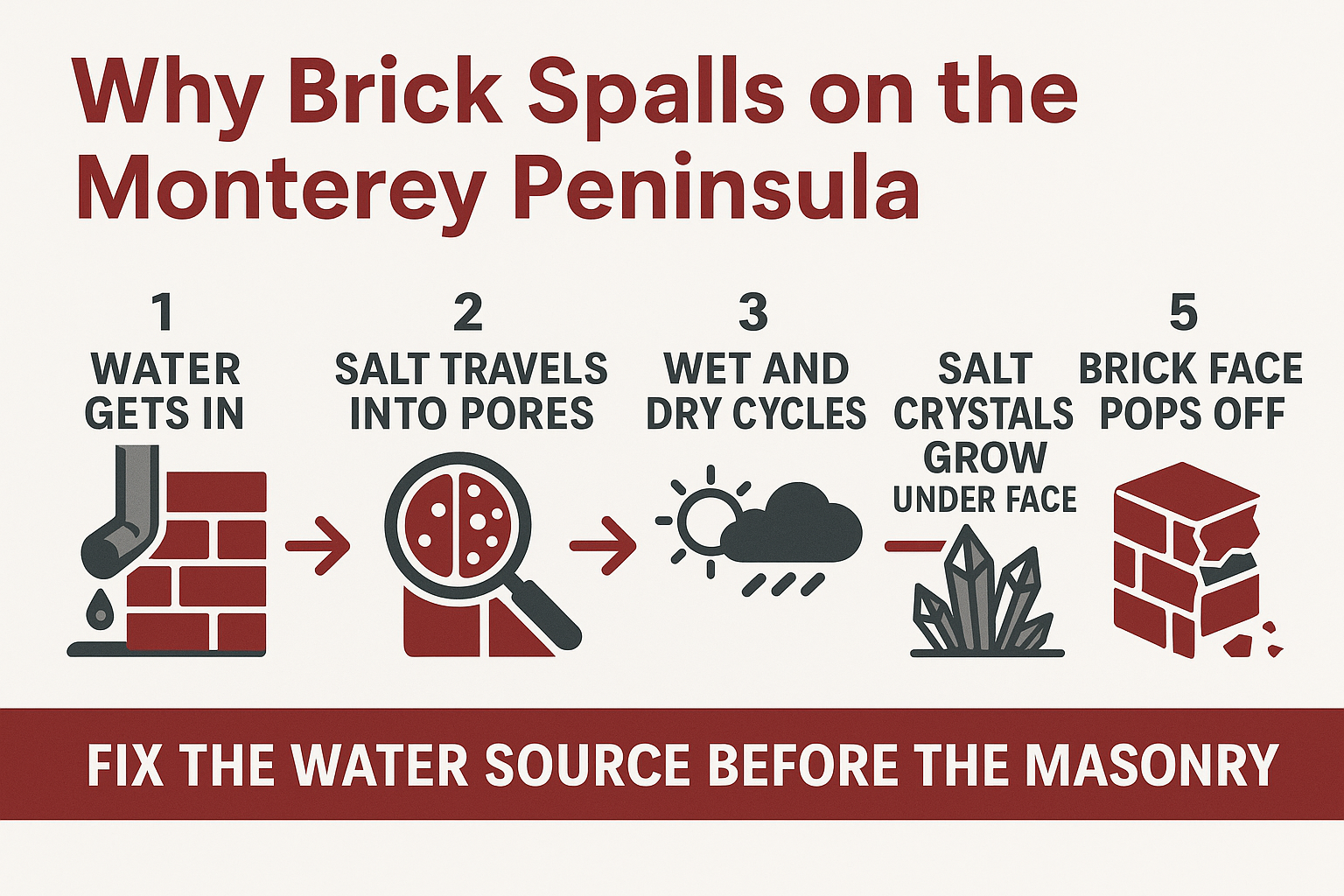
On the coast side, in Pacific Grove, Pebble Beach, and coastal Carmel, the marine layer keeps masonry damp for long stretches and the fog carries salt. Those salts move into the pores of the brick with the water. When the surface finally dries, the salts crystallize just under the face, and that pressure pushes the face off. The National Park Service preservation guidance describes the same mechanism and warns against sealing masonry that is already spalling.
Inland in Salinas the salt load is lower, but the swings are sharper. Hot, dry summers and heavy winter rain push brick through harder wet and dry cycles than the fog belt does.
The good news is that most of the water sources I find are fixable and cheap to fix:
- Irrigation spray hitting a brick wall every morning for years
- A downspout dumping straight onto the base of a wall or chimney
- Planter soil or mulch piled above grade against brick that was never meant to be buried
- A cracked or missing wall cap letting water in from the top, where brick has the least defense
- Failed chimney crown sending water down inside the stack
Salt air also changes how the joints behave, which is worth understanding alongside the brick itself. I covered that in more detail in how salt air changes the way mortar joints fail on the Peninsula.
The Two Repairs That Make Spalling Worse
I inherit these two more often than anything else, usually from a previous contractor or a handyman who meant well.
Sealing or painting a spalling wall. A film-forming sealer or exterior paint over damp, salt-loaded brick traps the moisture behind it. The water still gets in from the top, the back, or the ground, and now it cannot leave. When that film eventually fails, it takes more of the brick face with it. I have pulled paint off Peninsula chimneys and watched the brick come off in sheets behind it.
Repointing with hard, cement-rich mortar. Old brick is relatively soft. If the new mortar is harder and less permeable than the brick around it, moisture and salt stop moving out through the joint and start moving out through the brick face instead. The joints look sharp and the bricks keep crumbling.
A correct repair generally runs the other direction:
- Find and fix the water source first, before anyone touches the masonry
- Match a mortar that is softer than the brick, not harder, on older work
- Let the wall breathe instead of coating it
- Replace badly lost units rather than skim-coating over them
This is diagnostic work, not a weekend project. Guessing at the mortar mix on an older brick home is how a small repair turns into a wall rebuild five years later.
How a Brick Face Ends Up on the Ground
Here is the sequence I explain on almost every spalling brick site visit, start to finish.
Patch, Replace, or Rebuild: How I Make the Call
Once the water source is identified, the repair scope comes down to four judgment points.
Depth of loss. Shallow surface chipping on a handful of units is different from bricks that have lost a half inch or more of face and are now shedding at the body.
Count and grouping. Ten scattered bricks across a large wall is a spot repair. Ten bricks clustered in one corner usually means something structural or a concentrated water path, and I look harder before quoting.
Structural or veneer. A load-bearing brick wall and a brick veneer over wood framing fail differently and get repaired differently. Veneer raises questions about anchorage and what is happening behind the brick.
Can the water be corrected. If the grade cannot be lowered or the cap cannot be rebuilt, replacing units just resets the clock.
Then there is matching. Finding a brick that matches a 1920s Monterey or Pacific Grove home in color, size, and texture is often the hardest part of the job, because the original run is long discontinued. When an exact match does not exist, I will often blend replacement units across a wider area so the repair reads as part of the wall instead of a patch. The same principle applies to stone, which I wrote about in matching new stone to old.
Three Repair Paths for Spalling Brick
This is the general framework, though every wall gets judged on site.
| Approach | When it fits | What to watch for |
|---|---|---|
| Spot patch or dutchman repair | Shallow face loss on a few scattered units, non-structural | Patch material must be softer and breathable, not a hard cement skim |
| Cut out and replace units | Deep loss, hollow-sounding bricks, grouped damage | Sourcing a color and size match on older homes; blending across a wider field |
| Rebuild the section | Widespread loss, chimney above roofline, parapet, or movement in the wall | Scope may involve structural review and plan check depending on jurisdiction |
What Drives the Cost of Brick Repair Around Monterey County
I will not throw a number at you before I see the wall, because the same visible damage can price very differently. But the drivers are things you can look at yourself.
- Unit count. Cutting out and resetting brick is slow, careful hand work. Volume moves the price more than anything.
- Access. A chimney above a roofline or a wall in a tight Carmel side yard needs staging and hand-carried material. A garden wall at driveway level does not.
- Water correction first. If grade, drainage, or a cap has to be handled before the masonry, that is real work ahead of the repair.
- Material sourcing. A hard-to-match discontinued brick takes hunting, and sometimes a blend strategy instead.
- Permits and review. Requirements vary by jurisdiction and by scope. Small cosmetic repairs often do not trigger much, while structural and chimney work is more likely to see plan review.
Costs across Monterey County vary widely on these factors, so an accurate figure takes an on-site look. If you want the longer version of how estimates get built, I broke that down in what drives the cost of a masonry repair.
When Spalling Stops Being Cosmetic
Most spalling I look at on Peninsula homes is a maintenance issue caught in time. Some of it is not.
Widespread face loss on a chimney above the roofline, on a parapet, or on an older brick storefront changes the conversation. Those are the elements with the least lateral support and the most to lose in a seismic event, and Monterey County preparedness material points to a 99.7 percent probability of a magnitude 6.7 or greater earthquake in California within 30 years.
For commercial owners, the City of Monterey addresses unreinforced masonry buildings through an earthquake hazard reduction framework that puts the burden on the owner to obtain professional structural analysis. Surface deterioration on that kind of building should be evaluated by a structural professional, not patched and painted.
The question of whether damage is cosmetic or structural comes up constantly, and it is worth reading the real difference between a cosmetic fix and a masonry repair before you accept a bid on either one.
Frequently Asked Questions About Spalling Brick Repair
Can I just seal the brick to stop it from flaking?
No, and on masonry that is already spalling a film-forming sealer usually accelerates the damage. It traps moisture and salt behind the surface, and when the coating fails it can take more of the brick face with it. Stop the water first, then repair the brick.
How do I know if it is the brick or the mortar?
Look at where the material is coming from. Sandy gray dust and recessed joint lines mean mortar. Orange or red flakes with flat brick faces peeling off mean the brick itself is spalling. They are separate repairs, so it matters which one you are buying.
Is spalling brick dangerous?
On a low garden wall it is usually a maintenance problem. On a chimney above the roofline or a parapet it can be a safety issue, because falling brick and poor lateral support both become real concerns in a seismic event. Those get looked at sooner.
What if the original brick is discontinued and cannot be matched?
That is common on older Monterey and Pacific Grove homes. The usual answer is a close replacement blended across a wider area rather than concentrated in one patch, so the eye reads it as part of the wall instead of a repair scar.
Do I need a permit for brick repair?
It depends on your jurisdiction and the scope. Small cosmetic repairs often do not trigger much, while structural work and chimney rebuilds are more likely to require permits and plan review. Requirements vary, so it should be confirmed with your local building department for your specific project.
Getting a Straight Answer on Spalling Brick
One homeowner here in Monterey County ended a repair request by simply asking us to confirm our license and insurance, which is a fair thing to ask anyone who shows up to diagnose brick. We hold CSLB License #1073620 as a licensed, bonded, and insured C-29 masonry contractor, and any California license can be checked through the CSLB check-a-license tool. Repeat clients have described the work as done to a high standard and on schedule, and if you want a look at spalling brick on your own home, we can be reached at 831-262-0442 or at stonecapmasonry.com.
