
Direct Answer: Sealing brick rarely stops water damage. Most coatings block the surface where moisture escapes, not where it enters, so water and salt stay trapped and push the brick face off.
Every October I get the same call. A homeowner is standing in front of a brick or block wall that has gone damp, chalky, and a little crumbly, and they want to know what sealer to buy before the rain starts.
I understand the instinct. The wall looks wet, so you want to make it waterproof. But here is the part almost nobody explains: a coating goes on the place water is leaving the wall, not the place it is getting in.
My position after years of doing this on the Peninsula is simple. In most cases, sealing a damp wall makes the damage worse over the next two or three winters. This article covers why that happens, how to find the real water path yourself, and why a wall in Pacific Grove behaves differently than one in east Salinas.
Why Sealing Brick to Stop Water Damage Usually Backfires
Brick, block, and mortar are not waterproof materials and were never meant to be. They are assemblies that let small amounts of moisture move through and then dry out through the face. That drying is how the wall stays stable.
When you spray a film-forming waterproofer across the face, you close that exit. Water still finds its way in through the top of the wall, a bad joint, or wet soil at the base. Now it has nowhere to go.
Here is what I see happen next:
- Winter one: the wall looks great. The homeowner thinks it worked.
- Winter two: dark damp patches show up behind the coating, and the sealer starts to cloud or peel in spots.
- Winter three: brick faces start popping off, usually at the bottom three or four courses.
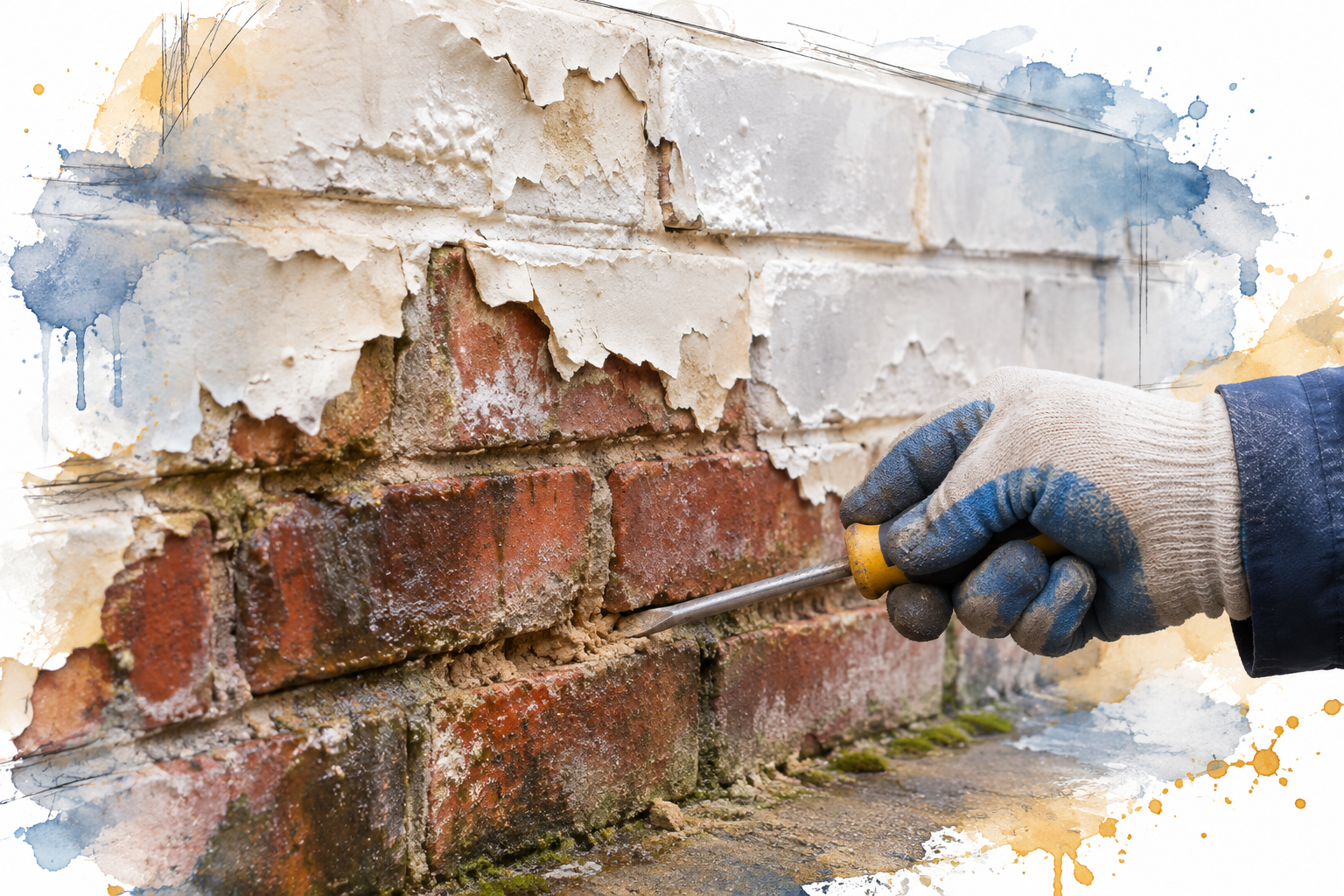
That last one is called spalling, and it is the expensive outcome. Trapped moisture carries dissolved salt. When that water tries to evaporate and cannot reach the surface, the salt crystallizes just under the face of the brick and pushes it off from the inside.
Once a brick face is gone, you are no longer cleaning a wall. You are replacing units and matching mortar, which is a different scale of job entirely. I wrote more about that failure pattern in why brick faces flake on Peninsula homes.
Not All Masonry Treatments Are the Same
I want to be fair here, because there is an honest use for masonry treatments. The problem is the product most people grab off the shelf.
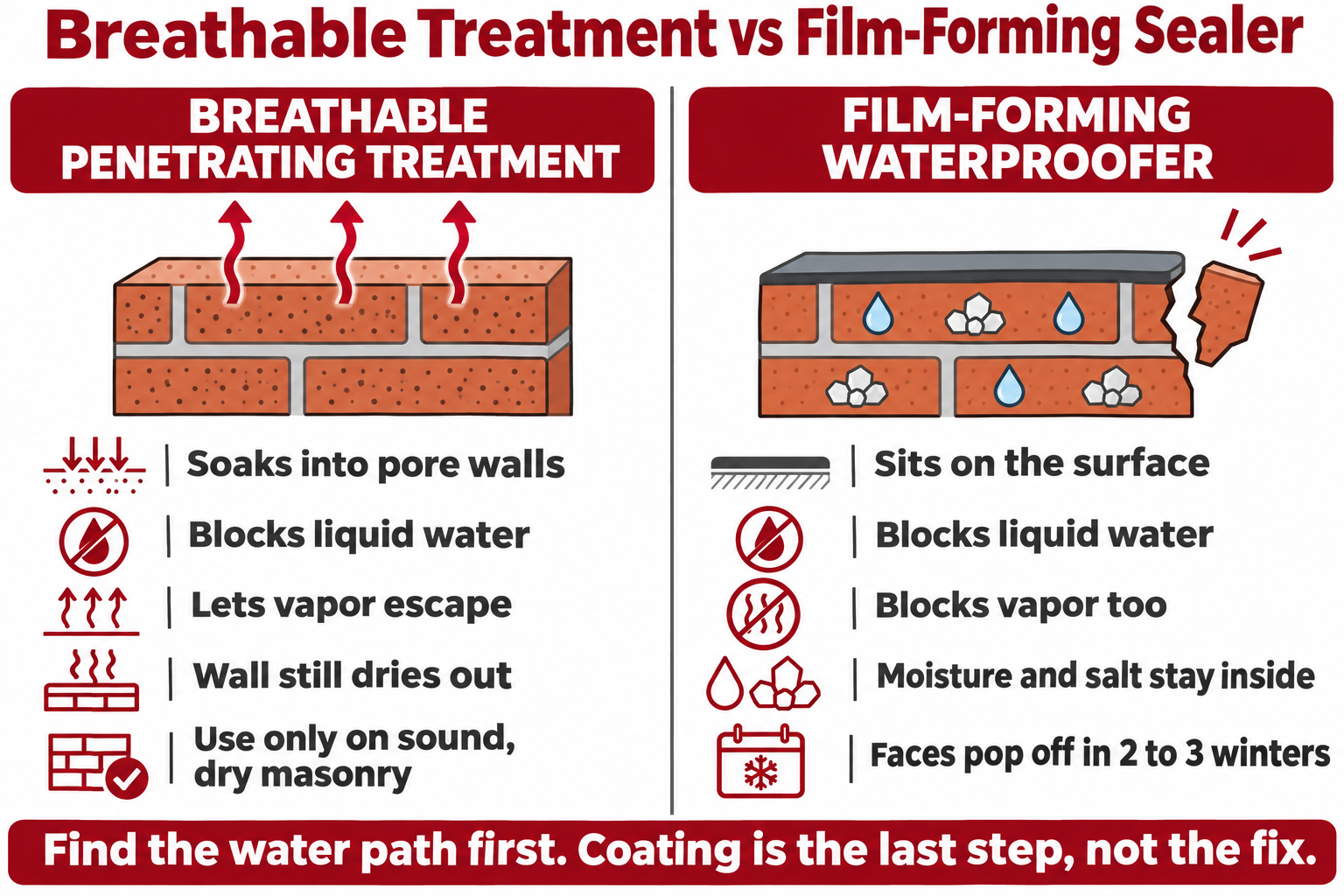
A breathable penetrating treatment, usually a silane or siloxane, soaks into the pores of the masonry and lines them instead of bridging them. Liquid water beads off, but water vapor can still pass out. These have a real place, mostly on sound, dry masonry that gets heavy wind-driven rain.
A film-forming waterproofer or a thick masonry paint sits on top and creates a skin. That skin is what traps moisture and salt in a wall that is already wet.
Two rules I hold to on every job:
- Never put any treatment on a wall that is actively damp. You are sealing the water in.
- Never put any treatment on a wall before you know where the water is entering. The coating is the last step, not the diagnosis.
There is a related mistake I see just as often, which is patching soft old joints with a hard modern mortar. Harder mortar does not flex, so the brick takes the stress instead and the face fails. That is covered in detail in what goes wrong when the mortar mix does not match.
The Five-Minute Triage You Can Run Yourself
Before anyone touches the wall, walk it. You are looking for the entry point, and on most homes it is one of a short list of places.
- The cap or top course. An open, cracked, or missing cap is the single most common path. Water pours straight down inside the wall.
- Mortar joints. Scratch a joint with a screwdriver tip. If it crumbles to sand or you can dig in a quarter inch, the joints are letting water in and need repointing by someone who matches the mix.
- The grade and splash zone at the base. Soil or mulch piled above the bottom course wicks moisture up. So does a hard surface that slopes toward the wall instead of away.
- Roof and gutter discharge. Follow where a downspout dumps. A splash block aimed wrong soaks the same four feet of wall every storm.
- Irrigation spray. Sprinklers hitting masonry four times a week will keep a wall permanently damp no matter what you coat it with.
Then check whether the wall is moving. Stair-step cracks, a lean, a bulge, or a cap that no longer sits level are structural signals, not moisture signals. Those need a mason with structural judgment, and I would never suggest a homeowner open up or rebuild structural masonry themselves.
Some of what you find will be cosmetic. White powdery bloom on the surface, called efflorescence, is salt left behind by evaporating water. The bloom itself is harmless. What it tells you about the water behind it is the useful part, and I broke that down in reading the water behind white powder on brick and block.
What You Are Seeing and What It Usually Means
This is the quick version of what I run through on a site visit. Your wall may not match a row exactly, but it narrows things down fast.
| What you see | Trade term | Likely water path | What it usually needs |
|---|---|---|---|
| White chalky powder you can brush off | Efflorescence | Water moving through and drying at the face | Find the source, dry brushing, no coating |
| Brick faces flaking or popping off | Spalling | Trapped moisture plus salt behind the face | Unit replacement and matched mortar |
| Joints soft, sandy, or recessed | Deteriorated mortar | Rain entering directly through joints | Repointing with a mix matched to the brick |
| Damp band along the bottom courses | Rising damp or splash | Grade, drainage, or irrigation at the base | Regrade, redirect water, then reassess |
| Stair-step cracks, lean, or bulge | Movement | Soil pressure, settlement, or footing issue | Structural evaluation by a licensed mason |
Breathable Treatment vs Film-Forming Sealer
The difference between these two products is the difference between a wall that dries and a wall that fails. Here is the short comparison.
Why a Wall in Pacific Grove Is Not the Same as a Wall in Salinas
This is the part out-of-area advice gets wrong, and it changes the repair.
On the coast, in Pacific Grove, Carmel, and Pebble Beach, the wall is not only dealing with winter rain. Marine fog rolls in most of the year and it carries salt. That salt lands on masonry, dissolves in moisture, wicks into the pores, and crystallizes when the surface dries.
Crystallizing salt expands. Do that a few thousand cycles and it works like a slow wedge inside the brick. A wall six blocks from the shoreline in Pacific Grove can be cycling wet and dry almost daily, even in July. That is why coastal repairs demand care with material and mortar selection in a way inland work does not.
Inland around Salinas and Prunedale, the picture is different. There the problems I see most are seasonal rain and heavy clay soil that swells when wet and shrinks when dry, which pushes on walls and footings. Drainage behind the wall matters more than salt does, something I covered in why retaining walls fail on Salinas clay soil.
Same county, two different failure mechanisms. A coating does not solve either one.
Why This Winter Is Worth Paying Attention To
I am not going to tell you a historic flood is coming. Nobody knows that.
What I can tell you is that forecasters have a strong El Nino in place for the 2026-27 season, and coastal California precipitation odds in the winter outlooks are tilted above normal. The National Weather Service is direct about this in its El Nino in California preparedness material: a stronger event shifts the odds toward a wet outcome, it does not guarantee one.
For a wall that already shows moisture, shifted odds mean a trapped-moisture mistake gets expensive faster. More rain means more cycles, and more cycles means more salt crystallizing behind whatever you just coated.
The practical note on timing: late October through November is the realistic window for diagnosis and repair on the Peninsula. Once the ground stays saturated and rain falls most days, excavation, regrading, and mortar work all get limited. If you want to see what a wet season does to masonry built without a working water path, this piece on El Nino winters and drainage walks through it.
Frequently Asked Questions About Sealing Brick and Water Damage
Is there ever a good reason to seal brick?
Yes, but the conditions are narrow. The masonry should be sound, dry, and already draining properly, and the product should be a breathable penetrating treatment, not a film former. Sealing is a finishing step after the water path is fixed, never a substitute for fixing it.
My wall gets white powder every winter. Is it damaging the brick?
The powder itself is salt left behind by evaporating water and it brushes off. The water moving through the wall to produce it is the real issue. If the bloom comes back every year in the same band, something is feeding that wall moisture on a schedule, usually grade, a downspout, or irrigation.
What does it cost to track down and fix a leak in a masonry wall?
It varies a lot, because the fix could be redirecting a downspout or it could be repointing thirty feet of joints and resetting a cap. Costs in Monterey County also move with access, wall height, and whether brick units need replacing. The honest answer is that an on-site look is what produces a real number, so call 831-262-0442 for a quote on your specific wall.
Can I just repoint the bad joints myself?
Small cosmetic touch-ups on a low garden wall are one thing. But the common DIY failure is using a mortar harder than the original brick, which sends stress into the brick face instead of the joint. On older masonry, matching the mix matters more than the tooling, and getting it wrong is slow, invisible damage.
How do I check that a masonry contractor is actually licensed?
Use the CSLB check-a-license tool at cslb.ca.gov. It takes about a minute and shows license status, classification, bonding, and workers compensation. Masonry work falls under the C-29 classification in California.
Thinking Through a Damp Wall Before the Rain Starts?
When we look at a wet wall anywhere on the Monterey Peninsula, we start by finding the water path rather than reaching for a coating, because the coating only makes sense once the wall can dry. Stonecap Masonry is a C-29 licensed, bonded, and insured masonry contractor holding CSLB #1073620, and any contractor’s license can be verified in about a minute at cslb.ca.gov. The team has availability for wall inspections ahead of the winter rains, and questions are welcome at 831-262-0442 or stonecapmasonry.com.
