
Direct Answer: The Board of Forestry approved Zone 0 defensible space regulations on August 19, 2026, then withdrew the package from Office of Administrative Law review on September 8, 2026. There is no statewide effective date right now.
A homeowner in Carmel Valley called me in September asking if she had to tear out the bark mulch along the front of her house before the end of the year. She had read that Zone 0 was approved, then read that it got pulled back, and could not tell which story was current.
Both were true, three weeks apart. The rule was adopted, then the filing was withdrawn, and that leaves a lot of people on the Peninsula guessing.
So here is the plain version of where things stand, what the approved language actually asked for in the first five feet around a house, and why I think planning that strip now is easier than scrambling later.
Where the California Zone 0 Defensible Space Rules Status Actually Stands
The short answer is that the rule exists on paper but is not in force statewide. Nothing has been abandoned, and nothing has a start date.
Here is the sequence as it played out:
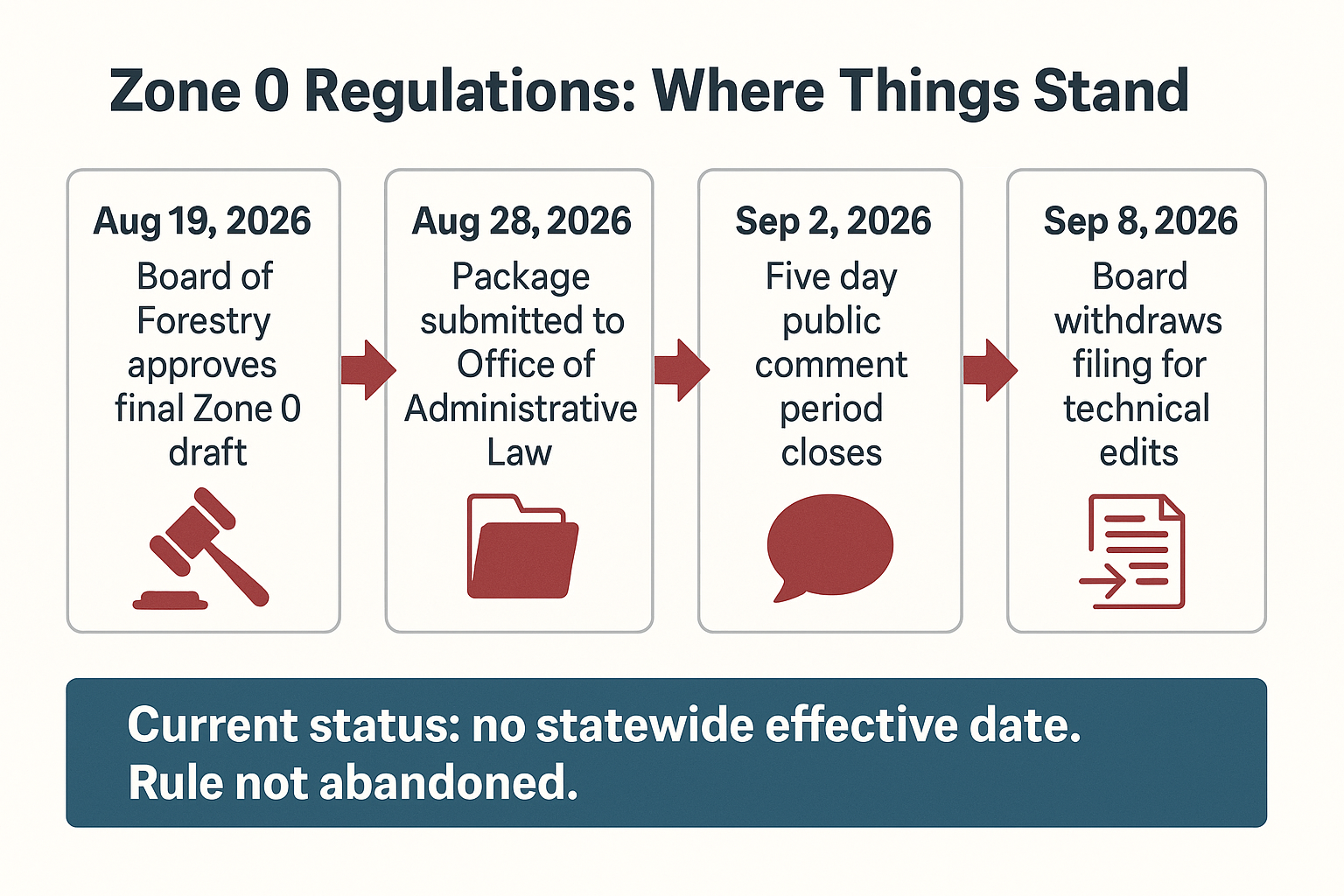
- August 19, 2026: the California Board of Forestry and Fire Protection approved the final draft of Zone 0 defensible space regulations, adopting emergency rules that establish an ember-resistant zone within five feet of qualifying structures under AB 3074.
- August 28, 2026: the Board submitted the package to the Office of Administrative Law. OAL approval and filing are required before the regulations take effect.
- September 2, 2026: the OAL five calendar day public comment period closed.
- September 8, 2026: the Board withdrew the regulatory package from OAL review for technical edits.
The California Wildfire and Forest Resilience Task Force published the approval notice in August. Legal analysis from Best Best and Krieger and a September 11 update from MySafe:LA both confirmed the withdrawal and noted it does not mean Zone 0 was rejected.
For a homeowner in Pebble Beach or the Salinas foothills, the practical read is this: there is no compliance deadline to miss today, and the substance of the rule is widely expected to come back once the edits are made.
What the Approved Language Pushed Toward in the First Five Feet
The whole idea behind Zone 0 is ember control. Research and field experience point to the strip right against the wall as the place where blowing embers find something to catch, and once that something burns against siding, the house is in trouble.
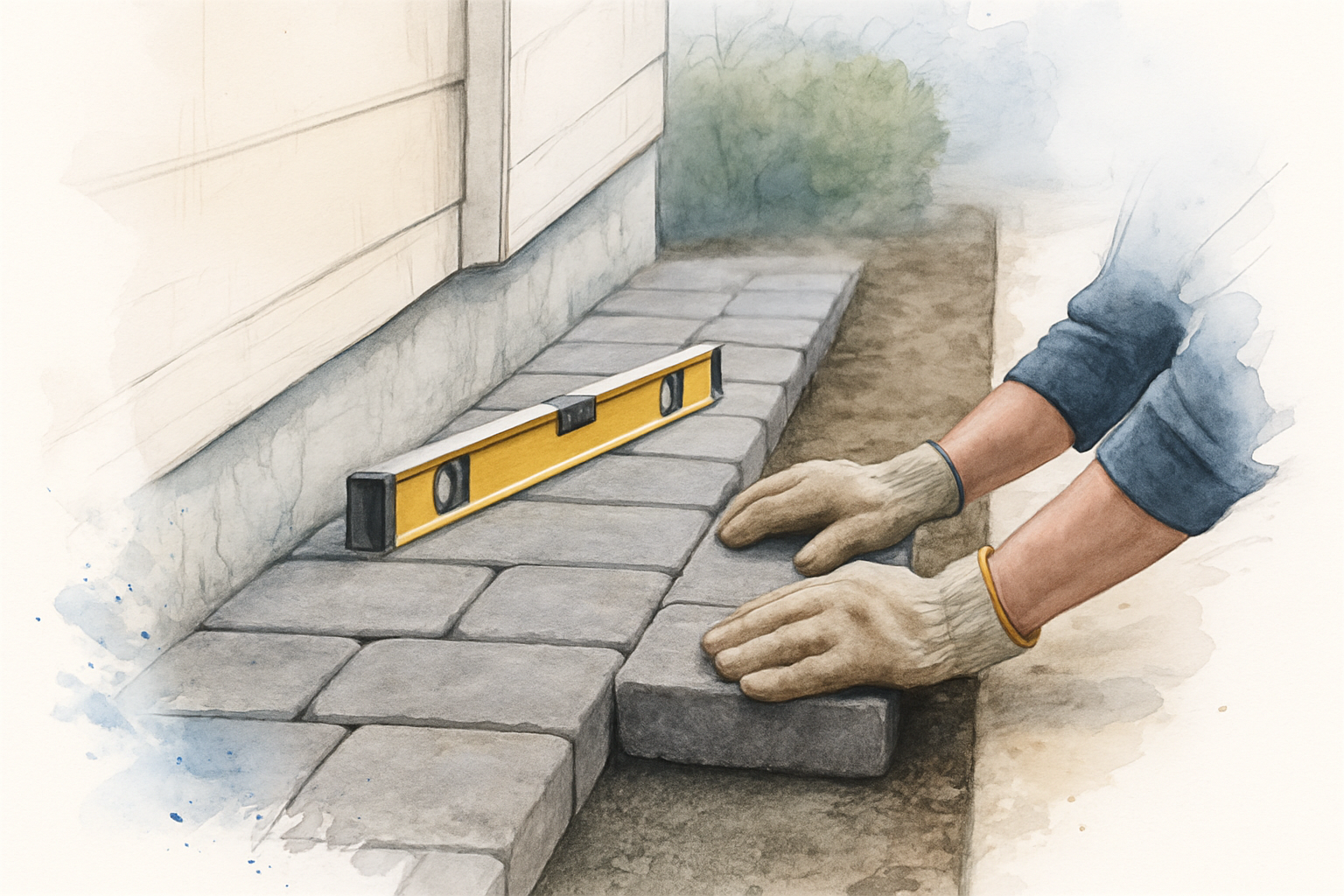
The approved rule pushed toward noncombustible ground cover and hardscape immediately against walls, decks, and attached structures. In practice, on the properties I see around Carmel, Monterey and the hills east of Salinas, that affects a short list of very common things:
- Bark mulch and wood chip beds laid tight to the foundation
- Junipers, rosemary and other resinous shrubs planted against siding
- Firewood stacked under eaves or along an exterior wall
- Wood lattice skirting and storage under attached decks
- Combustible fencing that ties directly into the house
What replaces them is usually simple: crushed stone, decomposed granite, concrete, pavers, or set stone. The design question is not whether rock works. It is how that strip drains, how it meets the siding, and whether it looks like part of the house or like a gravel accident.
I wrote a longer walkthrough of the material side in this piece on the first five feet around your home and noncombustible ground cover.
Common Items in the First Five Feet and the Usual Swap
This is the quick field version of what I look at when I walk a perimeter with a homeowner on the Peninsula.
| What is there now | Why it is a problem | Typical noncombustible swap |
|---|---|---|
| Bark mulch bed against stucco | Holds embers and smolders out of sight | Crushed stone or decomposed granite over filter fabric |
| Juniper or rosemary at the wall | Resinous foliage ignites fast and is right at siding | Set stone border with planting pulled past five feet |
| Firewood stacked along the house | Large fuel load directly at the wall | Relocated rack on a paver pad away from structures |
| Wood lattice under an attached deck | Lets embers into an enclosed space | Masonry or block skirting with proper venting |
| Bare dirt that sheds toward the foundation | Not a fire issue, but a water issue you create during the fix | Graded stone or paver strip pitched away from the wall |
Why I Tell Peninsula Homeowners to Plan It Now Instead of Waiting
When a rule like this refiles and lands with a date attached, everyone calls in the same month. That is what I have watched happen with every code change in Monterey County over the last several years.
Planning ahead buys you three things that a rushed retrofit never does:
- Time to do base prep right. A five foot strip against a foundation is also a drainage decision. Pitch it wrong and you move rain toward the house instead of away from it.
- Material selection that fits the house. Carmel stone, pavers and decomposed granite all read differently against stucco, shingle or board and batten. That is a choice worth making slowly.
- A chance to combine work. Most of the homeowners I talk to already wanted a patio edge, a walkway, or a seating wall at the patio anyway.
There is a water angle too. Pulling turf and plantings away from the house lines up with the conservation pressure Peninsula owners already live with under MPWMD, which I covered in this look at trading turf for stone on the Monterey Peninsula.
And if you are already thinking about a fire pit or outdoor fireplace in the same yard, the clearance and placement rules for those are a separate conversation from Zone 0. Worth reading up on what Monterey County air rules mean for a fireplace build before you draw anything.
The Zone 0 Timeline at a Glance
Here is the regulatory sequence in order, so you can see exactly where the rule sits today.
What a Noncombustible Perimeter Strip Tends to Cost
I get asked for a number before anyone has seen the house, and I understand why. I will give you the honest shape of it instead.
Costs vary a lot, but what drives the price on Monterey County properties is pretty consistent:
- Linear feet of perimeter. A compact Pacific Grove bungalow and a sprawling Carmel Valley ranch are not close.
- Access. Hillside lots where material has to be carried or wheeled in cost more than a flat Salinas lot with driveway access.
- Material. Loose crushed stone sits at the low end. Set stone and mortared work sit at the high end.
- What has to come out first. Mature shrub removal, old concrete, and irrigation rework all add scope.
- Drainage correction. If the grade already runs toward the house, that gets fixed before anything goes down.
A simple gravel strip on an accessible lot is one of the more affordable masonry-adjacent projects you can do. A fitted stone perimeter that wraps a large home is a real project with a real number. The only way to know yours is a site visit.
One more thing worth saying plainly: a licensed C-29 masonry contractor is the right call for anything structural or mortared. You can verify any California contractor’s license, bond and insurance status yourself through the CSLB check-a-license tool before you sign anything.
Frequently Asked Questions About the Zone 0 Rules Status
Do I have to remove the mulch against my house right now?
Not under a statewide Zone 0 mandate, because there is no effective date. The package was withdrawn from OAL review on September 8, 2026. Local defensible space requirements and your insurer’s expectations are separate matters, so check both.
Is Zone 0 dead?
No. The withdrawal was described as a procedural step for technical edits, not a rejection. The substance of the approved rule, pushing toward noncombustible ground cover in the first five feet, is expected to come back.
Does this apply to my property in Carmel or Pacific Grove?
The rule as approved applies to qualifying structures in designated fire hazard zones. Monterey County has plenty of those, especially in Carmel Valley, the Monterey hills and the Salinas foothills. Your local fire authority and planning department can confirm your specific hazard designation, and requirements vary by jurisdiction and project type.
Can I just dump gravel along the foundation myself?
On a flat lot with good existing grade, loose stone over filter fabric is a straightforward job. Where I would stop and get help is anywhere the ground already slopes toward the house, anywhere a deck or attached structure is involved, or anywhere mortared or structural work is needed. Fixing water intrusion later costs far more than grading it right the first time.
Will a stone perimeter strip hold up in the salt air out here?
Properly selected stone and a correctly built base hold up fine. Material choice matters more near the water, and so does drainage, since constant moisture cycling is harder on a poorly built base than any single storm.
Thinking Through the First Five Feet Around Your Home
Zone 0 will likely refile, and the homes that already have a clean, well drained perimeter will not have to do anything twice. If you want a read on what your property would actually involve, our team walks perimeters across Salinas, Carmel, Carmel Valley, Pebble Beach and Pacific Grove. Reach us at 831-262-0442 or stonecapmasonry.com when the timing suits you.
