
Direct Answer: Most price gaps in masonry bids come from things you cannot see: base depth, drainage, mortar spec, permits, and whether the contractor carries insurance and workers’ comp.
A homeowner near Moss Landing reached out to us about a damaged block retaining wall last winter. Before scheduling a site visit, they asked us to confirm our license and insurance in writing.
That is not a rude question. That is a buyer who has been burned before, and I get that request more often than you would think on the Monterey Peninsula.
The next question usually follows fast: why did one bid come in 40 to 50 percent lower than the others for what looks like the same job? I want to walk through where that gap actually lives, because it is almost never in the stone you can see.
The Real Problem With Masonry Contractor Bid Comparison
Most homeowners compare bids on two things: the material and the total. That is the one comparison that tells you almost nothing.
Two bids can both say “flagstone patio, 400 square feet” and describe completely different structures underground. The finished surface can look identical on day one and behave very differently in year three.
What actually drives the price difference in a masonry bid:
- Base depth and compaction under pavers, stone, or a wall footing
- Drainage design, including gravel type, geotextile fabric, and perforated pipe
- Mortar specification, which changes with heat exposure and coastal moisture
- Reinforcement, meaning rebar size, spacing, and grouted cells in block work
- Permits, plans, and inspection time where the work is structural
- License, bonding, general liability, and workers’ compensation carried by the contractor
- Site access and demolition, which matters a lot on narrow Carmel and Pacific Grove lots
Every one of those items has a real dollar cost. When a bid does not mention them, the money did not disappear. Either the contractor is doing less, or they are planning to decide later, on your property, without telling you.
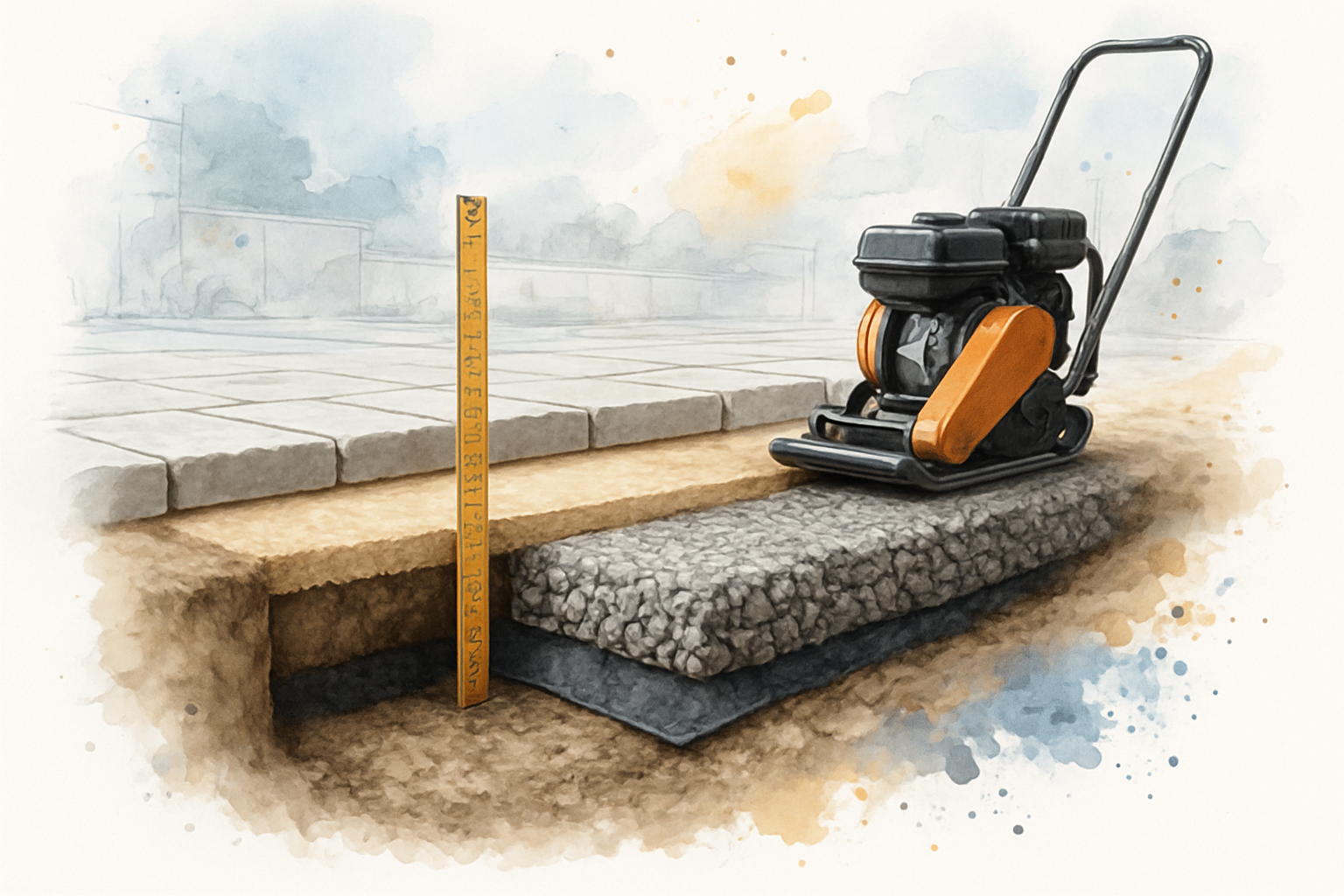
Base Preparation Is Where Most of the Price Gap Hides
If I had to name the single most common source of a price difference in hardscape and masonry bids, it is the base.
Say one contractor plans four inches of compacted base under a paver patio. Another plans six inches, with geotextile fabric between the soil and the aggregate, and a drainage layer sized for the site. The second bid is higher, and it should be.
On day one, both patios look great. The difference shows up in years two through five, when one surface starts to dip at the edges, joints open up, and pavers begin to rock underfoot while the other stays flat.
Our soils here make this worse, not better. Salinas Valley and Carmel Valley properties often sit on clay-heavy soil that swells when wet and shrinks when dry, and a wet Monterey County winter cycles that movement hard. What a strong El Niño winter actually does to masonry covers that pattern in more detail.
So when you compare bids, ask each contractor to put three numbers in writing:
- Excavation depth below finished grade
- Base material and thickness after compaction, not before
- Where the water goes, in plain terms
If a contractor will not commit to those in writing, you are not looking at a lower price. You are looking at an unknown.
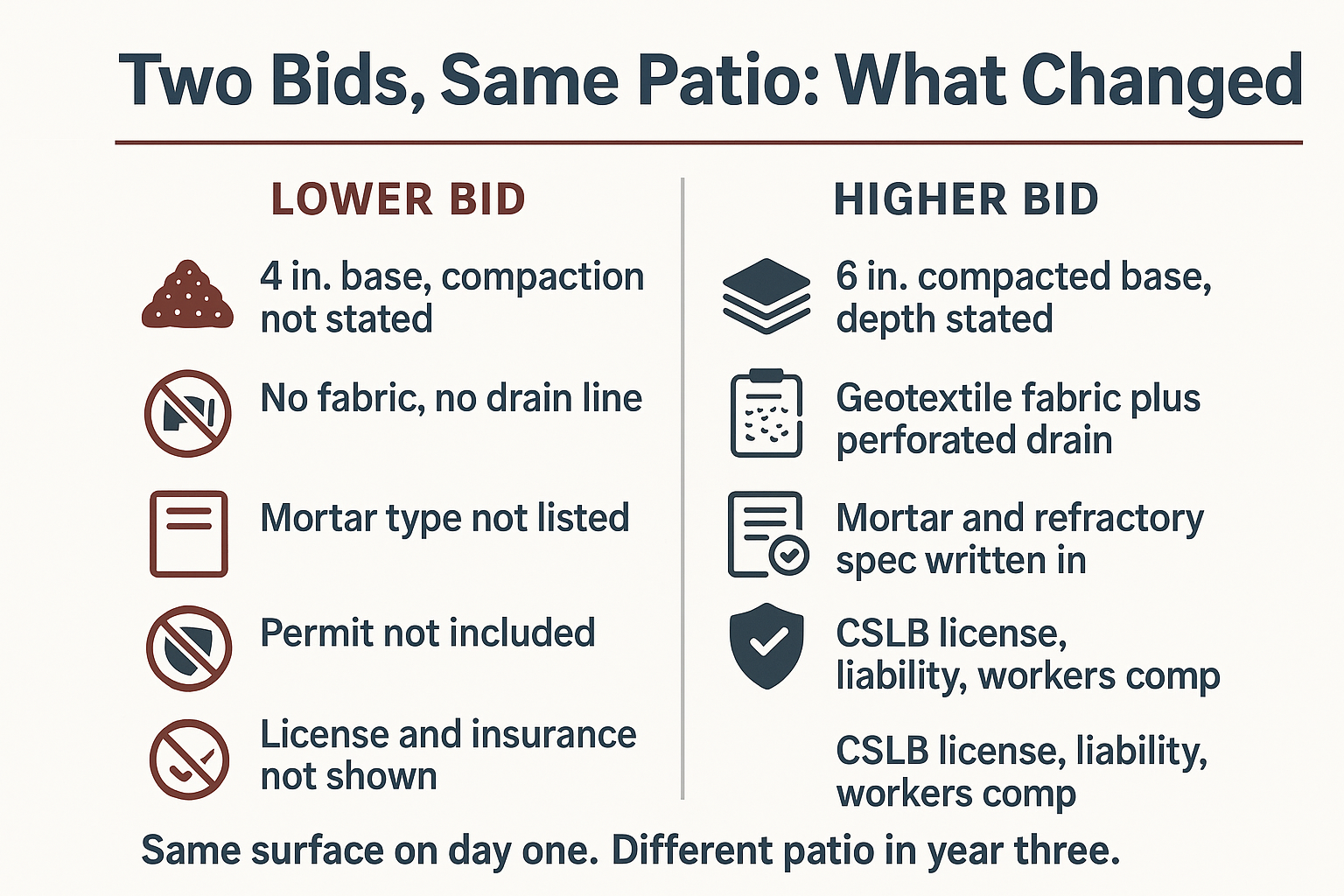
Where the Money Actually Goes in a Masonry Bid
This breaks down the difference between a bid that is genuinely priced lower and one that simply describes less work.
Mortar Spec: The Line Item Nobody Writes Down
Mortar sounds like a detail. On a fire feature or a coastal wall, it is a safety and durability decision.
Inside the firebox of a masonry fireplace or an outdoor fire pit, the mortar needs to be a refractory mix rated for high heat, not standard portland mortar. Ordinary mortar exposed to repeated fire will break down, and that failure happens where you cannot easily see it.
On a stone wall in Pebble Beach or Pacific Grove, the mortar has a different job. It has to work with the stone type and stand up to salt air and constant moisture cycling, which is one reason a wall a mile from the water and a wall in a Salinas backyard are not the same build.
When a bid for a fire feature does not name the mortar or firebrick, one of two things is true. The contractor has not thought about it yet, or they are counting on you not asking.
This is also a big part of why fireplace numbers swing so widely. Why masonry fireplace construction costs vary so widely walks through the assemblies behind those numbers.
Ask directly: what mortar type, what firebrick, and what flue or fire-rated components are included. A good mason will answer that in about fifteen seconds.
Licensing, Insurance, and Permits Cost Money for a Reason
A licensed C-29 masonry contractor in California carries general liability insurance and, when they have employees, workers’ compensation coverage. Those premiums are part of overhead, and they are part of the bid.
Here is what that buys you. If a worker is injured on a job where no workers’ comp is in place, California law can push that liability onto the homeowner. And if unpermitted work later fails and you file a claim, the insurer may push back on the grounds that the work was never permitted or inspected.
Permits are the other quiet line item. Some bids include permit fees, plan prep, and time spent meeting the inspector. Others say “permit not included” and expect you to handle it, or hope the subject fades.
For structural masonry in Monterey County, that is not a small distinction. Retaining walls above a set height and masonry fireplaces generally require permits and inspections, and thresholds vary by jurisdiction, so the City of Monterey, Carmel-by-the-Sea, and unincorporated county all deserve their own phone call. The 2025 California building standards take effect January 1, 2026, which is one more reason to have code compliance spelled out in your scope.
You can verify any contractor’s license, bond, and workers’ comp status yourself in about two minutes using the CSLB check a license tool. If you want help reading what comes back, how to read a California contractor’s license before you hire breaks down each field.
How to Turn Three Bids Into an Apples to Apples Comparison
I hand homeowners some version of this list all the time. Ask each bidder the same questions and watch how quickly the price gap explains itself.
| Bid Element | What a Vague Bid Says | What to Ask For in Writing |
|---|---|---|
| Base prep | “Prepare area for pavers” | Excavation depth, base material, compacted thickness, fabric yes or no |
| Drainage | Not mentioned | Gravel type, perforated pipe, outlet location, slope away from structures |
| Mortar and firebox | “Build fire pit” | Mortar type, refractory mix, firebrick, any fire-rated components |
| Reinforcement | “Block wall, 5 ft” | Footing size and depth, rebar size and spacing, grouted cells |
| Permits | “Permit not included” | Who pulls it, fee responsibility, inspection scheduling |
| Credentials | Verbal assurance | CSLB number, liability policy, workers’ comp certificate |
| Cleanup and finish | Not mentioned | Debris haul-off, joint sand or grout, final walkthrough |
What Cost Ranges Actually Tell You (and What They Don’t)
Homeowners often want a number before anything else, and I understand why. But a range is only useful once you know what is inside it.
Masonry pricing on the Peninsula moves with a handful of local factors:
- Site access. A backyard reachable only through a narrow Carmel side yard means hand-hauling material, and labor hours climb.
- Slope. Stepped terracing on a Carmel Valley hillside is a different build than a flat Salinas backyard.
- Stone selection. Natural stone with irregular thickness takes far more time to set than uniform pavers or manufactured veneer.
- Demolition. Removing an old failing wall or a cracked slab is real work before new work starts.
- Water rules. MPWMD conservation considerations shape irrigation and landscape choices around new hardscape on the Peninsula.
Because of that, I would rather explain the drivers than quote a per-square-foot figure that ignores your property. Costs vary widely here, and any honest range should come with the assumptions attached.
What I can tell you is this: the highest bid is not automatically the best one, and the lowest is not automatically a trap. The bid worth trusting is the one that tells you what is going under the surface, names the materials, addresses the permit, and shows its license. Across our projects, that written clarity is what customers point to when they say the finished work met a high standard.
If you are weighing a repair bid on an existing wall, 5 signs a retaining wall needs a masonry contractor, not a patch job will help you judge whether the scope you were quoted matches the actual problem.
Frequently Asked Questions About Comparing Masonry Bids
Should I always throw out the lowest bid?
No. Sometimes a contractor is genuinely more efficient, has the right crew size, or already has material sourced. But if the low bid is 40 to 50 percent below the others, ask what is different in the scope. Nine times out of ten it is base depth, drainage, or permits.
Is it rude to ask a contractor for their license and insurance before a site visit?
Not at all, and I would rather you ask. A licensed contractor has that information ready. You can also verify it independently through the CSLB before anyone comes out.
Do I really need a permit for a retaining wall in Monterey County?
It depends on the height, the load behind it, and which jurisdiction you are in. Walls above a certain height generally require a permit and inspection, and thresholds differ between the county and cities like Monterey and Carmel. Check with your local building department for your specific project, and expect a legitimate bid to address it either way.
Why do bids for the same fire pit vary so much?
Fuel type, firebrick and refractory mortar, ventilation and drainage details, and whether a licensed pro is coordinating a gas line connection. Two fire pits that look similar can have very different guts.
What is the single best question to ask every bidder?
“What is going under it, and how deep?” The answer tells you almost everything about how the rest of the job will be built.
Have Bids in Hand and Questions About What’s in Them?
If you are sorting through masonry bids for a property in Salinas, Carmel, Pebble Beach, Carmel Valley, or Pacific Grove, it helps to talk with someone who will explain the base, the mortar, and the permit before anything gets built. Stonecap Masonry can be reached at 831-262-0442 or at stonecapmasonry.com for a site visit and a written scope. Bring your questions, including the ones about license and insurance.
