
Direct Answer: Hairline cracks in mortar joints are often low urgency. Diagonal, stair-step, or horizontal cracks — especially in retaining walls or chimneys — usually signal structural movement that needs a professional look.
A crack shows up in your brick patio, your retaining wall, or the face of your chimney. The first instinct for most homeowners I talk to is either panic or dismissal — either it’s a catastrophe or it’s nothing. The truth is almost always somewhere in the middle, and the pattern of the crack is what tells you which direction to lean.
On the Monterey Peninsula, this question carries a little more weight than it does in drier, more seismically quiet parts of the state. Marine moisture cycles, Salinas Valley soil movement, and California’s documented seismic exposure all change how you should read a crack — and how much time you have before ignoring it costs you more.
I want to give you a clear way to read what you’re seeing before you call anyone. Understanding the visual language of masonry cracking is the first step toward making a smart, informed decision about what to do next.
The Visual Vocabulary of Masonry Cracks
Not all cracks mean the same thing. The shape and direction of a crack tells you more about its cause than its width does — at least at first glance.
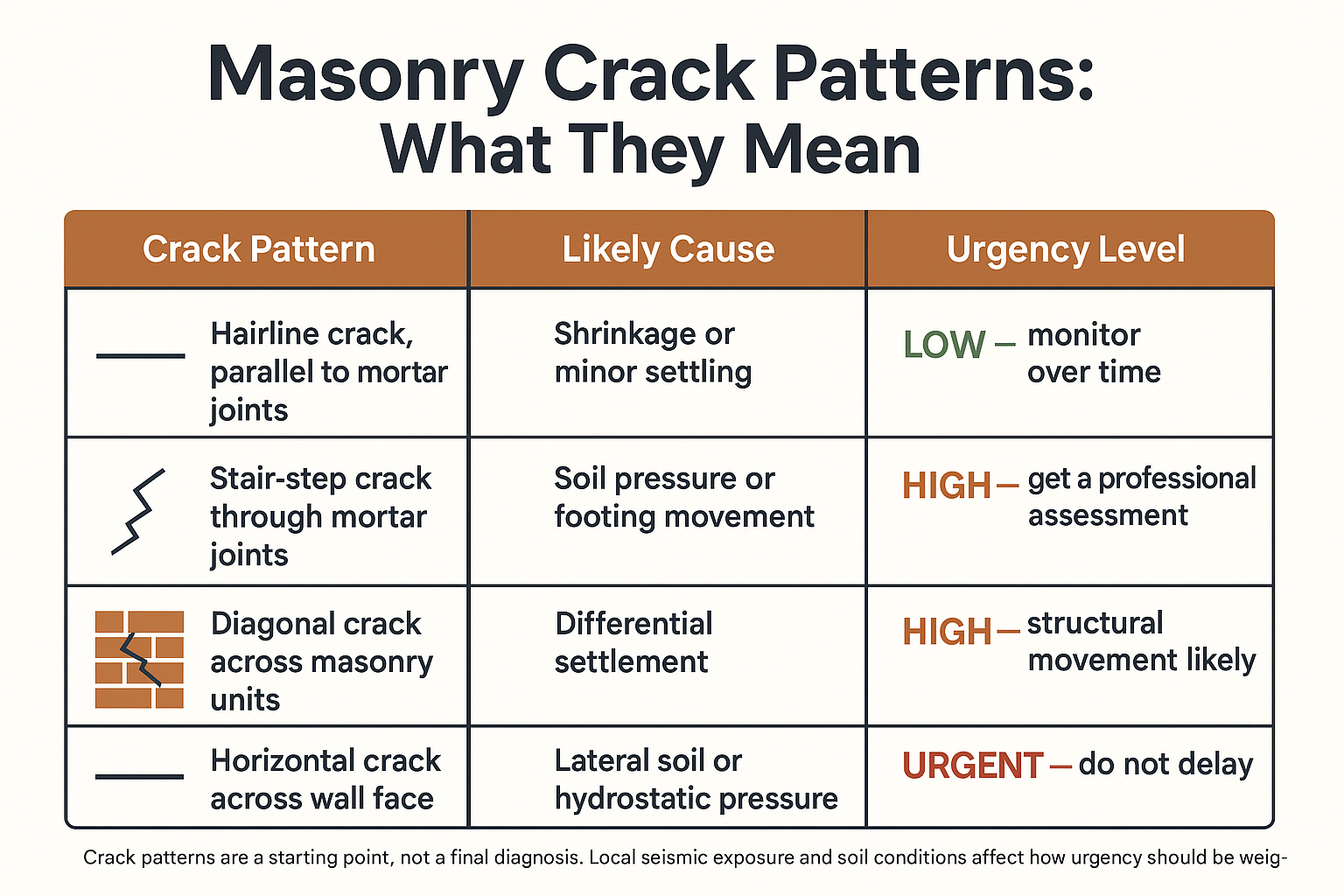
Hairline cracks running parallel to mortar joints are the most common and the least urgent. These often appear as concrete or mortar shrinks slightly during curing, or as a structure settles evenly over time. If the crack isn’t widening and the mortar on either side is still solid, it’s usually a cosmetic issue worth monitoring rather than repairing immediately.
The patterns that deserve more attention are:
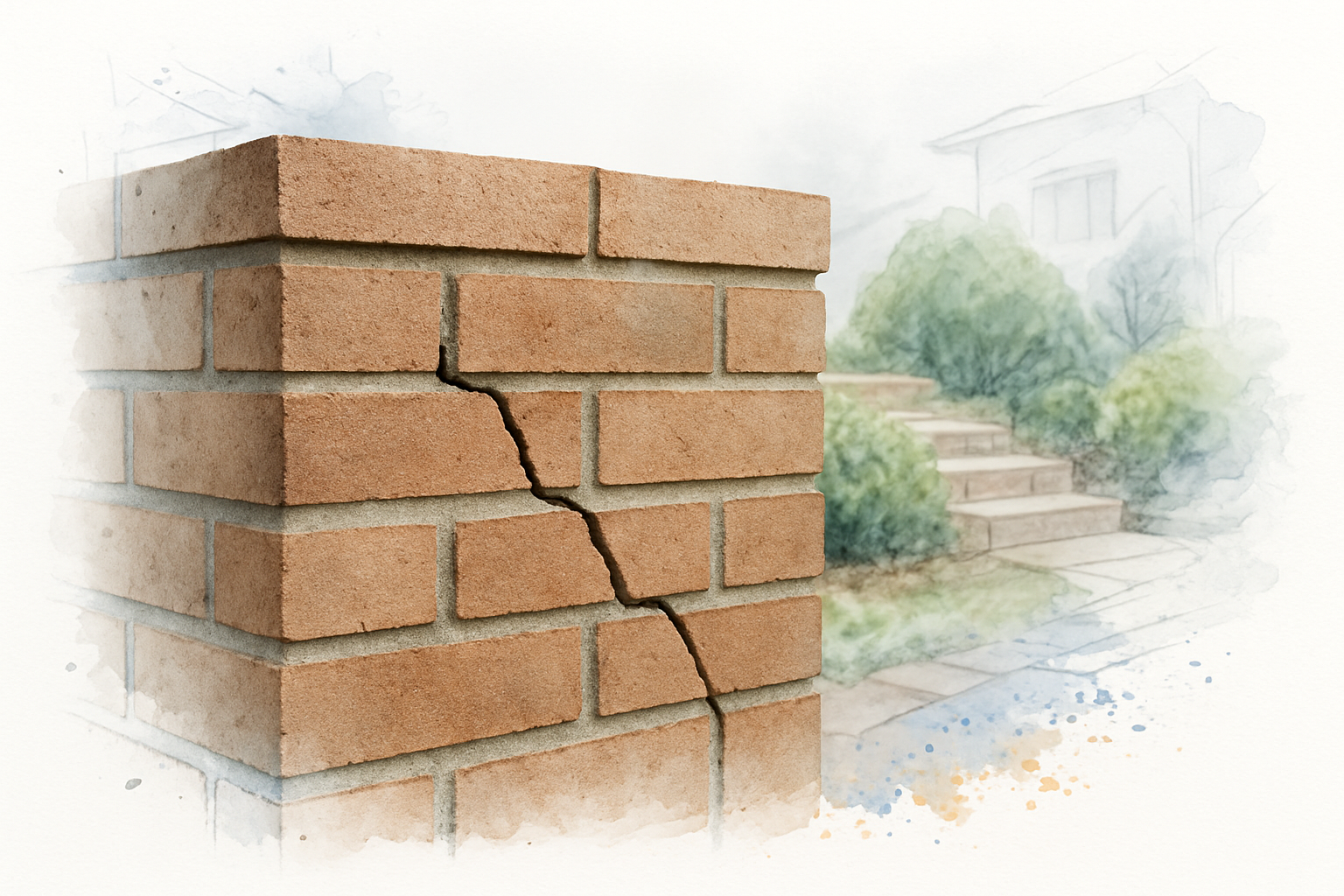
- Diagonal cracks running across brick or block face — these often indicate differential settlement, meaning one section of the structure is moving at a different rate than another
- Stair-step cracks following mortar joints on a retaining wall — a classic sign of lateral soil pressure or footing movement
- Horizontal cracking across a wall face — one of the more serious patterns, frequently linked to soil pressure pushing against the wall rather than just moving beneath it
- Cracks that are wider at one end than the other — this taper suggests rotation or tilting, not simple shrinkage
If you’re seeing any of the last four, that’s not a watch-and-wait situation. Those patterns tend to reflect forces that don’t resolve on their own — they progress. You can read more about the line between cosmetic and structural concerns in The Real Difference Between a Cosmetic Fix and a Masonry Repair.
Why Monterey County’s Seismic Context Changes the Calculation
A crack that might be routine maintenance in Sacramento or Fresno carries a different implication here. The USGS National Seismic Hazard Map shows that the Monterey County region sits within a high-probability seismic zone, with meaningful exposure from faults running through and around the Salinas Valley and Carmel Valley corridors.
What that means in practical terms: an existing crack in a masonry wall or chimney is a pre-weakened point. When a seismic event — even a moderate one — sends energy through a structure, those points behave differently than intact masonry. They can widen, shift, or in the case of unreinforced chimneys and older block walls, fail suddenly.
This doesn’t mean every hairline crack requires structural intervention. But it does mean a professional assessment is worth more here than in other markets. I’ve seen homeowners on the Peninsula put off a chimney crack inspection for a couple of seasons, only to find the interior flue had opened up in a way that changed the repair scope entirely.
If you’re looking at cracking on a commercial masonry structure, the stakes are higher still — California’s standards for unreinforced masonry (URM) buildings add a regulatory layer to what might otherwise look like a maintenance question. How Seismic Risk Changes the Way Commercial Masonry Should Be Built covers that territory in more depth.
Crack Pattern Quick-Reference Guide
This quick-reference breaks down the most common masonry crack patterns, what typically causes them, and the urgency level homeowners should assign to each.
The Hidden Problem: Mortar Joint Deterioration
Cracks get homeowners’ attention. Mortar joint erosion usually doesn’t — until it’s too late.
Mortar is designed to be the sacrificial element in a masonry assembly. It’s softer than the brick or stone it holds together, which means it weathers first. That’s intentional. The problem is when that erosion goes unaddressed long enough that water starts getting in regularly.
Once mortar joints erode past about a quarter inch deep, water penetrates the wall system on a regular basis. On the Peninsula, where marine moisture is a near-constant presence, that infiltration accelerates the deterioration cycle compared to drier inland climates. Water gets in, the masonry units expand and contract with temperature changes, and the joints widen further.
Left long enough, the damage migrates from the mortar into the masonry units themselves — the brick, block, or stone. At that point, you’re no longer talking about repointing (replacing deteriorated mortar), which is one of the more affordable masonry repairs. You’re talking about removing and replacing units, which is a different scope and a different cost.
Repointing caught early is genuinely cost-effective. Ignored, it becomes one of the more expensive masonry escalations I see. The What a Strong El Niño Winter Actually Does to Masonry article covers how heavy rainfall seasons compound exactly this kind of ongoing moisture exposure.
What Drives the Cost of Masonry Crack Repair
One of the most common reasons homeowners delay repair is not knowing what to expect in terms of scope and cost. Here are the main variables that affect what a masonry repair job actually involves — and why two similar-looking cracks can produce very different estimates.
| Cost Factor | Lower Scope | Higher Scope |
|---|---|---|
| Mortar vs. unit damage | Mortar joints only need repointing | Masonry units cracked or displaced — removal and replacement required |
| Extent of deterioration | Isolated area, a few linear feet | Multiple wall sections or widespread joint erosion |
| Access difficulty | Ground-level, open access | Behind mature landscaping, second-floor chimney, or tiered retaining wall |
| Color/texture matching | Standard mortar, no matching needed | Historic or custom stonework requiring matched mortar color and profile |
| Structural involvement | Cosmetic crack repair only | Footing or drainage issues driving the cracking — repair includes corrective work |
Why Hardware Store Patch Jobs Make Cracks Worse
I want to be direct about something I see regularly on repair calls: homeowners who filled a crack with hydraulic patching compound or a bag of premixed mortar from the hardware store, and then wondered why the crack came back — or why the brick around the patch started crumbling.
The issue isn’t just technique. It’s material compatibility.
Mortar used in repairs needs to match the compressive strength and flexibility of the original mortar. If the repair mortar is harder than the surrounding masonry, it doesn’t compress under load — the surrounding brick or stone does. The result is new cracking in the masonry units on either side of the patch, which is a harder fix than the original crack was.
Older homes in Carmel, Pacific Grove, and parts of Salinas often have original lime-based mortars that are quite soft by modern standards. Patching those joints with Portland cement-heavy modern mortar is one of the most common mistakes I’ve seen lead to accelerated unit damage. It’s a recoverable mistake if caught quickly, but it often goes unnoticed until the damage has spread well beyond the original repair area.
This is also a good reason to be cautious about treating any cracked masonry as a DIY project — not because the work is always complex, but because the material decision matters more than most homeowners realize. If you’re curious about where veneer systems in particular tend to go wrong with incompatible materials, Stone Veneer Installation: Where Most Problems Actually Start walks through that in detail.
How to Read a Retaining Wall Crack Differently
Retaining walls deserve their own paragraph here because the stakes are different. A crack in a garden-facing boundary wall is a different situation than a crack in a wall that’s actively holding back soil — especially on a sloped property in Salinas or Carmel Valley, where soil moisture content shifts significantly between summer dry and winter wet seasons.
Stair-step cracking on a retaining wall is almost always related to movement at the base, lateral soil pressure, or inadequate drainage behind the wall. Those forces don’t stop applying pressure just because you can’t see them. A wall that’s cracking under pressure is a wall that’s already telling you something is wrong with the load it’s carrying.
One Moss Landing homeowner contacted Stonecap after a vehicle struck a corner section of their block retaining wall — a situation where the damage was sudden and visible. But more often, retaining wall distress develops slowly, and the crack is the first visible signal of a longer-developing problem. Warning Signs Your Retaining Wall Is Under More Stress Than It Looks covers what to look for before a crack even appears.
Frequently Asked Questions About Masonry Crack Repair
Can I just watch a crack to see if it gets worse before calling anyone?
For hairline cracks running parallel to mortar joints, monitoring is a reasonable approach — mark the ends with a pencil and check it every few months. But diagonal, stair-step, or horizontal cracks should get a professional look sooner rather than later. In a seismically active area like Monterey County, a crack that’s ‘stable’ today can change quickly after a tremor.
How much does masonry crack repair typically cost in the Salinas area?
It varies considerably based on what’s actually happening. A straightforward repointing job on a section of deteriorated mortar joints might run a few hundred dollars for a small area. A retaining wall that’s cracking due to drainage failure or footing movement is a different scope entirely — potentially several thousand dollars depending on how much corrective work is involved. The table in this article breaks down the main cost drivers. The only way to get an accurate number is an on-site assessment.
Is repointing something I can do myself?
Physically, yes — the process of raking out old mortar and pressing in new is within reach for a careful DIYer. The harder part is choosing the right mortar. If you use a mix that’s stronger than your existing masonry, you’ll shift the stress into the surrounding units and create new damage. For historic or custom stonework, or anything on a retaining structure, I’d strongly recommend a licensed mason handle the material selection at minimum.
Does a masonry crack always mean the foundation is failing?
No. Most masonry cracks are not foundation failures. Shrinkage, thermal movement, and mortar erosion account for the majority of cracks homeowners find. That said, some crack patterns — especially horizontal or widely tapered diagonal cracks — can be early indicators of settlement or soil pressure issues that do involve the foundation or footing. A professional assessment tells you which category you’re in.
How do I verify that a masonry contractor is actually licensed in California?
Use the CSLB’s free license check tool at contractors.cslb.ca.gov. You can search by license number or business name and confirm the license type, status, bond, and insurance. For masonry work specifically, look for a C-29 classification. That’s the designation that covers the full scope of masonry contracting in California.
Not Sure What You’re Looking At?
If you’re staring at a crack in a wall, chimney, or retaining structure on the Monterey Peninsula and you’re not sure whether it’s worth a call, Stonecap Masonry is available to take a look. Cande and the team serve homeowners across Salinas, Carmel, Pebble Beach, Pacific Grove, and Carmel Valley. You can reach them at 831-262-0442 or request an assessment at stonecapmasonry.com.
