
Direct Answer: Zone 0 asks that the first five feet around a home resist embers. Stone, pavers, and gravel help, but only if they slope away from the wall and stay below siding.
A homeowner in Carmel Valley called me after an insurance inspection and asked a simple question: is the flagstone patio that runs right up to the house now a problem? That patio has been there for twenty years. Nobody built it thinking about embers.
On August 19, 2026, the California Board of Forestry and Fire Protection approved the final draft of the state’s Zone 0 defensible space rules. They focus on the first five feet around a house, which is where wind-blown embers are most likely to land and start a fire.
Here is my position after looking at a lot of Peninsula homes since then. For most properties this is an adjustment, not a demolition. And the mistake I see people make is treating a gravel or paver band as a fire fix only, when a strip of hard surface against a foundation is just as much a drainage decision.
What the Zone 0 rule is actually asking for
The idea behind Zone 0 is narrow and physical. Embers travel, they land, and they look for something to burn within arm’s reach of the wall. The rule pushes that band toward materials that will not catch.
The Board’s approval is documented by the California Wildfire and Forest Resilience Task Force, which confirms the five-foot focus and the first-in-the-nation framing.
What I tell people in Monterey County is to slow down on the deadline part. Rollout and enforcement move jurisdiction by jurisdiction, and the status of the rule has shifted more than once since the approval.
- Requirements can differ between Carmel Valley, the Salinas foothills, and an incorporated city
- New construction and existing homes are often treated differently
- Insurance inspectors are asking about the five-foot zone on their own timeline, separate from code
Before you change anything on your property, confirm current requirements with your local fire jurisdiction. I have written more about where the rule stands in Zone 0 was approved in August, then pulled back.
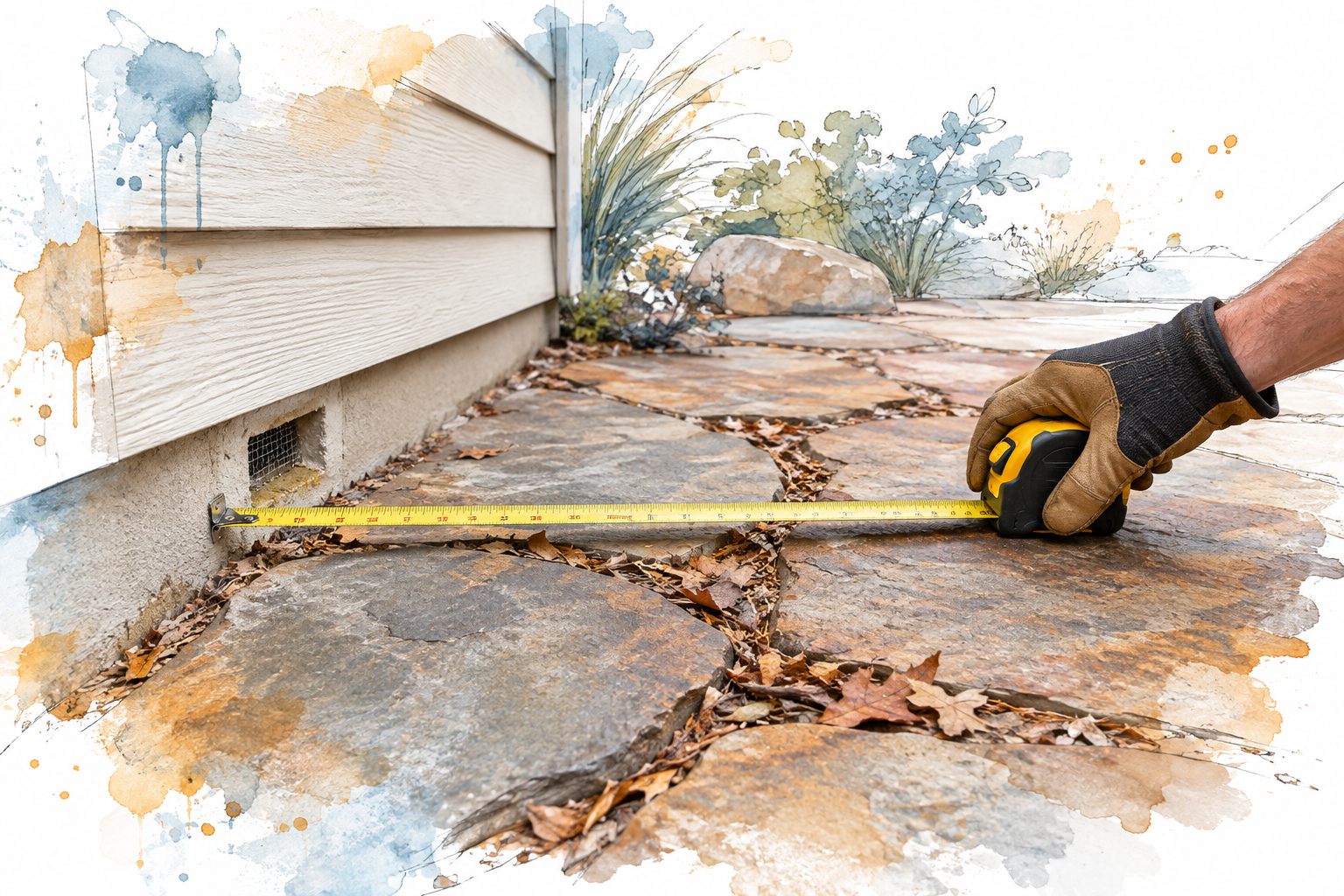
What part of the five feet is a masonry question
This is the practical question, and it deserves a straight answer. A mason handles the hard surfaces in that band. Other trades handle everything else.
In masonry territory:
- Stone and paver patios that run up to the wall
- Brick and block work at the base of the house
- Gravel strips and stone aprons
- Patio edges, edge restraint, and joint material
- Fire pits and the hardscape around them
- Raised planters built out of masonry against the foundation
Not my scope, and I will say so on site:
- Plants, shrubs, and bark mulch
- Wood fencing attached to the house
- Attic and crawlspace vents
- Roofing, gutters, and siding repairs
- Synthetic turf
One homeowner’s request to me read, word for word, like most backyard wish lists do: fire pit, outdoor bbq, pavers and artificial turf. Zone 0 splits that list apart. Pavers and stone behave one way next to a wall, and artificial turf is a separate conversation to raise with your local fire jurisdiction rather than assume either way.
The first five feet, item by item
Here is how I sort what I see when I walk a Peninsula property, and who should be handling each piece.
| What’s in the band | What usually matters | Who handles it |
|---|---|---|
| Flagstone or paver patio at the wall | Joint material, debris buildup, slope away from siding | Mason |
| Gravel strip against foundation | Depth, containment, finish height below siding | Mason |
| Masonry fire pit near the house | Distance from structure, local code and clearances | Mason, with your fire jurisdiction |
| Raised planter against foundation | What’s inside it, moisture against the wall | Mason removes or rebuilds; planting is landscape |
| Bark mulch and shrubs | Combustible material in the band | Landscaper |
| Wood fence tied into the house | Fire path straight to the siding | Fencing or general contractor |
| Vents, gutters, roof edge | Ember entry points | Roofer or general contractor |
| Artificial turf | Varies, confirm locally | Confirm with fire jurisdiction first |
Walking your own first five feet
A lot of Peninsula homes already have masonry inside that band, built long before anyone used the phrase ember-resistant. Most of it is fine. Some of it needs a change.
Take a tape measure and a flashlight and go slow around the perimeter. Look for:
- Wide joints packed with leaf litter, which is common under Carmel Valley oaks and Monterey pines
- Stone or pavers that sit too high against the siding, covering weep openings
- A fire pit sited closer to the house than you would place it today
- Raised planters hard against the foundation, holding soil and moisture at the wall
- Low spots where water pools against the house after a storm
Most of what I find falls under adjustment. Cleaning and resetting joints, lowering a finish height, swapping a planter for a gravel band, re-leveling a few stones. Full demolition is the exception, usually when a slab has settled toward the house or the material itself has failed. If you are not sure what your patio stone is doing in fog and salt air, the differences between flagstone, pavers, and granite matter here too.
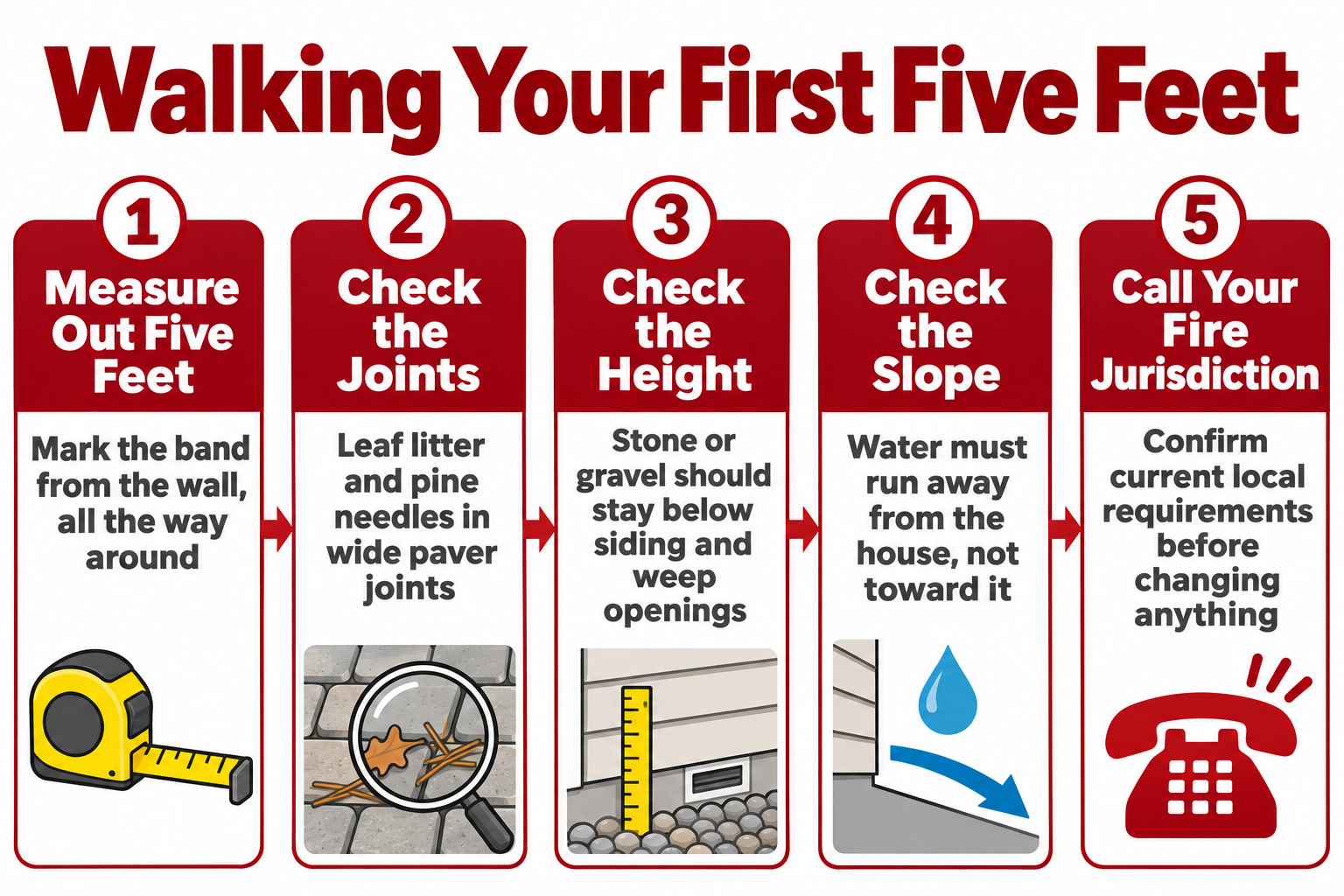
A five-step walk around your house
This is the order I use when I check the first five feet on a Monterey County property.
A noncombustible strip is still a drainage decision
This is where I push back on how Zone 0 gets talked about online. People post photos of a clean gravel band at the base of a house and call it done. Gravel against a foundation with no slope and no containment is a moisture problem waiting out the winter.
With a strong El Nino winter favored for the Central Coast through the October to December 2026 window, this is not a small point. Water that sits against a wall finds stucco, framing, and whatever is behind the veneer.
Done right, that narrow band still gets the full treatment:
- A compacted base, not loose fill dropped on native soil
- Positive slope away from the structure, consistent along the whole run
- Finish height kept below siding and weep openings
- Edge restraint so the material stays where it was placed
- A path to a controlled outlet, not a dead end against the foundation
A five-foot band done carelessly trades a fire problem for a moisture problem. Base prep is the part nobody sees and the part that decides how the work holds up, which is the same reason Peninsula rain shapes when masonry work gets scheduled.
What moves the cost of reworking the first five feet
I am not going to post a per-foot number, because the honest answer is that two houses on the same street price out differently. What I can do is tell you what actually moves it.
- Linear footage around the house, since the band wraps the whole perimeter
- Access, which gets tight on many Pacific Grove and Carmel lots where equipment cannot reach the side yard
- Demolition of existing planters, slabs, or an old patio edge
- How much grading correction the strip needs to slope properly
- Drainage tie-ins and where water is going to go
- Whether new stone has to match existing patio or veneer already on the property
That last one is usually the biggest swing. Insurers on the Peninsula have been asking homeowners about the five-foot zone during property inspections, and that is often what turns this from a someday project into a this-winter project. A real number comes from a site visit, not a search result. If you want the longer version of why bids diverge, two masonry bids for the same job can be thousands apart for reasons that have nothing to do with markup.
The part people regret: making it look like it belongs
A band of stone or pavers added at the base of a house reads as an obvious repair unless the color, size, and joint work match what is already there. I have seen gray concrete pavers set against a warm sandstone patio, and you cannot stop looking at the seam.
Matching is a craft problem. Stone from the same quarry can run different lots, and a weathered twenty-year-old patio will never match a fresh pallet straight out of the box without some blending and selection.
That is why a C-29 licensed mason who works in natural stone daily is a different hire than a landscape crew running a plate compactor. One Carmel Valley homeowner wrote that our crew “matched the stone hardscape around the pool perfectly” after an old water feature came out. Another put it plainly: “Cande and his crew are professional, creative and efficient.” – Andy S.
If matching is the deciding factor on your property, what makes new stone blend into old is worth reading before you pick a material.
Frequently Asked Questions About Zone 0 and Masonry
Do I have to tear out my patio if it touches the house?
Usually no. In most cases I see, the fix is adjustment: cleaning and resetting joints, lowering the finish height so it sits below the siding, or correcting slope. Full removal comes up when a slab has settled toward the house or the material has broken down.
Is gravel enough, or do I need pavers?
Both can work as a noncombustible surface. The difference is maintenance and water. Gravel needs edge restraint and gets refilled over time, and it collects debris. Set pavers hold their line better but cost more and need tighter base work. The right choice depends on your grade, your access, and what the rest of your hardscape looks like.
What about my fire pit? It sits close to the house.
Clearance from structures is a local code question, and it can differ depending on fuel type and jurisdiction. Check with your local fire jurisdiction before you assume your existing pit is either fine or a problem. Relocating or rebuilding one is routine masonry work when it comes to that.
Does artificial turf count as a problem in the first five feet?
That is the question I get most, and I am not going to guess for you. Synthetic turf sits outside masonry scope and the treatment varies. Ask your local fire jurisdiction directly before installing or removing any.
Is Zone 0 being enforced right now in Monterey County?
Enforcement is rolling out on a jurisdiction-by-jurisdiction basis and the rule’s status has moved since the August 2026 approval. Confirm current requirements for your specific address rather than relying on a statewide summary.
Thinking through the first five feet on your own property?
If you have walked your perimeter and you are not sure whether what you found is an adjustment or a rebuild, a set of eyes on site is worth more than another article. Stonecap Masonry works across Salinas, Carmel, Carmel Valley, Pebble Beach, and Pacific Grove, and the team can look at the hard surfaces in that band and tell you plainly what falls to masonry and what belongs to another trade. Reach us at 831-262-0442 or stonecapmasonry.com when you are ready to talk it through.
