
Direct Answer: Most Peninsula stone patios get built between late spring and fall, but the planning should start in October. Winter rain limits build windows, so early design, sourcing, and review protect a spring finish.
Nobody is setting flagstone in Carmel in January. But if you want to be eating dinner on a new patio by May, the call that makes that happen usually happens in October, not March.
That gap is where most homeowners lose a season. They wait for the weather to turn nice, then find out the spring board is already full, the stone they picked is six weeks out, and the yard still needs a drainage answer nobody looked at while it was raining.
Here is my position after years of building on the Monterey Peninsula: the off months are planning months, not dead months. And a winter site visit tells me more about your property than a dry July walkthrough ever will. This article covers what the calendar does to a hardscape project here, and what you can actually control about it.
Why the Spring Rush on the Monterey Peninsula Is So Predictable
The demand pattern is the same every year. Statewide interest in stone and flagstone patios drops off a cliff in December, then roughly doubles again by March as soon as the first warm weekend shows up.
So every mason on the Peninsula gets the same wave of calls in the same four weeks. That does not make us busier craftsmen, it just makes the spring calendar crowded.
What that looks like from the homeowner’s side:
- A two to six week wait just to get a site visit scheduled during peak season
- Material lead times stacked on top of that wait, not overlapping with it
- Less flexibility on start dates, since the crew is already sequenced through summer
- Rushed decisions on stone color and layout because the clock is running
Call in late fall and most of that disappears. The site visit happens in a week or two, the design conversation takes its time, and the stone order goes in long before anyone needs it on site.
I would rather spend December walking a property in Pacific Grove with a homeowner than spend April apologizing for a start date.
What Rain Actually Does to a Hardscape Build
People assume wet season work is just uncomfortable. The real problem is physical, and it costs money.
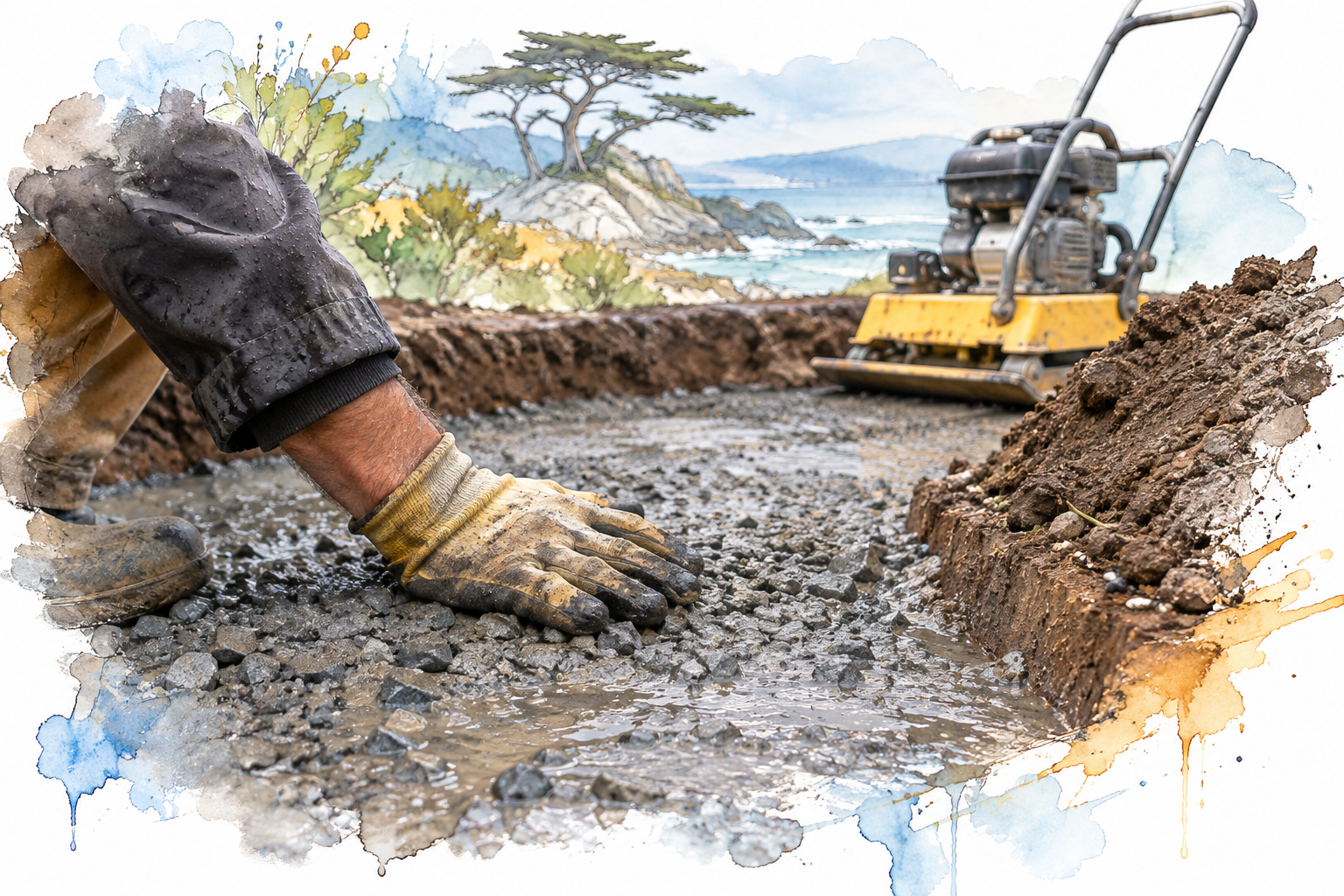
Aggregate base has to be compacted at the right moisture content. Too dry and it will not lock up. Too wet and it pumps under the compactor instead of tightening. There is a window, and winter blows past it.
A saturated subgrade cannot be properly proof-rolled either. When the ground under the patio turns to pudding, the fix is hauling that mud out and importing more base than the original scope assumed. That is a real change order on a job that looked straightforward in the bid. Our guide on how a stone patio is priced, from the base up walks through why the layer nobody sees drives so much of the number.
Then there is mortar. Mortar-set stone needs reasonable cure conditions, and the Peninsula adds its own wrinkle:
- The marine layer over Pacific Grove and the Carmel coast keeps surfaces damp well past sunrise
- Cool, humid mornings stretch cure windows even on days with zero rain in the forecast
- Sealing and jointing work gets pushed later in the day, which shortens the productive hours
None of this makes winter masonry impossible. It makes it slower and less predictable, which is exactly what you do not want when you have a date in mind.
This Winter’s Odds, Honestly
NOAA’s Climate Prediction Center has had an El Niño Advisory in place since June 2026, and late summer updates put the odds of a very strong event during fall and winter above 90 percent. The heaviest California rain signal is expected to ramp up from January through March 2027. You can see how forecasters frame those probabilities in the USDA Climate Hubs El Niño outlook.
I want to be careful here, because forecasters are careful. A strong El Niño tilts the odds toward a wet winter, it does not guarantee one. The 2015-16 event was supposed to soak California and largely underdelivered when the storm track ran north.
So treat it as a scheduling risk, not a prediction. The practical read for a Monterey County homeowner is fewer reliable dry working windows between January and March, which argues for getting design, sourcing, and any local review finished before that stretch rather than during it.
What a Peninsula Masonry Calendar Usually Looks Like
This is a general rhythm, not a rule. Every site and every winter behaves a little differently.
| Window | What Works Well | What Gets Difficult |
|---|---|---|
| October to November | Site visits, drainage observation, design, stone selection, permit questions | Longer builds risk running into early storms |
| December to February | Planning, material sourcing, small sheltered or repair work | Excavation, compaction, mortar cure, large open-ground work |
| March to April | Build starts as ground dries, spring rush begins | Scheduling gets tight, lead times stack up |
| May to September | Full build season, best cure and compaction conditions | Calendars fill early, less flexibility on start dates |
A Wet Site Visit Shows Me Things a Dry One Cannot
This is the part most homeowners never think about. Walking a property while water is actively moving is worth more than any amount of measuring on a sunny day.
During a storm or right after one, I can see:
- Where runoff sheets across the yard instead of soaking in
- Where water pools against the foundation or a low spot in the lawn
- Where a downspout dumps, and whether it is dumping right where you want the patio
- How the existing grade actually behaves, not how it looks
In a dry July walkthrough, all of that is invisible. You are guessing from contours.
That information changes real decisions: slope direction, joint type, edge restraint, and where the drainage outlet has to go. Those are cheap to design around and expensive to retrofit after the first winter under new stone.
If you already have walls on the property, this is also the season to look at them. Our retaining wall inspection checklist for Monterey County covers what to watch for before the rains build pressure behind the backfill.
The Build Order That Keeps a Multi-Element Project From Backtracking
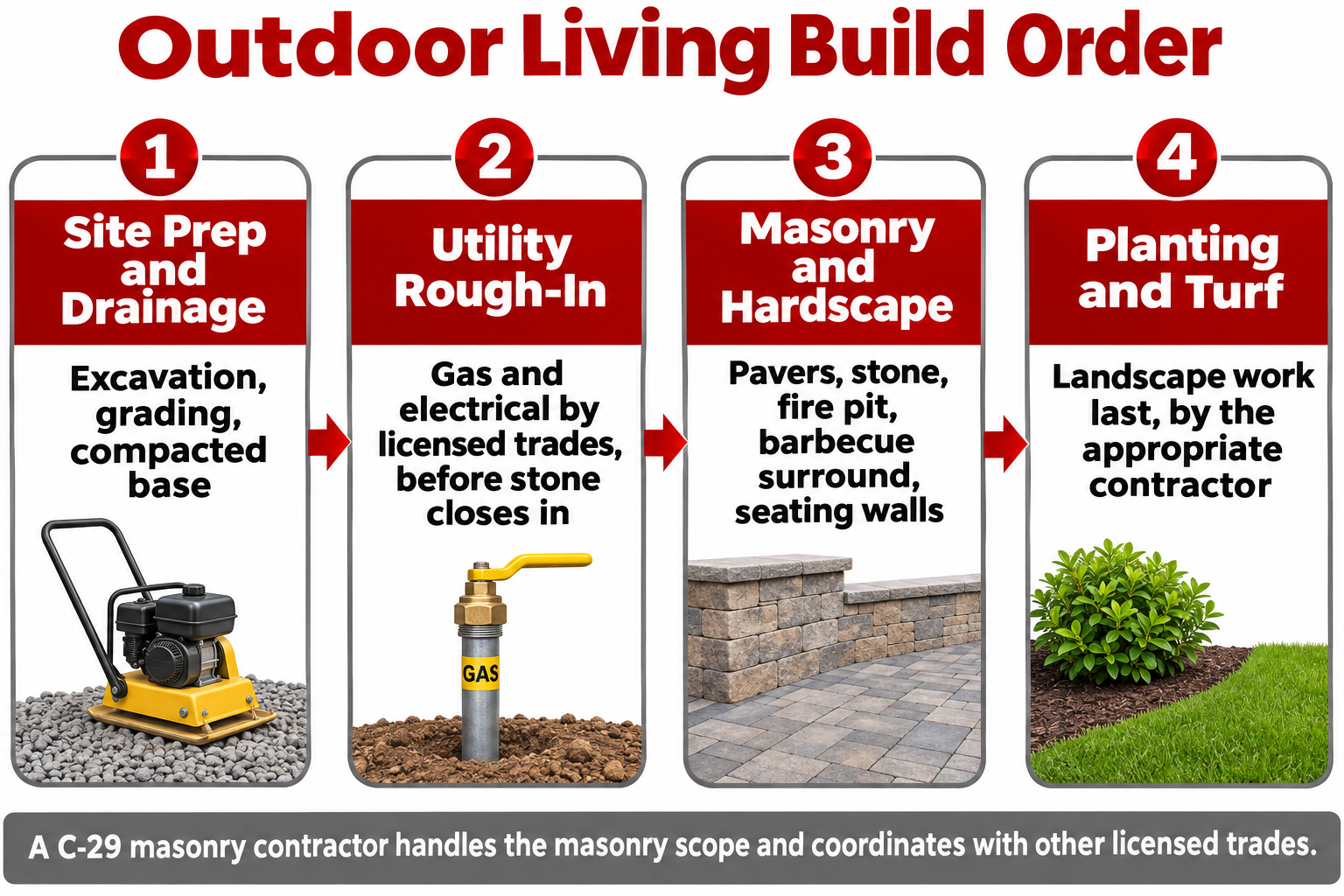
Several homeowners here ask for a fire pit, a built-in barbecue, pavers, and turf in one project. That combination has a sequence built into it, and getting it out of order means tearing things back out.
What Genuinely Moves Forward Between October and March
Plenty happens before a single stone gets set. This is the work that protects your spring date.
- Layout and measurement. Stakes, string lines, elevations, and how the patio ties into existing steps or a pool deck.
- Drainage planning. Where the water goes, confirmed by watching it go there.
- Stone selection and sourcing. This one surprises people. If you want a specific color or thickness instead of whatever is on the yard rack, that can add weeks. Picking patio stone for salt air and fog covers how coastal conditions narrow the material list.
- Local review. Requirements vary by jurisdiction and by what the project includes.
That last point deserves a note. A flat patio, a patio with steps, and a patio with a retaining element can land in very different places at a city counter or with Monterey County planning. Water considerations can matter too, especially on projects that change irrigated area, which we covered in how Peninsula water rules shape a hardscape plan.
Confirm your scope with the local building department early instead of assuming. That answer sets your real start date more than the weather does.
On sequencing, one more thing worth saying plainly: gas line work for a fire feature or built-in grill gets done by the appropriate licensed trade before the masonry closes it in. If you are adding a grill to an existing patio, what the slab underneath can carry is the first question, and that decision is covered here.
Scheduling Is a Trust Issue, Not Just a Logistics One
Most homeowners who call me have been burned before, and it is rarely about the stone. It is about a crew that disappeared, a start date that moved four times, or a job left open through a storm.
A realistic timeline given in October beats an optimistic one given in April. When our repeat clients describe the work, the same two things come up: finished to a high standard, and finished when it was supposed to be. One Carmel Valley homeowner put it simply in a review: “Cande and his crew are professional, creative and efficient.”
For what it is worth, verifying a contractor matters more than the season. Anyone can look up a CSLB license through the state’s check-a-license tool and confirm the classification, bond, and insurance before signing anything. Ours is C-29 masonry, license #1073620.
Frequently Asked Questions About Patio Build Timing on the Monterey Peninsula
Can masonry work happen at all during a Peninsula winter?
Some of it can. Smaller repairs, sheltered work, and jobs on already stable ground often move forward between storms. Large excavations and big mortar-set installations are the ones that stall, because compaction and cure both need conditions the wet season does not reliably provide.
If I call in November, when would my patio actually get built?
It depends on scope and on what your local jurisdiction requires, but a fall call usually means design, stone sourcing, and any review are done before spring. That often puts the build in the first workable dry window, instead of behind everyone who called in March.
Does rain damage a patio that is already finished?
A properly built one handles it. The failures I get called out to look at almost always trace back to base prep or drainage, not the stone itself. Water that has nowhere to go will find a way under the surface and move things over a few seasons.
Do I need a permit for a patio in Monterey County?
It varies by jurisdiction and by what the project includes. A simple flat patio, a patio with steps, and a patio with a retaining element can be treated very differently. Check with your city or county building department early, because that answer often sets the schedule.
Can one contractor handle the fire pit, barbecue, pavers, and turf?
A C-29 masonry contractor handles the masonry and hardscape scope and coordinates with other licensed trades for gas, electrical, and landscape work. That coordination is exactly why the sequencing conversation should happen before anything gets dug.
Thinking About a Patio for Next Spring?
Fall and winter typically hold more schedule flexibility than spring does, and a wet-season walkthrough tells us things a dry one cannot. Stonecap Masonry works across Salinas, Carmel, Carmel Valley, Pebble Beach, and Pacific Grove, and the team is happy to look at a site before the rains settle in. Details are at stonecapmasonry.com, or reach the office at 831-262-0442.
