
Direct Answer: Before the wet season, check five things on your retaining wall: plumb, the corner joints, bulging in the middle, weep holes, and water staining. Photograph everything with dates.
Most people never look closely at their retaining wall until something gives. Usually that happens in January or February, after weeks of rain, when a section pushes out or a capstone drops and there is water running where it never ran before.
By then the wall has been telling you something for months. The problem is that almost nobody has a record of what it looked like in October, so there is no way to know if it moved this winter or has looked that way since 2019.
This is a looking checklist, not a repair guide. Five things to check, in order, in about twenty minutes with a level and your phone. Then I will explain which walls in Monterey County actually need a mason before the rains, and which ones you can honestly leave alone until spring.
Check 1: Is the Wall Tipping Toward the Yard?
Grab a level, hold it flat against the face of the wall, and look at the bubble. Do it at the top of the wall and again near the bottom, in three or four spots along the length. A wall that leans out toward your yard is a wall the soil behind it is winning against (masons call this out of plumb).
A four-foot level works best. If you only have a small one, tape it to a straight board.
- Hold the level flat against the face, not on top of the cap
- Note whether the top leans out, the bottom kicks out, or the whole wall tilts as one piece
- Measure the gap in inches between the level and the wall, and write the number down
- Repeat in the same spots every year
That measured number matters more than the photo. One inch of lean over four feet of height is a real measurement you can compare against next year. “It looks a little crooked” is not.
In Carmel Valley and the hillside neighborhoods above Salinas, I see a lot of walls holding heavy clay soil that swells when it gets wet. Those walls almost always lean at the top first. If yours already has a visible tilt, when a leaning retaining wall becomes an urgent problem is worth reading before you decide how fast to move.
Check 2: Is There a Gap Where the Wall Meets the Corner?
Walk to every place where the wall turns a corner, ties into a column, or runs into a house or a set of steps. Look for a vertical gap or crack opening up right at that joint.
Those corners and short return walls are what brace the long straight run. When a gap opens there, it means the main wall is pulling away from the thing holding it steady (the return or tie-in).
- A hairline crack at a mortar joint is worth photographing and watching
- A gap you can slide a pencil into is a different conversation
- A gap that is wider at the top than the bottom means the wall is rotating out, not just settling
One more thing at the corners: look at the caps. If a capstone has shifted sideways or now hangs unsupported over the edge, something below it moved.
Same goes for brick walls and brick around the base of a house. If the brick is leaning away from the structure, or there is a gap between the brick and the wall behind it, that is movement, not cosmetic wear.
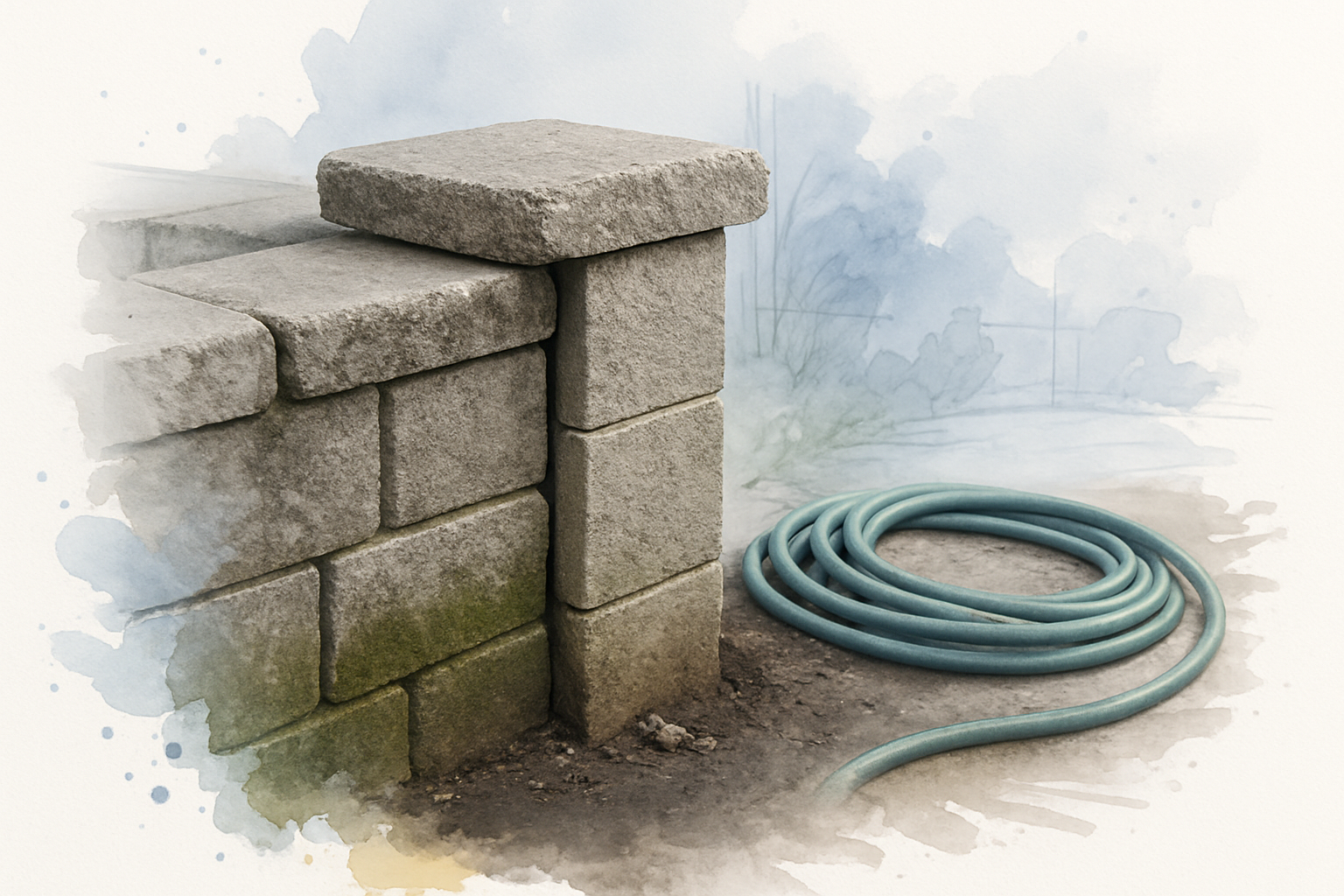
Checks 3, 4, and 5: Bulge, Weep Holes, and Water
Check 3: a belly in the middle. Stand at one end and sight down the length of the wall like you are checking a board for straightness. You are looking for a bulge in the middle third of the height, where a wall carries the most pressure. A wall can be perfectly plumb at the ends and still be pushing out in the middle.
Check 4: weep holes. These are the small openings near the base that let trapped water escape. Two questions: does your wall have any, and are they open?
- Look along the bottom course for holes, pipe ends, or gaps in the mortar every few feet
- Check whether they are packed with soil, mulch, or a mat of tree roots
- Note if there are none at all, which is common on older walls around Pacific Grove and Monterey
Do not drill new ones or dig them out yourself. Water is what breaks walls, and what happens behind the face is the whole story. The drainage layer a retaining wall cannot work without covers why.
Check 5: where the water goes. After the first real rain of the season, go back out and look. Is there standing water in the ground behind the wall a day later? Are there white mineral streaks, dark wet patches, or moss trails on the face? Is soil washing out at the base?
Staining on the face means water is moving through the wall instead of around it. That is the single most useful thing you can observe, and you can only see it after it rains. Saturated ground is also what drives most slope movement in the county, which is why the USGS tracks rainfall-triggered landslides so closely in coastal California.
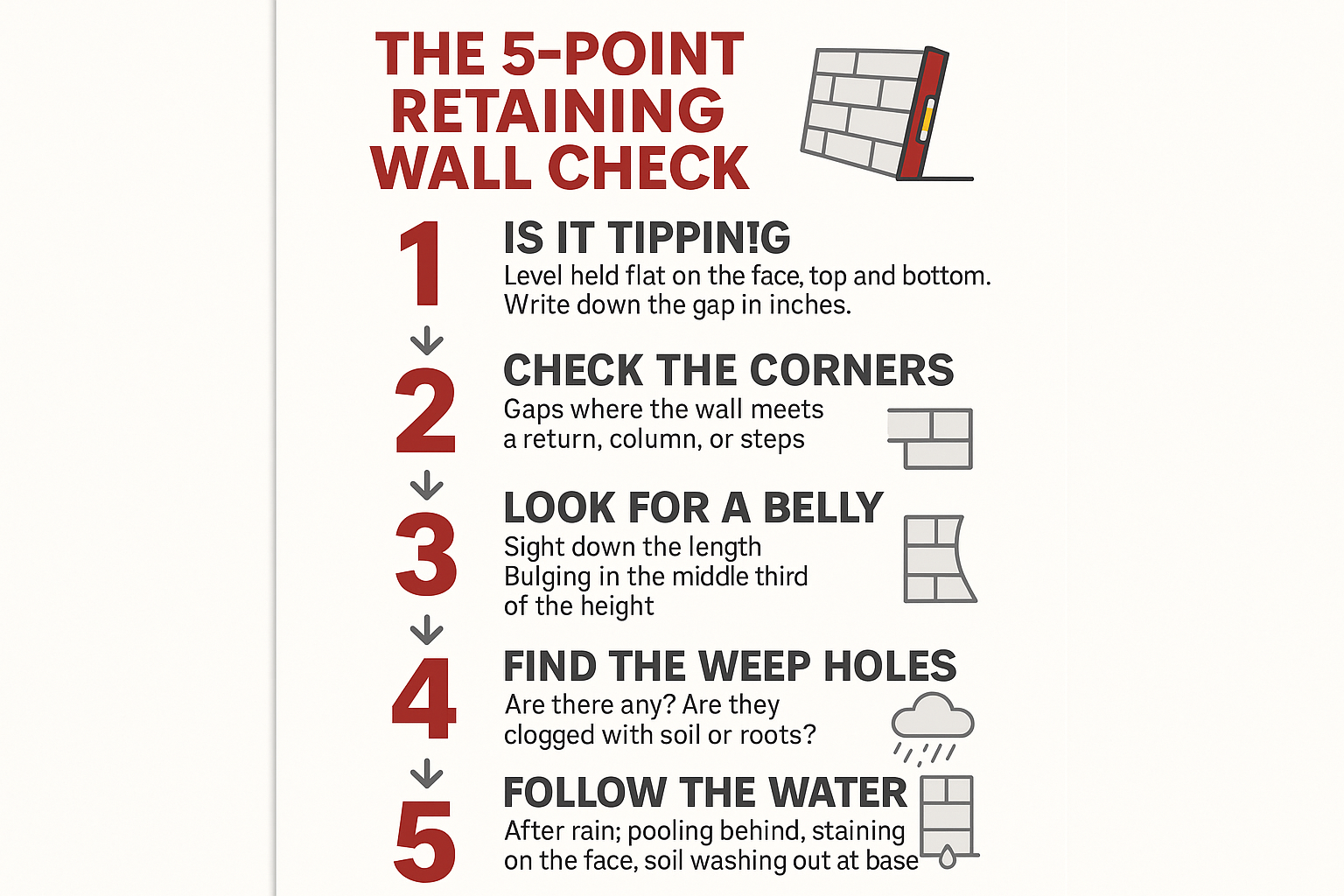
The Five-Point Wall Check, in Order
Here is the whole walk-around on one page. Print it, take it outside, and fill in the numbers.
Take the Photos Now, Not in February
This is the part most people skip, and it is the part that saves them money later.
Pick three or four fixed positions around the wall. A spot on the patio, the corner of the driveway, next to a specific tree. Stand in the same place each time and shoot the same frames.
- One wide shot of the full length from each end
- One straight-on shot of every corner and return
- One close shot of any crack, with a coin or tape measure in frame for scale
- One shot of the base showing the soil line and any weep holes
- One written note with your measured lean, in inches, at each spot you checked
Make sure the date stamp is on. Then do it again in January, from the exact same spots.
A wall that is getting worse through the wet season is a very different problem than a wall that has looked slightly off for six years. Movement that accelerates is the signal to act, and you cannot see acceleration without a starting point. The warning signs that a wall is under more stress than it looks get much easier to judge when you have two sets of photos to compare.
Your Photos Are Also Evidence
There is a second reason to document a wall, and almost nobody thinks about it until they need it.
Earlier this year a property owner near Moss Landing reached out to us after a third party’s utility vehicle struck a corner of their concrete block retaining wall. Cracked and displaced blocks at the corner column, a capstone shifted and hanging unsupported, damage to a curb nearby.
What made that situation workable was documentation. They sent photos through a shared cloud link before anyone visited, and they asked us to confirm license and insurance information up front, because the at-fault party was paying for the repair.
That request is exactly right, and it is the same thing I would tell anyone to do. In California you can look up any contractor in about thirty seconds on the CSLB license check tool and confirm the classification, the bond, and the workers’ comp status. A masonry contractor should hold a C-29 classification.
Think about how often this comes up on the Peninsula. A landscape crew backs into a wall. A neighbor regrades a slope above yours. A driver clips a wall along a narrow Carmel street. Without photos from before the damage, you are arguing about what the wall looked like. With them, you have a record.
Same logic applies to insurance and to any dispute over a shared wall on a property line. Documenting condition before the wet season is what makes the whole thing resolvable later.
Which Walls Jump the Queue
Not every wall on this checklist needs attention before Thanksgiving. Here is how I sort them when a homeowner sends me photos in the fall.
| Wall Situation | Why It Moves Up the List | Reasonable Next Step |
|---|---|---|
| Wall holding up a driveway, parking pad, pool, or structure | That extra weight on top of the soil (a surcharge) multiplies the pressure on the wall in wet conditions | Have it looked at before the wet season, not after |
| Wall that visibly moved in the last year | Recent movement means something changed. Old, stable lean is a different situation | Get eyes on it now and document the current position |
| Anything taller than head height | Height and pressure do not scale in a straight line. Taller walls fail with more force | Professional assessment, and check permit history with your local building department |
| Wall holding ground above a house, patio, or where people park | The consequence of failure is the deciding factor, not just the condition | Prioritize regardless of how minor the cracking looks |
| Low garden wall under about two feet with flat ground behind it | Low stakes, low load, easy to watch | Photograph it now, photograph it again in January, compare |
What Happens After You Find Something
If your checklist turns up movement on a wall in one of those top four categories, the next step is a set of eyes on site, not a bag of mortar from the hardware store.
Patching the face of a moving wall hides the evidence and buys nothing. The reason a wall leans is almost always behind it: no drainage layer, an undersized or shallow footing, backfill that was never compacted, or a slope that kept growing after the wall went in.
Monterey County also sits in an active seismic area, and structural masonry work here falls under real building standards. California’s updated Title 24 requirements took effect at the start of this year, and permit thresholds for retaining walls vary by jurisdiction and by height, so what Salinas requires is not automatically what the county or Carmel requires.
That is the honest reason a structural wall is not a weekend project. When a retaining wall needs a contractor rather than a handyman walks through where that line sits.
Frequently Asked Questions About Retaining Wall Inspections
How much lean is too much on a retaining wall?
There is no single number that fits every wall, because height, materials, and what sits behind it all change the answer. What I care about more is whether the lean is increasing. A wall that measured a half inch out of plumb last October and an inch and a half this October is telling you something urgent. A wall that has read the same for years is a different case.
My wall has no weep holes at all. Is that a deal breaker?
Not automatically. Some walls drain properly through a gravel layer and a pipe you cannot see from the front. But if there are no visible weeps and you also see staining, moss, or water pooling behind the wall after rain, that combination suggests water has nowhere to go. Please do not drill holes yourself. Cutting into a loaded wall can make things worse fast.
Should I really take photos if the wall looks fine?
Yes, and it takes ten minutes. The photos are worth the most on the day something goes wrong, whether that is a wet winter, a vehicle strike, or a disagreement with a neighbor about a shared wall. Date-stamped baseline photos are the one thing homeowners almost never have when they need them.
What does a retaining wall repair cost around Monterey County?
It varies more than almost any other masonry job, so I am not going to throw out a number that would mislead you. Cost is driven by height, length, access for equipment, whether the footing has to be rebuilt, drainage work behind the wall, and whether a permit or engineering is involved. A short cosmetic corner rebuild and a full wall replacement on a steep Carmel Valley lot are not in the same universe. An on-site look is the only way to get a real figure.
Do I need a permit to repair a retaining wall?
It depends on your jurisdiction, the height of the wall, and whether it carries a surcharge like a driveway. Requirements in Salinas, Monterey, Pacific Grove, and unincorporated Monterey County are not identical. Call your local planning or building department before work starts, and expect that taller walls and walls supporting a load are more likely to need a permit and engineering.
Walking Your Wall Before the Wet Season
Do the five checks, take the photos, and keep the numbers somewhere you will find them again in January. That alone puts you ahead of most homeowners on the Monterey Peninsula. If what you find falls into one of the categories that should not wait, Stonecap Masonry looks at retaining and garden walls across Salinas, Carmel, Carmel Valley, Pebble Beach, and Pacific Grove, and the team can be reached at 831-262-0442 or through stonecapmasonry.com.
