
Tackling a commercial masonry project in California can feel daunting. The reality is, it’s governed by strict rules built for one purpose: creating safe, long-lasting structures. The truth about commercial masonry requirements in California isn’t hidden in fine print; it's a practical framework covering state licensing, seismic codes, and specific local Monterey County regulations.
Most contractors offer vague statements like "we handle commercial projects" without explaining the coordination with General Contractors, seismic engineering, or material specifications that actually entails. This leaves clients unable to properly evaluate timelines, compliance risks, or long-term durability. Let’s walk through a clear roadmap for your project.
Decoding California's Commercial Masonry Rules
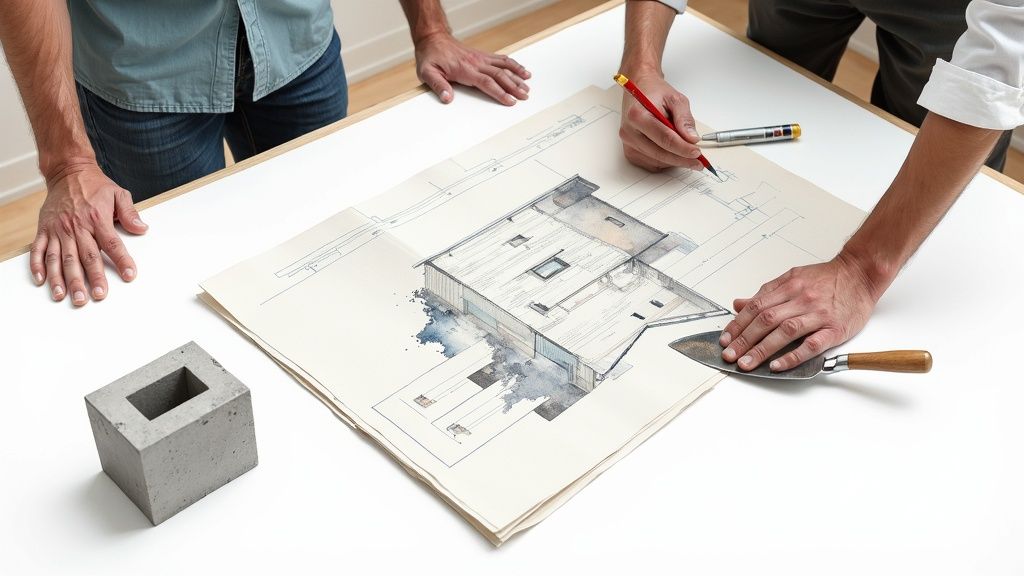
When planning a commercial build, "compliance" is a critical term. But what does it actually mean for your budget, timeline, and the building's ability to stand strong for decades? Many providers fail to address emerging code changes and technical factors vital to real commercial work.
This communication gap often leaves property owners and GCs shouldering all the risk. Without knowing the rules, it's impossible to budget for engineered plans, prepare for inspections, or select materials that meet today's seismic and environmental standards.
The Core Pillars of Compliance
True compliance isn't a single item; it rests on three critical pillars. Each pillar supports a different part of your project, from legal paperwork to the physical strength of the finished structure. Getting these right from the start is key to a smooth, successful build.
- Licensing and Insurance: This confirms your contractor is legally qualified and financially accountable. It is your first defense against poor workmanship and on-site liability.
- Building and Materials Codes: These technical rulebooks dictate the engineering, design, and materials needed to ensure your building can handle everything from coastal weather to a significant earthquake.
- Permitting and Inspections: This is your quality control. Local authorities provide third-party verification at key stages, ensuring work is done right before you can proceed to the next phase.
The real risk in commercial masonry isn’t just a crooked wall. It’s a failed inspection that stops your entire project, a liability lawsuit, or a structure that fails in the next earthquake. A professional masonry contractor confronts these risks head-on.
To give you a clearer picture, here’s a quick-reference table outlining the primary pillars of commercial masonry compliance that every project manager and property owner must understand.
Core Components of California Commercial Masonry Compliance
| Requirement Area | What It Governs | Why It Matters for Your Project |
|---|---|---|
| Licensing & Insurance | Contractor qualifications, legal status, and financial liability (Workers' Comp, General Liability). | Protects you from legal and financial risk. Ensures the team has proven expertise. |
| Building & Materials Codes | Structural design, seismic reinforcement, material specifications (e.g., CBC, TMS 402/602). | Guarantees the structure is engineered for safety, durability, and resilience against natural forces. |
| Permits & Inspections | Local jurisdiction approval for plans and verification of work at critical stages. | Prevents costly tear-outs, ensures work meets safety standards, and is required for project sign-off. |
This table serves as a foundational checklist. It ensures you're asking the right questions and tracking the most important elements of your project's legal and structural integrity.
Beyond the Basics for Monterey Bay Projects
For anyone building in Salinas, Monterey, or anywhere around the Monterey Bay, these requirements get even more specific. Coastal zones and local jurisdictions have their own unique permitting processes and structural demands that you won't find on a generic contractor's website.
This guide is designed to fill that gap, breaking down how modern masonry codes and seismic realities impact commercial projects. By talking about what others often overlook, we help you minimize compliance headaches and create a more accurate budget. For more on finding the right team, check out our articles about choosing a masonry contractor.
Why CSLB Licensing and Insurance Are Non-Negotiable

It’s easy—and dangerous—to assume any contractor can handle a commercial masonry job. But the truth about California’s requirements starts with one fundamental safeguard: proper licensing. This isn't just red tape; it's your project's first and most critical defense against shoddy work and legal trouble.
Any legitimate commercial mason must hold a C-29 Masonry license from the California Contractors State License Board (CSLB). This license requires years of documented experience and passing a tough exam on law, business, and trade-specific knowledge of structural and seismic safety.
The C-29 License: Your Proof of Expertise
Think of the C-29 license as a verified professional credential. It’s tangible proof that a contractor knows how to read complex engineered plans, understands load-bearing requirements, and can build structures that meet California's strict building codes. Hiring someone without it is a risk you simply can’t afford.
An unlicensed contractor doesn’t just expose your project to potential structural failure; they put you in direct legal jeopardy. The CSLB actively pursues property owners who hire unlicensed workers, which can lead to hefty fines, stop-work orders, and devastating liability if someone gets hurt on your site.
The Dual Shields: General Liability and Workers' Comp
Beyond the license, two types of insurance are essential for any commercial project: General Liability and Workers’ Compensation. They are the shields that protect your investment and your business from financial ruin.
- General Liability Insurance: This pays for property damage and injuries to third parties. If a masonry wall topples and damages an adjacent building, this insurance covers the bill—not you.
- Workers’ Compensation: California law requires this for any business with employees. It covers medical costs and lost wages for workers injured on the job, protecting them while shielding your company from direct lawsuits.
Hiring an uninsured contractor is like building without a foundation. When something goes wrong—an accident or faulty work—there is nothing to support you, and you are left to cover the full financial and legal fallout.
Choosing a contractor without these protections means any on-site accident could trigger a lawsuit filed directly against your business. Any damage they cause becomes your financial problem. That "great deal" from an uninsured contractor vanishes the moment reality hits.
Vetting Your Contractor for Full Compliance
Thankfully, verifying a contractor's credentials is a straightforward but vital step. You can check any license number instantly on the CSLB website to see if it’s active and in good standing. You should also demand a current Certificate of Insurance (COI) to verify their coverage.
For commercial projects here in Salinas, Monterey, and across the Central Coast, this diligence is non-negotiable. As you evaluate potential masonry partners, remember that Central Coast licensing rules are tightening, giving you even more reason to hire properly vetted professionals. A fully licensed and insured contractor is demonstrating a commitment to safety and the long-term success of your project.
Navigating California's Seismic Building Codes
In California, a commercial masonry structure must be engineered to stand its ground when the ground starts shaking. That's where the California Building Code (CBC) steps in. It's the ultimate playbook for construction with a laser focus on earthquake resilience, especially for materials like masonry.
Many contractors throw code numbers around, but understanding the principles behind them is what matters. The CBC pulls from national standards like TMS 402/602 (Building Code Requirements and Specification for Masonry Structures). These aren't just jargon—they are the bedrock of safe, engineered masonry in our state.
The "Why" Behind the Rules
Getting a handle on these codes is everything. They dictate the exact size, spacing, and placement of steel reinforcement (rebar) and spell out the required strength of the mortar and grout. The goal is to create a unified structure that can flex and absorb an earthquake's energy, rather than cracking and failing catastrophically.
This gets to the heart of the truth about commercial masonry requirements in California: it’s not just about ticking boxes. It's about building with a deep understanding of structural integrity. A contractor who blindly follows a plan without grasping the engineering intent can miss small details that lead to a failed inspection or hidden vulnerability.
The diagram below shows how these national and state codes flow down to influence the final design of your project.
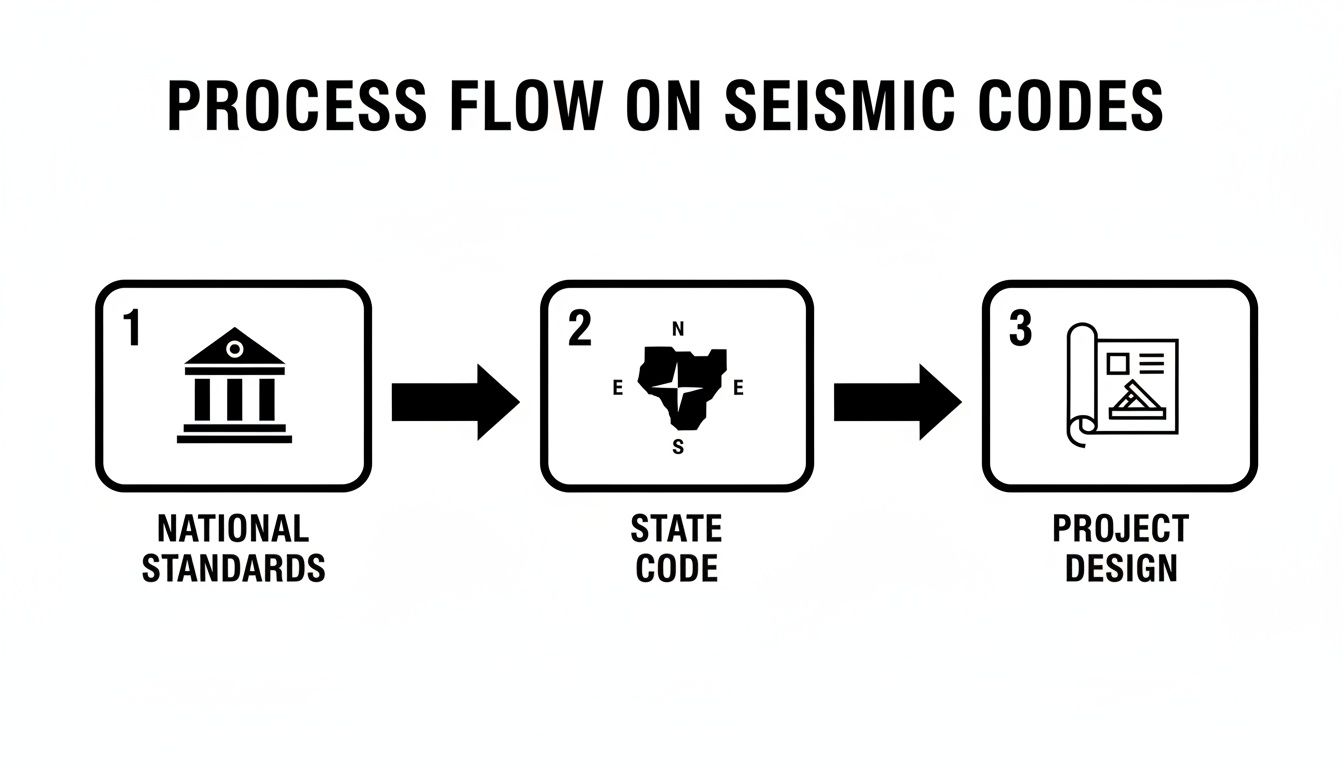
As you can see, your project's design isn't arbitrary. It’s the product of a deliberate, multi-layered system designed for safety.
From Unreinforced Masonry to Modern Standards
California's intense focus on seismic safety was born from tragedy. Major earthquakes revealed the deadly flaws in unreinforced masonry (URM) buildings. The state began tackling this with the 1986 URM law, requiring cities to identify these dangerous structures.
This program cataloged around 25,900 URM buildings, and thankfully, about 55% were eventually retrofitted or demolished to meet higher safety standards. You can dig deeper into these statewide efforts to reduce earthquake losses in California. (Source: California Geological Survey)
This history is written directly into today's codes. Modern commercial masonry is engineered to prevent the brittle failures that plagued older URM buildings. Key requirements now mandate:
- Continuous Steel Reinforcement: A grid of vertical and horizontal rebar runs through the walls, tying everything together and giving masonry the tensile strength it lacks.
- Secure Anchorage: Walls must be firmly connected to the foundation and roof or floor systems, creating a cohesive structure that moves as one during an earthquake.
- Specific Material Strengths: Blocks, bricks, mortar, and grout are all held to strict ASTM standards to ensure they have the compressive strength needed for the job.
A classic mistake is poor grout consolidation. If the grout has voids or air pockets around the rebar, it creates a critical weak point. An experienced mason knows how to ensure every core is filled solid, creating the strong, monolithic wall the engineer designed.
For any project on the Central Coast—whether in Salinas, Monterey, or Santa Cruz—these seismic rules are non-negotiable. Our proximity to major fault lines means following the CBC isn't just about compliance. It’s about protecting your investment and the people inside it.
The Permitting and Inspection Process Explained
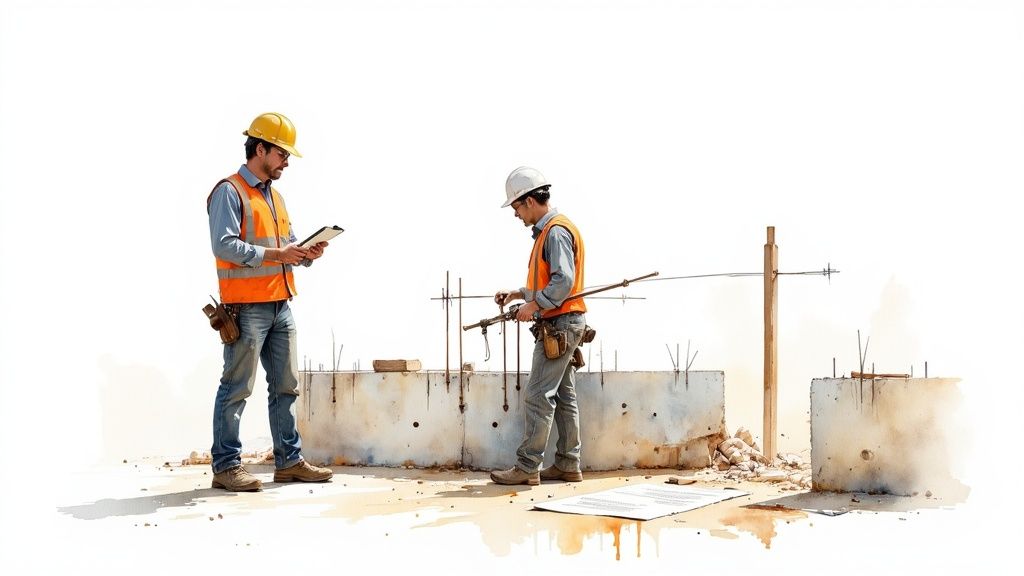
A perfectly engineered design is a great start, but it's only half the battle. The real test is navigating the local permitting and inspection process. This journey can grind plans to a halt without the right experience.
This is where your contractor's procedural knowledge becomes as valuable as their skill with a trowel. The system's purpose is to have an independent set of eyes confirm your project is being built safely and exactly to the approved plans. When coordination is clumsy, you get frustrating delays.
Key Stages of the Permitting Journey
The permitting and inspection process follows a clear sequence. You must pass each stage before legally moving on to the next. For commercial masonry in California, these steps are non-negotiable.
- Plan Submittal and Review: Before work begins, your structural engineer’s plans are submitted to the local building department. Officials in cities like Salinas or Monterey will check for compliance with the CBC, seismic codes, and any unique local rules.
- Permit Issuance: Once plans are approved, the city issues a building permit. This official placard must be posted on the job site and is your legal green light to start building.
- Scheduled Inspections: Construction pauses for a series of mandatory inspections at critical moments. It's your contractor’s job to schedule these at precisely the right time.
A classic mistake is calling for an inspection too early. If the rebar isn't fully tied off, the inspector will fail the inspection on the spot. That means rescheduling, which can easily throw off the project schedule and hold up other trades for days.
Critical Masonry Inspection Points
For commercial masonry, inspectors zero in on a few key areas where structural integrity is critical. These aren't formalities; they are pass/fail tests. Failing one can mean a stop-work order or being forced to tear down what you just built.
A professional masonry crew prepares for these inspections meticulously. They document their work and keep an open line of communication with the general contractor and project engineer. Here are the most common make-or-break inspections:
- Foundation and Footing Inspection: This happens after trenches are dug and rebar is laid, but before concrete is poured. The inspector verifies footing dimensions, rebar size and spacing, and proper clearance.
- Rebar and Anchor Bolt Inspection: Before pumping grout into block walls, an inspector must sign off on all vertical and horizontal steel. They confirm the steel matches the engineer’s specs for size, spacing, and overlaps.
- Grout Lift Inspection: For tall walls, grout is poured in stages, or “lifts.” An inspector may be required to verify the first lift to ensure proper consolidation before the rest of the wall is filled.
- Final Inspection: Once all masonry work is finished, a final inspection signs off on that part of the job. This confirms all previous inspections passed and the structure is solid.
Understanding these checkpoints helps everyone manage expectations and build a realistic timeline. A professional team knows that acing every inspection is the secret to avoiding costly setbacks. It’s also crucial to know the legal scope of work for contractors; learn more in the truth about the $500 rule for contractors.
Choosing Materials That Meet Modern Standards
Codes and inspections are a huge part of the puzzle, but the truth about commercial masonry requirements in California comes down to the physical materials you build with. The long-term performance, durability, and safety of your structure hinge on the quality of its components. Material standards are non-negotiable.
Every masonry unit and every mix of mortar must meet specific standards laid out by ASTM International. Those aren't just random letters; they represent a material's tested compressive strength and its ability to stand up to the elements. This is especially critical for projects in coastal communities like Pacific Grove or Monterey, where salt-laden air attacks lesser materials.
The Rise of Sustainable and Innovative Materials
While time-tested materials are industry workhorses, we're seeing a major shift toward sustainability. Commercial clients and regulators emphasize environmental impact, opening the door for innovative materials that don't sacrifice integrity.
The biggest game-changer is low-carbon concrete. Companies like CarbonCure inject captured CO2 into wet concrete, where it mineralizes and becomes a permanent part of the structure, actually making it stronger. This reduces the amount of cement needed—a massive win for lowering a project's carbon footprint.
Choosing sustainable materials is no longer just a nice-to-have. It's a strategic move that helps hit Environmental, Social, and Governance (ESG) targets, attracts modern tenants, and keeps you ahead of California’s progressive environmental regulations.
This push for eco-friendly options mirrors a broader trend. Both homeowners and commercial clients want materials that are beautiful and responsible, a topic we cover in our guide to upcoming trends that make stone patios a top home upgrade.
Why Material Selection Is a Core Compliance Issue
Picking the right materials is more than just about aesthetics or being green—it's a fundamental checkpoint for compliance. Structural plans call out very specific material strengths, like Type S mortar or concrete block rated for a certain PSI. Substituting with cheaper, non-compliant materials is a surefire way to fail an inspection.
A professional masonry contractor gets this. They provide documentation proving that every block, bag of mortar, and piece of rebar meets engineered specs. For any project on the Monterey Bay, from Salinas to Carmel, getting the materials right is the final, crucial step to building something that truly lasts.
How Local Monterey Bay Rules Shape Your Masonry Project
California's statewide commercial masonry requirements set a solid baseline, but they're not the whole story. The real make-or-break details often come down to local rules. Here in the Monterey Bay area, that local oversight is a big deal.
A contractor's intimate knowledge of the specific amendments in Salinas, Carmel, Pebble Beach, or Seaside can be the difference between a project that sails through approvals and one that gets bogged down in costly delays. These rules are tailored responses to our unique environment.
Monterey Bay's Unique Building Challenges
From the persistent salt spray in Pacific Grove to the real wildfire risks in Carmel Valley, our local building departments adapt state codes to protect buildings from known threats. This is precisely where generic advice misses the mark and deep local expertise becomes essential.
Every commercial project, whether in Prunedale or right on the Monterey coast, contends with specific environmental pressures. A truly experienced local mason doesn't just build to code; they build for the specific spot on the map.
Three major regional factors always come into play here:
- Coastal Weather Exposure: Salty sea air is relentless. Local codes often demand materials like hot-dip galvanized or stainless steel rebar and ties to stop rust from compromising the structure.
- Variable Soil Conditions: Monterey County has incredibly diverse soil, from loose sand to heavy, expansive clays inland. Local foundation requirements are often stricter here to prevent a building from shifting, cracking, or settling.
- Inland Wildfire Risk: Heading inland towards Carmel Valley, the focus shifts to fire-resilient construction. Local fire codes are getting tougher, mandating non-combustible materials, as we discuss in how Carmel Valley's fire zones are changing stone patio design.
Navigating Local Rules and Who Enforces Them
How building codes are enforced can feel worlds apart from one city to the next. The history of seismic retrofit programs in California shows this in action. Los Angeles pushed an aggressive program in the 1980s, while many Bay Area jurisdictions started later and had a much smaller percentage of at-risk buildings retrofitted by the early 2000s.
These regional retrofit program differences show just how much local policy and priorities matter. A contractor who has built relationships with local building departments and understands what a particular inspector looks for is invaluable. This on-the-ground knowledge is a vital part of meeting commercial masonry requirements in California.
Frequently Asked Questions About Commercial Masonry
Here are answers to common questions we hear from developers, GCs, and property owners to help you plan your next project and hire with confidence.
What is the most overlooked commercial masonry requirement?
It’s almost always specialty inspection. California law requires an independent, third-party inspector to sign off on critical structural steps, like rebar placement and grout consolidation. Missing one of these inspections can trigger a stop-work order, grinding the entire job to a halt.
How do seismic codes affect the cost of a project?
Seismic codes absolutely drive up material and labor costs. A commercial masonry wall is a heavily engineered system packed with a grid of steel rebar and filled solid with grout. That means more steel, more concrete, and more skilled labor hours, but it’s a non-negotiable investment in safety.
Why can’t I just hire any mason for a commercial job?
A C-29 license is the bare minimum. Commercial jobs demand someone who can read complex structural blueprints, understand seismic engineering, and coordinate with other trades and inspectors. Hiring a mason who primarily does residential work is a huge gamble that puts your entire project at risk.
Are sustainable materials like low-carbon concrete code-compliant?
Yes, absolutely. Materials like low-carbon concrete are engineered to meet or exceed the ASTM standards in the California Building Code. An experienced contractor can guide you to the right products and ensure they're installed correctly to maintain full structural integrity and compliance.
Do masonry requirements change between Salinas and Monterey?
Yes, they do. While the California Building Code sets the baseline, local jurisdictions like Salinas, Monterey, or Carmel can add their own rules. A project on the coast might face stricter corrosion-resistance rules, while an inland site could have unique fire-safety requirements.
Planning a commercial masonry project in California means finding a partner who understands all layers of state and local rules. Especially for projects here in Monterey County, navigating the coastal climate, varied soils, and fire concerns requires deep local experience. If you’re getting ready to build, consulting a licensed and insured professional is the best first step you can take.
