
You've probably heard people talk about "the $500 rule" for contractors, but there’s a lot of confusion out there. Let's clear it up: this isn't some company policy. It’s a strict California state law designed to protect you, the homeowner.
The bottom line is simple: for any construction or hardscape project that costs $500 or more—including both labor and materials—the person doing the work must have a valid contractor's license. This single rule has a huge impact on everything from a small paver fix to a full-blown stone patio installation. Understanding the truth about the $500 rule is the first step toward a safe and successful project.
What Is the $500 Contractor Rule in California?
We hear it all the time from homeowners around Monterey Bay: "It's just a small job, why do I need to hire a licensed contractor?" The answer is all about protecting your investment and your safety.
California law draws a clear line in the sand between minor handyman tasks and professional construction work. That line is drawn at $500.
Think of it as a safety net. The rule ensures that anyone taking on a significant project at your home has proven their skills, carries the right insurance, and is held accountable by the state.
The Law and Its Purpose for Homeowners
This isn't just a suggestion; it’s codified in the California Business and Professions Code. Its entire purpose is to shield homeowners from shoddy workmanship, financial scams, and unsafe practices from unqualified individuals.
Here's the part that trips most people up: the $500 total includes both the cost of labor and the cost of all materials. You can't split the invoice to sneak under the limit. If pavers cost $300 and labor is $250, the total is $550, and a licensed contractor is legally required.
How the $500 Rule Applies to Your Hardscape Project
This rule is front-and-center for hardscape work. Whether you're picturing a new patio in Carmel, need to reset wobbly pavers in Pebble Beach, or want a retaining wall to tame the clay soil in Salinas, costs can quickly pass $500.
Let’s look at a few real-world examples:
- A simple paver reset: The cost of good-quality pavers, sand, and base material, plus the hours for proper installation, can easily top the limit.
- Repairing a crack in concrete: Specialized sealants and equipment for a lasting repair often push the total project cost over $500.
- Building a small garden wall: Even a low, decorative wall needs a proper footing, mortar, and quality stone—all of which almost always exceed the threshold.
Why Nearly Every Hardscape Project Exceeds the $500 Limit
Many clients in Salinas and Carmel ask, “Why do I need a licensed contractor for such a small repair?” The reality is that California's $500 threshold is much lower than people think for professional hardscape work.
The law is crystal clear: the $500 limit covers the total cost, including both labor and materials. Quality materials built for the Monterey Peninsula's coastal weather aren't cheap, and expert labor adds up quickly. Homeowners complain online that even tiny projects require a licensed pro due to this law, highlighting how the $500 exemption barely covers any real masonry repair. (Source: Reddit insights)

Breaking Down the Real Costs of Hardscape Repairs
Let's ground this in reality with a couple of common repair jobs we see around here. These aren't inflated numbers; this is what it takes to do the job right so it lasts.
-
Resetting a Small Paver Section in Pebble Beach: For a 4×4 foot patch of buckled pavers, quality materials can run $150-$200. A skilled mason's time to properly excavate, re-compact the base, and relay the pavers can easily top $300. Just like that, you’re over the limit.
-
Patching a Cracked Concrete Step in Pacific Grove: A real concrete repair requires chipping out weak material, prepping the surface, and applying a high-strength patching compound. Specialized materials can cost over $100, and the careful labor for a structural, invisible patch can be $400-$500.
Why Quality Materials and Labor Add Up
Anyone can try to keep a job under $500 by using cheap materials and cutting corners. But that's a recipe for disaster that will need fixing again in a year. Proper hardscape installation, whether for new patios and walkways or a small repair, requires a baseline of quality.
Here's what goes into a professional quote that pushes it past that $500 handyman limit:
- Durable Materials: We only use materials proven to withstand our coastal climate—the salt air, fog, and temperature swings.
- Proper Base Preparation: This is the non-negotiable foundation for stability and drainage, preventing sinking and cracking.
- Skilled Craftsmanship: The expertise to perfect the grading, joints, and finish comes from years of experience.
When you get a quote over $500, you're investing in quality craftsmanship and legal compliance—a solution that will last while protecting your property's value and safety.
The Hidden Costs of Hiring an Unlicensed Contractor
Hiring someone without a license for a project over the legal limit might seem like a way to save money, but it often costs homeowners far more in the long run. The risks involve serious financial liability, legal headaches, and the stress of a job gone wrong.
The biggest issue is the lack of liability protection. A licensed masonry contractor must carry general liability and workers’ compensation insurance. If an unlicensed worker gets hurt on your Pacific Grove property, you could be responsible for their medical bills.
No Warranty, No Recourse
With an unlicensed worker, you get no guarantee of quality. If the work fails—a retaining and garden walls collapses or a patio sinks—you have little legal recourse. The money you thought you saved vanishes when you hire a licensed pro to do it right the second time.
Improperly built hardscapes can cause major problems, especially with our local clay soils. A patio without proper drainage can funnel water towards your home’s foundation, leading to expensive structural damage.
Legal Dangers for Homeowners and Workers
California’s Contractors State License Board (CSLB) actively enforces the law. In a single 2025 sting operation, they took 119 enforcement actions targeting unlicensed bids, including hardscape work. (Source: Strategic Report)
Penalties for the worker are stiff, including misdemeanor charges, fines up to $15,000, and even jail time. For you, the homeowner, risks include potential fines and the inability to sell your home if unpermitted work is discovered. In fire-prone areas like Carmel Valley, a non-compliant structure can void your homeowner's insurance.
Licensed Vs. Unlicensed Work: What Contractors Can and Cannot Do
Understanding the legal lines between a professional contractor and an unlicensed handyman protects your home, investment, and peace of mind. A licensed hardscape pro operates under a strict code of conduct—these are legal and ethical requirements.
What this actually means for you is that the law is strict, not optional. Hiring unlicensed contractors puts both the homeowner and the contractor at risk, while clear explanations from a professional build trust and prevent misunderstandings.
What A Licensed Contractor Must Do
When you hire a licensed C-29 Masonry contractor in California, you get a system of built-in protections.
They are legally required to:
- Provide a Written Contract: Any job over $500 requires a detailed contract outlining the scope, timeline, and cost.
- Carry Insurance: They must have general liability insurance and workers' compensation, protecting you from on-site accidents.
- Adhere to Building Codes: They know local rules, ensuring the job meets fire safety codes in Carmel Valley or seismic standards across the Monterey Peninsula.
- Pull Necessary Permits: They have the authority to pull permits, ensuring your project is legal and passes inspection.
What An Unlicensed Person Cannot Do
An unlicensed individual works completely outside these legal safety nets. The state is very clear about their limitations.
An unlicensed person is legally forbidden from:
- Taking on Jobs Over the Legal Limit: They cannot take any project where the total cost—labor and materials—is $500 or more.
- Advertising for Larger Projects: It's illegal for them to advertise for work valued above the $500 threshold.
- Splitting Projects to Bypass the Law: Breaking a large project into smaller "phases" under $500 is an illegal tactic.
This flowchart lays out the gamble you take when hiring someone without a license for a job that legally requires one.
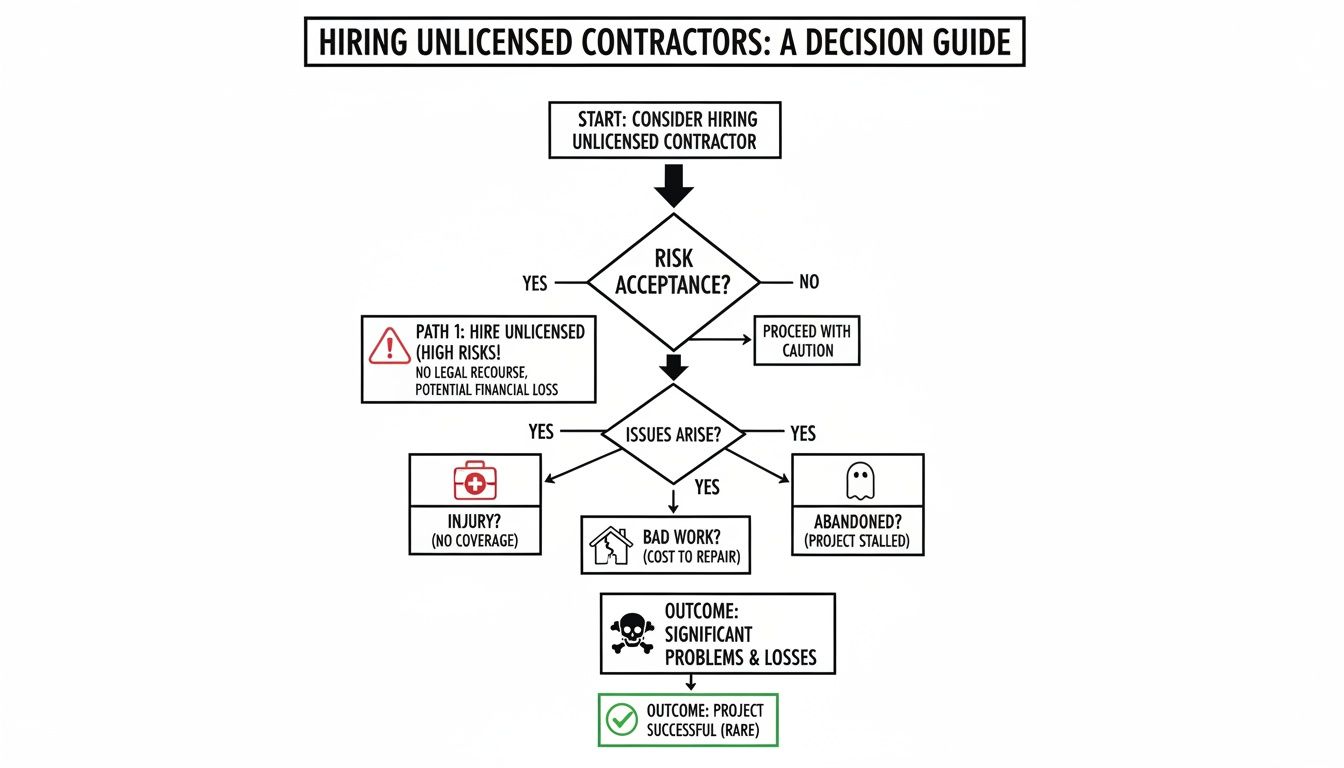
As you can see, a simple choice can spiral into on-site injuries, shoddy work, or a half-finished project. It’s why high-quality custom stone work is a job best left to verified professionals.
Licensed Pro vs. Unlicensed Worker: A Comparison
The price difference between bids often reflects a huge gap in protection, quality, and accountability.
| Feature | Licensed Hardscape Contractor | Unlicensed Individual |
|---|---|---|
| Project Value | No legal limit on project size. | Legally limited to jobs under $500 (total). |
| Contract | Provides a legally binding written contract. | No legal requirement; verbal agreements are risky. |
| Insurance | Carries workers' comp and general liability. | Uninsured, making you liable for accidents and damages. |
| Permits & Codes | Handles all permits and ensures work meets code. | Cannot pull permits; work may be illegal and unsafe. |
| Accountability | Accountable to the Contractors State License Board (CSLB). | No regulatory oversight; few options if they disappear. |
| Work Quality | Must meet industry standards; experience is verified. | Skill and quality are unverified and often inconsistent. |
Choosing a licensed professional is an investment in certainty, ensuring the job is done safely, legally, and to a professional standard.
How to Verify a Contractor's License
The single most important thing you can do before hiring anyone is verifying their contractor's license. This five-minute check is your first line of defense, protecting your home and money.
California’s Contractors State License Board (CSLB) has an online tool that lets you look up any contractor in seconds.
Using the CSLB Online License Lookup
All you need is the contractor's license number, which any reputable pro will provide.
Here’s how simple it is:
- Head to the CSLB Website: Navigate to the CSLB’s “Instant License Check” page.
- Enter Their Info: Pop in their license number for the most accurate results.
- Review the Record: The site will pull up a page with everything you need to know.
A reputable contractor will have their license number on their business card, website, or estimate. If they are hesitant to provide it, consider that a major red flag.
What to Look For on the License Record
Once you’ve found their record, look for a few specific things to ensure they are qualified for your project.
Here's your checklist:
- License Status: It must say “Active.” Expired, suspended, or revoked means they are legally barred from working.
- Classification: For any paver patio, stone wall, or outdoor fireplace, you need to see the C-29 Masonry classification.
- Bonding Information: Check that they have an active contractor's bond, a small financial safety net for you.
- Workers' Compensation: Ensure they have a valid workers' comp policy listed and that the box for exemption is NOT checked.
Taking these few minutes empowers you to make a smart, safe choice. To see what a fully licensed and insured team looks like, you can learn about the Stonecap Masonry team and our professional credentials.
Frequently Asked Questions About the $500 Rule
Let's clear up some common questions homeowners have about California's contractor rule.
Does the $500 limit include materials?
Yes, absolutely. The $500 threshold covers the total project cost, which includes both the cost of labor and all materials combined. This is a critical detail that many people overlook.
What if a contractor wants me to pay cash and skip the contract?
This is a massive red flag. Any licensed professional will insist on a written contract for jobs over $500, as it’s required by law. Avoiding a contract is a tactic used by unlicensed operators and leaves you with no legal protection.
How does this rule apply to small hardscape repairs?
A "small" job in Carmel or Pacific Grove can easily exceed the limit. Once you factor in professional-grade materials and the time for skilled craftsmanship, a simple paver or concrete repair often costs more than $500. Always get a quote from a licensed pro to be safe.
Why do I need a licensed contractor for a small repair?
Even minor hardscape work often requires a licensed pro because the total cost of labor and quality materials quickly surpasses the $500 legal limit set by California law. This rule exists to protect homeowners by ensuring the work is insured, code-compliant, and performed by a qualified professional.
What should I do if I think someone is working without a license?
If you suspect illegal contracting, you should report them to the Contractors State License Board (CSLB). Filing a complaint helps protect other homeowners in our community and upholds professional standards in the construction trade.
A properly built hardscape is an investment in your home's safety, value, and enjoyment. Given Monterey County's unique climate and soil conditions, ensuring your project is compliant and built to last is critical. Always consult with a licensed masonry professional who understands local requirements.
If you’re unsure whether a repair or project requires a licensed contractor, we’re happy to clarify the rules and help you plan a safe, compliant hardscape project that fits your budget.
Learn more at https://stonecapmasonry.com
