
Direct Answer: A fireplace usually smokes because the firebox, throat, damper, or smoke chamber is shaped or sized wrong. The opening is too big for the flue, or the passageway above the firebox is choked.
You light a fire, the room looks great for about four minutes, and then a soft gray haze starts drifting out over the mantel. By the time the log is really going, your eyes sting and the whole house smells like a campfire.
I hear this a lot on the Monterey Peninsula, especially in older homes in Pacific Grove and Carmel where the fireplace was built decades ago and nobody has looked behind the stone since. Homeowners usually blame the wood, the weather, or the damper. Most of the time the real problem is shape.
This article stays inside the fireplace: the firebox, the throat, the damper, and the smoke chamber. That short stretch of masonry, maybe three feet of it, decides whether smoke goes up the flue or into your living room.
Why a fireplace pushes smoke back at you
A masonry fireplace does not blow smoke up the chimney. It relies on draft, which is just warm air rising and pulling cooler room air in behind it.
For that to work, everything above the fire has to get out of the way and everything around the fire has to push heat forward and up. When the geometry is off, the smoke hits a slow spot, stalls, and rolls out the front.
The usual culprits I find are simple:
- A fireplace opening that is too large for the flue it feeds
- A firebox that is too shallow, so the fire sits almost in the room
- A throat that is too low or too wide, killing the velocity of the rising gases
- A rough, oversized smoke chamber that lets smoke swirl instead of funnel
- A damper plate that does not open fully, or a damper frame narrower than the flue
Add the Peninsula’s marine layer and the problem gets worse. On a damp, still evening when a cold inversion is sitting over the bay, the flue starts out cold and heavy. A fireplace with borderline proportions will draw fine in dry January air and smoke badly in August fog.
The masonry fireplace construction details the code actually spells out
There are hard numbers behind all of this, and they are worth knowing before you get a bid. A government masonry training document lays out the same model code figures masons work to, including firebox depth, throat height, and the rule about the passageway above the firebox.
The key ones:
- A masonry firebox needs a minimum depth of 20 inches
- The throat has to sit at least 8 inches above the fireplace opening
- The throat opening itself must be at least 4 inches deep
- The combined cross section of the throat, damper, and smoke chamber cannot be smaller than the flue it feeds
- Where a smoke chamber is built from corbeled masonry, those walls cannot lean more than 30 degrees off vertical
Read those as floors, not a design. They are the lowest acceptable version of each part.
A fireplace can meet every single minimum and still smoke, because none of those numbers say anything about how big the front opening is relative to the flue. That ratio is the one nobody talks about, and it is the one that usually fails. If you want the wider regulatory picture, I covered what the 2025 building code actually requires for a masonry fireplace separately.
Code minimums vs. what a fireplace actually needs
Here is how the model code numbers line up against the judgment call behind each one.
| Element | Model code minimum | Why the minimum alone can still smoke |
|---|---|---|
| Firebox depth | 20 inches | A shallow box puts the fire closer to the room, so more smoke escapes the opening before it can rise |
| Throat height above opening | 8 inches | Too low and the smoke has no room to gather and accelerate before it squeezes through |
| Throat opening depth | 4 inches | A wide, shallow throat drops gas speed; the smoke slows down right where it needs to move fastest |
| Throat, damper, and smoke chamber cross section | No smaller than the flue | A damper frame or rough corbel that pinches the path chokes the whole system no matter how good the chimney is |
| Corbeled smoke chamber wall slope | No more than 30 degrees off vertical | Legal slope can still be rough and turbulent if the surface is never parged smooth |
| Opening size vs. flue area | Not covered by a single minimum | This is the ratio that makes or breaks draft, and it is the most common design error I find |
Where a mason earns the money: slope, splay, and a smooth smoke chamber
Three shapes inside the firebox do most of the work, and none of them are decoration.
The sloped fireback is the back wall that leans forward as it rises. It reflects radiant heat out into the room and, more importantly, it aims the rising column of smoke toward the throat instead of letting it climb straight up into a dead corner.
The splayed side walls angle outward toward the room. Same idea: they push heat forward and keep the smoke moving toward the center and up rather than curling along the walls and spilling over the opening.
Then there is the smoke chamber, the funnel-shaped space between the damper and the flue. Its whole job is to collect smoke and neck it down smoothly into the flue.
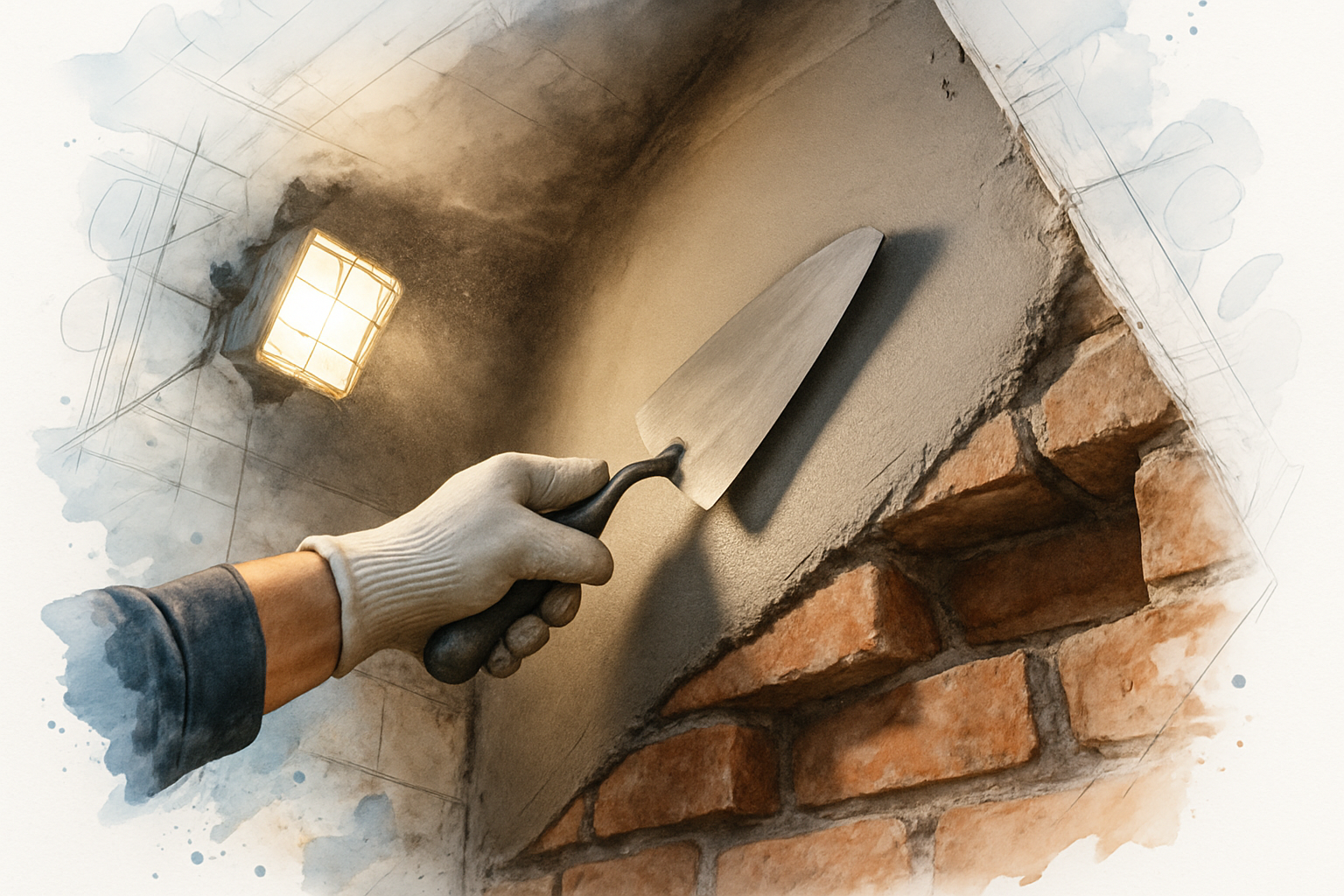
A smoke chamber built from stepped, corbeled brick and left rough is a turbulence machine. Every brick ledge is a little eddy that slows the gas and catches creosote. Parging it, meaning coating the inside with a smooth layer of refractory mortar, is one of the highest-value hours of labor in the entire build.
And the damper has to match. A throat damper frame that is narrower than the flue area strangles a fireplace that was otherwise built correctly, and a plate that only swings halfway open does the same thing every single evening.
This is also why two bids on the same fireplace can land far apart. One mason priced parging, a properly sized damper, and a firebox laid to a real slope. The other priced brick. I got into that in why masonry fireplace construction costs vary so widely.
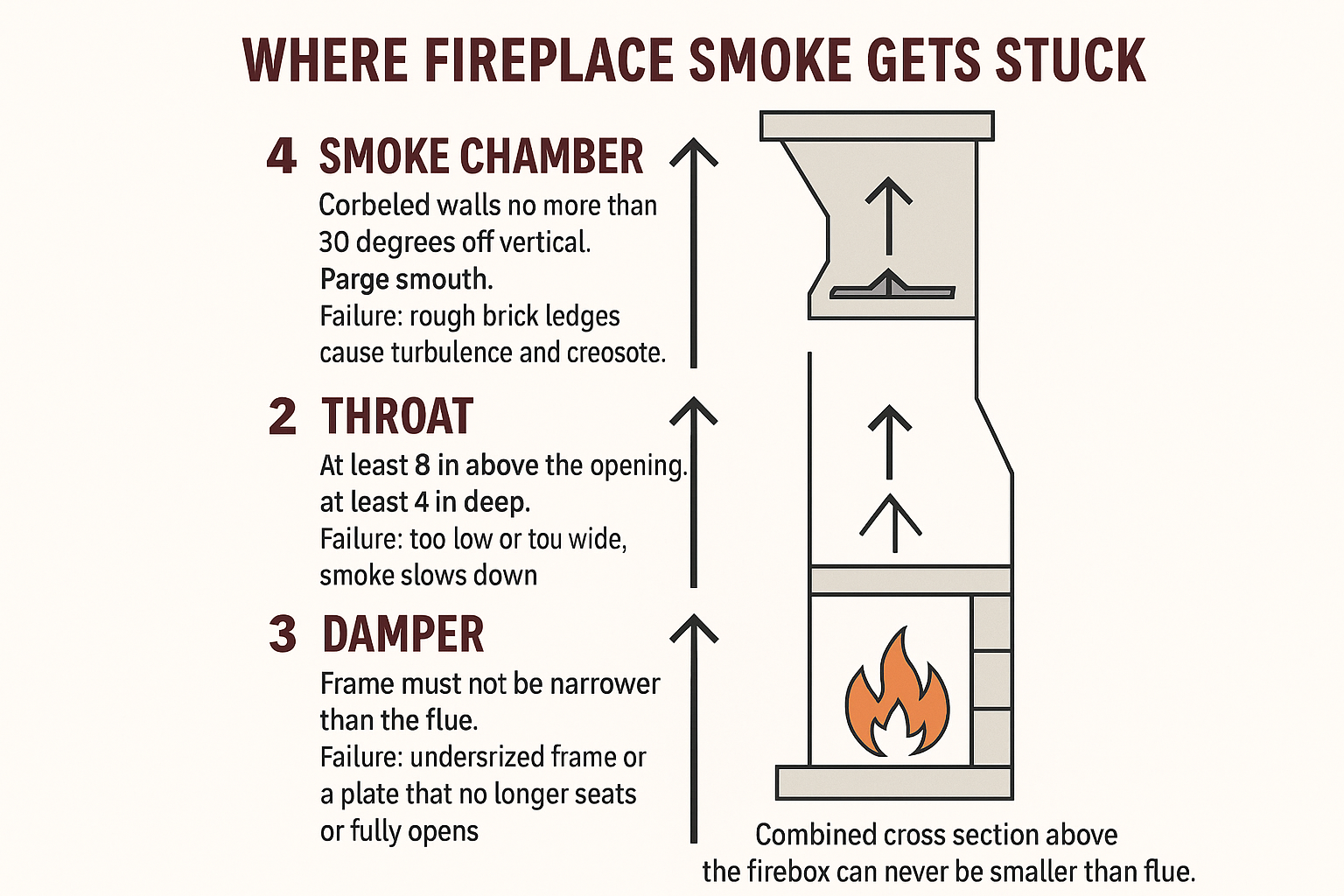
The path smoke takes, and where it gets stuck
This walks the four zones smoke passes through and the failure that shows up in each one.
How to tell if it is shape, or something else
Before anyone opens up masonry, it is worth sorting out which part of the system is failing. Here is roughly how I triage it on a site visit.
Points toward a shape problem in the firebox or throat:
- It smokes on every fire, in every season, no matter how the fire is built
- Smoke spills evenly across the top of the opening from the very start
- The opening looks unusually wide or tall for the size of the chimney
- The back wall is nearly vertical and the side walls are square instead of angled
- It got worse right after a remodel where the opening was enlarged
Points somewhere else entirely:
- It only smokes on cold or foggy starts, then clears once the flue warms
- It smokes when the dryer, bath fan, or kitchen range hood is running, which is negative pressure in a tightly sealed house pulling against the fireplace
- Soot buildup, a cracked flue liner, or an animal nest, which is a blockage issue
- A chimney that terminates too low against a nearby roof ridge or a tall Monterey pine, covered in what the chimney above a masonry fireplace actually has to do
- A damper that no longer seats or swings fully open
One important note. Firebox rebuilds, lintel replacement, smoke chamber parging, and throat corrections are structural masonry work, not weekend projects. A smoking fireplace is also a combustion byproduct problem, not only an annoyance, so it deserves a real diagnosis rather than a guess.
Why a facing job is the best chance you will get
A lot of these projects reach me as three words. One homeowner’s entire request through our site read “Fireplace facing.” That is a completely normal starting point.
But new stone across the front does nothing for a firebox or throat that was built wrong. You will have a beautiful surround and the same haze over the mantel.
A facing job is often the only time in twenty or thirty years that the surround comes off and the geometry behind it is visible. That is the moment to check the firebox depth, look at the fireback slope, and see whether the damper frame chokes the flue.
If the shape is fine, you have lost nothing but an hour. If it is not, fixing it while the face is already open costs a fraction of tearing finished stone off later.
Permits and the one inspection that catches this
California’s 2025 Title 24 standards took effect January 1, 2026, and they govern permitted masonry fireplace work on the Peninsula right now. The City of Monterey adopted the 2025 California Fire Code with local amendments in spring 2026.
Requirements and inspection schedules are not the same across the region. The City of Salinas, the City of Monterey, and unincorporated Monterey County each handle this a little differently, and the scope of your project drives whether a permit is needed at all. A cosmetic veneer change and a firebox rebuild are not the same conversation with a plans counter.
Here is the part that matters for smoke. A firebox and throat get inspected while they are still open and visible, before any facing goes on.
That window is the last honest chance to catch a proportion error. Once stone covers the front, verifying throat height or damper sizing means demolition. I broke down that sequence in the inspection points inside a masonry fireplace build.
Frequently Asked Questions About Firebox Proportions and Smoking Fireplaces
Can a smoky fireplace be fixed without tearing the whole thing out?
Often, yes. Depending on what the diagnosis shows, the fix might be parging a rough smoke chamber, correcting the throat, replacing an undersized damper, or reducing the height of the opening with a smoke guard or a rebuilt lintel course. Full firebox rebuilds happen, but they are not the automatic answer.
Why does my fireplace only smoke on foggy evenings?
Cold, damp, heavy air makes it harder for a cold flue to start pulling. On a Peninsula evening with the marine layer sitting low, a fireplace with borderline proportions has no margin left. A fireplace with good geometry handles those nights without complaint, which is a useful tell.
Does closing the damper halfway help the smoke?
No, it usually makes things worse by shrinking the passageway. Remember the rule that the combined cross section above the firebox cannot be smaller than the flue. A half-open damper breaks that on purpose.
What does it cost to correct firebox or throat proportions?
It depends heavily on what has to come apart, whether the lintel is involved, how much refractory work is needed, and access to the room. Costs across Monterey County can range widely for that reason, so the honest answer comes from an on-site look. A call to 831-262-0442 gets you an actual number instead of a guess.
Is this something a chimney sweep can handle?
A sweep is the right call for blockage, creosote, and liner inspection, and that should usually come first. But rebuilding a firebox, replacing a lintel, correcting a throat, or parging a smoke chamber is masonry work under the C-29 classification in California.
Thinking about a fireplace that finally draws right?
We are a licensed, bonded, and insured C-29 masonry contractor out of Salinas, CSLB #1073620, led by master mason Candelario “Cande” Perez and his son Adrian, and you can verify any California contractor’s license through the CSLB check-a-license tool before anyone touches your fireplace. Our review record tends to say the same thing about the work itself, like one Monterey County homeowner who wrote, “Cande and his crew were professional, friendly and did quality work.” If you want a set of eyes on a firebox before stone covers it, the number is 831-262-0442 and the site is stonecapmasonry.com.
