
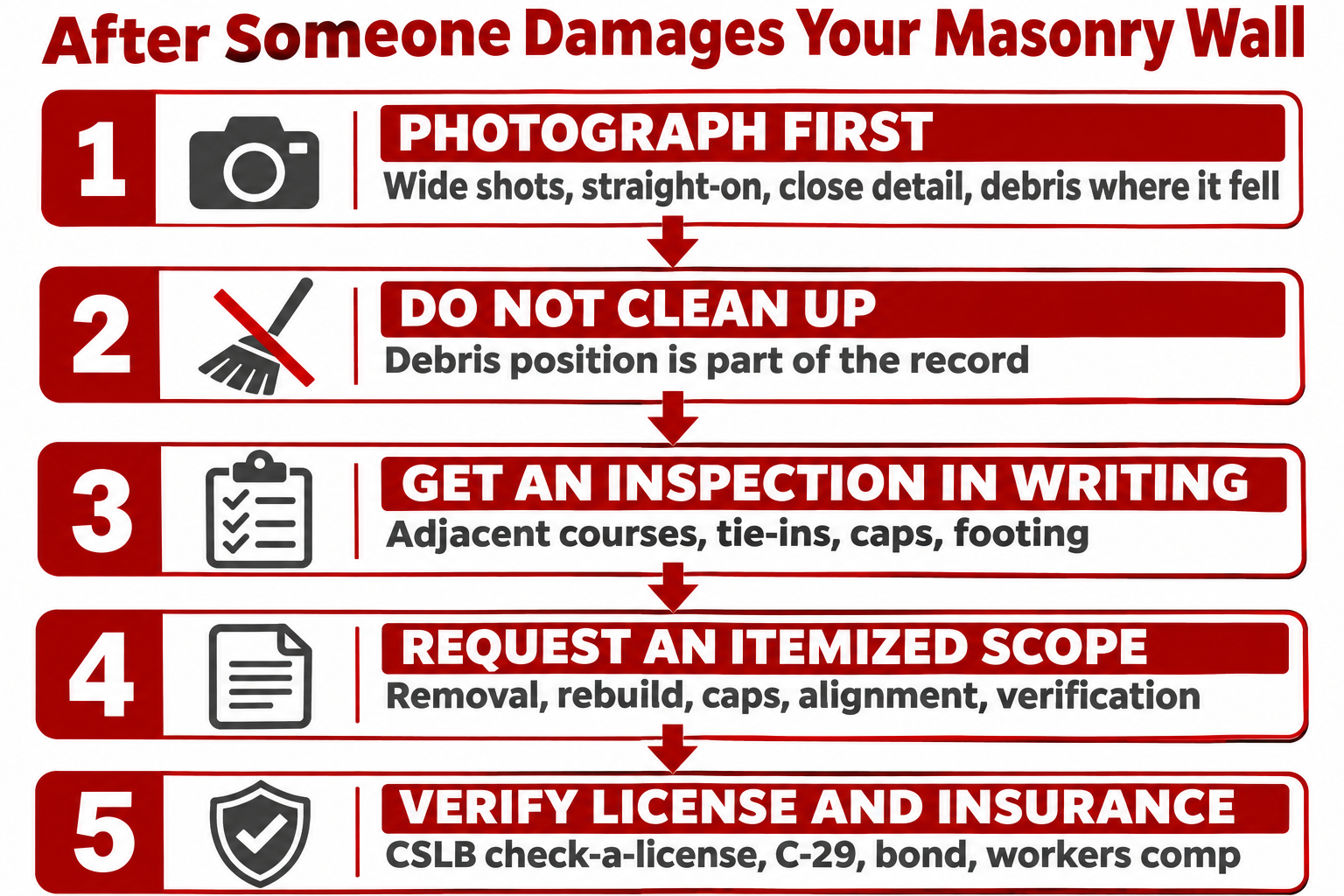
Direct Answer: Photograph everything before you clean up: the wall in context, the damaged section straight on, close detail on cracked blocks and joints, and the debris exactly where it fell.
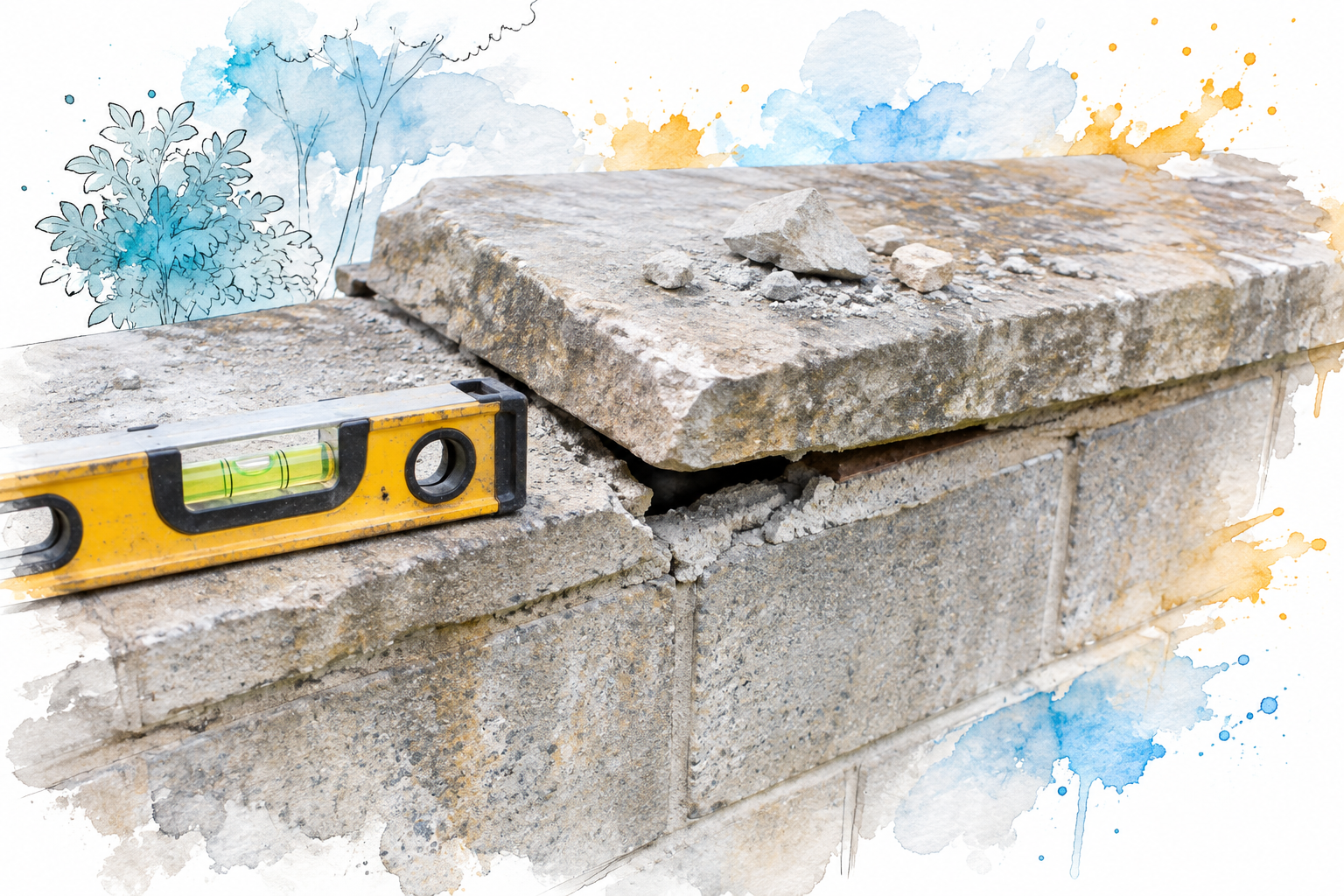
You walk outside and the corner of your block wall is shoved out of line. A delivery truck, a utility rig, or somebody else’s contractor clipped it, and now there are cracked blocks on the ground and a capstone sitting crooked.
My advice is simple and people almost always get it backwards: do not clean it up yet. The broken block lying in the dirt is worth more to you as a photograph than as a tidy yard, because the position of the debris and the direction things moved is the only record of what the impact actually did.
I get calls like this across Monterey County, and the ones that go smoothly have two things in common. The owner documented the scene before touching it, and somebody put the pre-repair inspection findings in writing before the first block came out.
Photograph the scene before anyone picks up a single block
Once the debris is swept and the loose pieces are stacked by the fence, you have lost the evidence that shows how the wall failed. A third-party payer reviewing the file later cannot tell the difference between impact damage and a wall that was already leaning.
Shoot more than you think you need, in this order:
- Wide context shots. Stand back far enough to show the wall in relation to the driveway, the roadway, or wherever the vehicle came from. Tire tracks, scuff marks, and disturbed gravel all belong in frame.
- Straight-on elevation. Square up to the damaged section from a few feet back so the displacement is obvious against the rest of the run.
- Close detail on the breaks. Cracked block faces, open mortar joints, broken corners. Get close enough that the fracture lines read clearly.
- The capstone from above. If a cap shifted or is now hanging over air, shoot down on it so the gap underneath shows.
- The debris exactly where it fell. Do not restack it for the photo.
Add a timestamp if your phone allows it, and keep the originals rather than texted copies. One homeowner I worked with had a clean photo set from the day of the strike, and that file did more to move the claim along than anything I wrote.
The damage you can see is almost never the whole scope
This is the step people skip, and it is the one that costs them later. An impact strong enough to displace a corner column pushes force into the courses next to it, and that movement does not photograph from ten feet away.
When I walk a damaged wall, I am looking past the obvious hole for things like:
- Gaps opening at the tie-in where two wall sections meet, which means the sections are no longer working together
- Courses that are no longer plumb several feet away from the strike point
- Caps that rock when you press on one end
- Hairline cracks stepping down through the block below the impact, which often points at the footing
- Base course blocks shifted off the footing line, visible only when you clear the soil at the bottom
One property owner in the area asked me specifically to check the surrounding courses for additional movement or a base and footing problem. That is a sharper question than most people think to ask, and it is the right one.
If a quick rebuild covers only the broken part, a hidden footing crack surfaces a year later, long after the responsible party has closed the file. Getting those findings written down before repairs start is what keeps a later discovery from turning into an argument about who caused it. For how a strike like this gets measured and priced out, I covered that separately in when a vehicle hits your block wall.
What a written scope of work should actually itemize
A line that reads “repair wall” gives an adjuster or a third-party payer nothing to evaluate. It also gives you nothing to hold anyone to.
The best request I ever received on this came from an owner who listed the scope himself: remove the loose masonry and haul the debris, rebuild the damaged corner and column, reset and secure the capstones, realign the top course so it sits level and continuous, and check the adjacent section for stability and proper tie-in. That is exactly the right level of detail.
Itemization does something else too. When two bids are broken out line by line, it becomes obvious when they are not describing the same work, which is usually the real reason two masonry bids land thousands apart.
A sample line-item structure for a damage repair scope
Here is how I would expect a third-party damage scope to be broken out, and what each line is doing for you.
| Scope line | What it covers | Why a payer needs it separated |
|---|---|---|
| Removal and debris disposal | Taking out loose and cracked units, hauling broken block off site | Disposal is a real cost and gets questioned if it is buried in a lump sum |
| Rebuild of damaged section and column | New units, mortar, reinforcement, and rebuilding the corner to original line | This is the core of the claim and should name materials and unit count |
| Reset and secure capstones | Lifting, cleaning, and re-bedding caps that shifted or lost support | Shows the cap work is part of the impact damage, not a separate upgrade |
| Realign top course | Bringing the top run back to level and continuous across the repair | Explains labor that is not obvious from photos alone |
| Verify adjacent run and tie-in | Checking plumb, joints, and footing condition beyond the strike point | Documents hidden damage before it becomes a dispute later |
The order of operations after a third-party strike
This is the sequence I give homeowners who call the day the damage happens.
Confirm license and insurance before anyone walks the property
An owner once closed a long, detailed repair request to me with one short line: please confirm your license and insurance information. Smart. When somebody else is reimbursing the work, that paperwork gets reviewed by more than just you.
Here is what to look at and what it means:
- C-29 classification. That is California’s masonry contractor license classification. It covers the full scope of masonry work, including structural block.
- Active status. A license can exist and still be expired or suspended. The status field tells you.
- Bond. A contractor’s bond is a limited pool of money for certain claims against the contractor. It is not the same as insurance and it does not protect your property.
- Workers’ compensation. This is the one that matters if somebody gets hurt on your property during the repair.
You can run any license number through the CSLB’s check-a-license tool in about a minute. The state has also tightened disclosure and consumer protection rules attached to home improvement contracts, which the CSLB summarized in its bulletin on new laws taking effect in 2026.
One thing I notice looking at other masonry sites around Salinas: plenty of them mention the CSLB and say they are licensed, but the actual number never appears anywhere on the page. A claim you cannot look up is just a claim. Ours is CSLB #1073620, and I would expect you to check it.
A damaged wall going into a wet winter is a different problem
Claims take time. I understand why people assume the repair can wait until the money is settled, and in July that is usually fine.
December through March is another story. Forecast guidance pointing to a strong El Niño pattern favors wetter conditions on the Central Coast, and the honest way to say it is that the odds have shifted, not that anything is guaranteed. A wall with a broken corner, a disrupted cap line, and open joints is a wall that lets water straight into the backfill.
That matters more here than people realize. Most wall failures I see around the Peninsula and the Salinas Valley trace back to drainage rather than soil weight, and expansive clay soil turns saturated backfill into a real load problem.
While you wait, a few things are reasonable for a homeowner to do:
- Re-photograph the damaged section after each major storm so you have a record of whether anything moved further
- Keep debris clear of drains and weep holes so water still has somewhere to go
- Stay off and away from the failed section, and keep vehicles and kids clear of it
What is not homeowner work: bracing, shoring, or rebuilding a damaged structural wall. If you want a sense of what the pros check before the rains, I put that in a retaining wall inspection checklist.
Frequently Asked Questions About Documenting Masonry Damage
How many photos is enough?
More than feels necessary. I would want at least 20 to 30 images covering the wide context, the straight-on elevation, close detail on every cracked unit, the capstones from above, and the debris in place. Storage is free and a second chance to shoot the scene is not.
Can I move the broken blocks if they are a safety hazard?
Yes, safety comes first. Photograph everything where it sits before you move a single piece, then set the debris aside somewhere on the property instead of hauling it off. A mason may want to look at the fracture faces.
Will a contractor put the inspection findings in writing?
A good one will. Ask for it specifically, and ask that the findings on the undamaged-looking sections be included, not just the obvious break. That written record is what separates impact damage from pre-existing wear if anyone questions it later.
Who pays if the inspection turns up damage beyond the strike point?
That depends on the responsible party and their carrier, and I cannot speak for how they will handle it. What I can say is that documenting it before repairs begin puts you in a far better position than discovering it mid-rebuild.
Do I need a permit to repair a damaged retaining wall?
It depends on the jurisdiction, the wall height, and whether the repair is structural. Requirements differ between Monterey County, the City of Monterey, Carmel, and Pacific Grove, so the honest answer is to check with the local planning or building department for your specific project.
Getting the damage on paper before the repair starts
Our shop, Stonecap Masonry, is based in Salinas and works across the Monterey Peninsula, and the same person who walks your damaged wall is the one who writes the findings down. If you want an on-site look at what the impact did and what sits beyond it, the number is 831-262-0442 and the site is stonecapmasonry.com.
