
Direct Answer: Hairline heat checking in firebrick is common and usually watched. Open joints, loose brick, or gaps showing material behind the firebox mean stop burning and have a qualified mason evaluate it.
You crouched down at the hearth with a flashlight sometime in late September, probably because the fog finally turned cold and you were thinking about the first fire. And what you found was cracked brick, gaps where the mortar used to be, and no idea whether it is safe to light.
I get this call every fall from homeowners in Salinas, Carmel Valley, and Pacific Grove. A lot of our local housing stock went up between the 1940s and the 1970s, so these fireboxes have decades of heating cycles and a few earthquakes behind them.
This article is about the firebox you already have, not how one gets built. I want to give you the words for what you are looking at, then a plain way to decide whether to watch it, have it looked at, or stop using it.
The firebox is not made of the same stuff as the rest of the fireplace
The part you are staring at is the firebox, the box that holds the fire. It is lined with firebrick, which is a dense brick made to sit in direct flame and take heat over and over without breaking down.
Between those bricks is refractory mortar, a high heat mortar that behaves differently than the gray mortar on the outside of your chimney. Regular mortar in that spot turns to powder, and it usually does it fast.
Everything else in the structure is built from different material entirely:
- Common brick or CMU block for the body and the structure behind the firebox
- Standard portland based mortar for those joints
- Stone or brick veneer for the facing you see in the room
- Flue tile or liner in the chimney above, which is its own system
So when a handyman tells you the cracks can just be patched, the real question is patched with what. A firebox repaired with bag mortar from a hardware store fails again within a season or two, usually in the same joints.
The same logic shows up elsewhere in masonry. Our piece on hard mortar on old brick makes the identical argument in a different setting: when the mix does not match the material, the material loses.
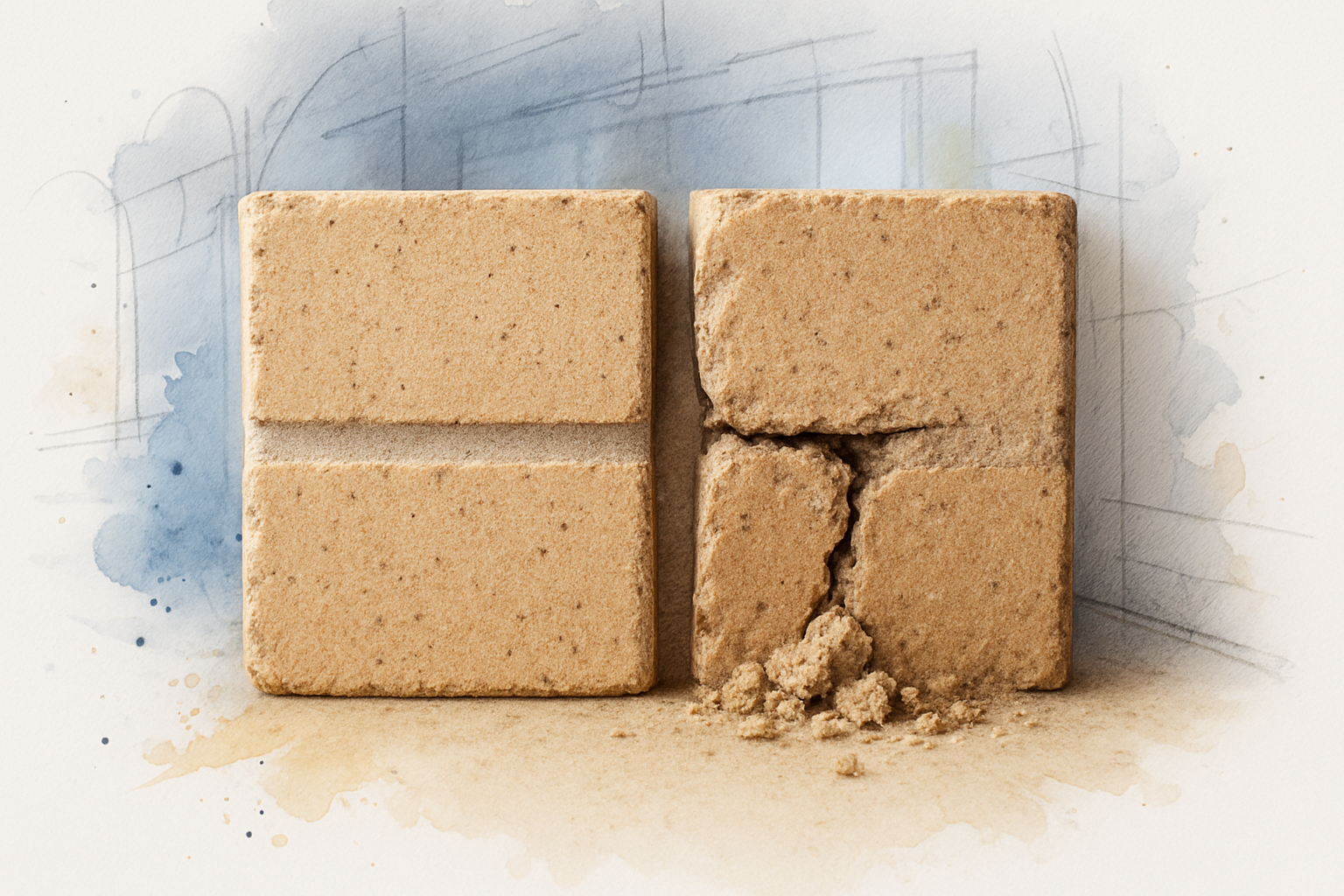
Reading the damage: what each symptom usually means
Not every crack is a problem. Firebrick expands when it heats and shrinks when it cools, and after enough cycles the faces develop a fine web of surface lines. That is heat checking, and on its own it is normal aging.
What changes the picture is depth and movement. Once a joint is open enough that you can slide a key into it, or a brick wiggles when you press it, you are no longer looking at cosmetic wear.
The one that always gets my attention is a gap at the back wall where you can see through to something behind the firebrick. That means the lining has lost its job, and heat is reaching material that was never meant to take it.
If you want a broader framework for sorting cosmetic cracking from the kind that matters, how to tell if a masonry crack actually needs repair covers the same thinking across walls and chimneys.
A plain triage ladder for a firebox
Here is how I sort what people send me photos of. Find your symptom, read the likely cause, then take the next step listed.
| What you see | What usually causes it | Next step |
|---|---|---|
| Fine web of hairline lines on brick faces | Normal expansion and contraction from repeated heating | Monitor. Photograph it and compare next season |
| Joints recessed, crumbly, or missing mortar | Refractory mortar worn out, or the wrong mix was used in a past repair | Have it evaluated before the next fire |
| Brick faces flaking or shedding layers | Moisture in the brick turning to steam, or brick never rated for direct flame | Have it evaluated before the next fire |
| A brick that moves, sits proud, or has dropped | Joint failure or movement in the structure behind it | Stop using it until someone qualified looks |
| Gap at the back wall showing material behind the firebrick | Lining has failed and heat is reaching unprotected material | Stop using it until someone qualified looks |
| Crack running up past the firebox into the smoke chamber | Structural movement, often settlement or seismic | Stop using it until someone qualified looks |
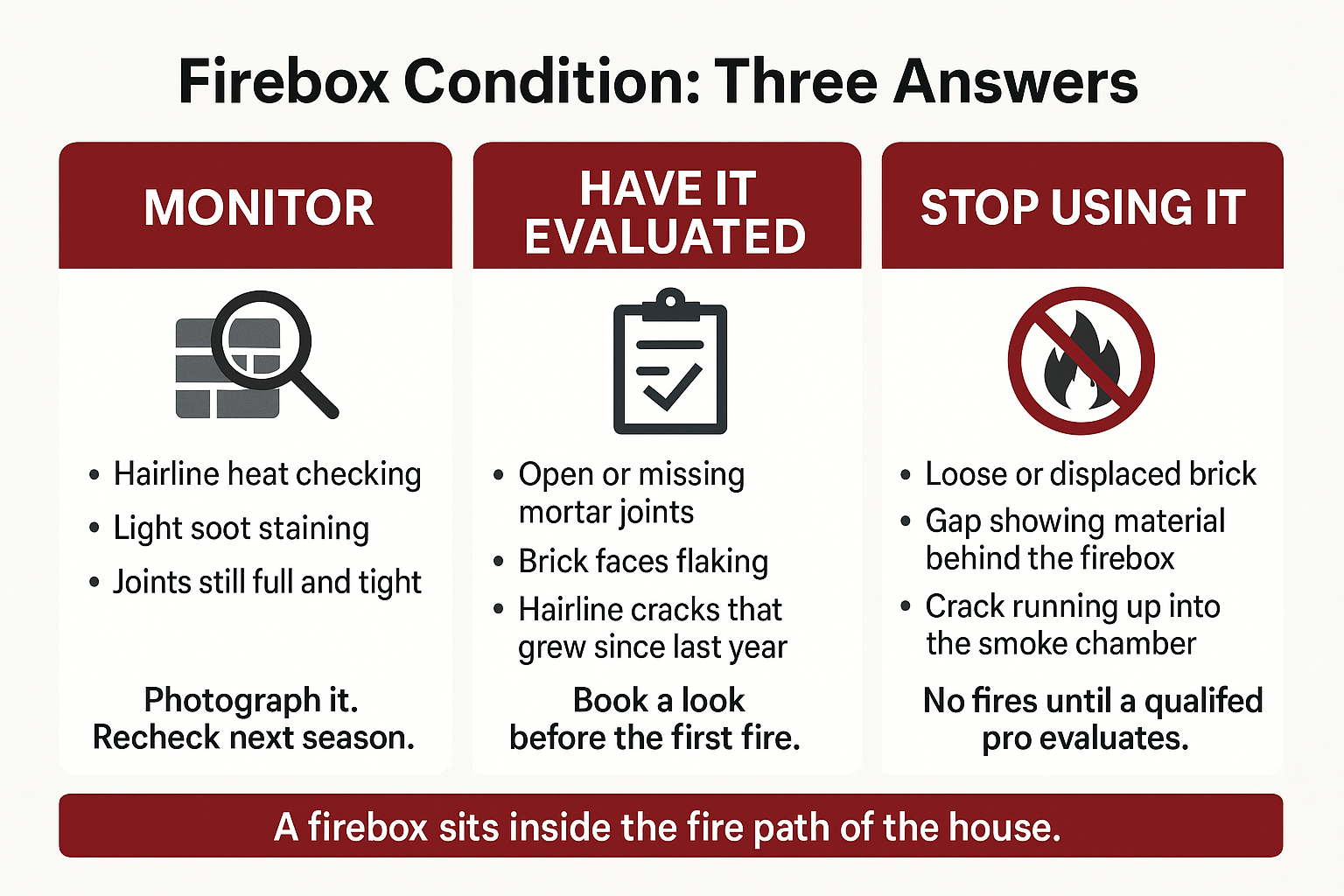
The three answers, at a glance
Most homeowners want permission to either relax or act. This breaks the decision into the only three answers that exist.
Why late fall is the worst time to find out
On the Peninsula, two forces work on the same masonry during the same months. Heat goes up the chimney all winter, and rain comes down it all winter.
That combination is why firebox and mortar problems show up here on a schedule. Searches for mortar repair spike in October, and efflorescence, the white salty crust that water leaves behind, peaks in January, right in our wet window.
NOAA’s Climate Prediction Center has carried an active El Nino advisory into the 2026 to 2027 winter. That does not guarantee a soaking season, but it does shift the odds toward a wet one, and what a strong El Nino winter actually does to masonry walks through how that plays out here.
The practical takeaway is simple. Look at your firebox in September or early October, not in December when you already have a fire going and a house full of people. If you have ever seen a stain on the wall beside the fireplace, water is already getting in somewhere, and water stains near the fireplace covers the usual entry points.
Who actually handles what, so you know who to call
A lot of people delay because they are not sure which trade owns the problem. Here is the split as I explain it on the phone.
- Masonry condition work covers the firebox, the hearth, the facing, the smoke chamber brickwork, and the structure. That is a C-29 masonry contractor‘s scope.
- Creosote removal and flue cleaning belong to a chimney professional. We do not sweep chimneys.
- Gas line connections belong to a licensed gas fitter. We coordinate, we do not connect.
It also helps to know that firebox condition is judged against a published standard, not someone’s gut. NFPA 211, the Standard for Chimneys, Fireplaces, Vents, and Solid Fuel Burning Appliances, is the national reference for design, maintenance, and inspection of masonry fireplaces.
One more thing. Any California contractor’s license can be checked in about a minute through the CSLB check a license tool, and you should do it before anyone touches the fire path of your house. One Moss Landing homeowner who wrote to us with a detailed repair request closed the message by asking us to confirm our license and insurance, which is exactly the right instinct. Ours is CSLB License #1073620, C-29 masonry, bonded and insured.
On cost, I will not quote a number sight unseen. Repointing a handful of firebox joints and rebuilding a full firebox are different projects, and age, size, access, and what is found behind the brick all move the price. What drives the cost of a masonry repair explains the drivers in detail.
Rebuild is an answer, not a default
The habit I am proudest of is telling people when a firebox does not need to come apart. Plenty of fireboxes with ugly faces have sound joints and a solid back wall, and the honest answer is to clean it, watch it, and burn seasoned wood.
When a rebuild is the right call, it is because the lining has lost its ability to protect what is behind it. That is a judgment made with a light, a probe, and a look at how the cracking relates to the structure, not by glancing at the opening from the couch.
One local homeowner summed up the crew about as plainly as it can be said: “Cande and his crew were professional, friendly and did quality work.” That is the bar we work to on repair calls, including the ones where the answer is that nothing needs doing yet.
Frequently Asked Questions About Cracked Firebrick and Firebox Joints
Can I just use fireplace caulk or patch compound on the cracks myself?
No. Firebox repair is a material and workmanship question, not a caulk question. The joint has to be cleaned out and refilled with refractory mortar to the right depth, and the firebox sits inside the fire path of your house, so a failed patch has real consequences. This is not a DIY project.
Is hairline cracking in firebrick normal?
Usually, yes. Firebrick heats and cools hundreds of times over the years and develops a fine surface web called heat checking. Take a photo now, then compare next September. Growth over a single season is the thing worth reporting.
How much does firebox repair cost on the Monterey Peninsula?
It varies more than most homeowners expect. Repointing a few joints sits at one end and a full firebox rebuild sits at the other, and the drivers are the firebox size, its age, access through the room, and what shows up once the damaged brick comes out. A real number comes from an on site look, because no two fireboxes here are the same age or size.
Do I need a permit to repair a firebox?
It depends on the jurisdiction and the scope. Cleaning and repointing joints is generally treated differently than structural rebuilding, and Salinas, Monterey, Carmel, and the county planning offices each handle it their own way. Anyone quoting the work should tell you which category your project falls into before it starts.
My fireplace smokes into the room. Is that a firebox damage problem?
Sometimes, but more often it is about proportions or draft rather than cracking. A damaged back wall or smoke chamber can change how the fireplace pulls, though the usual causes are the relationship between the opening, the throat, and the flue.
Wondering whether your firebox is safe to light this season?
If you looked in with a flashlight and are not sure what you found, an on site look is the only way to answer it honestly for a specific fireplace. Stonecap Masonry works across Salinas, Carmel, Carmel Valley, Pebble Beach, and Pacific Grove, and fall is when our schedule fills for condition work. You can reach the team at 831-262-0442 or at stonecapmasonry.com.
