
Direct Answer: Some can. Safety work like removing loose stone, clearing weep holes, and redirecting water is fine in the rain. Compaction, footings, new mortar, and backfill need dry ground.
You walked the property after the first real storms and something is different. A capstone sits crooked. A block wall leans a little more than it used to. There is a crack at the corner that was not there in September.
The question I get in that same week every year is simple: can masonry work be done in the rain, or does all of it wait until spring? The honest answer is that it splits into two piles, and knowing which pile your problem falls into saves you money and keeps you from paying for work that will fail.
Monterey County supervisors declared a local emergency on October 21, 2026 ahead of an expected El Nino winter, and MBARI reported the warmest water at its Monterey Bay mooring in close to 40 years on October 29. That shifts the odds toward a wet winter. It does not guarantee one, and a single storm can do real damage in an ordinary year anyway.
The short version: stabilize now, rebuild on dry ground
My position on this is firm, and it has not changed in years of working on Peninsula hillsides and Salinas clay.
Safety work happens whenever it needs to happen. Structural rebuilding waits for the ground to dry. Anything that stops a stone from falling on someone, or stops water from loading a wall further, is fair game in February. Anything that depends on compacted base, a clean footing trench, or mortar that cures properly needs a dry window.
That sounds obvious until a crew knocks on your door mid-storm and offers to start Tuesday. They can start Tuesday. The wall will still be wrong in two years.
A contractor who tells you the weather does not matter for a footing or a patio base is telling you something useful about how they work. You do not need to argue with them. You just need to keep looking.
The other half of this, which most homeowners do not expect, is that winter is the single best diagnostic season of the year. A wall only shows you the truth when the soil behind it is holding water. More on that below.
Why saturated ground ruins the work you cannot see
Every one of our service lines puts site preparation, footer depth, and drainage ahead of installation, because the hidden layers decide whether the finished work lasts. Water wrecks all four of them.
Base compaction. Crushed base gets compacted in lifts to reach a target density. When that material is already holding water, the water takes up space the stone is supposed to occupy. You can run a plate compactor over it all day and it will look flat, then settle out over the next two winters. That is where most sunken patio corners come from.
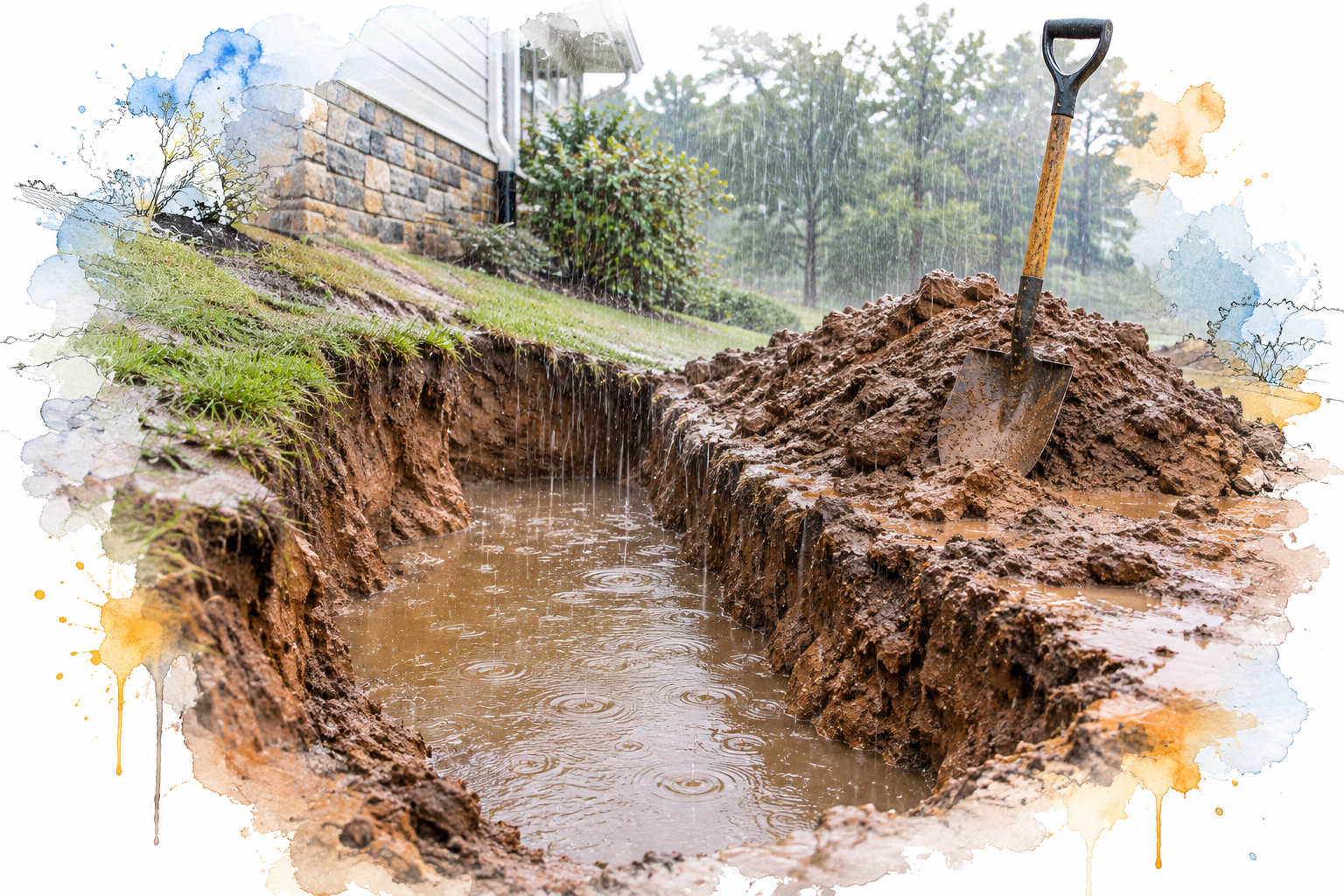
Footing trenches. A trench that keeps filling with water is not a trench yet. Pouring into standing water weakens the mix and leaves you guessing at the actual bearing surface under it. On Salinas clay, the sidewalls slump in too.
Mortar and grout curing. Fresh mortar needs time and protection. Steady rain washes cement out of the joint face and leaves a soft, chalky bond. Cold nights slow the chemical reaction that gives mortar its strength, and masonry work in temperatures near or below 40 degrees generally calls for protection and heated practices, which is rarely practical on a residential job here.
Backfill. Behind a new retaining wall sits a drainage assembly of clean rock, filter fabric, and a pipe with somewhere to go. Backfilling with mud pushes fines into that rock and plugs it. You have just built a wall and disabled the drainage layer a retaining wall cannot work without on the same day.
What a mason can legitimately do while it is still wet
This is not a list of reasons to wait. There is real work that belongs in the wet months, and most of it falls under making the situation safe and stopping it from getting worse.
- Remove loose or undermined units. If blocks are cracked and displaced at a corner column, or a capstone is shifted and partially unsupported, taking it down beats waiting for it to come down on its own.
- Clear weep holes and drain outlets. Weeps pack with soil and leaf litter. A plugged outlet turns the soil behind a wall into a water tank.
- Redirect downspouts and surface runoff away from a wall that is already leaning. This is often the single highest-value thing you can do in January.
- Keep load off the top. No parked vehicles, no stacked pavers, no soil piles above a stressed wall.
- Document the movement. Dated photos, a tape measure in frame, a reference mark on the cap so you can see whether it moves again in the next storm.
That last one matters more than people expect, especially when someone else caused the damage. One property owner who contacted us after a utility vehicle struck a block wall described cracked and displaced blocks with debris at the base, then asked us to check the surrounding courses for additional movement or a base and footing issue. That is exactly the right wet-season scope. Here is more on what to document before repairs start and how a vehicle-damage repair gets scoped.
Stabilizing is not repairing. A wall that has been made safe in December still needs a proper rebuild when the ground dries, and any honest mason will say so in writing.
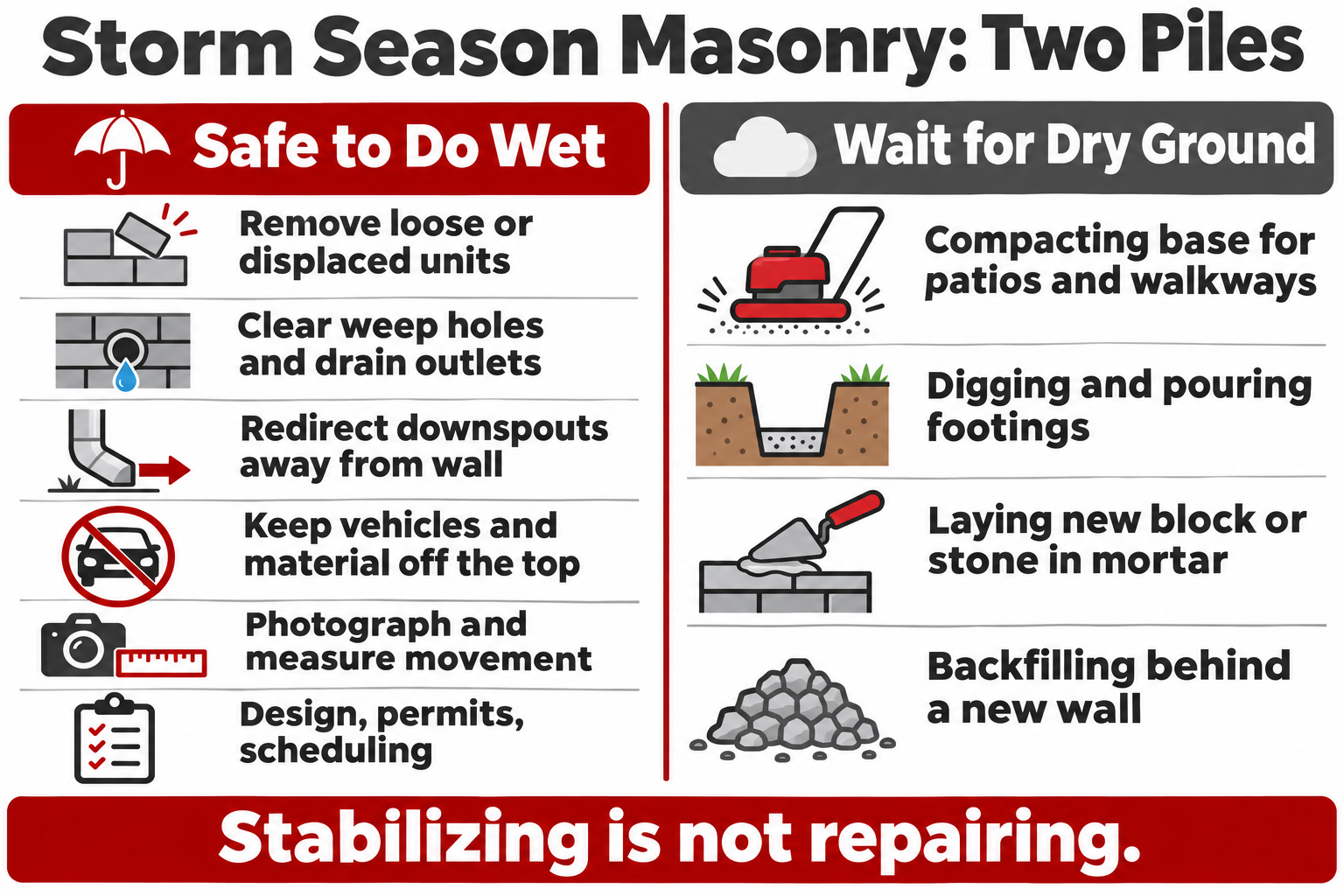
Storm Season Masonry: Two Piles
A quick way to sort what you are looking at in the yard right now.
Winter is the best diagnostic season you get
Plenty of homeowners assume there is no point calling anyone until March. I understand the logic, and I think it costs people the best information of the year.
A wall tells you the truth when it is loaded. In August, dry soil behaves itself and a marginal wall looks fine. In February, with the slope behind it saturated, you can see where it is actually bulging, where water is exiting that it should not be, and whether the base is the problem or the drainage is. A wet-season look often produces a more accurate scope than a dry-season one.
Search demand in California for retaining wall help peaks in February rather than summer, which lines up with exactly this pattern. Failures become visible when the soil is heavy.
There is also calendar work that costs nothing to do while it rains:
- Design and layout decisions
- Material selection and sourcing, including stone that holds up to Peninsula salt air
- Engineering input where a wall needs it
- Permit submittal and review time
- Getting a position in the spring schedule before it fills
On permits, requirements vary by jurisdiction and project type. A wall holding back a slope, a driveway, or a structure behind it is evaluated differently than a freestanding garden wall, and your local building department is the authority on your specific project. Review takes calendar time, and winter is free time to spend on it. How Peninsula rain shapes the masonry calendar goes deeper on that sequencing.
Now or Later: A Task-by-Task Reference
Use this to sort what you found in the yard this week.
| Task | Wet weather? | Why |
|---|---|---|
| Remove loose or undermined units | Yes | Safety work, no curing or compaction involved |
| Clear clogged weep holes and outlets | Yes | Reduces water pressure behind the wall right away |
| Redirect downspouts and runoff | Yes | Takes load off soil that is already saturated |
| Photograph and measure movement | Yes, and better wet | The wall shows its true behavior under load |
| Compact base for patio or walkway | No | Saturated material will not reach target density |
| Dig and pour a footing | Usually no | Trench fills, sidewalls slump, bearing surface unclear |
| Lay new block or stone in mortar | Usually no | Rain and cold nights interfere with proper curing |
| Backfill behind a new wall | No | Mud fouls the drainage rock the wall depends on |
| Design, material sourcing, permit submittal | Yes | Office work moves while the ground recovers |
Wet winters bring door knockers. Screen harder than you shop.
Storm seasons pull in quick-patch crews who are gone by April. The screening takes about a minute if you know what to ask for.
Get these in writing before anyone touches storm damage:
- The CSLB license number, not just a claim of being licensed
- The classification. C-29 is the masonry classification in California. A general contractor can hold masonry work, but a C-29 is the specific credential for it
- Current bond and insurance information, including workers’ comp if a crew is on site
- A written scope that separates stabilization from the eventual rebuild
- Whether the quoted price assumes dry-ground conditions
Then verify it yourself. The state’s check-a-license tool shows status, classification, bond, and any discipline. A number you can look up is worth more than a logo on a truck. One Moss Landing property owner asked us to confirm license and insurance in writing before scheduling, because a third party’s company was paying for the repair. That is the right instinct in any season.
For the record, Stonecap Masonry holds CSLB License #1073620 as a C-29 contractor, bonded and insured, and the person quoting your wet-season repair is the person standing in your yard. A longtime customer put the part that matters most in winter plainly: work “completed to a high standard in a timely manor.” Weather rearranges calendars. Communication is what keeps that from turning into a mess.
If what you found is a shifted cap rather than a leaning wall, loose capstones and where winter water gets in covers that specific failure.
Frequently Asked Questions About Masonry Work in Wet Weather
Can masonry work be done in the rain at all?
Yes, but a limited set of it. Removal of unsafe material, drainage clearing, water redirection, and documentation all work fine in wet weather. Anything that relies on compacted base, a clean footing, or curing mortar should wait for dry ground.
A contractor offered to start my wall next week during a storm. Should I let them?
I would ask one question: how will the base be compacted and how will the mortar be protected? If the answer is vague or they tell you weather is not a factor, that tells you how the hidden layers will be handled. Getting it done fast and getting it done once are different goals.
My block wall moved after the storms. Is it going to fall?
Hard to say from a description, and I would not guess. What I can tell you is that a wall that has moved once under load tends to move again during the next storm. Keep weight off the top, keep people away from the downhill side, and get eyes on it rather than waiting until March.
How much does a storm-damaged wall repair cost?
Costs vary widely, and I will not put a number on a wall I have not seen. The drivers are usually wall height, how much of the base and footing has to be opened up, whether the drainage assembly behind it is intact, access for equipment, and whether stone has to be matched to existing work. A repair at one corner is a different project than a wall that moved along its length. An on-site look is the only way to get a real figure.
Do I need a permit to rebuild a retaining wall in Monterey County?
It depends on the jurisdiction and the project. Height, whether the wall supports a slope or driveway or structure, and whether it is being rebuilt in place all factor in. Your city or county building department is the authority, and winter is a reasonable time to start that conversation since review takes calendar time anyway.
Looking at storm damage and not sure which pile it falls in?
Our team looks at wet-season masonry damage across Salinas, Carmel, Carmel Valley, Pebble Beach, and Pacific Grove, and we are straight with homeowners about what can be handled now versus what belongs on a dry-ground schedule. If you want a set of experienced eyes on something that moved this winter, Stonecap Masonry can be reached at 831-262-0442 or at stonecapmasonry.com. CSLB License #1073620, C-29, and you are welcome to verify it before you call.
