
Direct Answer: On older Monterey County homes, I look first at the build year, then at crack pattern and plumb. Stair step cracks, a gap at the roofline, or any lean mean a structural review.
Most people call me about a chimney after something small happens. A little shake rolls through, or the first real rain leaves a stain on the living room wall, and they go stand in the yard and look up at a stack of brick they have never once thought about.
Here is the position I hold after years of climbing around older Peninsula homes: age alone is not a verdict, but on a brick chimney built before the 1980s, the right first move is a structural look, not a cosmetic patch. Tuckpointing over a crack that is being caused by movement just hides the problem until the next winter.
This article walks through what I actually look at first, what you can safely read from the ground yourself, and why two honest masons can look at the same chimney and quote very different work.
Why I Ask the Build Year Before I Ask About the Crack
A big share of the owner occupied housing around Salinas, Pacific Grove, and the older Carmel neighborhoods went up between the 1940s and the 1970s. Chimneys from that era were often built as plain stacked brick with mortar doing all of the work and little or no steel inside.
That is what unreinforced masonry means in plain words: a tall column of brick and mortar with nothing tying it together vertically. It stands because of its own weight and the bond between the units. In a seismic county like ours, that matters, because a chimney is the heaviest, narrowest, most exposed thing on the house.
From the ground, a few clues point toward an older unreinforced stack:
- Build year before roughly 1980, which you can usually pull from the county assessor record or your title paperwork
- Smaller, softer, more irregular brick with wide, sandy mortar joints rather than crisp modern units
- No visible steel straps or anchors where the chimney meets the roof or wall framing
- No record of a retrofit in the permit history for the property
None of that proves anything is wrong. It just moves the chimney from the category of “probably fine” into the category of “worth having someone look at it properly before winter.”
What You Can Read From the Yard Without Touching Anything
Most cracks on an old chimney are not emergencies. A few are. The way to tell them apart is pattern, width, and whether anything has moved.
Stand back in the yard with your phone camera and zoom in. Look for these:
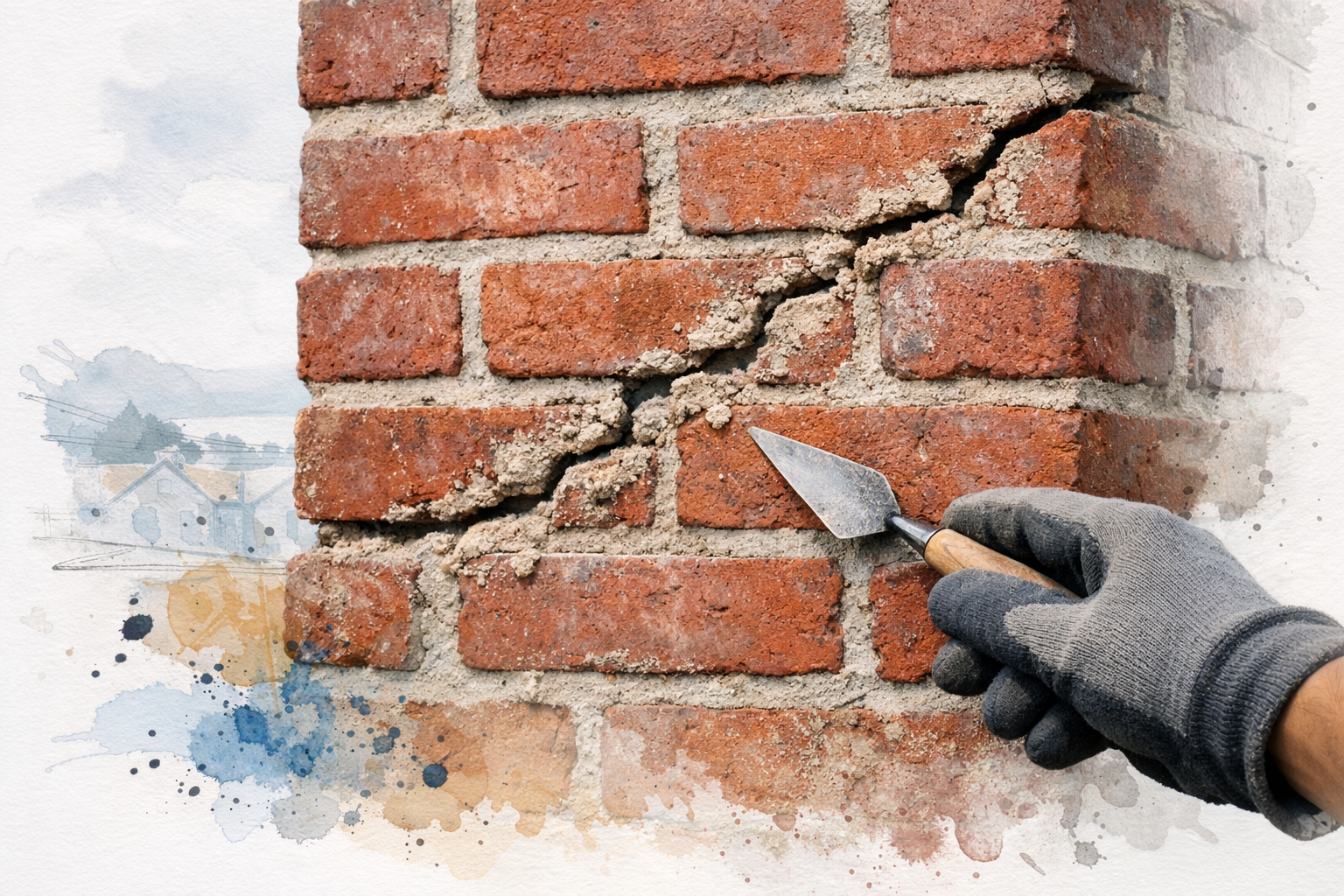
- Stair step cracking that follows the mortar joints up and across the brick in a staircase shape
- A visible gap where the chimney meets the siding, the wall, or the roof flashing
- Any lean out of plumb, which you can check by comparing the chimney edge to the vertical corner of the house
- Crumbling joints and loose brick at the very top, where the weather hits hardest
- Inside the house, cracked firebrick or brick dust and small debris sitting in the firebox
Two safety rules I do not bend on. Do not climb up there, and do not push or lean on the stack to test it. A chimney above the roofline is the one piece of masonry on your house where falling material has somewhere to fall, and people get hurt under them.
If you see brick dust in the firebox, stop using the fireplace until someone has looked at it. That debris is usually coming from somewhere above you.
Reading the Signs: Monitor, Repair, or Structural Review
This is roughly the triage I run in my head during the first few minutes on a property. It is a starting point, not a diagnosis.
| What you see | What it usually points to | Reasonable next step |
|---|---|---|
| Hairline cracks in a few mortar joints | Normal weathering and age | Monitor, photograph it, recheck after the rains |
| Stair step cracking along the joints | Movement in the stack or at the base | Have it assessed before the wet season |
| Gap where the chimney meets wall or roof | The stack is pulling away from the house | Structural review, do not wait |
| Crumbling joints, loose brick at the top | Water working on the most exposed masonry | Repair now, often repointing or a top rebuild |
| Visible lean out of plumb | Possible failure of an unreinforced stack | Structural review, keep people clear of the area |
| Brick dust or chunks in the firebox | Deterioration inside the flue or firebox | Stop using it and get it inspected |
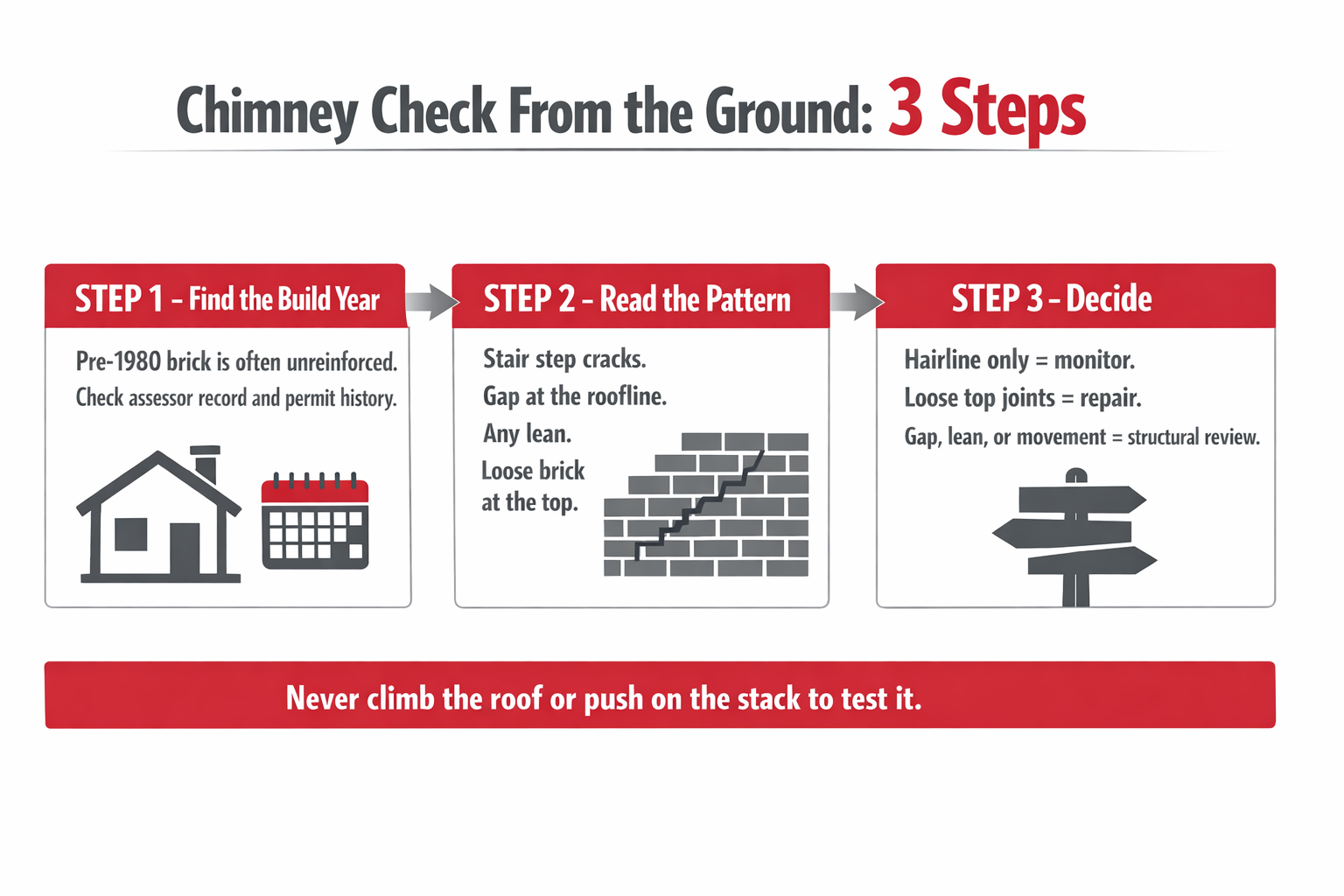
A Simple Three Step Check From the Ground
Here is the same triage laid out as a sequence you can run in about ten minutes without a ladder.
The Repair Ladder, and Why Two Bids Can Look Nothing Alike
Confusion over bid spread is one of the real reasons these projects stall. Once you understand the ladder of repair paths, the spread makes sense.
From lightest to heaviest:
- Repointing the joints. Cutting out failed mortar and packing in fresh mortar matched to the original mix. On soft old brick, the match matters more than most people expect, which is why I wrote about hard mortar on old brick.
- Rebuilding the section above the roofline. Taking the exposed portion down and rebuilding it with proper reinforcement and anchorage back to the structure.
- Full rebuild down to the firebox. The heaviest scope, usually reserved for stacks with real movement or widespread failure.
The things that actually move the number are not mysterious:
- Height and access, including whether scaffolding is required
- Whether the existing brick can be salvaged and matched to the rest of the house
- Whether a flue liner is part of the work
- Whether the scope crosses into permitted structural territory
A rebuild above the roofline is rarely in the same range as a repoint. It is often several times the work and several times the cost, and that is normal, not a red flag.
What is a red flag is a quote with no written scope. A number with no stated scope cannot be compared to a number that has one. If you want the longer version of that, I broke down what drives the cost of a masonry repair in a separate piece. The actual figure for your chimney comes from an on site look.
Why I Push People to Handle This in October, Not January
Water is the mechanism behind nearly every masonry failure I get called for. And a chimney is the most exposed masonry on your entire house.
It takes weather on four sides and from above. It has no neighboring wall giving it shelter. On the Peninsula, salt carried in the fog works at the joints year round, which is also why so many of these stacks end up spalling at the brick faces.
Open joints let water into the core of the stack. In there it adds weight, carries salts through the brick, and loosens whatever bond was already weak. By spring it shows up on the inside, and I get the call about stains near the fireplace.
Forecasters currently have the odds tilted toward a wetter than normal winter on the Central Coast. That is a shift in odds, not a promise of any particular storm, but it is a good enough reason to move a chimney assessment up the list.
The practical part is simpler than the weather. Masonry work needs dry conditions and workable temperatures to cure properly. Scheduling a chimney in October is far easier than scheduling one in the middle of a storm cycle.
Permits, Code, and Checking the License Before Anyone Shows Up
Chimney work is structural. Treat the paperwork side of it accordingly.
Permit requirements vary by jurisdiction and by scope. A repoint and a rebuild are not handled the same way, and Salinas, Monterey, Carmel, and the county each run their own process. California’s 2025 Title 24 building standards took effect January 1, 2026, so any permitted masonry work this season falls under the updated framework. Your local building department is the only authority on what your specific project needs.
On the contractor side, you can verify credentials before anyone sets foot on your property. The state license board lets you check any California contractor’s license, including classification, bond status, and workers compensation coverage.
Masonry chimney work falls under the C-29 masonry classification. One homeowner in north county wrote in about a damaged block wall and ended the message by asking straight out for license and insurance confirmation, which is exactly the right instinct.
To say it plainly: structural chimney work is not a weekend project and not a handyman scope. Nobody should be rebuilding a stack from a ladder without a license, a plan, and the right anchorage.
Frequently Asked Questions About Older Brick Chimneys
How do I know if my chimney is unreinforced?
Usually by build year and construction style. Brick chimneys built in Monterey County from the 1940s through the 1970s were often stacked with no internal steel. From the ground, look for older irregular brick, wide sandy joints, and no visible straps or anchors at the roofline. A mason can confirm it on site.
Is a crack in my chimney an emergency?
Most are not. Hairline cracking in a few joints is usually age. What raises concern is stair step cracking along the joints, a gap where the chimney meets the house, or any lean out of plumb. Those three mean something has moved, and movement does not fix itself.
Can you just rebuild the top part instead of the whole chimney?
Often yes. Rebuilding from the roofline up is a common scope, because the exposed section takes the worst of the weather and the lower portion is frequently still sound. Whether that works for your chimney depends on how far down the deterioration or movement actually goes.
Will new brick match the old brick on my house?
That is the hardest part of a partial rebuild and the part I spend the most time on. Salvaging original brick where possible, matching unit size and color, and matching mortar color and joint tooling all go into making a new section read as part of the original house.
Do I need a permit to repoint my chimney?
It depends on your jurisdiction and the scope. Light repointing is often treated differently than structural rebuilding, but requirements vary across Salinas, Monterey, Carmel, and unincorporated county areas. Check with your local building department before work starts.
Thinking About Your Chimney Before the Rains Start?
Stonecap Masonry is a family operated C-29 licensed, bonded, and insured masonry contractor working across Monterey County, and the classification covers structural masonry like chimney rebuilds. Matching a new section so it belongs to the house is the part customers tend to remember, the way one Carmel Valley homeowner put it after a rebuild near their pool: “matched the stone hardscape around the pool perfectly.” Assessments are open ahead of the rainy season at 831-262-0442 or stonecapmasonry.com.
