
Direct Answer: Front steps pull away from a house when the soil under their footing settles at a different rate than the house foundation. The crack is a soil problem, not a stone problem.
You walk out the front door one morning and there it is. A gap between the top step and the face of the house, wide enough to slide a finger into, that you are fairly sure was not there last spring.
The question every homeowner asks me next is the same one: is this cosmetic, or is this serious? Almost always, the honest answer is that the stone is fine and the ground under it is not.
I work on entry steps across Salinas, Carmel, Pacific Grove, and out into Carmel Valley. What follows is what I actually look at when I kneel down in front of a failing set of steps, how I sort the symptoms into watch it, fix it, or look deeper first, and why this particular winter is a bad one to put it off.
A Set of Steps Is Not a Solid Block of Stone
People picture masonry steps as one heavy chunk of brick or stone. They are not. A typical set of entry steps is a structure with four parts, and only one of them is visible.
- A footing below grade that carries the weight
- A compacted base of gravel or engineered fill above that footing
- A core, often hollow block or poured fill, that gives the steps their shape
- A veneer face of brick, stone, or cast tread that you actually see and touch
Water is the mechanism behind nearly every masonry failure I get called out for. It moves soil, it washes fines out of a base, and it swells and shrinks the heavy clay we have inland of the Peninsula.
A lot of owner-occupied housing in Salinas went up between the 1940s and the 1970s. Entry steps from that era were frequently set on fill that was never properly compacted, which means the base was borrowing time from day one.
That is why the face of a step can still look crisp while the base beneath it has already dropped half an inch. It is also why a surface patch on settled steps tends to come back within a season or two. You patched the report, not the problem.
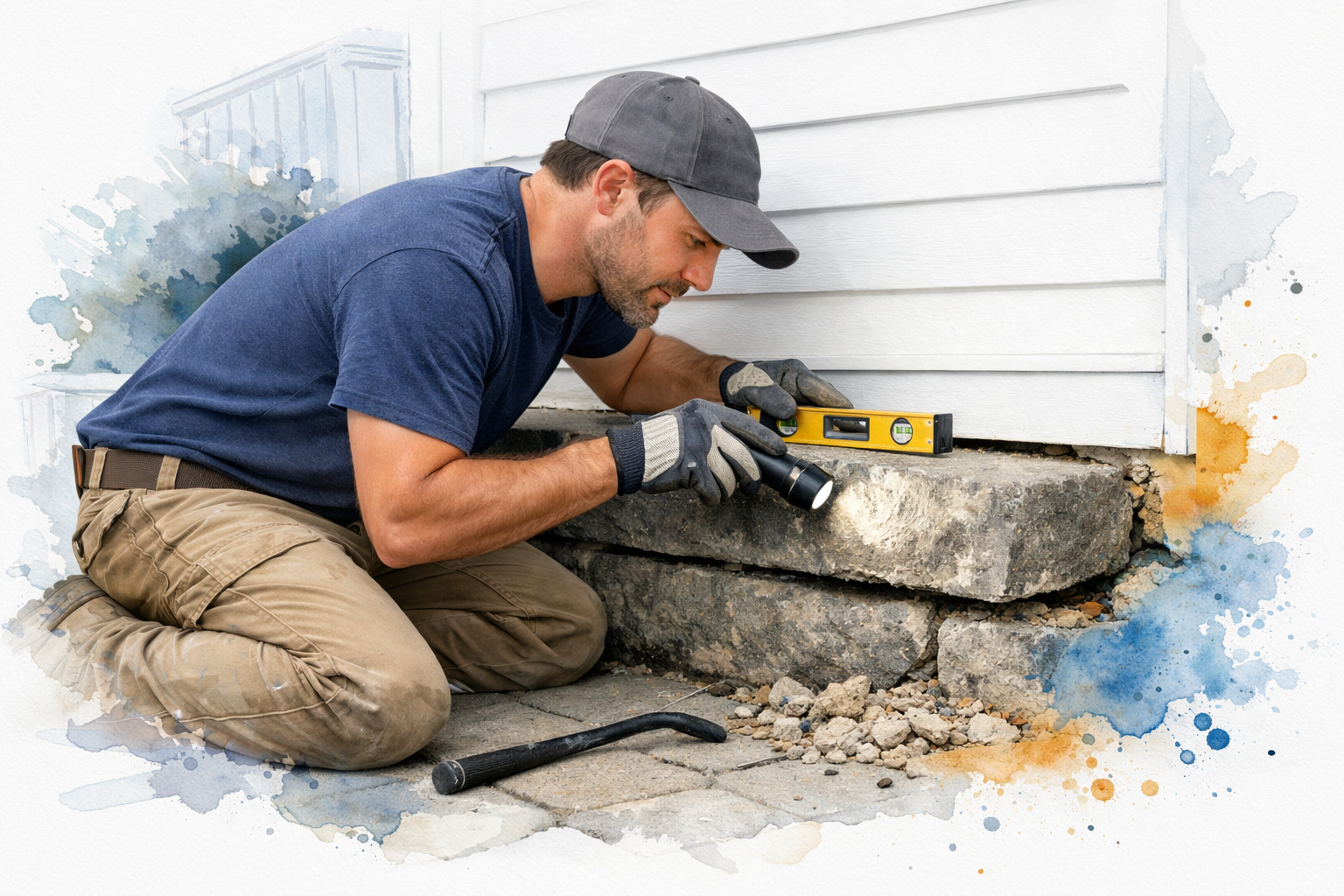
A Simple Triage Ladder for Masonry Step Repair
Most homeowners will not pick up the phone until they can name the problem and feel sure it is real. Fair enough. Here are the distinctions I make standing in your front yard.
Watch it. A hairline crack in a single mortar joint, no movement when you load the tread, no gap at the house. Mortar is the sacrificial part of any masonry assembly, and a tight hairline on its own is usually just age showing.
Repair it now. A tread that rocks when you put weight on one corner. Loose or shifted caps. Open joints you can see daylight or soil through. These are water doors, and left open through a wet winter they turn a one-day reset into a rebuild.
Get a structural look before anyone quotes a repair. This is the category your situation probably falls into if the steps are pulling away from the house. So does stair-step cracking running diagonally down the cheek wall beside the steps, following the mortar joints like a staircase.
A step separating from the house is telling you the step footing and the house foundation are settling at different rates. That is worth looking at sooner rather than later, because the fix gets more expensive the further apart they drift. The same logic applies to the warning signs that a retaining wall needs a mason rather than a patch.
Reading the Symptom at Your Own Front Door
Here is the shorthand I use when a homeowner texts me a photo and asks how worried they should be.
| What you see | What is usually moving | Reasonable next step |
|---|---|---|
| Hairline crack in one mortar joint | Normal mortar aging, no base movement | Watch it through one wet season |
| Tread rocks under one corner | Base washout or voided fill under the tread | Reset and repoint before winter |
| Finger-wide gap at the house | Step footing settling faster than the house foundation | Structural look before any quote |
| Stair-step cracking down the cheek wall | Differential settlement under the wall footing | Structural look before any quote |
| White powdery film on the brick face | Water moving through the masonry and leaving salts behind | Find the water source, then treat the surface |
| Step has visibly tilted toward the house | Soil saturation and slope failure at the base | Keep off the steps, get it assessed |
Why This Winter Matters More Than the Last One
Saturated ground is what turns a slow settlement into a sudden one. The soil loses the friction holding it in place, and a step that moved a sixteenth of an inch a year for a decade can drop a quarter inch over a single storm week.
NOAA’s Climate Prediction Center has an active El Nino Advisory as of its August 10, 2026 update, with a 97 percent chance the event holds through early spring 2027 and an 81 percent chance of a very strong event during October through December 2026. A strong El Nino tilts the odds toward a wet winter here. It does not guarantee one, but it is not the year to gamble.
There is a smaller signal I pay attention to too: statewide searches for efflorescence removal, that chalky white bloom on brick, peak in January. That is people noticing water inside their masonry at the deepest part of the wet season.
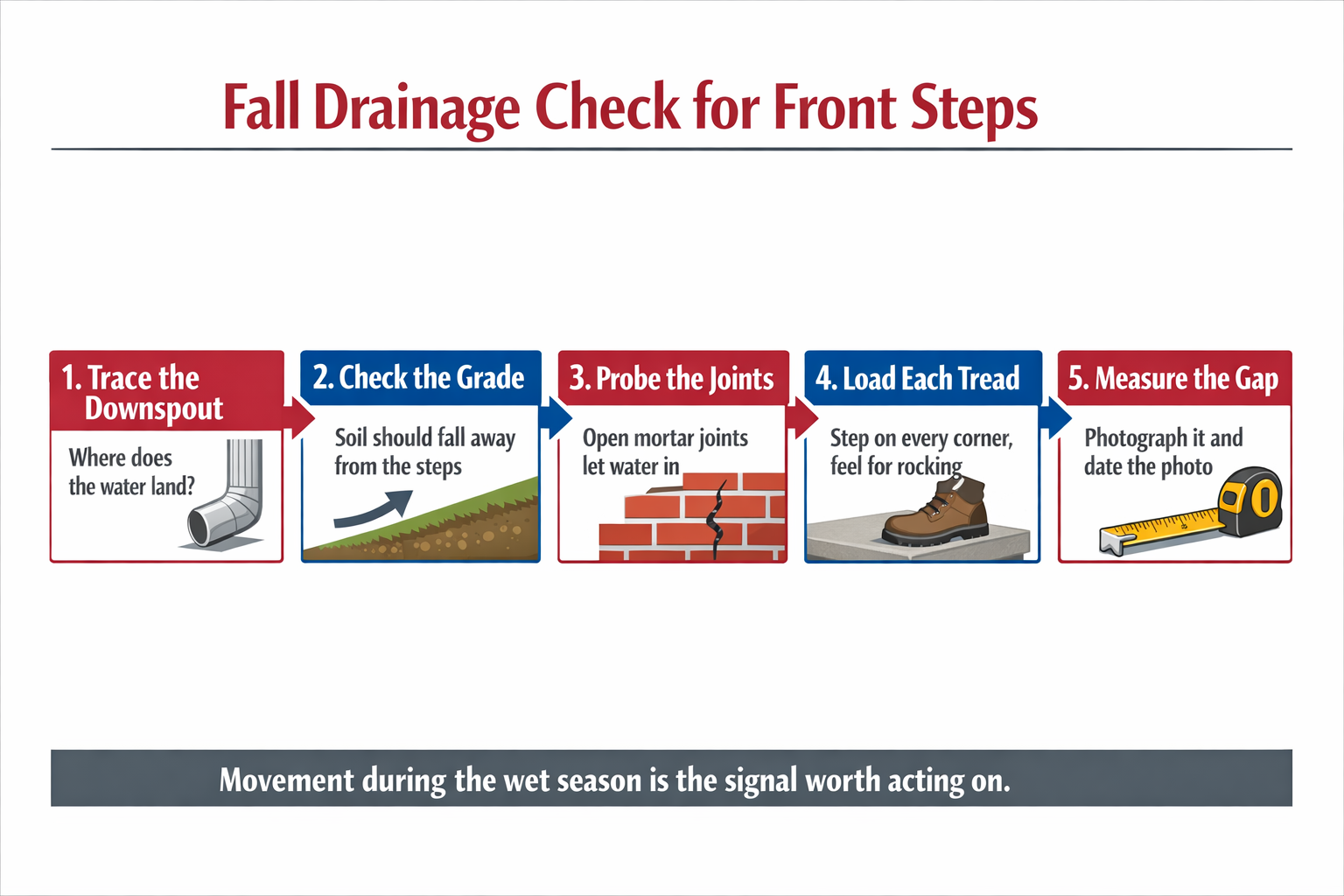
If you do nothing else in October and November, walk the entry and check three things:
- Where the downspout discharges. If it dumps within a few feet of the step base, you are irrigating your own footing.
- Which way the grade falls. Soil should shed water away from the steps, not pond against them.
- How long the ground stays wet. Heavy Salinas clay holds water against a footing for days after a storm, and that is when movement happens.
The Fall Walk-Around Before the Rain Starts
A five-minute check in October tells you more about your steps than any inspection in March will.
The Three Repairs, and What Actually Drives the Spread
Confusion about why one bid is double another is the single biggest source of friction I run into. It helps to know there are really three different jobs hiding under the phrase masonry step repair.
Reset and repoint. Lift the loose treads and caps, rebed them, rake out and replace the failed mortar joints. Lightest scope. Many Monterey County homeowners see this land somewhere in the low four figures, though it swings with how many pieces come up.
Rebuild the top courses. Take the steps down to sound work, correct the base in the affected area, and rebuild up. This often runs two to three times a straight reset.
Full tear-out to a new footing. Excavate, pour a proper footing below the frost and moisture line, compact a real base, rebuild the core and reset the face. This is the most expensive path and the only one that permanently fixes a footing problem.
The fourth option, veneering over a failed core to make it look new, is the one that comes back. I will not do it on steps that are actively moving.
What moves the number inside any of those scopes:
- Depth of excavation and whether the existing footing can be reused
- Access for equipment, which gets tight on sloped Carmel Valley and Pacific Grove lots
- Material matching, since sourcing stone or brick to blend with a 1950s entry is slow, skilled work
- Mortar compatibility, because a hard modern mix on soft old brick will chew up the brick faces
On higher-value Peninsula properties, the deciding factor is usually evidence that the mason can match new stone to old convincingly. If you want more on the line items behind a bid, what drives the cost of a masonry repair breaks it down further. For an exact figure on your steps, you need someone on site with a probe and a level.
Permits, Code, and Checking a License in About a Minute
Whether a step repair needs a permit depends on the jurisdiction and on how much of the structure is coming out. Resetting a few caps is a different animal from rebuilding an entry stair on a new footing, and the rules are not the same in unincorporated Monterey County as they are inside the city limits.
The code items that most often come into play on entry stairs are uniform riser and tread dimensions and handrail requirements once the run reaches a certain height. If a rebuild changes your riser heights, that becomes part of the conversation.
Submittal methods vary too. The City of Monterey moved building permit applications onto an online portal effective January 7, 2026, with an application flow that asks project-specific questions about scope of work and valuation. Your local building department is the one to confirm with before work starts.
On the contractor side, one homeowner in Moss Landing closed a request about a damaged block wall with a line I wish more people used: “Also, please confirm your license and insurance information.”
You can verify any California contractor yourself through the CSLB’s check-a-license tool in about a minute. Enter the license number and you will see the classification, the bond, the workers’ comp status, and any disciplinary history. The classification that covers this work is C-29 Masonry, which spans stone, brick, block, and the structural masonry that sits under a set of steps.
Frequently Asked Questions About Masonry Step Repair
Can I just caulk the gap between my steps and the house?
You can, and for a truly stable set of steps a flexible sealant at that joint is reasonable maintenance. But if the gap is widening year over year, caulk just hides the movement while water keeps working on the base underneath.
How do I know if my steps are still moving or already settled out?
Photograph the gap with a tape measure in frame and date the photo. Take the same shot after the first heavy storm and again in spring. Any measurable change across one wet season means it is active, and active settlement is worth a structural look.
Why did my last step repair fail after two years?
Most likely because the repair addressed the face and not the base. If the footing or the compacted fill under the steps is the thing moving, new mortar on top of it has nothing solid to hold onto. That is also why two bids for the same steps can be thousands apart, since one may include the excavation and the other may not.
Does the white powder on my brick steps mean water damage?
That is efflorescence, salts left behind as water passes through the masonry and evaporates off the face. It is not damage by itself, but it tells you water is moving through the assembly, and that is the condition that erodes mortar and washes out base material over time.
Is fall a bad time to start step work on the Peninsula?
Early fall is actually one of the better windows. The ground is still workable, mortar cures well in our mild temperatures, and getting drainage corrected before the first real storms is the whole point.
Looking at a Set of Steps That Has Started to Move?
Stonecap Masonry is a family-operated C-29 masonry contractor based in Salinas, CSLB License #1073620, run by master mason Candelario Perez and his son Adrian. The work ranges from showpiece stonework to the small structural repairs that nobody photographs, and one longtime customer summed that up as “foundations and also smaller driveway projects all completed to a high standard in a timely manor.” Site visits are available across Monterey County and the Peninsula at 831-262-0442 or stonecapmasonry.com.
