
Direct Answer: Coping sits on the pool’s bond beam and holds the edge. Deck stone sits on a prepared base and sheds water. They fail for different reasons, so they are prepped, priced, and repaired separately.
Most poolside calls I get start the same way. A few deck stones have shifted or cracked, the coping along the edge feels loose underfoot, and the homeowner cannot tell whether the problem is the stone, the mortar, the base underneath, or the pool shell itself.
That confusion is fair. From the surface, a pool deck looks like one continuous field of stone, but it is really two different systems meeting at a seam.
This article is about poolside conditions specifically on the Monterey Peninsula: how coping differs from deck stone, why slope and drainage decide how long the work lasts, and what it takes to blend new stone into old. General patio stone selection for coastal weather is its own topic and already covered elsewhere on the blog.
Coping and Deck Stone Do Two Different Jobs
Coping is the capped edge that wraps the perimeter of the pool. It sits on the pool’s bond beam, which is the thickened top edge of the pool shell, and it caps the waterline tile and the shell edge where they meet.
Field stone across the rest of the deck is a different animal. It sits on a prepared base, not on the pool structure, and its job is to carry foot traffic and move water away.
That difference shows up in how each one fails:
- Coping usually loosens because the mortar bed under it has broken down, the bond beam has moved, or water got behind the stone and stayed there
- Deck stone usually cracks or rocks because the base settled, the setting bed lost bond, or water has been sitting in the joints
- Coping repairs are measured in linear feet, deck repairs in square feet, which is why the two get priced separately on any honest bid
I always want to look at both before quoting. Replacing deck stone around failing coping just buries the real problem under new material, and it tends to come back within a few seasons.
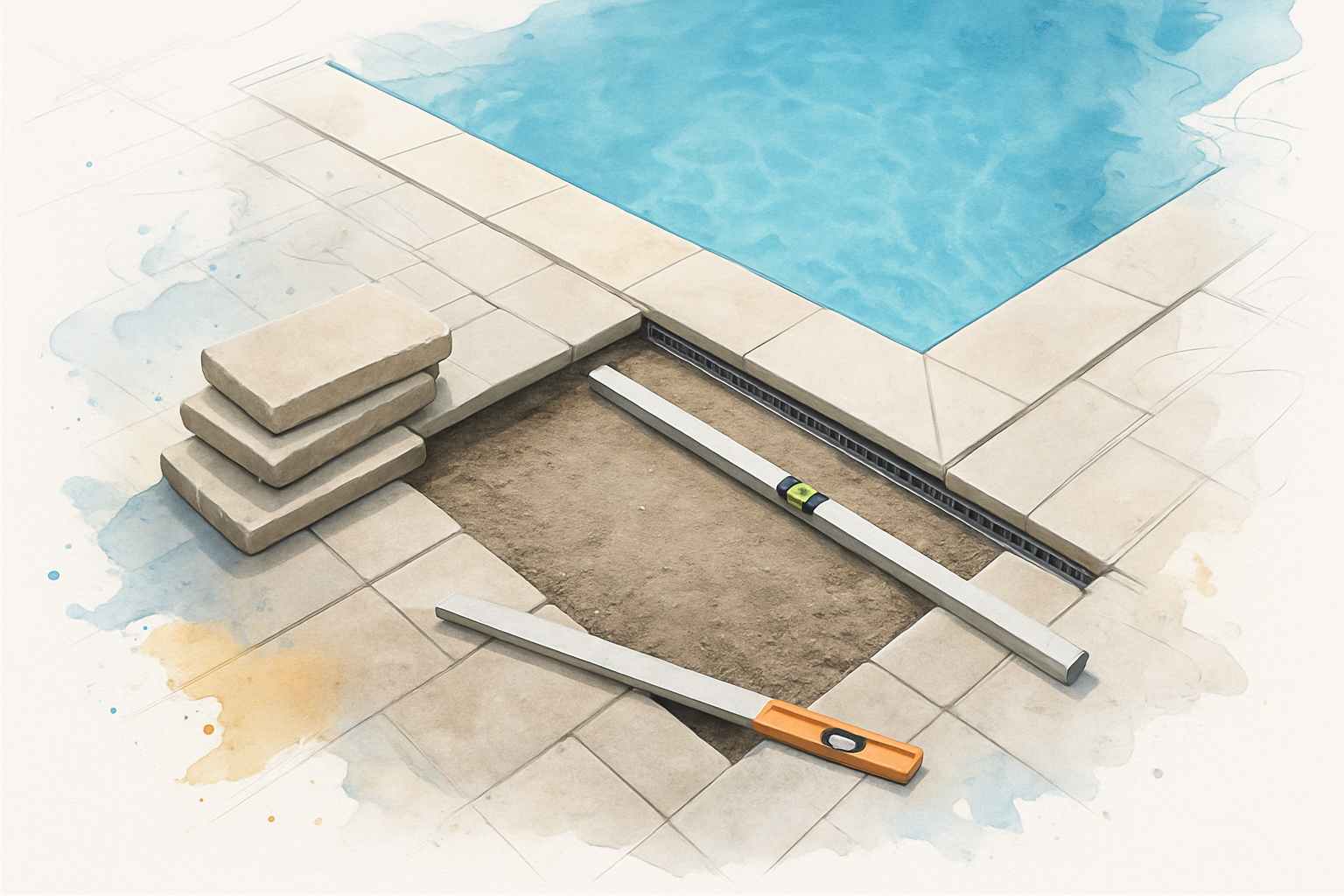
Slope and Drainage Are Where Peninsula Pool Decks Fail First
Water is behind nearly every masonry failure I get called out for. On a pool deck it is worse, because the surface is wet from swimmers, rain, and irrigation all at once.
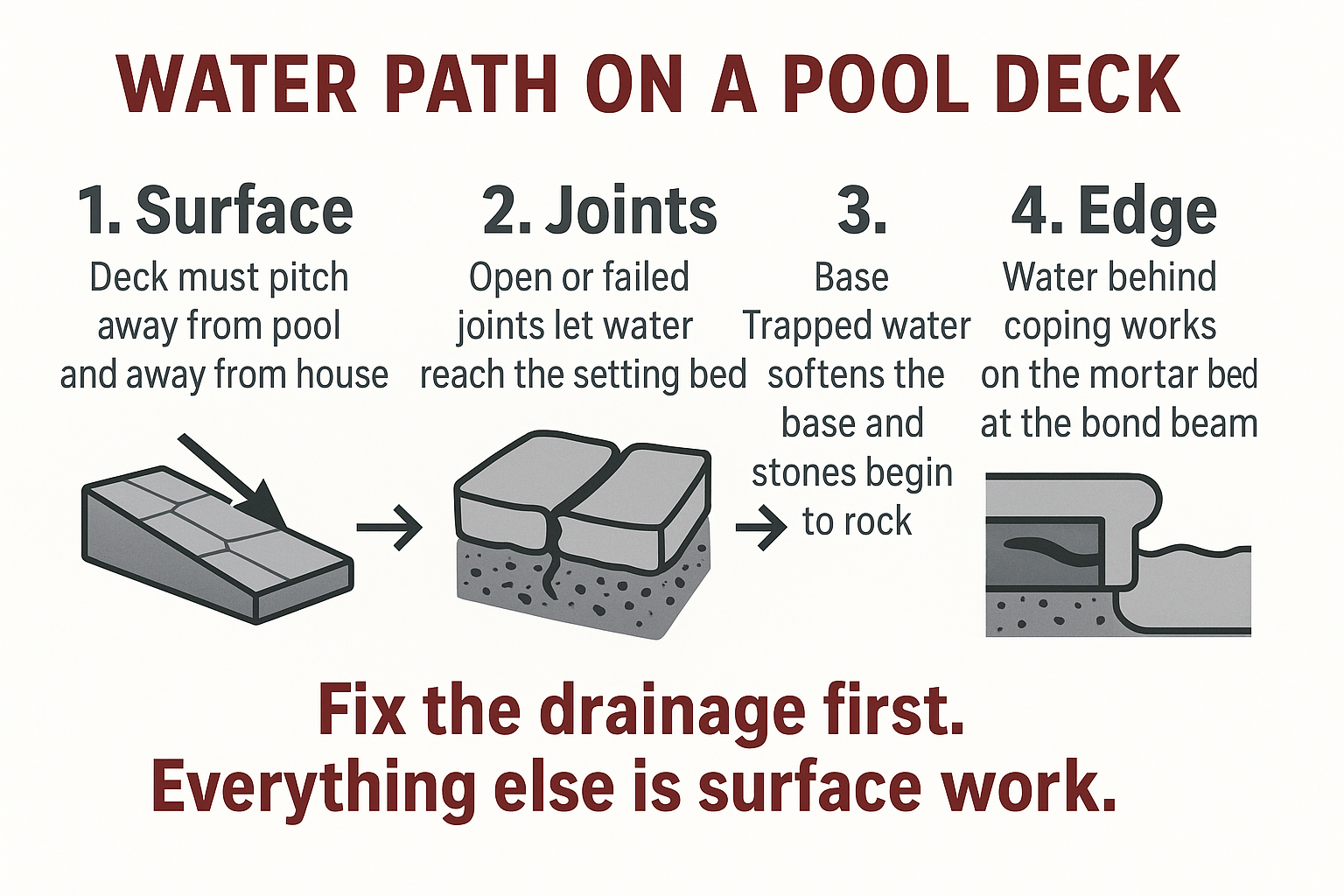
A deck has to pitch water away from the pool and away from the house. When a deck pitches back toward the coping, water pools at the seam, soaks into the joints, and sits under the setting bed where it works on mortar all winter long.
What I look at on a slope assessment:
- Which direction the finished surface actually drains, measured with a level, not by eye
- Whether any deck drains or channel drains exist, and whether they are clogged or set too high to catch anything
- Whether downspouts or landscape runoff dump onto the deck instead of around it
- Whether the joint material has opened up enough to let water through to the base
The forecast matters here. NOAA’s Climate Prediction Center has an active El Nino Advisory with a strong event expected through the 2026-27 winter, and a wetter than normal Central Coast winter pushes far more water through every joint and drain on a pool deck than an average year does.
If you want the longer version of that, what a strong El Niño winter actually does to masonry walks through the same mechanism on walls and patios.
Coping vs. Deck Stone at a Glance
Here is how the two parts of a pool surround compare when something goes wrong.
| Pool Coping | Deck Field Stone | |
|---|---|---|
| What it sits on | The pool’s bond beam (part of the shell) | A compacted base and setting bed |
| Main job | Caps and protects the pool edge | Carries traffic and sheds water away |
| Common failure | Loose or hollow stones, failed mortar joints, movement at the beam | Cracking, rocking, settled low spots holding water |
| Measured by | Linear feet along the perimeter | Square feet of surface |
| Repair driver | Condition of the bond beam and mortar bed | Condition of the base and the slope |
Where the Water Actually Goes
This breaks down the path water takes across a pool deck and the four points where it causes trouble.
Matching New Stone to Old Without It Reading as a Patch
On Carmel, Carmel Valley, and Pebble Beach properties, the pool hardscape usually went in years ago and the homeowner only wants one section replaced. Nobody wants to tear out a deck that is 80 percent fine.
A partial replacement blends in when a few things line up:
- Stone with a similar color range, not one flat color pulled from a single pallet
- Matching thickness, so the new pieces sit flush with the old without shimming
- The same joint width and mortar color, which is often what gives a patch away before the stone does
- Tying new courses into existing ones rather than butting a clean rectangle of new work against old
That last one takes the most time. Cutting back the existing edge in a staggered line and weaving the new stone in costs more labor, but it is the difference between a repair and an obvious square.
One Carmel Valley homeowner had an old pool waterfall removed and a seating area built at the pool’s edge, and described the result this way: “Cande demolished it and created a nice sitting area at the pools edge and matched the stone hardscape around the pool perfectly.” That is the standard I aim for on any partial job. There is more detail in matching new stone to old.
Water Features, Conservation Rules, and Scheduling
That Carmel Valley project started for a reason I hear often here. The pool waterfall was causing heavy evaporation, so it came out and the area was rebuilt in stone.
Removing a decorative water feature and turning that footprint into seating or deck is a common Peninsula request. It cuts evaporation, it removes a structure that was leaking water into the surrounding masonry, and it usually adds usable space.
Scheduling is the part people do not expect. Peninsula properties fall under MPWMD Stage 1 conservation, and the District’s Stage 1 conservation requirements state that pools and spas should not be drained or refilled except to prevent or correct structural damage, or with prior District approval.
So if a repair plan assumes a drained pool, that conversation has to happen before the calendar does. Rules get updated and every property is different, so check with the District or have your contractor confirm the current requirement before anyone orders stone.
Scope, Permits, and What a C-29 Contractor Actually Handles
Form inquiries usually arrive bundled. People write in asking about pavers, a fire pit, a built-in grill, and turf all in one message, which is reasonable, because from the homeowner’s side it is one backyard.
A C-29 masonry contractor handles the stone, block, setting beds, and structural masonry. Gas line connections and any electrical bonding around a pool belong to other licensed trades, and that coordination gets scheduled rather than absorbed. The masonry scope in an outdoor kitchen build breaks down where that line falls.
On permits, the honest answer is that requirements vary by jurisdiction and project type. Salinas, Monterey County, and Carmel each review differently, and a like-for-like surface replacement is treated differently than structural work or anything touching the pool enclosure.
One detail worth knowing: permitted work that starts after January 1, 2026 falls under California’s 2025 Title 24 standards. Call your local planning department before assuming a project is exempt.
What Moves the Number on a Pool Surround
I will not quote a pool deck without walking it, and I would be careful with anyone who does. Too much of the cost lives below the surface.
What actually drives the price:
- Square footage and stone thickness, since thicker stone means more material weight, more cutting, and more setting time
- Whether the existing deck and setting bed have to come out, which adds demolition and disposal
- Coping length, and whether the bond beam underneath needs attention before new coping is set
- Access for material in and debris out, which on tight Peninsula lots can mean wheelbarrows instead of equipment
- How much cutting the pattern requires around curves, steps, spa edges, and skimmer lids
Two bids on the same pool deck can land thousands apart because one includes demolition, base rebuild, and drainage, and the other quietly leaves them out. A written scope is the only fair way to compare them. How a stone patio is priced from the base up and why two masonry bids for the same job can be thousands apart both go deeper on that.
Verify the License Before the Site Visit
One homeowner who wrote in about a damaged block wall asked for license and insurance confirmation before scheduling a site visit. That is a good habit, and it applies just as well to poolside work, where the stone is sitting on part of the pool structure.
Any California contractor license can be checked free through the CSLB check-a-license tool. Look for an active license, the right classification for the work, and current bond and workers’ compensation coverage.
For reference, Stonecap Masonry holds CSLB License #1073620 as a licensed, bonded, and insured C-29 masonry contractor working in Salinas, Carmel, Carmel Valley, Pebble Beach, and Pacific Grove.
Frequently Asked Questions About Pool Deck and Coping Stone
Can I replace just the loose coping and leave the deck alone?
Sometimes, yes. If the deck stone is sound and the slope is correct, resetting coping on a fresh mortar bed is a contained job. But if water has been getting behind the coping for years, the base near the edge often needs attention too, and that only shows once the stone comes up.
Does the pool have to be drained for this kind of work?
Usually not for deck stone. Coping work sometimes calls for a lowered water level, and on the Peninsula that runs into MPWMD Stage 1 conservation rules limiting draining and refilling. Talk it through with the District or your contractor before the schedule is set.
Why does my deck stone keep cracking in the same spot?
Repeat cracking in one area almost always points to something below the stone, not the stone itself. A low spot holding water, a settled section of base, or runoff dumping in one place will crack new stone just as fast as it cracked the old.
Will new stone ever match the old perfectly?
Close, often very close, but set expectations honestly. Existing stone has years of sun and weather on it, so new material tends to look a little fresher at first. Color range, thickness, joint width, and mortar color matter more than finding the exact same quarry.
How long does a pool deck repair take?
It depends heavily on whether demolition and base work are involved. A coping reset on a short run is quick. A full tear-out, base rebuild, drainage correction, and reset across a large deck is a multi-week project, and curing time is not something to rush.
Thinking Through a Pool Surround Project on the Peninsula?
Poolside stone is one of the few places where drainage, structure, and appearance all meet in the same few feet, so it is worth walking the site before anyone talks numbers. We take on pool deck and coping stone work across Salinas, Carmel, Carmel Valley, Pebble Beach, and Pacific Grove, and availability shifts with the season. Reach the Stonecap team at 831-262-0442 or stonecapmasonry.com when you want a site-specific look.
