
Direct Answer: That white powder is efflorescence: salt left behind when water moves through masonry and evaporates at the surface. It is not usually harmful, but it shows you where water is getting in.
You walk out after a rain and part of your brick or block wall looks like someone dusted it with flour. A chalky white film across the face, sometimes heaviest along the mortar joints, sometimes low near the ground. It rubs off on your hand and it was not there last month.
I get these calls every winter, usually right after the first real storm rolls through Monterey Bay. The name for it is efflorescence, but almost nobody searches that word. People search what they see.
So here is the short version of what you actually came for. You have three choices: leave it alone and watch it, clean it and fix the water that caused it, or have someone look at the wall structurally. This article is about how to tell which one you are dealing with.
What the White Powder on Masonry Actually Is
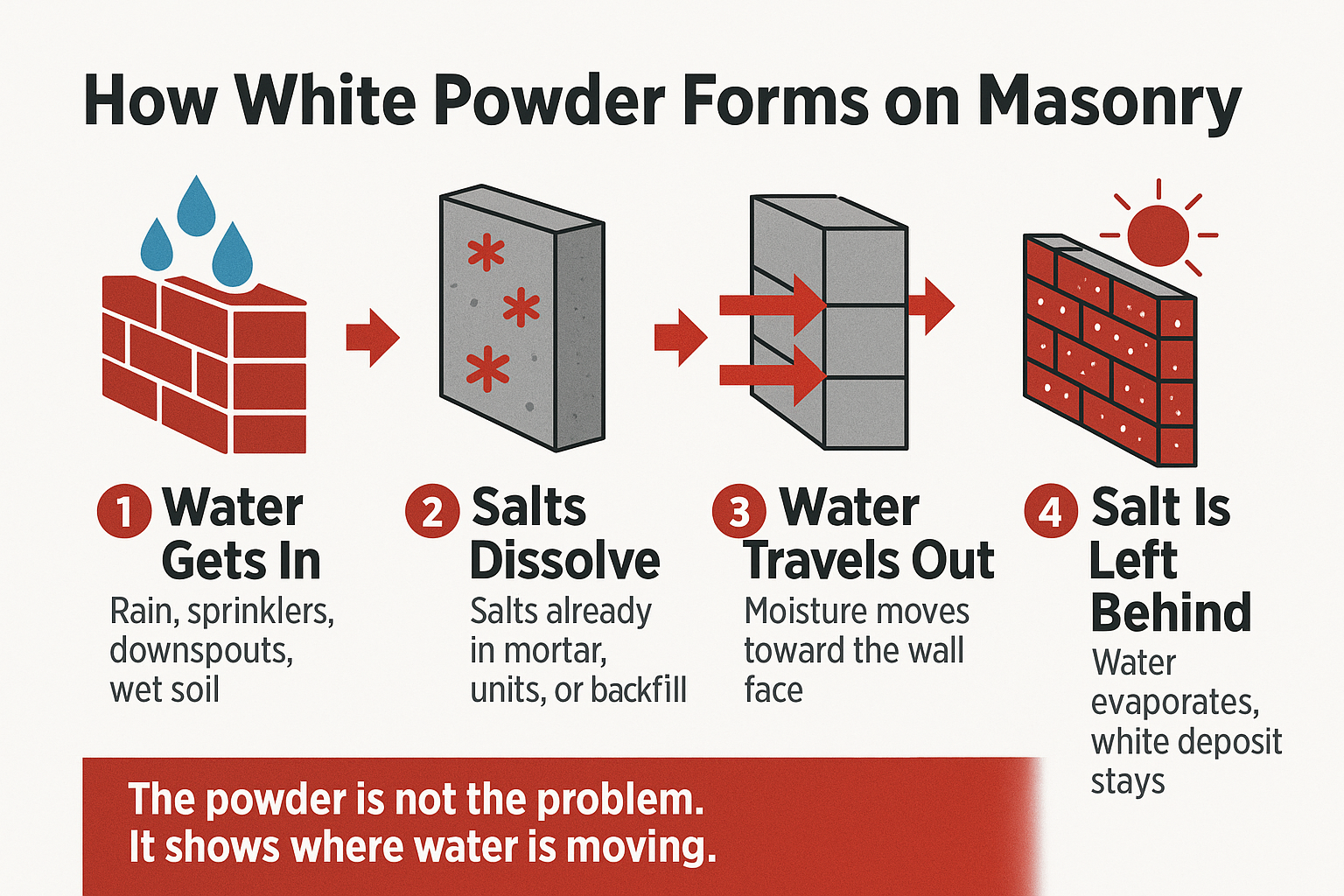
The mechanism is simple. Water gets inside the masonry, dissolves salts that are already sitting in the mortar, the brick or block, or the soil behind the wall, and then carries those salts to the surface. The water evaporates and the salt stays.
That means the powder itself is not the damage. It is a map of where water is moving through your wall.
The Brick Industry Association’s technical note on efflorescence makes the same point: the deposit is generally not harmful to the brick itself. What matters is the moisture path that put it there.
Timing tells you a lot:
- A first bloom on new masonry is common. Fresh mortar and new units carry soluble salts, and the first wet season flushes some of them out. It often fades on its own.
- The same patch blooming every winter is different. That wall is telling you the water path never closed.
- A deposit that keeps spreading across more of the wall face usually means the water is finding more ways in, not fewer.
I tell homeowners to photograph it and date the photo. One winter of white powder is information. Three winters of it in the same spot is a pattern, and patterns are what I read when I show up.
Where the Water Is Coming From on Peninsula Properties
On Monterey Peninsula homes, the source is almost never mysterious. It is usually something ordinary that has been running for years.
The usual suspects I find on site:
- Irrigation heads spraying the wall face three or four times a week. This is the single most common one I see in Carmel Valley and Salinas yards.
- Downspouts dumping at the base of a wall with nowhere for the water to go.
- Planter beds and soil piled against block, holding moisture right against the units.
- Clogged or missing weeps at the bottom course of a retaining wall.
- Open joints under a capstone, letting rain run straight down inside the wall.
On a retaining wall, the bloom shows up on the face you can see while the real story sits behind it, in the backfill and the drainage. That is why I treat the deposit as a first clue instead of a diagnosis. The wall is the last place the water goes, not the first.
If the wall holds back soil, the question underneath all of this is whether it was built with the drainage layer a retaining wall cannot work without. Plenty of older walls here were not.
When I walk a wall with white powder on it, I am looking at three other things in the same pass:
- Mortar joints next to the deposit. Soft, sandy, or crumbling joints mean water has been sitting in there a long time.
- Lower courses that never dry. Damp weeks after the last rain is a drainage problem, not a cleaning problem.
- Movement. Have those same courses shifted, bulged, or opened up at the ends?
Reading Your Wall: What You See and What It Usually Means
This is the quick sort I run through before deciding whether a wall needs a brush or a scoped look.
| What you see | What it usually means | Reasonable next step |
|---|---|---|
| Light haze on new masonry, first wet season | Salts flushing out of fresh mortar and units | Dry brush it, watch through the next rain |
| Same patch returns every winter | The water path never closed | Find the source: sprinklers, downspout, grading |
| Deposit plus soft or crumbling joints | Water has been sitting in the wall | Licensed masonry contractor should look at it |
| Heavy bloom low on a retaining wall face | Drainage or backfill behind the wall | Structural evaluation, not surface cleaning |
| Chalky film on a wall facing the ocean | Possibly airborne salt, not internal salt | Compare sheltered sections of the same wall |
| Bloom spreading wider each year | More water finding more ways in | Get eyes on it before the next wet season |
How Efflorescence Forms, Step by Step
Four stages, and every fix targets one of them.
The Coastal Wrinkle: Salt in the Wall or Salt in the Air?
Properties in Pacific Grove, Pebble Beach, and the Carmel coast have a second possible source. These walls sit in salt air year round, and airborne salt lands on masonry and builds up as a chalky surface film that looks a lot like efflorescence.
The difference matters. Salt from the air points at exposure and material selection. Salt from inside the wall points at a water path that has to be found and closed.
I tell the two apart by reading the pattern:
- Where on the wall the deposit sits. Airborne salt tends to favor the exposed, weather-facing side. Internal salt often concentrates at joints, low courses, and under caps.
- Whether sheltered sections of the same wall show the same film.
- How it comes back after rain versus after a dry, foggy stretch.
The Monterey Bay microclimate makes all of this linger. Cool, damp marine air means a saturated wall dries slowly, so a bloom that would burn off in a week of Salinas Valley heat can sit on a Pacific Grove wall for a month.
What Not to Do to a Wall With White Powder on It
Most of the damage I repair from efflorescence was not caused by the salt. It was caused by the cleanup.
- Acid on dry brick. Muriatic acid applied without properly saturating the wall first can burn the face, discolor it, and eat into the mortar joints. Once brick is stained that way, it stays that way.
- Sandblasting. This strips the hard fired surface off brick permanently and leaves a soft, porous face that soaks up even more water.
- Hosing it down. Water can drive the salts back into the wall, where they reappear as it dries. You feel productive for about four days.
- Sealing a wall that is still wet inside. A sealer traps the exact moisture that caused the problem, and now it has nowhere to go but into the joints.
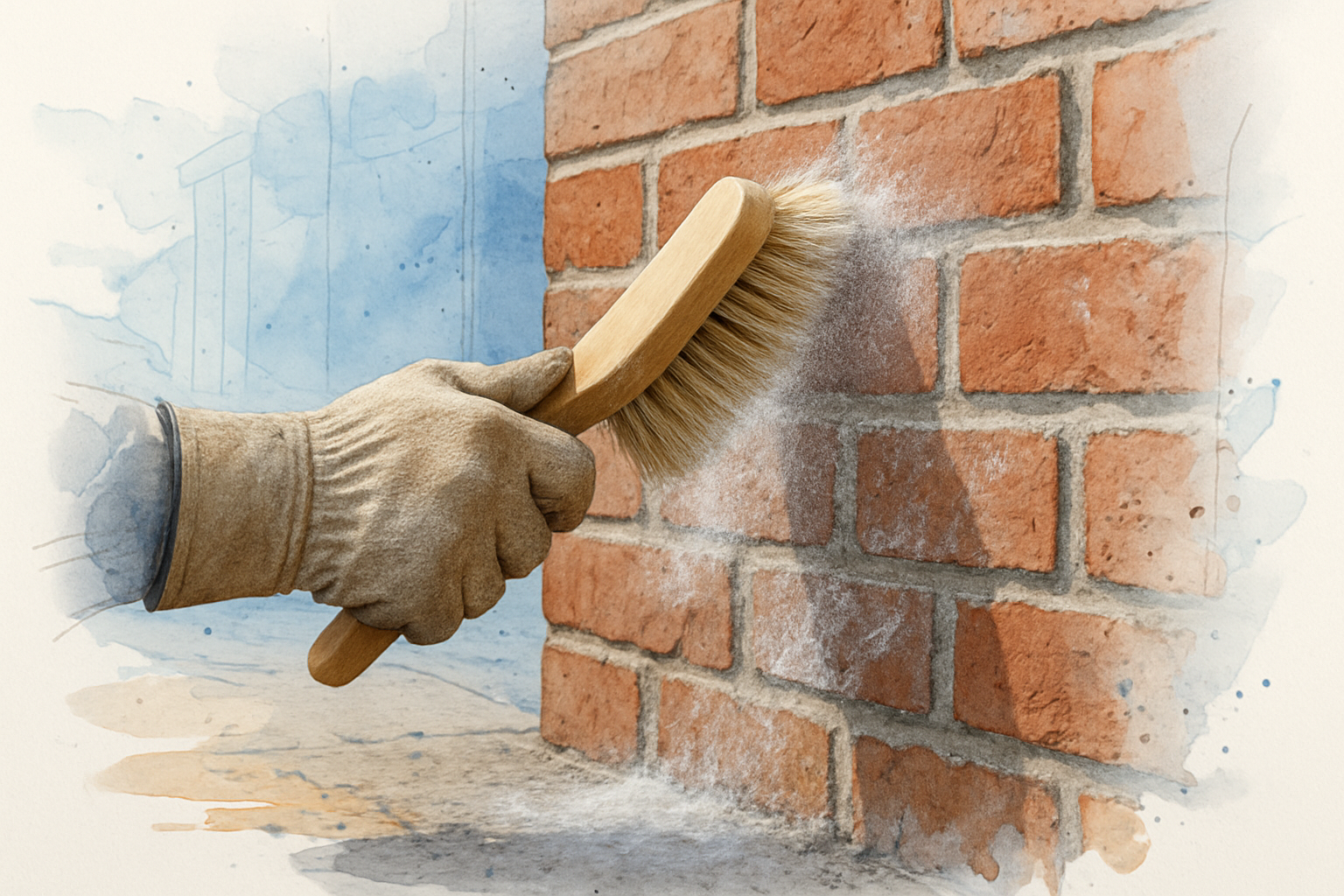
Dry brushing with a stiff brush is the standard starting point, and for a first bloom on new masonry it is often all that is needed.
But cleaning is cosmetic. If the deposit keeps coming back, spreads, or sits next to joints you can scratch out with a screwdriver, that wall belongs in front of a licensed masonry contractor instead of a weekend. It is the same judgment call as figuring out whether a masonry crack actually needs repair.
A Wet Winter Changes the Odds, Not the Outcome
Forecasters have been tracking a strong and possibly very strong El Niño for the 2026-27 winter. Prior strong events in California have brought above normal precipitation, more atmospheric rivers, and higher flood risk from December through March.
I want to be careful here. A strong event shifts the odds, it does not guarantee anything. The 2015-16 El Niño underdelivered badly for the Central Coast.
The honest framing is this: a wet stretch does not create a problem in a wall that drains properly. It exposes one in a wall that does not. If you want the longer version, I wrote about what a strong El Niño winter does to a wall built without drainage.
What a Fix Costs, and Why I Cannot Give You a Number Here
Nobody prices a moisture problem from a photo, and any number I put in an article would be a guess dressed up as a quote.
What drives the cost:
- How much of the wall is affected. A three foot section and a forty foot run are different jobs.
- Access and wall height. A wall you can reach from flat ground costs less to work on than one on a slope behind a planted bed.
- Whether joints have to be cut out and repointed, which is labor heavy and hard to estimate from the curb.
- Whether the real fix is masonry at all. Sometimes it is a sprinkler head, a downspout extension, and regrading the soil away from the wall.
General Central Coast market context is that repointing and moisture correction pricing swings widely for exactly these reasons. If you want to understand the variables before you get bids, what repointing masonry actually costs and what drives the price breaks it down further.
One more thing worth saying. A homeowner in Moss Landing wrote in last winter about a damaged block wall and asked us to check the adjacent section for stability and proper tie-in. Then they closed with a plain request: please confirm your license and insurance information.
That is the right instinct, and I wish more people had it. Any California contractor’s license can be checked through the CSLB’s check-a-license tool, and C-29 is the state’s masonry classification. If you are not sure what you are looking at on a license record, how to read a California contractor’s license before you hire walks through it.
Frequently Asked Questions About White Powder on Brick and Block Walls
Is efflorescence damaging my wall?
The deposit itself is usually not harmful to the brick or block. The water that carried it there is the concern, because long term moisture breaks down mortar joints and can wash fines out of the base behind a retaining wall.
Will the white powder go away on its own?
On new masonry, often yes. The first wet season flushes salts out of fresh mortar and the bloom fades over a few months. If it comes back in the same spot every winter, it will not stop on its own, because the water path is still open.
Can I just pressure wash it off?
I would not. Pressure washing drives water deeper into the masonry, which dissolves more salt and brings it right back as the wall dries. It can also erode aging mortar joints. Dry brushing first is the standard move.
Should I seal my wall to stop it?
Not until you know the wall is dry inside and you have closed the water source. Sealing a damp wall traps the moisture behind the surface, and that moisture then works on the joints instead of evaporating out.
Why is the powder only on the bottom two feet of my block wall?
That pattern usually points at ground moisture. Soil piled against the wall, a planter bed holding water, sprinklers hitting the base, or weeps that are clogged or were never installed. On a retaining wall it often means the drainage behind it is not working.
How do I know if it is salt from the ocean air instead?
Compare the exposed face of the wall to a sheltered section of the same wall. Airborne salt on Pacific Grove and Pebble Beach properties tends to coat the weather-facing side evenly, while internal salt concentrates at mortar joints, low courses, and under capstones.
Wondering whether your wall needs cleaning or a closer look?
Stonecap Masonry is a licensed, bonded, and insured C-29 masonry contractor in Salinas, CSLB License #1073620, led by master mason Candelario Perez and his son Adrian. Recurring moisture on a wall almost always comes back to base preparation, drainage, and whether the materials suit coastal conditions, which is the work the team does every day. Our crew evaluates masonry moisture issues across Salinas, Carmel, Carmel Valley, Pebble Beach, and Pacific Grove, and readers who want an on-site look can reach us at 831-262-0442 or stonecapmasonry.com.
