Direct Answer: Most masonry fireplace builds on the Monterey Peninsula run two to four months door to door. Actual construction days are often three to six weeks. Design, materials, permit review, and cure time fill the rest.
By the time most people call me, they have already decided to build. They are not asking how a fireplace goes together or what it costs. They want to know when they can light it.
On the Peninsula that question shows up like clockwork in late summer and early fall. The evenings cool off, people start planning holiday hosting, and suddenly a patio fireplace has a deadline attached to it.
So this article stays on the calendar side of the job. What each phase takes, why cure time is longer here than inland, and which decisions quietly add weeks before anyone picks up a shovel.
What a Masonry Fireplace Construction Timeline Actually Includes
The number people want is a single one. The honest answer is a set of ranges, because a fireplace build is really seven small projects stacked in order.
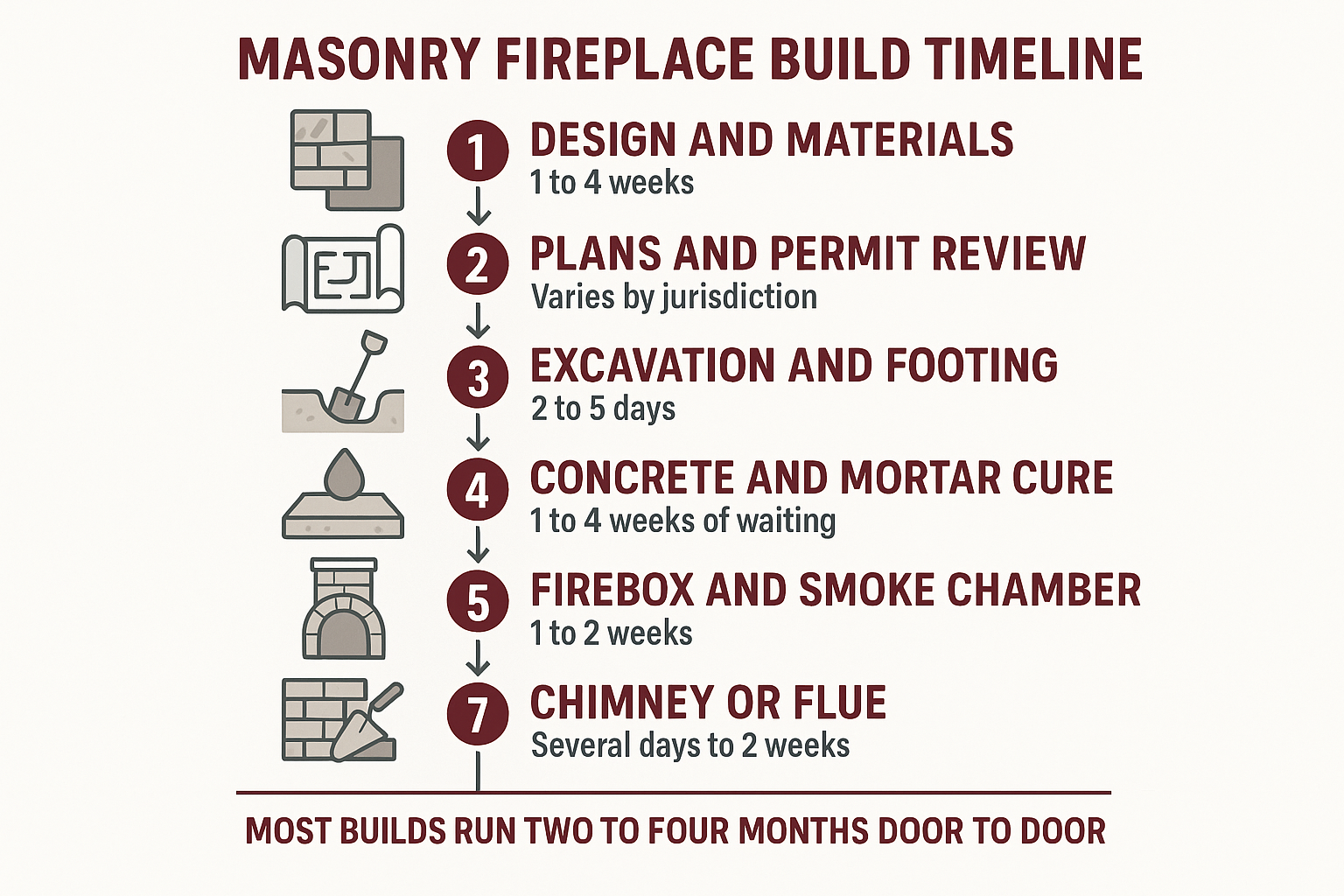
Here is how the phases usually fall on a Monterey County job:
- Design and material selection: 1 to 4 weeks. Style, size, fuel type, and stone choice. This is where the most time gets lost.
- Plan prep and permit review: highly variable. Depends on the jurisdiction and the scope. More on that below.
- Excavation and footing: 2 to 5 days. Faster on an open Salinas lot, slower on a slope in Carmel Valley.
- Concrete and mortar cure: 1 to 4 weeks of waiting, not working.
- Firebox and smoke chamber: roughly 1 to 2 weeks.
- Chimney or flue work: several days to 2 weeks, depending on height and whether it ties into a roof.
- Facing, hearth, and final cleanup: 1 to 2 weeks.
Add it up and most builds land somewhere around two to four months from first conversation to first fire, with only three to six weeks of that being actual crew days on site.
If you want the construction side rather than the calendar side, I covered that in what actually goes into building a masonry fireplace.
Permit Review Runs on a Different Clock in Every Town Here
This is the part I cannot promise a date on, and neither can anyone else who is being straight with you.
Whether a permit is required depends on the address and the scope of the work. A detached outdoor fire feature and an interior fireplace tied into a wall assembly are not treated the same way. The local planning or building department confirms that for each specific project.
What I can tell you is that the review clock is not uniform across the Peninsula:
- Unincorporated Monterey County handles a different volume and process than a small city does.
- Carmel-by-the-Sea has design review considerations that can add a layer before building review even begins.
- Pacific Grove has its own historic and residential review context.
- Salinas operates on a separate schedule again.
So when a homeowner in Pebble Beach and one in Salinas both ask why their neighbor’s project moved faster, the answer is often that they were never on the same clock to begin with.
The practical move is to ask the department early, in writing, and to build the answer into the schedule instead of assuming it. The 2025 building code requirements for a masonry fireplace also shape what has to be drawn before anything gets submitted.
Phase by Phase: Typical Ranges and What Stretches Them
These ranges reflect what I see on Peninsula jobs. Every property is different, so treat this as a planning frame, not a promise.
| Phase | Typical Range | What Stretches It |
|---|---|---|
| Design and material selection | 1 to 4 weeks | Custom stone sourcing, slab size or price changes, indecision on fuel type |
| Plan prep and permit review | Varies by jurisdiction | Design review communities, incomplete plans, scope that touches the structure |
| Excavation and footing | 2 to 5 days | Slope, rock, tight access, wet soil after a storm |
| Concrete and mortar cure | 1 to 4 weeks of waiting | Marine layer humidity, cool coastal mornings, winter rain |
| Firebox and smoke chamber | 1 to 2 weeks | Custom throat detailing, inspection holds |
| Chimney or flue | Several days to 2 weeks | Height, roof penetration, weather |
| Facing and final cleanup | 1 to 2 weeks | Intricate stone patterns, mid build design changes |
Cure Time Is the Part Homeowners Always Underestimate
Concrete and mortar do not dry. They cure, which is a chemical reaction that needs time and moisture to reach full strength.
That matters twice in a fireplace build. Once before the footing carries the weight of the masonry above it, and again before the first fire pushes heat through green mortar joints.
The Monterey Bay microclimate makes this a real scheduling factor, not a technicality. A cool marine layer morning in Pacific Grove with high humidity behaves nothing like a hot August afternoon in Salinas. Coastal work often cures slower and more evenly, which is good for the masonry and inconvenient for a deadline.
Winter adds another variable. Between roughly November and March, rain can pause exterior work for days at a time, and a saturated site is not a site anyone should be pouring on.
What a rushed cure costs later:
- Hairline cracking through mortar joints that shows up in the first season
- Spalling on the firebox face from heat hitting joints that were not ready
- Repair work on a fireplace that was supposed to be finished
I would rather tell someone their first fire is two weeks out than come back in eighteen months to rebuild a firebox. The foundation stage sets up everything above it, and that stage is the one that least tolerates being hurried.
The Build Calendar at a Glance
This walks the phases in the order they actually happen, with the waiting periods shown as their own steps rather than hidden inside construction.
The Five Things That Actually Stretch a Schedule
Weather and permits get blamed for delays. In my experience, the bigger schedule movers are decisions, and most of them are yours to control.
1. Natural stone selection. This is the most common one. A Carmel homeowner came to me set on a particular granite slab, and we spent real time working through alternatives because the slab was oversized for the piece and priced above where they wanted to land. Nothing could be ordered until that settled, and that was all before a shovel moved.
2. Design changes mid build. Moving an opening or changing a hearth height after the footing is poured is not a small edit. It can reset a phase.
3. Gas line coordination. Masonry is my scope. Gas connections belong to the appropriate licensed trade, and their calendar has to line up with mine. The gas versus wood decision affects the schedule as much as it affects the build.
4. Tight site access. Wooded lots in Carmel Valley and Pebble Beach often mean material gets moved by hand or small equipment. That is slower, and it is worth planning for honestly up front.
5. Design review in communities that have it. Not every address triggers it, but where it applies, it happens before construction days start counting.
Booking Reality on the Peninsula: Call Earlier Than Feels Necessary
Demand for fire features here climbs steadily through September, October, and November. People shift from summer patio projects to warmth and hosting, and the calls all arrive in the same window.
So a homeowner calling in mid October hoping for a finished fireplace by Thanksgiving is usually planning against a crew schedule that filled up back in August.
This is not meant as pressure. It is arithmetic. Design conversations, material lead time, and permit review all happen before a single construction day gets counted.
My honest planning advice is to start the conversation 30 to 60 days earlier than you think you need to. If your target is holiday season, that means summer. If your target is spring entertaining, that means winter, when the design and permit work can move even while rain limits site work.
On outdoor builds specifically, the Peninsula’s climate shapes more than the schedule, including material choices that hold up to salt air.
Get the Dates in the Contract, Not in a Handshake
Most contractor frustration I hear about traces back to a vague timeline that was never written down.
A California home improvement contract is expected to spell out approximate start and completion dates and describe the scope in plain terms. As of January 1, 2026, agreements also address whether a subcontractor will be used on the job, which is directly relevant when gas or electrical coordination is part of a fire feature. The CSLB’s 2026 industry bulletin on new laws lays out those disclosure changes.
When you read a proposal, look for:
- An approximate start date and an approximate completion date
- A scope description you can actually understand
- Whether any part of the work goes to a subcontractor
- What events would legitimately move those dates
Then ask the contractor directly what would push the completion date, and see whether the answer sounds like someone who has thought about cure windows and inspection holds. There are defined inspection points inside a fireplace build, and a crew that plans around them keeps a schedule better than one that discovers them mid build.
What Timeline Reliability Actually Looks Like
A realistic schedule is not the shortest one. It is the one that accounts for cure time, weather, inspection holds, and material lead time before anyone commits to a date.
That is the difference repeat clients tend to notice. One Peninsula homeowner who has had several projects done with us, ranging from traditional masonry to foundations and driveway work, put it simply: “all completed to a high standard in a timely manor” (Gary C.).
We work as a licensed C-29 masonry contractor under CSLB License #1073620, and any homeowner can verify a contractor’s license status through the CSLB’s check-a-license tool before signing anything.
Frequently Asked Questions About Masonry Fireplace Timelines
How long do I have to wait before the first fire?
Masons commonly advise waiting around 30 days after the masonry is complete before a full fire, and then starting with small, short burns rather than a roaring one. Green mortar and sudden heat do not get along. The exact window depends on conditions during the build, which is why coastal jobs sometimes need a little more patience than inland ones.
Can a masonry fireplace be built during the Monterey winter?
Yes, though exterior work gets interrupted. Between November and March, rain can shut a site down for days at a time and slow cure schedules. Winter is actually a good season to handle design, material selection, and permit review so construction can start clean once the weather turns.
I want a fireplace finished by Thanksgiving. When should I call?
Ideally by mid to late summer. Fire feature demand on the Peninsula climbs through September, October, and November, and design plus material lead time plus permit review all happen before construction days begin. Calling in October for a November finish usually means competing with a calendar that filled months earlier.
Why is my neighbor’s fireplace taking half as long as mine?
Usually scope and jurisdiction. A detached outdoor fire feature on flat ground in Salinas is a different project from an interior fireplace with a chimney on a sloped, wooded lot in Carmel Valley. Stone selection and mid build changes account for a lot of the rest.
Does the crew work every day of the project?
No, and that surprises people. Cure windows and inspection holds are days where nothing visible happens on purpose. A schedule that shows continuous daily work on a masonry fireplace is usually a schedule that has not accounted for the waiting.
Planning a Fireplace Build in Monterey County?
If you are mapping out a timeline for a fireplace or fire feature anywhere from Salinas to Carmel, the earlier the conversation starts, the more realistic the finish date becomes. Stonecap Masonry can walk through the phases for your specific property and jurisdiction at 831-262-0442 or stonecapmasonry.com.
