
Direct Answer: Stair-step cracking, visible lean, capstone displacement, water or soil pushing through the face, and heaving at the wall’s base all signal structural failure, not cosmetic damage. Each one requires a licensed masonry contractor, not a patch.
A cracked retaining wall is easy to rationalize. You slap some hydraulic cement into the gap, the wall looks fine from ten feet away, and you tell yourself you’ll deal with it properly next season. I’ve seen that approach fail more times than I can count, and when a retaining wall fails, it doesn’t just look bad. It moves soil, damages property, and in a seismic zone like Monterey County, it can go from “manageable problem” to genuine safety hazard faster than most homeowners expect.
Not every crack or blemish warrants a full rebuild. But some warning signs are telling you something specific: the wall’s structure is compromised, and no amount of patching the surface will fix what’s happening underneath. That’s the line this article is about, the five physical signs you can actually see with your eyes that tell you a patch job isn’t going to cut it.
If you’ve already read When a Retaining Wall Needs a Contractor, Not a Handyman and want to go deeper on the specific symptoms, this is where we get into the details.
1. Cracking That Follows the Mortar Joints in a Stair-Step Pattern
Random surface cracks happen. Mortar ages, minor settling occurs, and a hairline crack here and there is usually cosmetic. But when cracks run diagonally along the mortar joints in a stair-step configuration, stepping from one horizontal joint down to a vertical joint, then across to the next horizontal joint, that pattern is telling you something specific about how the wall is moving.
Stair-step cracking is a classic sign of differential settlement or lateral soil pressure pushing one section of the wall at a different rate than an adjacent section. The blocks or stones themselves aren’t breaking, the mortar between them is failing because the wall is moving as a unit and the joints are absorbing that stress. A patch fills the crack, but it does nothing about why the wall is moving.
In Monterey County, soil moisture cycles hard between our wet winters and dry summers. That expansion and contraction puts sustained pressure on retaining walls, especially ones with inadequate drainage behind them. A stair-step crack pattern in that context usually means the drainage has already failed, and that’s a structural repair, not a surface fix. For a broader look at how to read masonry cracks, this guide on masonry cracks and what they actually mean lays it out clearly.
2. Visible Outward Lean or Bulge in the Wall Face
Stand back from the wall and look along its face from one end. A wall in good structural condition reads as a straight, plumb vertical surface. If you can see a bow or bulge pushing outward from the middle of the wall, or if the wall has developed a noticeable lean away from the soil it’s retaining, that movement is not going to self-correct.
Lateral soil pressure builds continuously. Once a wall starts to lean, the force acting on it only increases as the base becomes less effective at distributing that load. The footing, the drainage layer, and the tie-back system (if there is one) are all being compromised at the same time.
This is the sign I take most seriously, especially on the Peninsula. USGS data cited in Monterey County’s own preparedness guidance places California at a 99.7% probability of a magnitude 6.7 or greater earthquake within the next 30 years. A wall already under lateral stress has almost no margin when seismic forces are added on top of that. A leaning wall in Monterey County is not a “deal with it next year” situation.
3. Capstone Displacement or Separation From the Top Course
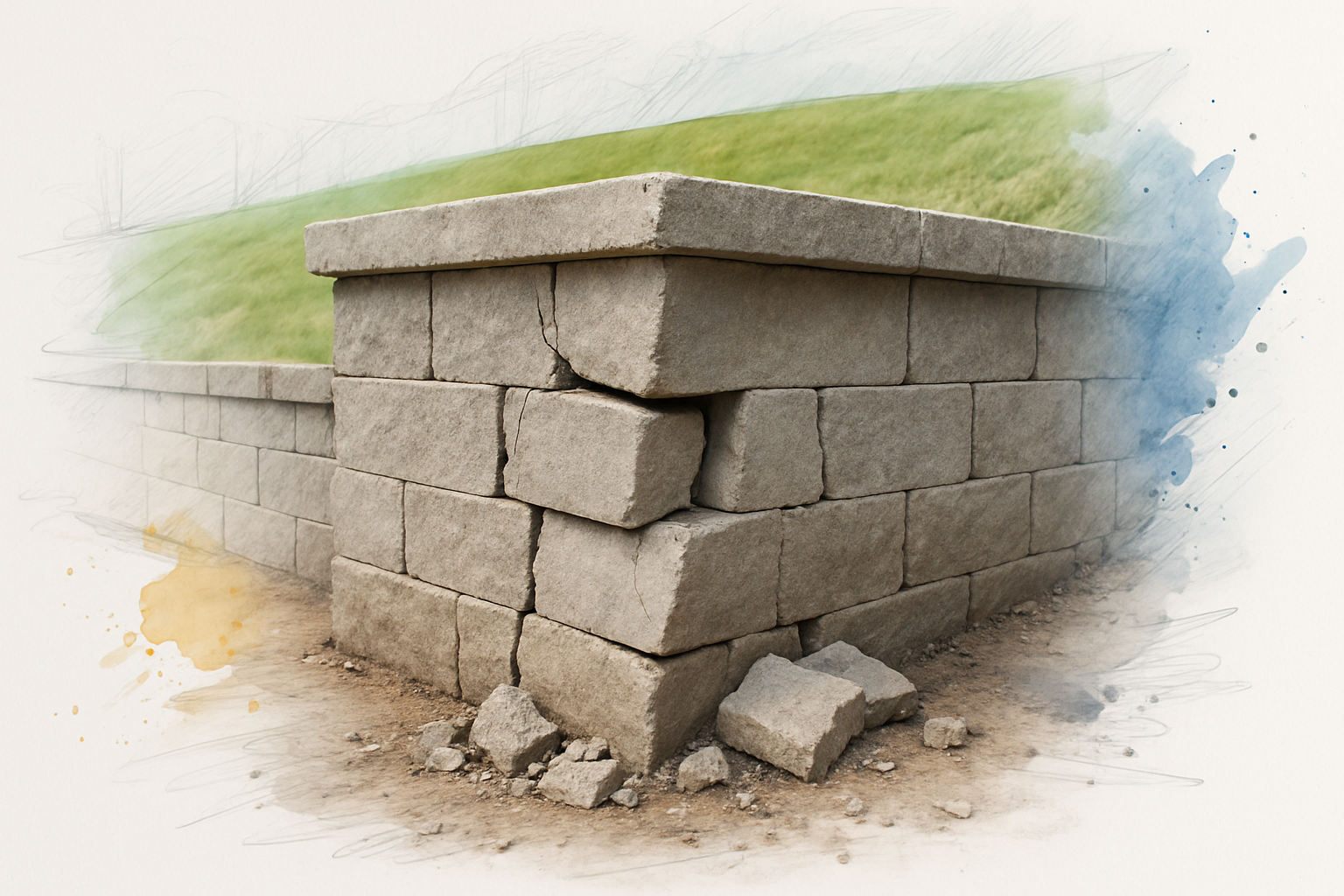
The capstone sits at the top of the wall and serves two jobs: it protects the cores of the blocks or stones below it from direct water infiltration, and it locks the top course in place. When capstones shift, separate, or sit at an angle relative to the course beneath them, that’s a sign the top of the wall has moved, or the mortar bed holding the caps has failed enough to allow independent movement.
We recently worked with a homeowner near Moss Landing whose concrete block retaining wall was struck by a third-party vehicle. The impact cracked and displaced several blocks at a corner column, and the capstone at that corner was shifted and partially unsupported. The visible corner damage was obvious, but what concerned us more was inspecting the adjacent courses for footing issues and stability problems that weren’t visible from the surface.
That’s the real risk with capstone displacement: it’s often a symptom of something happening lower in the wall, not just a surface-level cap problem. Reset the cap without understanding why it moved, and you’ll be resetting it again inside a year.
4. Soil or Water Actively Pushing Through the Wall Face
A functioning retaining wall manages the water behind it. Drainage aggregate, weep holes, and proper slope work together to let hydrostatic pressure escape rather than build. When that system breaks down, you start to see the evidence on the wall’s face:
- Weep holes that are clogged or absent entirely
- Efflorescence (white mineral deposits) streaking down the face, indicating water moving through the wall body
- Actual soil migration, fine particles of dirt appearing at cracks or joints, meaning the soil is literally moving through the wall under pressure
- Moisture staining concentrated in areas that should be dry
Any of these means the drainage system is failing. Patching the cracks while leaving the drainage problem intact just forces the water to find a new path. On coastal properties between Carmel and Salinas, where our ground can go from bone-dry to saturated after a single El Niño storm system, failed drainage behind a retaining wall creates a serious hydrostatic pressure problem quickly. You can see what a hard winter does to masonry in this breakdown of El Niño storm impacts on masonry structures.
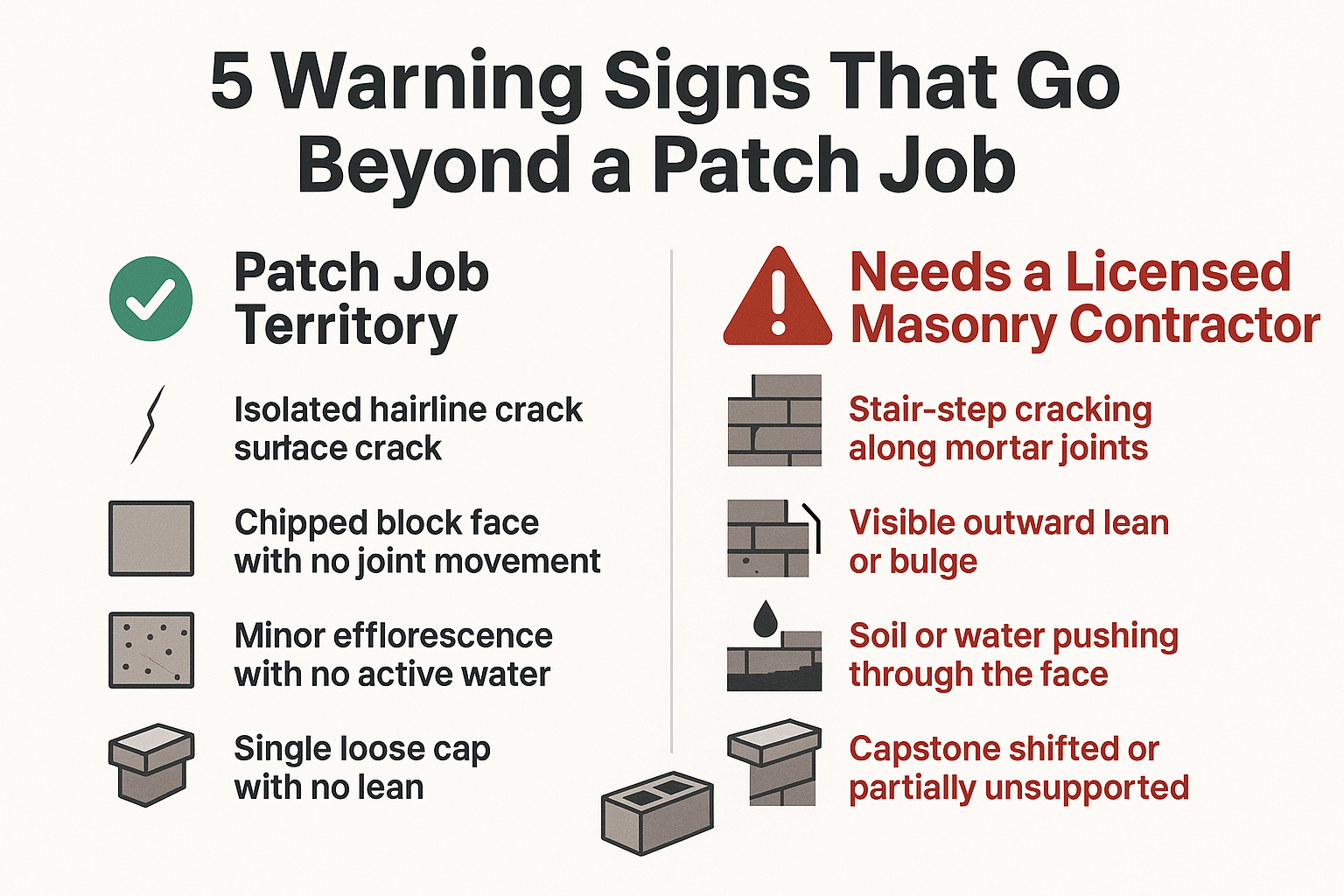
Quick Reference: Cosmetic Patch vs. Contractor-Level Repair
Use this comparison to quickly sort what you’re seeing on your wall against what each type of damage actually requires.
5. Settlement or Heaving in the Surface Right at the Wall’s Base
Walk the ground on both sides of the wall and look at what’s happening at grade level. If the patio, walkway, or lawn immediately adjacent to the wall’s base is cracking, sinking, or heaving upward, the wall’s footing is likely compromised.
A retaining wall footer is what transfers the weight of the wall and the soil pressure it holds into stable ground below. When footers settle unevenly or lose their bearing, the wall above starts to move, and the ground surface at grade reflects that stress before the wall itself shows obvious visible damage.
This is also the sign that most directly implicates a permit and inspection issue. In California, retaining walls above approximately 4 feet of retained height (the exact threshold varies by jurisdiction, check with your local building department) typically require permitted construction with inspection checkpoints. A contractor who rebuilds a failing wall without pulling the required permits leaves the homeowner with no legal recourse if the work fails, and potential complications at resale. A C-29 licensed masonry contractor carries the credential to pull permits, coordinate inspections, and deliver work that closes out properly with the building department. You can verify any contractor’s license through the CSLB’s check-a-license tool before signing anything.
What Each Warning Sign Is Actually Telling You
Each visible symptom points to a specific structural condition. This table maps what you see to what’s likely happening, and why a surface patch doesn’t address the root cause.
| What You See | What It Likely Means | Why Patching Fails |
|---|---|---|
| Stair-step cracking along joints | Differential settlement or lateral soil pressure | Crack returns because wall movement continues |
| Outward lean or bulge | Base or footing losing bearing; lateral load increasing | Lean worsens under added seismic or soil pressure |
| Shifted or unsupported capstones | Top course has moved; mortar bed or structure compromised | Resetting cap doesn’t fix why it moved |
| Soil or water through the wall face | Drainage system failed; hydrostatic pressure building | Patching cracks forces water to find a new path |
| Heaving or sinking at the wall base | Footer settlement or soil instability beneath the wall | Surface repair ignores what’s happening below grade |
Frequently Asked Questions About Retaining Wall Repairs
Can I repair a retaining wall myself if the damage looks minor?
Minor cosmetic issues, a chipped block face, surface efflorescence, a single loose stone with no joint movement, can sometimes be addressed by a careful homeowner. But anything involving joint cracking patterns, visible lean, capstone movement, or drainage failure crosses into territory where the wrong repair makes the underlying problem worse. Structural masonry repair in a seismic zone is not a good candidate for DIY.
How do I know if my retaining wall repair needs a permit?
Permit requirements vary by jurisdiction and project scope. As a general rule in California, walls retaining more than approximately 4 feet of soil typically require a permit and inspections, but that threshold varies by city and county, and the type of repair matters too. Your local building department is the authoritative source. A licensed C-29 masonry contractor can help you understand what’s required for your specific project before work begins.
What should I ask a masonry contractor before hiring them for a retaining wall repair?
Ask for their CSLB license number and verify it yourself at the state’s official check-a-license site. Confirm they carry a C-29 masonry classification specifically, not just a general contractor license. Ask whether the scope of work requires a permit and how they handle the inspection process. And ask whether the quote includes an assessment of the footing and drainage, not just the visible damage. A contractor who only quotes what’s visible on the surface may be missing the structural root cause.
Does a vehicle impact that damages a retaining wall count as structural damage?
It depends on which section was hit and how much force was involved. A corner column strike, like the situation one Moss Landing homeowner described when a utility vehicle damaged their concrete block wall, can displace multiple courses and compromise the footing and adjacent wall sections even when the surrounding wall looks intact. An on-site inspection that checks adjacent courses and the base is the only reliable way to know the true scope of damage.
How does Monterey County’s seismic environment affect how urgent these repairs are?
Significantly. A wall already showing lean or joint distress is a compromised structure. Seismic forces act laterally, exactly the same direction the wall is already under stress. USGS data places California at a 99.7% probability of a 6.7+ magnitude earthquake within 30 years, and Monterey County sits in a high-ground-motion zone. Deferring a repair that would be low-stakes elsewhere is genuinely riskier here.
Seeing Any of These Signs on Your Wall?
If something on this list matches what you’re looking at, the right next step is an on-site assessment, not another season of watching it. Stonecap Masonry serves homeowners and property owners across Salinas, Carmel, Moss Landing, Pacific Grove, and the broader Monterey Peninsula. You can reach the team at 831-262-0442 or request a quote at stonecapmasonry.com to talk through what you’re seeing and get a licensed C-29 masonry contractor on-site to assess the actual scope.