Direct Answer: A masonry fireplace is built in a specific sequence — footing, firebox, smoke chamber, damper, and chimney — where each phase depends on the one before it. Skipping or underbidding any step causes problems that show up years later.
Most homeowners think of a masonry fireplace as a decorative feature — a stone face, a hearth, a mantel. What they don’t see is everything happening below floor level and inside the throat that actually determines whether the fireplace works. The visible surface is the last ten percent of the job.
I’ve seen projects on the Monterey Peninsula where a beautiful stone facing sits in front of a firebox that smokes back into the room on every use. The problem wasn’t the stone — it was a smoke chamber that was never properly finished, or a firebox built to the wrong proportions. Those mistakes live behind the wall forever.
This article walks through how masonry fireplace construction actually progresses, phase by phase — what decisions matter at each stage, and why the sequence itself is as important as any single material choice.
Why the Footing Comes Before Everything Else
A full masonry fireplace with a chimney can weigh several tons. On the Monterey Peninsula, where expansive soils are common and seismic loading has to be factored into every structural design, that weight has to land somewhere that won’t shift.
The concrete footing beneath the fireplace is sized based on the total weight it will carry and the soil bearing capacity at that specific location. Getting this wrong doesn’t show up on day one — it shows up as hairline cracks in the masonry three or five years after the project is done, usually starting at the corners of the firebox opening and working outward.
We’ve written more about why this step carries so much downstream consequence in How a Masonry Fireplace Foundation Changes Everything. The short version: no amount of craftsmanship above the slab makes up for a footing that was undersized or poured into compromised soil.
For permitted masonry fireplace projects in Monterey County, the footing is also what inspectors are looking at during the rough inspection — before anything else goes in. The California 2025 Title 24 building standards, effective January 1, 2026, are now the framework those inspectors are applying. That means the footing dimensions, the reinforcement schedule, and the concrete mix all need to be documentable before the next phase begins.
Firebox Geometry: The Proportions That Determine Performance
Once the footing and base masonry are in place, the firebox itself gets built — and this is where I see the biggest gap between contractors who know masonry and contractors who are winging it.
A firebox is not just a box that holds fire. The proportions between the opening width, opening height, firebox depth, and the throat that feeds into the smoke chamber are governed by established engineering references that have been adopted into California’s building code. Those ratios exist for one reason: they control how combustion gases move. Get them right and the fireplace draws cleanly. Get them wrong and you have a smoke problem on every cold or windy night.
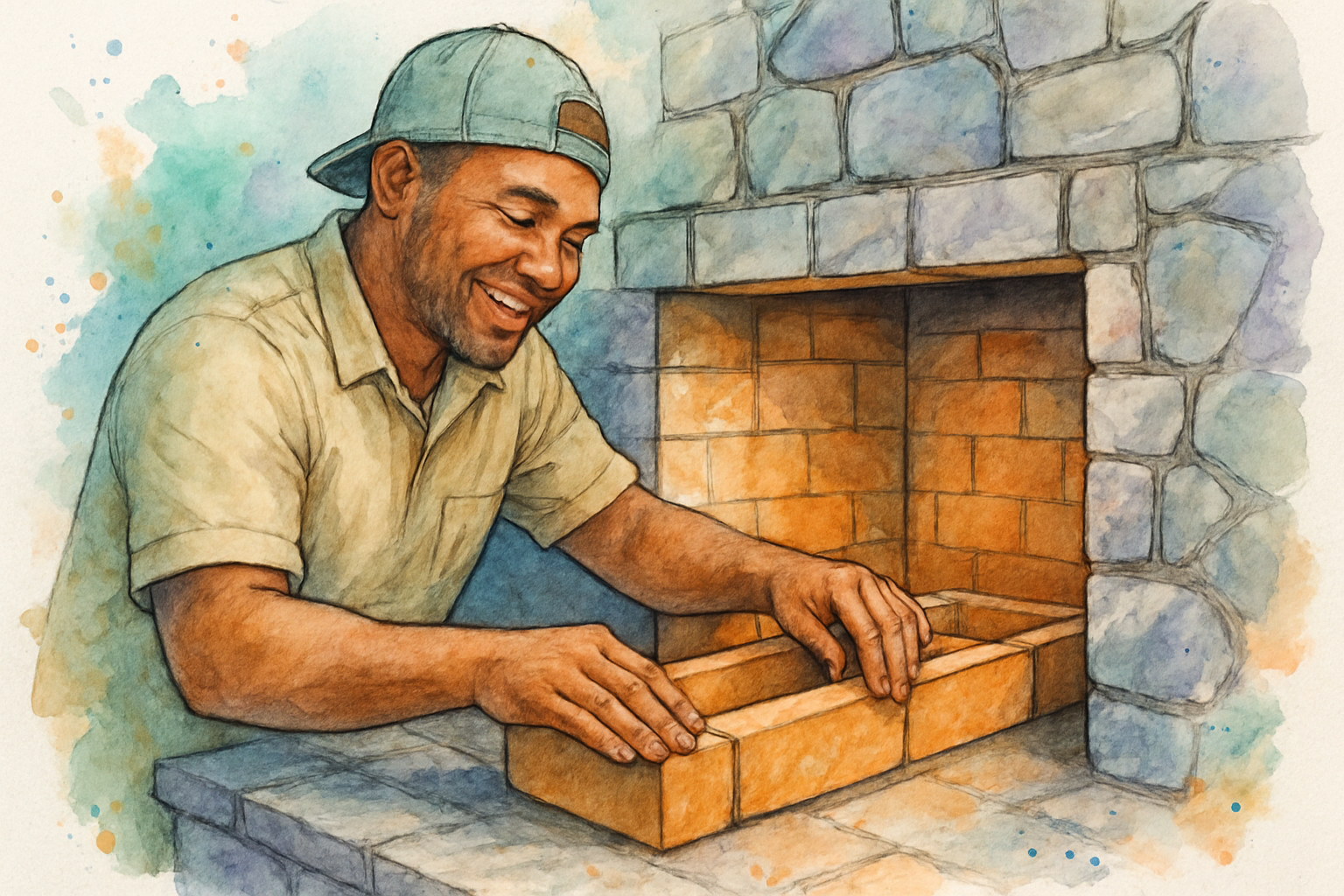
The firebox interior is lined with refractory brick — a material rated to handle repeated thermal cycling without cracking. Standard masonry units cannot do this job. I’ve seen fireboxes built with regular CMU that looked fine for the first season and then cracked through the second winter as the material expanded and contracted under heat it wasn’t designed to handle.
Key firebox decisions that are made at this phase:
- Opening dimensions — width and height set the visual scale, but they also drive every proportion downstream
- Firebox depth — too shallow and combustion products spill forward; too deep and efficiency drops
- Throat width — this feeds directly into smoke chamber performance, so the two can’t be designed in isolation
- Refractory liner spec — the material rating has to match the fuel type and expected burn frequency
For anyone comparing this to a prefabricated unit, What Actually Goes Into Building a Masonry Fireplace covers that distinction in more depth.
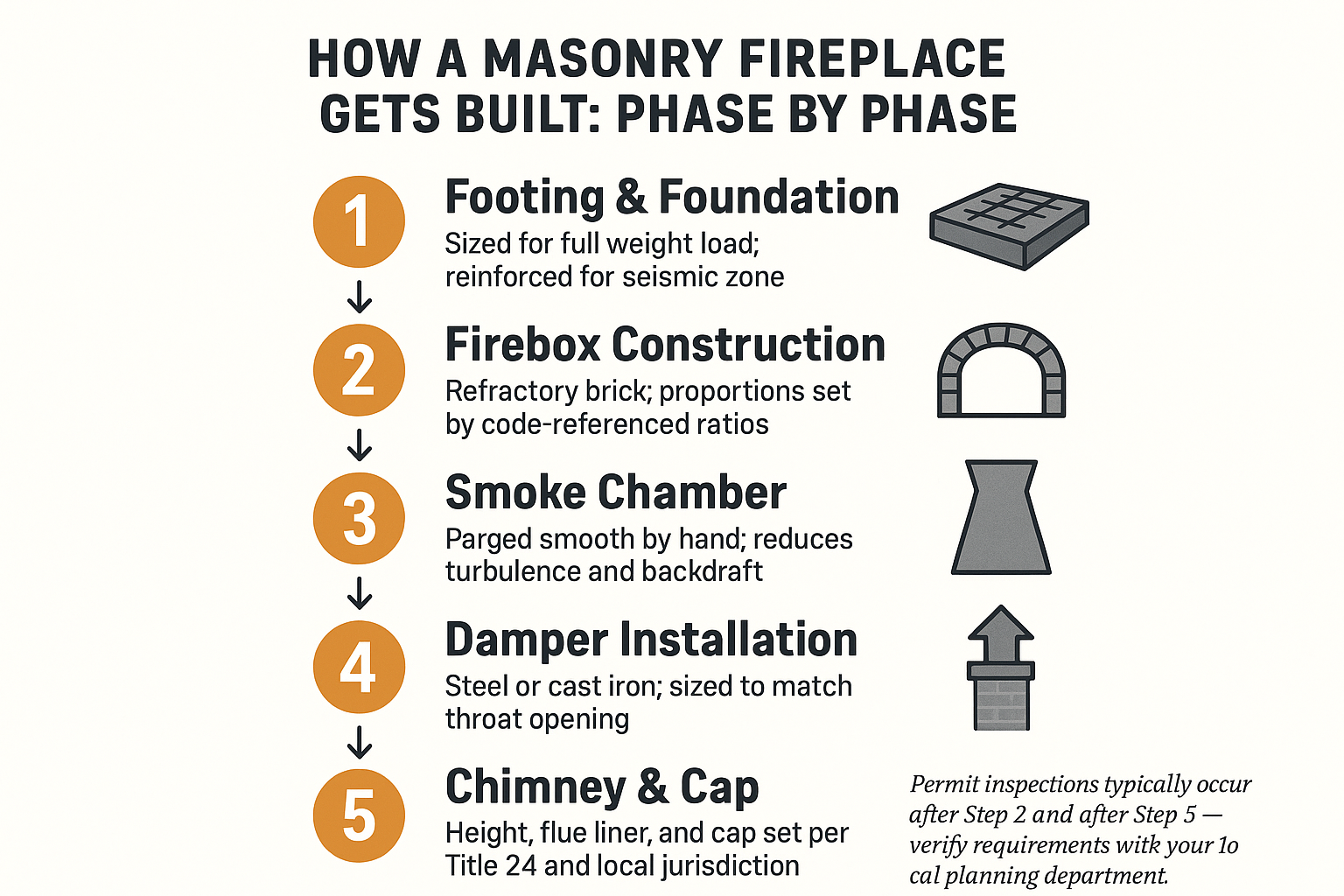
The Masonry Fireplace Construction Sequence
The phases of masonry fireplace construction follow a fixed sequence — each one depends on the work that came before it.
The Smoke Chamber: Where Price Gaps Between Bids Actually Come From
If you’ve collected more than one quote for a masonry fireplace and can’t figure out why two bids are several thousand dollars apart, ask each contractor one question: what is your smoke chamber finish specification?
The smoke chamber sits above the firebox and below the flue. Its job is to compress and direct combustion gases upward into the chimney without turbulence. A rough-formed smoke chamber has interior surfaces that create drag and dead zones — places where smoke hesitates before rising. A parged smoke chamber is hand-troweled smooth on every interior surface, which allows gases to move cleanly.
Pargingthe smoke chamber takes real labor — typically several hours of careful hand work inside a confined space while the mortar is still workable. Many contractors skip it, or do a partial job. The homeowner can’t see the difference until the fireplace is lit and smoke starts rolling into the living room.
That labor cost is real, and it’s one of the clearest examples of where a lower bid often means a lower-performing fireplace. A parged smoke chamber isn’t a luxury finish — it’s what makes the firebox geometry actually work.
The damper also lives in this zone. Its size and placement have to match the throat dimensions established during firebox construction. A damper that’s too small for the throat creates the same turbulence problem as a rough smoke chamber — the two issues compound each other.
Outdoor Fireplaces on the Coast: Material Choices Change Here
Everything above applies to both indoor and outdoor masonry fireplace construction — but for outdoor projects on the Monterey Peninsula, the material selection conversation goes a step further.
Salt air is aggressive. It gets into mortar joints, works behind stone faces, and accelerates the breakdown of materials that would hold up fine in a drier inland environment. A fireplace built for a Pebble Beach backyard or a Pacific Grove courtyard is being asked to survive constant moisture cycling, fog-driven chloride exposure, and seismic movement — all at the same time.
For these projects, refractory mortars and materials rated for coastal exposure aren’t an upgrade — they’re the minimum. Joint profiles matter too: a tooled, slightly recessed joint sheds water better than a flush or proud joint that traps moisture and accelerates freeze-thaw damage. In a climate as mild as the Monterey Peninsula, true freeze-thaw cycles are rare, but the moisture cycling alone is enough to cause cracking in under-specified mortar within a few years.
The choice between gas and wood fuel also changes the build in ways most homeowners don’t anticipate. Gas vs. Wood: What That Choice Really Means for a Masonry Fireplace Build covers the practical construction differences — flue sizing, firebox geometry, clearance requirements — and is worth reading before finalizing the design.
For those planning the broader outdoor space around a fireplace, What to Know Before Building an Outdoor Fireplace on the Monterey Peninsula is a useful starting point for the site and permit questions that come up before construction even begins.
Key Phases and What Each One Determines
Each phase of masonry fireplace construction has consequences that reach forward into the next phase. This table shows what’s being decided at each step and what it affects.
| Construction Phase | What Gets Decided | What Fails If It’s Wrong |
|---|---|---|
| Footing | Depth, width, rebar schedule, concrete spec | Settlement cracking, structural movement over time |
| Firebox | Opening proportions, refractory brick type, depth | Smoke spillage, thermal cracking, combustion inefficiency |
| Smoke Chamber | Parging quality, surface smoothness, taper angle | Backdraft, poor draw, smoke entering the room |
| Damper | Size, placement, material rating | Heat loss, poor draft control, premature corrosion |
| Chimney | Flue liner spec, height above roofline, cap design | Draft problems, moisture intrusion, code non-compliance |
Permits, Inspections, and What Title 24 Means for This Work
A masonry fireplace is a permitted structural project in every Monterey County jurisdiction I’m aware of. That means a building permit before work starts, a rough inspection of the firebox and reinforcement before it gets enclosed, and a final inspection once the chimney is complete.
The California 2025 Title 24 building standards — effective January 1, 2026 — are now what inspectors reference for new masonry construction. This doesn’t mean the old rules were meaningless, but it does mean that projects permitted after that date are being evaluated against updated provisions covering structural reinforcement, clearances, and energy-related requirements like damper specs.
Requirements vary between the City of Salinas, the City of Monterey, and unincorporated Monterey County. Always confirm the specific permit requirements for your address with the local planning or building department before any work begins — what applies to one parcel may not apply to the one next door.
One thing worth flagging: permits protect the homeowner, not just the contractor. A fireplace built without a permit can cause complications at resale, may not be covered by homeowners insurance if something goes wrong, and leaves the homeowner with no inspection record to verify the work was done to code. The inspection process isn’t bureaucratic friction — it’s the mechanism that confirms the smoke chamber was finished correctly and the footing was poured to spec.
What the Process Looks Like From the Homeowner’s Side
Andy Stoddard, a homeowner in Carmel Valley, described what it looked like when the Stonecap team built an outdoor gas grill enclosure into his backyard hardscape: ‘The finished project is beautiful. It has become a well used focal point in our backyard.’ That outcome — a space that actually gets used — starts with a conversation at the beginning of the project, not after the concrete is poured.
Before any masonry work begins, the expectation-setting conversation matters as much as anything else. What are the site conditions? Is there an existing slab that can be incorporated or does the footing need to come up from scratch? What’s the fuel source and has the gas line location been confirmed? What does the adjacent hardscape look like, and does the stone selection need to match existing material?
Site prep on a masonry fireplace project typically involves:
- Locating and confirming utilities before any excavation
- Establishing the footing footprint and confirming soil conditions
- Staging materials in a way that doesn’t damage existing landscape or hardscape
- Sequencing the permit inspection so rough work doesn’t get enclosed before the inspector signs off
A crew that communicates through each of these phases produces a result the homeowner actually understands — and one that matches what was agreed to at the start. That communication doesn’t happen by accident; it’s built into how the job is run from day one.
Frequently Asked Questions About Masonry Fireplace Construction
How much does a masonry fireplace cost to build on the Monterey Peninsula?
Costs vary significantly based on size, fuel type, stone selection, and site conditions. Many Monterey County homeowners see somewhere in the range of $15,000 to $40,000 or more for a full custom masonry fireplace build — with outdoor projects on the coast often running higher because of coastal-rated materials and the additional site prep coastal properties sometimes require. The only reliable way to get a real number is a site visit and a detailed written scope. What I’d caution against is choosing the lowest bid without understanding what’s included — specifically, ask about the smoke chamber finish spec and the footing design, since those two items explain most of the gap between bids.
Do I need a permit for a masonry fireplace in Salinas or Monterey?
Yes, in virtually every case. A masonry fireplace is a structural project that requires a building permit, at minimum, in Salinas, Monterey, and unincorporated Monterey County. Requirements vary by jurisdiction and project type, so confirm the specific permit requirements for your address with your local building department before work begins.
What’s the difference between a masonry fireplace and a prefabricated unit?
A masonry fireplace is built in place using individual refractory bricks, poured concrete, and hand-finished mortar joints — every dimension is site-specific. A prefabricated unit is a factory-built metal firebox that gets framed in and faced with stone or tile. The two look similar from the front but perform and age very differently. For a detailed comparison, What Actually Goes Into Building a Masonry Fireplace covers the key differences.
Why does the smoke chamber matter so much?
Because it’s the connection between the firebox and the flue, and turbulence there is what causes smoke to spill into the room. A parged smoke chamber — hand-troweled smooth on all interior surfaces — reduces turbulence dramatically compared to a rough-formed one. It takes more labor, which is why it’s often the first thing cut from a lower bid. But it’s also the single biggest factor in whether the fireplace draws reliably.
How do I verify that a masonry contractor is licensed in California?
The California Contractors State License Board (CSLB) maintains a public license lookup at cslb.ca.gov. You can search by license number or contractor name and confirm that the license is active, properly classified, and that the bond and insurance are current. For masonry work, the relevant classification is C-29. Any contractor who hesitates to give you their license number is a red flag.
Can I burn wood in an outdoor masonry fireplace in Salinas or on the Monterey Peninsula?
It depends on local air quality rules and the specific project type. The rules around wood burning on the Monterey Peninsula involve both local jurisdiction requirements and MBUAPCD (Monterey Bay Unified Air Pollution Control District) regulations. Are You Allowed to Burn Wood in an Outdoor Fireplace in Salinas? covers this question in detail.
Have a Fireplace Project on the Monterey Peninsula?
Stonecap Masonry serves homeowners across Salinas, Carmel, Carmel Valley, Pebble Beach, and Pacific Grove — and the Stonecap team is available to walk through project scope, site conditions, and what the permit process looks like for your specific address. Call 831-262-0442 or visit stonecapmasonry.com to request a quote and start the conversation.
