
Direct Answer: A cosmetic fix covers visible damage without addressing the cause. A real masonry repair fixes what’s underneath — the base, the mortar system, the drainage — so the problem doesn’t return.
A lot of homeowners on the Monterey Peninsula have been through the same experience: they hired someone to fix cracked mortar or a spalling stone face, the work looked great for six months, and then the same damage came back — sometimes worse. That’s not a coincidence. It’s what happens when a patch gets applied over a problem that was never actually diagnosed.
The Monterey Coast’s environment makes this more than an aesthetic issue. Salt air off Monterey Bay accelerates mortar breakdown, freeze-thaw cycling in Carmel Valley stresses porous stones, and Monterey County’s seismic history means certain cracks are structural red flags — not cosmetic annoyances. Understanding what you’re actually looking at matters before anyone touches the wall.
This article breaks down what separates a cosmetic fix from a true masonry repair — what each one addresses, what each one misses, and how to know which your situation actually calls for.
What a Cosmetic Fix Actually Does
A cosmetic fix is exactly what the name suggests: it changes the appearance of damaged masonry without addressing what caused the damage in the first place.
Common cosmetic approaches include:
- Applying a fresh layer of mortar over deteriorated joints without removing the old material
- Caulking cracks with a flexible sealant that doesn’t bond to masonry the way mortar does
- Painting or coating a surface to hide staining, spalling, or surface cracking
- Re-facing a veneer panel without checking the anchorage behind it
None of these are inherently wrong in every situation. If a wall is structurally sound and the issue is purely surface-level weathering, a light surface treatment may be entirely appropriate. The problem is when cosmetic work is applied to damage that has a root cause — water intrusion, failed base preparation, corroded ties, or settlement — because that root cause keeps working beneath the surface.
In Monterey County, where salt-laden air wicks into porous mortar year-round, surface coatings can actually trap moisture inside the wall system. That moisture cycles with temperature, expands, and accelerates the damage from the inside out. A coating that looks like a fix can turn a $400 repair into a $4,000 one within two to three years.
If you’ve already noticed cracking and aren’t sure whether it’s surface-level or something more serious, understanding what masonry cracks are actually telling you is a useful starting point before any repair decision is made.
What a Real Masonry Repair Actually Involves
A proper masonry repair starts with a diagnosis, not a trowel. Before any material goes back on the wall, a qualified mason looks at the whole system — what cracked, where water is moving, whether the base or footing has shifted, and whether the damage pattern points to a structural issue or a maintenance issue.
Depending on what that evaluation turns up, a real repair might include:
- Full repointing: removing deteriorated mortar to a depth of ¾ inch or more before packing new mortar — not just skimming over the surface
- Mortar matching: selecting a mortar mix that matches the original wall’s compressive strength; using a mix that’s too hard will transfer stress into the stone units themselves
- Base or drainage correction: fixing the water path that caused the damage in the first place, whether that’s a clogged weep hole, failed flashing, or poor grading
- Tie or anchor replacement: for veneers and stone cladding, checking and replacing corroded metal ties before re-securing any loose panels
- Crack routing and tuckpointing: properly cutting and filling cracks rather than bridging them with caulk
For retaining walls specifically, a repair that doesn’t address drainage and lateral soil pressure is almost always temporary. The warning signs that a retaining wall is under more stress than it looks are worth reviewing if the wall in question has any lean, cracking at the base, or visible displacement.
The labor difference between a cosmetic patch and a proper repair is real — a genuine repointing job on a 20-foot chimney or garden wall in the Salinas area typically runs $800 to $2,500 depending on joint depth and access. A surface skim might cost half that, but the savings disappear quickly if the underlying problem continues.
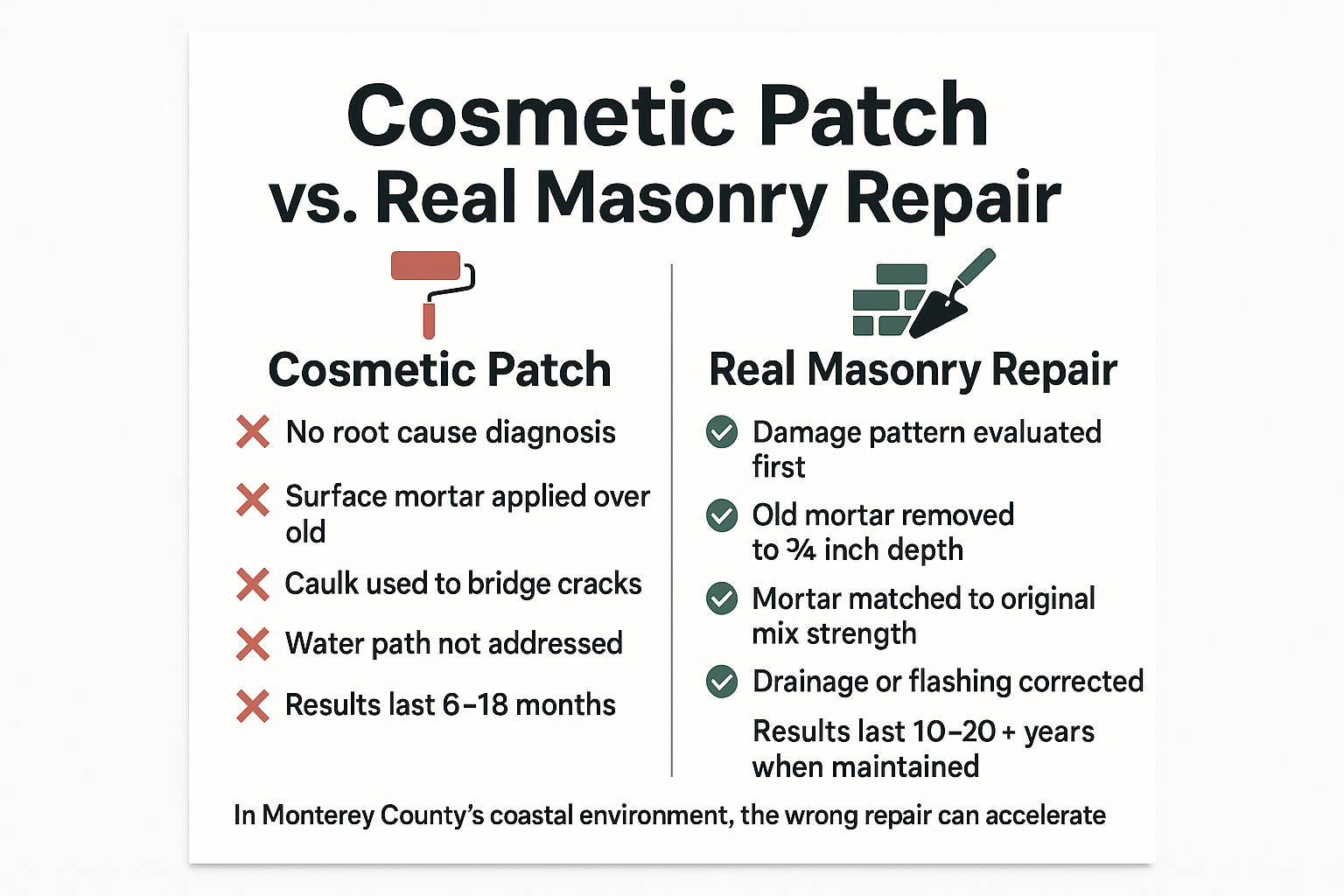
Cosmetic Patch vs. Masonry Repair: Side-by-Side
This comparison covers the key differences between a surface patch and a full masonry repair — from what gets assessed to what actually gets fixed.
How to Tell Which One You’re Being Quoted For
This is where a lot of homeowners get caught. Two bids come in — one for $600, one for $2,100 — and without context, the cheaper one looks like a deal.
Here are questions that will tell you immediately which kind of repair is being proposed:
- “How deep will you remove the existing mortar before repacking?” A real repointing job requires mechanical removal to proper depth. If the answer is vague, that’s a sign.
- “What mortar mix will you use, and how did you match it?” The wrong mortar hardness is a documented cause of stone damage. A mason who can’t answer this is guessing.
- “What do you think caused this damage?” If the contractor can’t point to a root cause, they’re not fixing one.
- “Does this work require a permit?” Some structural masonry repairs in Monterey County do require permits, particularly for retaining walls over 4 feet or chimney repairs on older homes. Any contractor who brushes this off without explanation deserves a follow-up question.
Also — verify the license. California’s CSLB license lookup tool at cslb.ca.gov takes about 60 seconds to use. A C-29 masonry license is the specific classification that covers structural masonry work in California. Anyone doing mortar repairs, stone installation, or structural work without that license is operating outside their legal scope in this state.
For a broader look at what gets missed in commercial masonry maintenance on the Central Coast, this overview of common commercial property masonry mistakes covers related ground.
What the Price Difference Usually Reflects
Repair costs on the Monterey Peninsula vary based on scope, access, and whether the underlying cause is being addressed. This table shows typical ranges and what drives the difference.
| Repair Type | Typical Cost Range (Monterey County) | What It Covers |
|---|---|---|
| Surface re-coating or caulk fill | $150 – $450 | Appearance only; no mortar removal; no root cause addressed |
| Partial repointing (spot repair) | $400 – $900 | Mortar removed and repacked in isolated areas; basic diagnosis included |
| Full repointing (section or structure) | $800 – $3,500+ | Full joint removal, mortar matching, structural assessment, proper tooling |
| Drainage or base correction with repair | $1,200 – $5,000+ | Root cause addressed; grading, flashing, or weep holes corrected alongside masonry work |
| Structural crack repair (permitted) | $2,000 – $8,000+ | Engineering review may apply; anchoring or reinforcement added; permit pulled |
Why the Coastal Environment Changes the Calculus
Masonry in Carmel, Pacific Grove, or along the Salinas Valley floor weathers differently than masonry in Sacramento or the Central Valley. This isn’t a minor footnote — it changes which materials hold up and which ones fail faster.
Salt air off Monterey Bay works into mortar joints and stone faces year-round. It doesn’t cause dramatic cracking the way freeze-thaw does, but it creates a slow, steady chloride migration that degrades Portland cement-based mortars and corrodes metal ties and anchors hidden inside veneer systems. By the time you see the exterior damage, the tie corrosion has often been happening for years.
For homeowners in Carmel Valley, temperature swings between cold nights and warm afternoons are more pronounced than at the coast. Porous natural stones — sandstone, certain limestones — absorb water during wet months and cycle through expansion and contraction. Stone that was installed without proper drainage management behind it shows this damage first at the base of walls and at corners.
The practical implication is that a cosmetic fix on a coastal or inland valley property isn’t just aesthetically insufficient — it can seal in the moisture and salt chemistry that’s actually doing the damage. What separates a solid hardscape installation from one that fails early gets into the base preparation side of this same issue for patios and walkways.
Frequently Asked Questions About Masonry Repairs
Can I tell just by looking whether a crack needs a real repair or just a patch?
Sometimes. Horizontal cracks in a retaining wall, stair-step cracks following mortar joints in a block wall, or any crack wider than 1/8 inch that’s still growing are patterns that typically point to structural causes — not surface weathering. Hairline cracks in a single mortar joint that haven’t changed in years are often cosmetic. When in doubt, a mason can assess the crack pattern and give you a straight answer before any money changes hands.
Does masonry repair in Monterey County require a permit?
It depends on the scope and the jurisdiction. Routine repointing and mortar maintenance on a residential structure generally doesn’t require a permit. But retaining walls over 4 feet in height, chimney repairs that affect structural components, and any work on unreinforced masonry (URM) buildings in the City of Monterey may trigger a permit requirement. Requirements vary by city — Salinas, Carmel, and Pacific Grove each have their own planning departments. A licensed contractor should be able to tell you upfront whether your specific project needs a permit.
How long does a proper masonry repair last compared to a patch?
A properly executed repair — full mortar removal, correct mix, root cause addressed — on a residential wall in this climate should hold for 10 to 20 years with basic maintenance. A surface patch over an unresolved problem typically shows failure within 12 to 36 months, sometimes sooner if salt air or moisture cycling is active in the wall system.
What is tuckpointing, and is it the same as repointing?
They’re related but not identical. Repointing means removing deteriorated mortar and packing in new material — it’s the broad repair process. Tuckpointing is a specific technique where two different mortar colors are used to create the appearance of very fine joints, often done for aesthetic reasons on decorative brickwork. In the field, the terms get used interchangeably, so it’s worth asking the contractor exactly what process they’re proposing.
Is it ever OK to use caulk on a masonry crack?
In some limited situations, yes — expansion joints in certain masonry assemblies are designed to be filled with a flexible sealant rather than rigid mortar, because those joints are meant to move. But using caulk to fill a structural crack or a mortar joint that should be repointed is generally a mistake. Caulk doesn’t bond to masonry the same way mortar does, it traps moisture differently, and it fails faster in direct sun exposure — which is common on south- and west-facing walls in Salinas and Carmel.
Not Sure Which Kind of Repair Your Property Needs?
Stonecap Masonry serves homeowners and property owners across Monterey County — from Salinas and Carmel to Pacific Grove and Carmel Valley. If you’re looking at damaged mortar, a cracked wall, or repair work that didn’t hold the first time, the team can assess what’s actually going on before any work gets proposed. Reach out at 831-262-0442 or visit stonecapmasonry.com to request a quote.
