
Direct Answer: A leaning retaining wall becomes urgent when the lean is accelerating, the wall is holding back a slope, or you see cracking, bulging, or water damage alongside the tilt. Get a mason to look at it before the next rain season.
A retaining wall that leans a little doesn’t always mean disaster is around the corner. But it doesn’t mean you can ignore it either — and that gray area is where homeowners on the Monterey Peninsula tend to get into trouble.
Monterey County has some of the most variable soil conditions in Central California. Properties in Carmel Valley sit on expansive clay. Hillside homes in Pacific Grove deal with sandy fill and moisture that swings hard with the season. That soil movement is one of the biggest reasons retaining walls shift, and it’s also why a wall that looks stable in August can be a real problem by January.
This article covers how to read a leaning wall — what’s cosmetic, what’s structural, and at what point you need someone on-site before the next storm comes through.
What a Lean Actually Tells You
Not every lean means failure. Walls can shift slightly during the first few years after installation as soil settles. A uniform, minor lean — say, an inch or two over the full height of the wall — that has stayed consistent for years is very different from a wall that has noticeably moved since last winter.
What you’re really watching for is change over time. If you took a photo of your wall two years ago and it looks meaningfully different today, that’s your signal. A wall that is actively moving is a wall that has lost its equilibrium with the soil behind it.
The lean direction matters too. A wall leaning away from the slope — outward, toward your yard — is the most common failure pattern and the most serious. The soil mass behind it is winning. A wall that has cracked and is tilting inward is less common but can indicate foundation settlement or a drainage problem underneath.
For a deeper look at what stress looks like before a wall starts to lean, see this breakdown of warning signs your retaining wall is under more stress than it looks.
The Signs That Push a Lean From ‘Watch It’ to ‘Call Someone Now’
A lean paired with any of the following is not a wait-and-see situation:
- Horizontal cracking running through the face of the wall — this is a sign the wall is bending under lateral pressure
- Bulging in the midsection of the wall, even if the top and bottom look stable
- Water weeping through the wall face after rain — this means the drainage behind the wall has failed, and hydrostatic pressure is building
- Gaps opening between the wall and adjacent structures, like a fence post or steps
- Soil pulling away from behind the wall near the top, or visible settlement of the yard above it
- A lean that has increased since you last measured it — even an inch of new movement in a season is meaningful
Any one of these on its own is worth a professional look. Two or more together — especially heading into Monterey’s wet season, which typically runs November through March — means you should not wait.
This is also relevant to the question of what separates cosmetic masonry damage from an actual structural failure. The distinction matters a lot for what comes next.
Why Soil and Water Are the Real Culprits on the Monterey Peninsula
Most retaining wall failures on the Central Coast come down to two things: soil that was never properly accounted for, and drainage that was never built correctly — or that has broken down over time.
Hydrostatic pressure is the term for water that builds up behind a wall with nowhere to go. When it rains hard in Salinas or Carmel Valley and the soil behind a wall saturates, the pressure on that wall can increase by hundreds of pounds per linear foot. Walls that weren’t built with proper drainage aggregate, drain pipe, or weep holes are essentially holding back water and soil at the same time.
The clay-heavy soils common in inland Monterey County expand when wet and contract when dry. That seasonal cycling puts stress on a wall’s footing and the mortar joints holding it together. Over several years, that movement compounds. A wall built in 2010 without adequate base preparation may be showing the results of 15 years of expansion and contraction right now.
Salt air adds another layer for homes close to the coast. Chloride intrusion from the marine environment weakens the steel reinforcement inside concrete block walls over time. A wall in Pacific Grove or Pebble Beach that looks fine on the surface may have rebar corrosion eating at its structural core — which is one reason a visual inspection alone doesn’t always tell the full story.
The relationship between base prep, drainage, and long-term wall performance is exactly why what your hardscape project needs to survive Salinas soil and weather matters before a wall ever goes in.
Lean Severity: How to Read What You’re Looking At
This table gives homeowners a general framework for evaluating severity. It’s not a substitute for a professional assessment — but it helps you know how quickly to act.
| What You See | Likely Severity | Suggested Action |
|---|---|---|
| Minor uniform lean, no cracks, no change in years | Low — monitor | Photograph and check annually |
| Lean with horizontal cracking through block or stone | Moderate to high | Schedule inspection before next rain season |
| Lean with bulging, water weeping, or visible soil movement | High | Call a licensed mason within days, not weeks |
| Lean has increased noticeably in one season | High | Do not wait — get eyes on it immediately |
| Wall is leaning and holding back a slope above a structure or walkway | Critical | Treat as an emergency regardless of other signs |
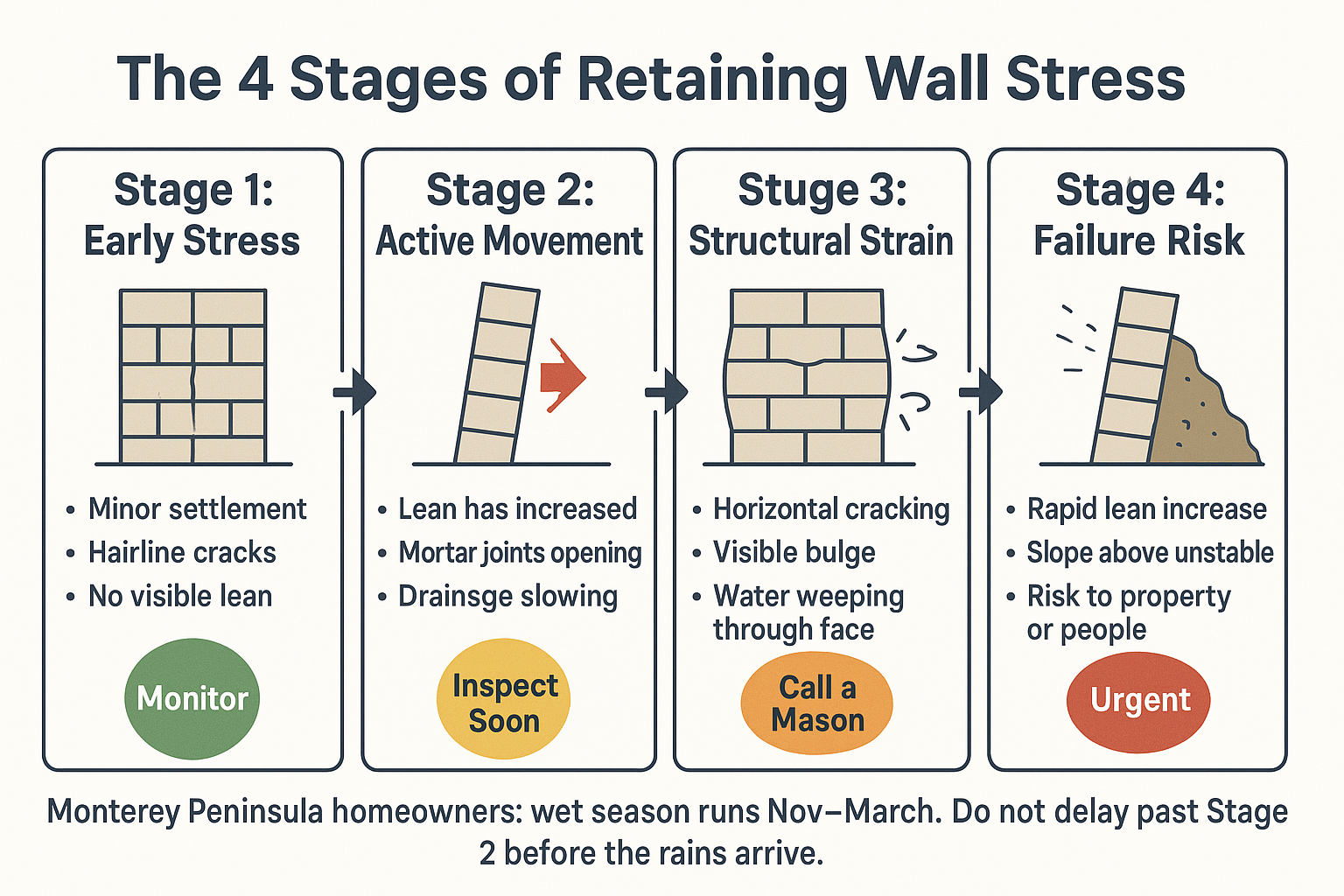
The 4 Stages of Retaining Wall Stress
This infographic maps the four stages a retaining wall typically moves through — from early warning to failure — so homeowners can identify where their wall stands.
What Happens If You Wait Too Long
A wall that crosses from structural strain into active failure can move fast — especially during a storm event. The Monterey Peninsula sees atmospheric river conditions some winters that dump several inches of rain over 48 hours. That’s the scenario that turns a compromised wall from a repair job into an emergency.
When a retaining wall fails completely, the consequences scale with what’s behind it:
- A garden wall holding back a flower bed — property damage, landscape loss, probably $8,000–$18,000 to rebuild correctly
- A slope wall behind a driveway or detached structure — potential vehicle or structure damage, costs rising to $20,000–$50,000 depending on scope
- A wall adjacent to a living space — safety risk, potential liability, and reconstruction costs that can exceed $75,000 when you factor in grading and drainage correction
Those numbers aren’t meant to alarm — they’re meant to illustrate why catching a wall at Stage 2 or 3 is almost always significantly cheaper than catching it at Stage 4.
Repair costs on the Monterey Peninsula also reflect the region’s labor and permitting realities. Monterey County building permits for retaining walls over 4 feet in height typically require engineered drawings, a soils report in some cases, and inspection. That’s before any masonry work begins. Planning for this early — rather than scrambling after a failure — keeps the project manageable.
When to Call a Licensed Masonry Contractor vs. When to Call an Engineer
For most residential retaining walls, a licensed C-29 masonry contractor is the right first call. They can assess whether the wall is repairable, whether it needs to come down and be rebuilt, and what drainage corrections are required. In California, always verify a contractor’s license through the CSLB license check tool before signing anything.
A structural engineer becomes necessary when:
- The wall is over 4 feet tall and retaining a significant slope
- The wall is adjacent to a structure, driveway, or area with foot traffic
- The repair requires regrading or a new footing design
- The local building department requires engineered plans for permit approval
Some repairs — like repointing deteriorated mortar joints or rebuilding a short freestanding section — can be permitted and handled by a licensed mason without engineering. But anything involving the structural integrity of a wall holding back a slope should have professional eyes on it before work begins.
For context on how masonry repair decisions get made — and how to tell whether a crack is actually structural — see how to know if a masonry crack actually needs repair.
Frequently Asked Questions About Leaning Retaining Walls
My wall has been leaning for years and hasn’t gotten worse. Is it still a problem?
If the lean has genuinely been stable for several years, that’s a better sign than a wall that’s actively moving. But ‘stable’ is hard to verify without documentation. Take photos now, measure the lean from a fixed reference point, and check again in 6 months. If anything changes — especially after a wet winter — get it looked at. Stability that was true last year doesn’t guarantee stability this year, particularly in clay-heavy soils like those common in Carmel Valley.
How much does it typically cost to repair a leaning retaining wall in Monterey County?
Repair costs vary widely based on the wall’s height, material, length, and what’s driving the lean. A minor rebuild of a short dry-stack stone section might run $3,000–$7,000. A full reconstruction of a block wall with proper drainage and footing correction — including permits — can reach $20,000–$40,000 for longer walls on hillside properties. Getting an assessment early is the best way to keep costs on the lower end of that range.
Do I need a permit to repair a retaining wall in Monterey County?
It depends on the scope of work and the wall’s height. In most Monterey County jurisdictions, walls over 4 feet tall from the bottom of the footing require a building permit. Repairs that involve structural changes — replacing the footing, rebuilding more than a short section — typically require a permit regardless of height. Cosmetic repairs like repointing mortar joints may not. Requirements vary by city, so check with your local building department or ask your contractor to pull the permit as part of the project.
Can I just push the wall back into place and re-mortar it?
No. A leaning wall has lost contact with its original footing alignment, and the soil pressure that caused the lean is still there. Pushing it back without correcting drainage, footing condition, and the soil behind it will result in the same failure — usually faster the second time. This is one of the masonry situations where DIY repairs can make the underlying problem significantly worse.
What’s the risk if a retaining wall fails during a storm?
If the wall is holding back a slope above a structure, vehicle, or walkway, a storm failure can cause serious property damage and safety risk very quickly. Atmospheric river events — which the Monterey Peninsula sees in some winters — can saturate soil in hours. A wall that was marginal going into a storm may not survive it. If your wall is in Stage 3 or 4 (see the guide above), don’t wait for wet season to arrive.
Have a Wall You’re Not Sure About?
If your retaining wall has been on your mind — and especially if it’s heading into another wet season showing any of the signs above — Stonecap Masonry Inc. serves homeowners across Salinas, Carmel, Pacific Grove, Pebble Beach, and the wider Monterey Peninsula. The Stonecap team can assess what’s happening, explain what it means, and tell you honestly what the wall needs. Reach them at 831-262-0442 or visit stonecapmasonry.com to request a quote.
