
Direct Answer: Leaning, horizontal cracks, bulging face stone, and water weeping from the base are the clearest signs a retaining wall is under more load than it can handle safely.
A retaining wall that looks fine from the driveway can already be in serious trouble. The pressure that causes walls to fail builds slowly — from saturated soil, tree roots, seismic movement, or drainage that stopped working years ago — and most of it happens where you can’t see it.
On the Monterey Peninsula, that pressure problem is worse than in drier inland areas. The region’s clay-heavy soils absorb winter rain and expand. Then they dry out, contract, and shift. Over several seasons, that cycle moves walls in ways that add up fast, especially on hillside properties in Carmel Valley, Pebble Beach, and the hillside neighborhoods east of Salinas.
This article covers the specific signs that a retaining wall has moved past cosmetic wear and into structural risk — and what those signs usually mean about what’s happening behind the wall.
What Retaining Walls Are Actually Holding Back
Most homeowners think of a retaining wall as a visual element — a nice border between grade changes. But structurally, it’s holding back a continuous mass of soil that is always pushing outward and downward.
That pressure is called lateral earth pressure, and it doesn’t stay constant. After a heavy rain — say, the kind that hits Salinas and Carmel Valley in January and February — saturated soil can weigh 25 to 30 percent more than dry soil. The wall absorbs all of that extra load.
A wall that was built without proper drainage behind it, or without a footing deep enough to resist that outward push, is already working harder than it should. The signs of that overload usually start subtle:
- Slight forward lean at the top of the wall
- Horizontal cracks running parallel to the ground
- Bulging or bowing in the middle section of the face
- Weep holes blocked by sediment or plant growth
- Soil spilling over the top after rain
Any one of those alone is worth a closer look. Two or more together means the wall is telling you it’s losing the fight. Understanding what separates a solid hardscape installation from one that fails early starts with recognizing when the ground itself is working against the structure.
How to Read the Cracks You’re Actually Seeing
Not every crack in a retaining wall means the same thing. The direction, location, and width of a crack are all clues about what kind of stress is causing it.
Horizontal cracks are the most serious. They typically mean the wall is bending forward under lateral soil pressure. On a concrete block (CMU) wall, a horizontal crack running along a mortar joint is a sign that the wall may be on the verge of rotation — the base stays put while the top moves outward. This is the pattern that precedes collapse.
Vertical cracks are usually less urgent but still worth watching. They often indicate differential settlement — meaning one section of the wall sank slightly more than an adjacent section. On the Monterey Peninsula, this is common where soils transition between clay and sandy fill, particularly on older hillside lots developed before modern compaction standards.
Diagonal cracks running from a corner often point to a localized settlement problem — a soft spot in the base, an eroded footing, or a buried drainage pipe that shifted. They can also appear after seismic events, which Monterey County sees regularly given its proximity to the Calaveras and San Andreas fault systems.
Crack width matters too. A crack you can slip a credit card into — roughly 3mm or wider — is already past the point of surface-only repair. Cracks that are actively widening between seasons are a more urgent concern than stable ones of the same size. The article on how to know if a masonry crack actually needs repair goes deeper on what that measurement process looks like in practice.
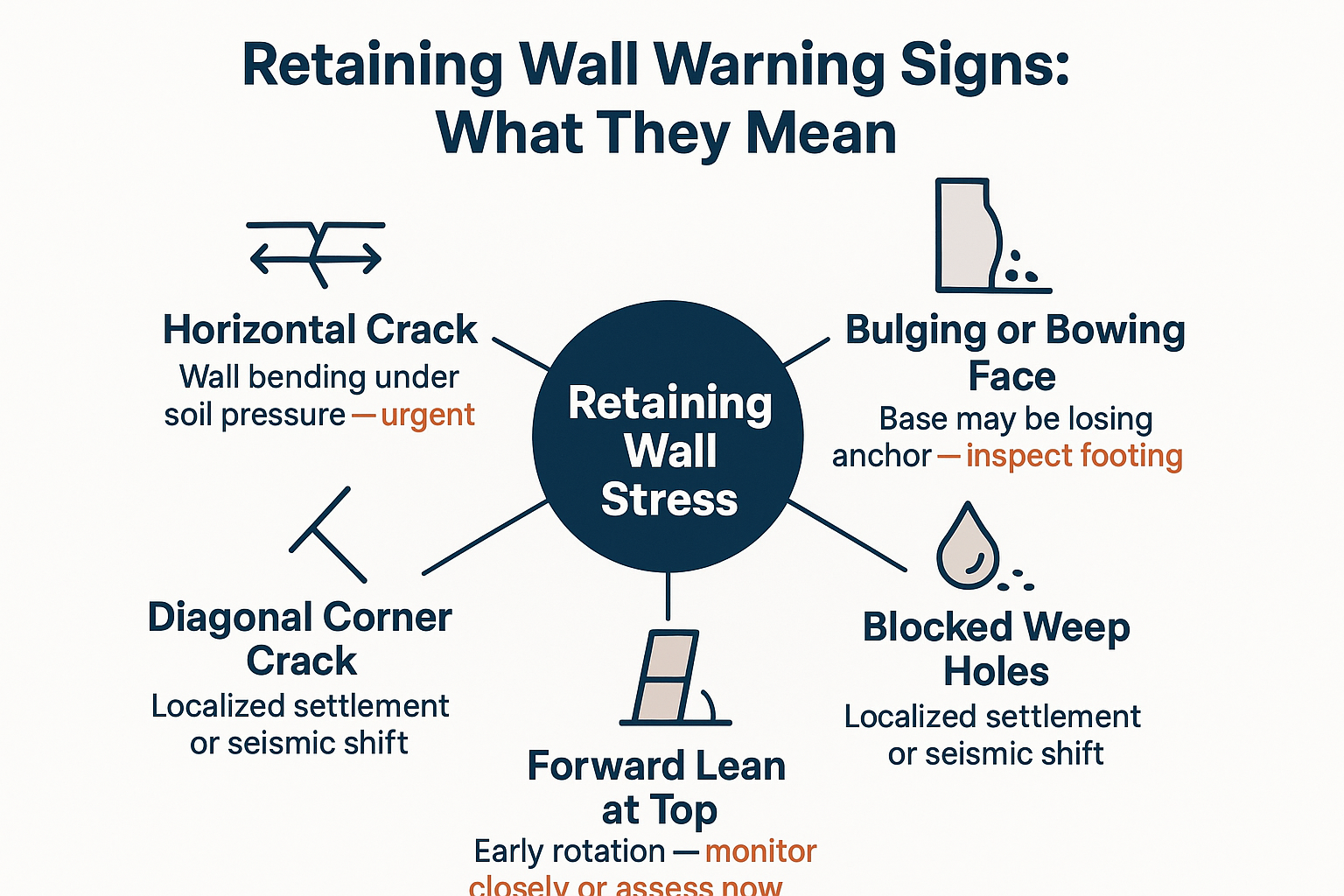
Retaining Wall Warning Signs at a Glance
This infographic breaks down the five most common physical warning signs of retaining wall stress, where on the wall each sign typically appears, and what it usually indicates structurally.
Why Drainage Behind the Wall Matters More Than the Wall Itself
The single most common reason retaining walls fail prematurely isn’t the stone, the block, or the mortar. It’s water that had nowhere to go.
When a wall is built without proper drainage aggregate behind it — or when that drainage gets clogged over time — water accumulates in the soil mass the wall is holding. That’s called hydrostatic pressure, and it can add hundreds of pounds per square foot of additional outward force against the wall’s back face.
On Central Coast properties, this problem gets accelerated by a few local factors:
- The region’s clay-expansive soils hold water rather than draining through
- Winter rain events in Monterey County can deliver 3 to 6 inches in a single weekend
- Older walls — particularly those built in the 1970s and 1980s — were often installed without gravel drainage columns or functional weep holes
- Landscape irrigation running near older walls adds sustained moisture that compounds seasonal saturation
The physical sign of drainage failure is usually efflorescence — the white mineral staining that appears on the face of a wall as water moves through it and deposits salts on the surface. It’s not a structural failure by itself, but it confirms water is moving through the wall regularly, which over time weakens mortar joints and can corrode any embedded steel.
If you’re also seeing soil spill over the top of the wall after rain, or soft spots in the ground near the base, those are signs the drainage behind the wall has already failed. The deeper question at that point isn’t repair — it’s rebuild.
For homeowners considering new hardscape projects nearby, it’s worth understanding how Salinas soil and weather conditions affect installation decisions before any grading or excavation work begins.
Warning Sign Severity Reference for Retaining Walls
This table summarizes the most common retaining wall warning signs, their likely cause, and how urgently each one warrants professional assessment.
| Warning Sign | Likely Cause | Urgency Level |
|---|---|---|
| Horizontal crack at mid-wall | Lateral soil pressure / wall bending | High — assess within weeks |
| Forward lean at top of wall | Base rotation beginning | High — do not wait |
| Bulging face at center | Loss of footing anchor | High — structural risk |
| Diagonal crack from corner | Differential settlement or seismic movement | Moderate — monitor and measure |
| Vertical crack between panels | Differential settlement | Moderate — depends on width |
| Efflorescence (white staining) | Water moving through wall regularly | Low-Moderate — drainage review needed |
| Blocked or missing weep holes | Drainage system failure | Moderate — leads to hydrostatic pressure |
| Soil spilling over top after rain | Drainage failure / wall overtopped | High — drainage and wall condition both compromised |
The Seismic Layer: What Monterey County Adds to the Equation
Most of the country can evaluate retaining wall risk primarily around soil and water. In Monterey County, seismic movement is a third variable that doesn’t show up in the wall’s appearance until after an event.
The Monterey Peninsula sits within Seismic Zone 4 under older classification systems — and under the current California Building Code framework, it falls in a high seismic hazard zone requiring specific reinforcement standards for new masonry construction. Walls built before the 1994 Northridge earthquake — and certainly before the 1989 Loma Prieta quake, which was centered roughly 80 miles north near Santa Cruz — may predate the reinforcement standards now required for new builds.
For retaining walls specifically, this matters because lateral seismic forces work in the same direction as the soil pressure the wall is already managing. An earthquake doesn’t have to be large to push a wall that’s already close to its load limit past the point of failure.
If your property has a retaining wall that predates 1995 and has never been evaluated, and you’ve experienced any of the signs described above — leaning, cracking, drainage problems — it’s worth having a licensed C-29 masonry contractor assess whether it meets current reinforcement standards. That assessment is separate from repair; it’s about understanding the wall’s baseline capacity before the next rain season or seismic event.
The difference between cosmetic damage and actual structural compromise is something the Real Difference Between Cosmetic Damage and Structural Failure in Masonry article explains in useful detail for homeowners trying to calibrate that on their own.
Frequently Asked Questions About Retaining Wall Stress and Failure
My retaining wall leans a little but has looked like that for years. Does that mean it’s stable?
Not necessarily. A lean that has been consistent and hasn’t changed over several years is less urgent than one that has progressed — but ‘it’s always looked like that’ doesn’t mean it’s safe. The question is whether the lean is getting worse, especially after wet winters. Soil pressure is cumulative. A wall can hold a lean for a long time and then move significantly in one heavy rain season when the drainage behind it finally saturates. If you haven’t had anyone measure the lean against a fixed reference point, you don’t actually know if it’s changed.
Can a failing retaining wall be repaired, or does it have to be rebuilt?
It depends entirely on what caused the failure. If the issue is a drainage problem and the wall structure itself is sound, correcting the drainage and repointing damaged mortar joints may be enough. But if the wall has rotated, the footing has eroded, or the backfill has shifted significantly, repair is usually not the right call — you’re just adding cost to a wall that will fail again. A licensed C-29 contractor can tell you which category you’re in after a proper site assessment.
Do I need a permit to repair or replace a retaining wall in Monterey County?
It depends on the wall’s height and whether the work is repair or full replacement. In most Monterey County jurisdictions, retaining walls over 4 feet tall (measured from the bottom of the footing) require a building permit. Some cities on the Peninsula — including the City of Monterey — have their own thresholds and review processes. Permit requirements vary by jurisdiction and project scope, so it’s always worth checking with the local planning or building department before work starts. A licensed contractor should pull permits for any permitted-scope work.
What does it cost to replace a retaining wall on the Monterey Peninsula?
Costs vary widely based on wall height, length, material type, and whether the site has access challenges. A basic CMU block retaining wall in the Salinas area typically runs $40 to $65 per square face foot installed, including drainage backfill. Natural stone walls run higher — often $75 to $120 per square face foot depending on stone selection and complexity. Walls on steep hillside lots in Carmel or Pebble Beach can run higher still due to access and shoring requirements. Those are rough ranges — every site is different.
Should I be worried about the retaining wall near my patio or outdoor kitchen?
Any retaining wall that supports a grade change near a paved or built surface deserves periodic attention, especially if there’s heavy foot traffic or structure load above it. The added weight of a patio slab, outdoor kitchen, or hot tub above a retaining wall changes the load the wall was originally designed to handle. If you’re planning any new outdoor living features near an existing retaining wall, it’s worth having the wall evaluated first. The interaction between hardscape loads and soil retention is explained in more context at what separates a solid hardscape installation from one that fails early.
Have a Retaining Wall You’re Not Sure About?
If a wall on your Monterey Peninsula property is showing any of the signs covered here — lean, horizontal cracking, drainage failure, or age-related concern — Stonecap Masonry Inc. offers on-site assessments for homeowners who want a straight answer from a licensed C-29 contractor before the next rain season. Reach the Stonecap team at 831-262-0442 or visit stonecapmasonry.com to request a consultation.
