Direct Answer: Most hardscape failures in the Salinas area trace back to two things: expansive clay soil that wasn’t properly prepared, and materials that weren’t chosen for coastal moisture and salt air.
A lot of homeowners in Salinas and the surrounding Monterey Peninsula start a hardscape project focused on the finish — what the pavers will look like, how wide the patio will be, whether to add a fire pit or an outdoor kitchen. That’s a reasonable place to start. But what’s underneath the finished surface, and how well the design accounts for local soil and weather, will determine whether that project looks great in five years or starts falling apart in two.
The Salinas Valley sits on some of the most productive — and problematic — agricultural soil in California. That same clay-heavy, moisture-reactive earth runs under residential lots throughout the area. Combine that with the Monterey Peninsula’s coastal microclimate — marine layer, salt air, fog moisture cycling through dry stretches — and you have conditions that punish shortcuts fast.
This guide focuses on the two things that actually separate a durable hardscape from an expensive disappointment in this region: soil preparation and material selection for coastal conditions. Get those two right, and almost everything else follows.
What Salinas Soil Actually Does to Hardscape Foundations
Salinas sits in an agricultural valley known for deep, fertile soil — but fertile for farming and stable for construction are two very different things. Much of the residential soil in and around Salinas is high in clay content, which means it expands when wet and contracts when dry. That cycle, repeated over years, creates movement underneath any structure built on top of it.
Patios, walkways, and retaining walls that weren’t built to account for this movement will crack, shift, and settle — usually within the first few winters. The Monterey Peninsula’s annual rainfall average of around 15 to 20 inches, concentrated between November and March, gives that clay soil plenty of opportunity to cycle. A dry summer followed by the first heavy November rains is often what triggers the early cracking homeowners notice and can’t explain.
The fix isn’t complicated, but it does require work upfront:
- Excavate deep enough — typically 6 to 8 inches for a paver patio, more for a retaining wall or structural slab
- Import compacted aggregate base — crushed rock that drains well and doesn’t expand the way native clay does
- Install edge restraints that hold the base in place as soil shifts seasonally
- Address drainage before the surface goes in — water sitting under a patio is the root cause of most failures
As explained in what separates a solid hardscape installation from one that fails early, skipping or rushing the base work is the single most common reason projects fail — and it’s almost never visible once the job is done. That’s what makes it so easy to cut corners on and so expensive to fix later.
Why Coastal Weather Changes the Material Conversation
The Monterey Peninsula has one of the more unusual microclimates in California. Carmel, Pacific Grove, Pebble Beach, and even parts of Salinas close to the bay see consistent salt air, persistent fog moisture, and dramatic temperature swings between night and day — sometimes 30 degrees or more within a single 24-hour period.
Those conditions aren’t just uncomfortable. They’re hard on masonry materials that weren’t selected with them in mind.
Salt air accelerates the breakdown of porous materials. Concrete pavers with low compressive strength absorb moisture, and when that moisture carries salt, it degrades the material from the inside out. Spalling — where the surface flakes and pits — is one of the most common signs. Efflorescence, the white salt deposits that appear on stone and block surfaces, is another.
Freeze-thaw cycles are less severe here than in inland California, but coastal fog keeps surfaces wet for long stretches, and those wet surfaces do experience temperature movement. That matters for mortar joints, grout lines, and any stone or tile installation that relies on adhesion.
For projects on the Monterey Peninsula, material selection should account for:
- Pavers with a compressive strength of at least 8,000 psi for exposed coastal locations
- Natural stone types that resist salt absorption — granite and certain basalts hold up better than softer sandstones in this climate
- Mortars and grouts rated for exterior coastal use, not standard interior-grade products
- Sealers appropriate for the specific material, applied correctly and on a schedule — not as an afterthought
Homeowners considering pavers in yard for Monterey Bay homes should ask any contractor they’re interviewing what compressive strength their standard paver product carries and whether it’s rated for coastal exposure. A contractor who can’t answer that question clearly may not be specifying the right materials for this environment.
Common Hardscape Materials: How They Hold Up on the Monterey Peninsula
Not all hardscape materials perform equally in coastal conditions. This comparison covers the most commonly used options for patios, walkways, and outdoor living areas in the Salinas and Monterey Peninsula market.
| Material | Coastal Performance | Key Consideration |
|---|---|---|
| Concrete pavers (high-density) | Good — when 8,000+ psi rated | Specify compressive strength before ordering |
| Natural granite | Excellent | Dense, low-absorption; resists salt and moisture cycling well |
| Sandstone / soft limestone | Fair to poor | High porosity means faster salt damage and staining near the bay |
| Travertine | Fair | Requires sealing; pitting common if sealant maintenance is skipped |
| Poured concrete (standard mix) | Moderate | Surface spalling accelerates in salt air without proper finishing and sealing |
| Brick (dense, fired) | Good | Quality varies widely; verify ASTM rating for exterior severe-weather use |
| Decomposed granite (DG) | Poor for permanence | Erodes quickly in winter rain; not suited for primary patio surfaces |
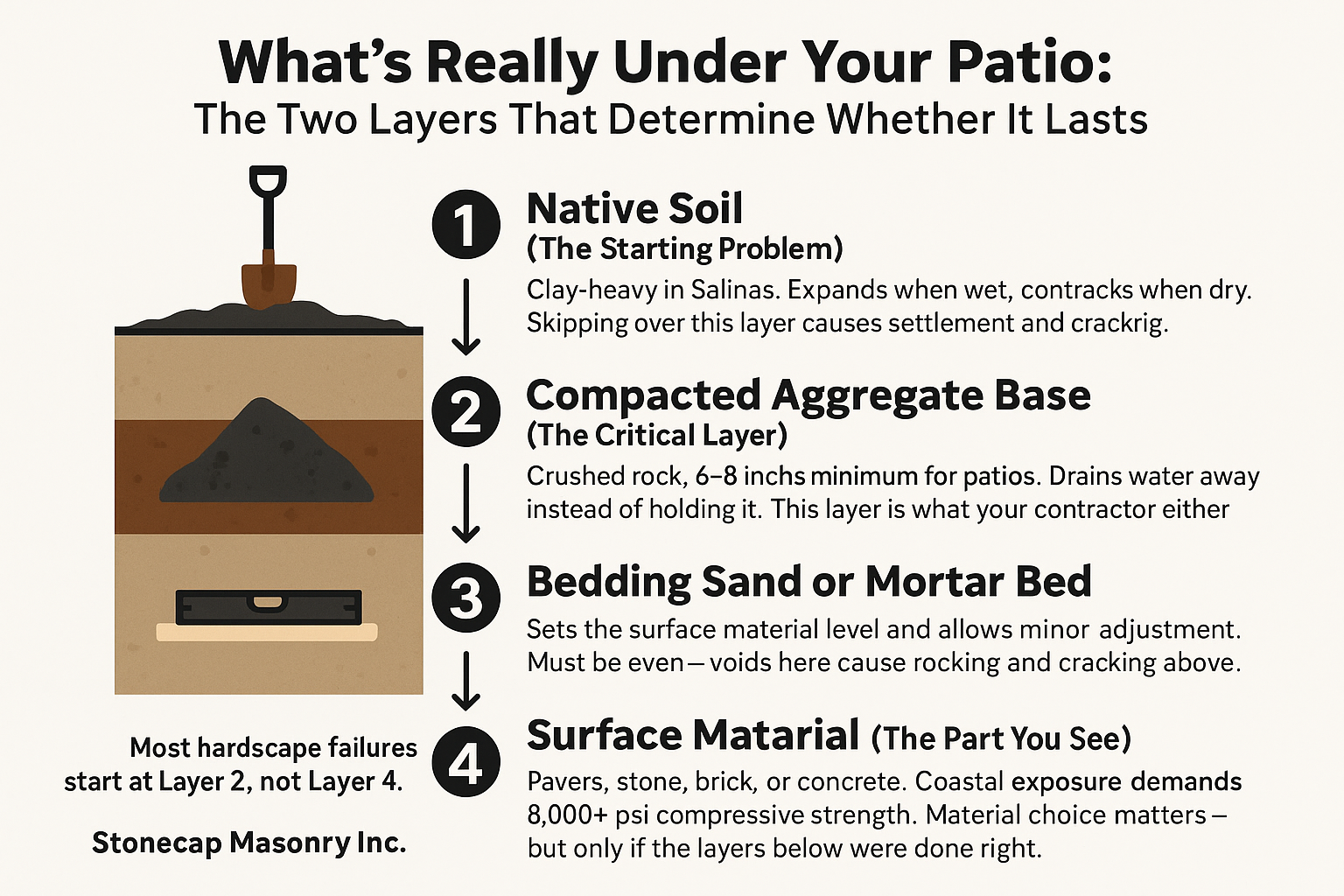
The Two Layers That Determine Whether Hardscape Lasts
This infographic breaks down what’s actually happening beneath a finished patio surface — and where problems start when each layer is done wrong.
Drainage: The Problem That Hides Until It’s Expensive
Drainage is the part of hardscape planning that homeowners almost never think about until water is pooling where it shouldn’t be — or worse, running toward a foundation.
On flat Salinas lots, water has nowhere to go on its own. On sloped Carmel Valley or Pebble Beach properties, water moves fast and takes material with it if the grade and drainage aren’t designed into the project from the start. Both situations require intentional drainage planning — not just the assumption that water will figure it out.
For patios, the standard approach is a minimum 2% slope away from the structure (about a quarter inch of drop per foot). That seems small, but it’s enough to move water off the surface before it pools. For areas where surface drainage isn’t enough, a French drain or channel drain installed at a low point in the hardscape can redirect water before it saturates the base.
Retaining walls are a separate concern. A wall holding back a significant amount of soil is also holding back water — and hydrostatic pressure behind a wall with no drainage outlet is one of the most common causes of structural masonry failure. Weep holes, drain rock backfill, and perforated pipe behind the wall aren’t optional on serious retaining structures — they’re what keeps the wall standing over time.
The Monterey Peninsula Water Management District (MPWMD) also has conservation considerations that can affect how drainage and irrigation interact with hardscape. Any project that redirects runoff or changes drainage patterns on a property is worth discussing with your contractor before the design is finalized.
What This Means for Your Project Budget
Proper base preparation and coastal-rated materials do add cost upfront. That’s an honest answer, and homeowners deserve to know it before comparing bids.
In the Salinas and Monterey Peninsula market, a paver patio installed with a proper compacted base and drainage plan typically runs $18 to $30 per square foot depending on material selection, site conditions, and patio complexity. A bid that comes in at $10 to $12 per square foot for the same scope should raise a real question: what’s being skipped?
As covered in why two stonework quotes for the same project can be wildly different, the difference between low and mid-range bids almost always lives in the base preparation and material spec — not in labor efficiency or some competitive advantage. A contractor who can explain exactly what’s in their base detail and why they chose a specific paver product is giving you the real picture. One who can’t is usually hoping you don’t ask.
For retaining walls, expect $50 to $90 per square face foot for properly engineered block or stone work in Monterey County, including drainage provisions. Structural walls over 4 feet typically require a permit and engineer review under California building code — a cost that belongs in the budget conversation from the beginning, not as a surprise after the contract is signed.
Frequently Asked Questions About Hardscape in Salinas and the Monterey Peninsula
Do I need a permit to build a patio or walkway in Salinas?
For most ground-level paver patios under a certain square footage, no permit is required. But requirements vary by jurisdiction and project type — a retaining wall over 4 feet tall, a structure with footings, or work that changes drainage patterns may trigger permit requirements in the City of Salinas or Monterey County. Always confirm with your local planning department or ask your contractor before assuming a permit isn’t needed.
How do I know if a contractor is actually licensed to do this work in California?
The California Contractors State License Board (CSLB) maintains a free public database at cslb.ca.gov where you can look up any license number and confirm it’s active, bonded, and insured. Masonry work in California falls under a C-29 license classification. Any contractor doing significant hardscape or structural masonry work should be able to hand you their license number without hesitation. You can learn more about what to look for in the truth about hiring a licensed masonry contractor in California.
My patio is only two years old and it’s already cracking. Is this a material problem or something else?
In most cases on Monterey Peninsula properties, early cracking comes from the base — not the surface material. If the aggregate base wasn’t compacted to the right density, or if drainage wasn’t accounted for, the clay soil underneath shifts and the surface above follows. Two years is a common window for base-related failures to show up after the first full winter moisture cycle. It’s worth having a licensed mason assess whether the damage is cosmetic or something deeper — how to know if a masonry crack actually needs repair walks through what to look for.
Is natural stone actually better than concrete pavers for coastal homes near the bay?
Dense natural stones like granite genuinely outperform most standard concrete pavers in salt-air environments because of their low porosity. But ‘concrete paver’ covers a huge range of products — a high-density paver rated at 8,000 psi or above can perform comparably to many natural stones in coastal conditions. The answer depends more on the specific product spec than the broad category.
Can I add a fire pit to my patio at the same time, or should that be a separate project?
Building them together is usually the smarter move — the base work, drainage, and grade planning can be coordinated as one design, and you avoid tearing into a finished patio later to tie in the fire feature. There are also permit and setback requirements for fire pits that affect placement, so working it into the initial plan saves headaches. The mason’s guide to building a fire pit covers what’s involved in more detail.
Ready to Plan a Hardscape That Actually Holds Up?
Stonecap Masonry Inc. works with homeowners across Salinas, Carmel, Pacific Grove, and the broader Monterey Peninsula who want to understand what they’re building before the first stone goes down. If you have questions about site conditions, material selection, or what a project like yours actually involves, the Stonecap team is reachable at 831-262-0442 or through stonecapmasonry.com.
